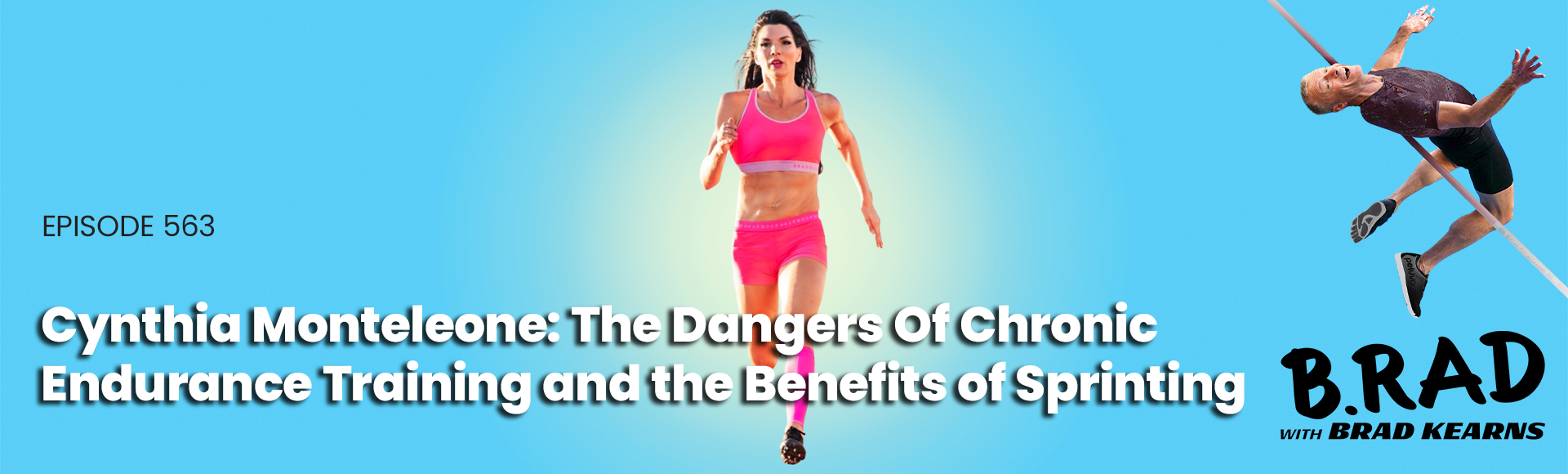
Please enjoy a great conversation with my friend and sprinting mentor Cynthia Monteleone, coming to you all the way from the beautiful big island of Hawaii.
A Team USA world champion sprinter, Cynthia is also a highly trained metabolic health analytics practitioner who coaches numerous Olympic athletes and world champion masters-level athletes, and she goes deep into the nuances of what delivers peak performance and helps people overcome health challenges to reach personal goals, especially weight loss and excelling in athletic goals.
In this episode, Cynthia tells us why chronic cardio might actually be hurting your health—and how training like a sprinter can lead to better longevity, hormones, and overall energy. We discuss the important principles outlined in Born to Walk and get into the damage that can happen to the heart from excessive endurance exercise, how living in that black hole heart rate zone keeps your body in fight or flight, and why you might be storing more visceral fat or throwing off your thyroid just from overtraining. Cynthia shares some eye-opening examples, like a fit masters track athlete who started marathon training and ended up with a heart attack—and we explore how too much endurance training can lead to electrical signaling issues in the heart and chronic inflammation.
We also push back on the grind-it-out mindset that’s become so common—where suffering and pain are glorified as signs of discipline. Instead, we highlight a more empowering, intelligent approach to fitness, based on sprinting, walking, lifting heavy things, and prioritizing recovery. This conversation is all about training smarter—not harder—for the long term.
TIMESTAMPS:
Fitness people may need to rethink their idea of what is good for the body. [04:25]
Brad talks about his participation in sports as a kid and his evolution into triathlon. It took a toll on his life. [06:48]
As a parent coach for the kids, is it effective to push the kids hard to teach them life’s lessons? [10:38]
What are the lessons to be learned from this crazy running boom that we’ve had where people think that when they turn 40, they should run a marathon? [17:22]
Why do people think it is hard to sprint? [18:52]
What is the best way to balance your exercise regimen? [25:53]
A combination of walking and sprinting is preferable to steady state cardio. [33:12]
You can exercise the heart too much. [40:10]
There’s a disconnect between mental strength and hurting yourself. [47:38]
All your training and all your fitness endeavors have to factor into the same equation as all the other forms of stress in your life. [51:06]
Is your training making you feel empowered or tired? [59:48]
LINKS:
- Brad Kearns.com
- BradNutrition.com
- B.rad Whey Protein Superfuel – The Best Protein on The Planet!
- Brad’s Shopping Page
- BornToWalkBook.com
- B.rad Podcast – All Episodes
- Peluva Five-Toe Minimalist Shoes
- B.rad Podcast – All Episodes
- Peluva Five-Toe Minimalist Shoes
- Brad’s Podcast with Cynthia Monteleone
- Fast Over Forty
- MAM 808.org
 LISTEN:We appreciate all feedback, and questions for Q&A shows, emailed to podcast@bradventures.com. If you have a moment, please share an episode you like with a quick text message, or leave a review on your podcast app. Thank you!
Check out each of these companies because they are absolutely awesome or they wouldn’t occupy this revered space. Seriously, I won’t promote anything that I don’t absolutely love and use in daily life:
- B.rad Nutrition: Premium quality, all-natural supplements for peak performance, recovery, and longevity; including the world’s highest quality whey protein!
- Peluva: Comfortable, functional, stylish five-toe minimalist shoe to reawaken optimal foot function. Use code BRADPODCAST for 15% off!
- Ketone-IQ Save 30% off your first subscription order & receive a free six-pack of Ketone-IQ!
- Get Stride: Advanced DNA, methylation profile, microbiome & blood at-home testing. Hit your stride the right way, with cutting-edge technology and customized programming. Save 10% with the code BRAD
- Mito Red Light: Photobiomodulation light panels to enhance cellular energy production, improve recovery, and optimize circadian rhythm. Use code BRAD for 5% discount!
- Online educational courses: Numerous great offerings for an immersive home-study educational experience
- Primal Fitness Expert Certification: The most comprehensive online course on all aspects of traditional fitness programming and a total immersion fitness lifestyle. Save 25% on tuition with code BRAD
I have a newly organized shopping experience at BradKearns.com/Shop. Visit here and you can navigate to my B.rad Nutrition products (for direct order or Amazon order), my library of online multimedia educational courses, great discounts from my affiliate favorites, and my recommended health&fitness products on Amazon.
TRANSCRIPT:
Brad (00:00:00):
Welcome to the B.rad podcast – where we explore ways to pursue peak performance with passion throughout life. I’m Brad Kearns, NY Times bestselling author, world #1 ranked masters age 60-plus high jumper, and former #3 world-ranked professional triathlete. You’ll learn how to stay fit, strong and powerful as you age; transform your diet to lose body fat and increase energy; sort through hype and misinformation to make simple, sustainable lifestyle changes; and broaden your perspective beyond a fit body to experience healthy relationships, nonstop personal growth, and ultimately a happy, healthy, long life. Let’s explore beyond shortcuts, hacks, and crushing competition to laugh, have fun, appreciate the journey, and not take ourselves too seriously. It’s time to B.rad!
Cynthia (00:00:51):
You know, of my mentor, Charles, of course, and he had all of these fun sayings he used to say, um, like no one got, no one ever got mugged by a box of donuts. That was one of my favorite <laugh>, um, <laugh>. And so, of course, meaning it’s always your,
Brad (00:01:04):
Please enjoy a great conversation with my friend and sprinting mentor Cynthia Monteleone, coming to you all the way from the beautiful big island of Hawaii. And she is a metabolic health analytics practitioner, very highly trained and goes deep into the nuances of what delivers peak performance and helps people overcome health challenges to reach personal goals, especially weight loss and excelling in athletic goals. She coaches numerous Olympic athletes and world champion masters-level athletes. You’ll find in the master’s track and field community that is pretty small and most of the top people have some relationship or coaching protocol through Cynthia. Not just with the workout planning and things that she’s very good at, but also, uh, getting deep into things like sleep stress management, body composition, how to improve that, um, hormone balance, diet, supplements, minerals, biohacking. She’s big on red meat.
Brad (00:02:14):
One of her taglines is Have a steak for breakfast, and you’ll be a peak performer. So a wealth of information. She’s a protege of the late great Charles Poliquin, who was a strength training and progressive health legend who passed away a few years ago. But she references him often in her work. And there’s some really far out ideas that you might not have heard about from other people. So please listen to our first show where we talked a bit about that. But this conversation was centered on discussing the principles in the book Born to Walk. She really enjoyed the message that Mark Sisson and I worked hard to put together because of course, she’s all about sprinting and anti exhausting, stressful endurance training, having to convince many clients to transform their program. So we have a good talk about Born to Walk, but also so much good back and forth about the benefits of sprinting, how to get started.
Brad (00:03:12):
So I think you’re gonna get a lot of value from this and perhaps get inspired to start taking some baby steps toward integrating something powerful, brief and explosive into your training regimen. Cynthia’s world champion at 400 meters. My favorite event. She ran a 56 seconds at the age of 45 to win that gold medal, and then she transitioned recently into Pentathlon. That’s the five events contested indoors. They do seven events outdoors, it’s called the Heptathlon. So she had to learn a bunch of skills and unfortunately had an injury and pole vault, so she’s gonna be sidelined for a while. And she talks about her wonderful empowering, process oriented mindset, even as she struggles with this rehab. Instead of going out there and trying to get more medals for a while. Here we go with Cynthia Monteleone, check her out on Instagram. She has great content, including top 10 lists of things that you might be doing wrong in your diet or ways that extreme training is harming your health. It’s Fast over 40 at Instagram. And then her metabolic health practitioner website is called MAM 808.org. Here we go with Cynthia.
Cynthia (00:04:25):
Okay, Aloha. Thank you all for joining me. And I’m so excited to be interviewing one of my favorite, favorite masters, track and field athletes today. And I’ve been doing a series called Pieces of the Puzzle where I ask my athletes what are the pieces of the puzzle that have made them successful. And in addition to asking Brad these things or basically we’re gonna talk about it anyway, I really wanted Brad on today to talk about his new book, um, that he co-wrote, and that is called Born to Walk. And boy did this book resonate with me, like 110% there it is. Born to Walk. Sorry, I don’t have my copy up here. I’ve had crazy technical difficulties this morning. We won’t get into it, but so yes, born to Walk. Brad, thank you for writing this book so
Brad (00:05:15):
Well, Cynthia. You’re welcome. And if we had more space on the cover, I just showed the cover for those watching on YouTube, uh, we would’ve called it Born to Walk and Sprint because that is truly the human genetic expectation for health, and it’s, it’s really forgotten. So I know we’re gonna get into the, the sprint topic, of course, with, with both of us eager and the listeners eager too. But we will get into the, the major premise here, which is that in between stuff that you write beautiful content and, and, and talk about so much is not really good for your health. And it’s time to reeducate the population, especially the fitness minded people that, uh, heading, heading out the door and shuffling along for however many miles on the run or miles per week, can very likely be destructive to your health. And even when you get fit and you’re a cardio freak and you can get your finisher metals, it’s still a tiny little pie slice of the big picture for what it means to be healthy. So it’s a little bit of a controversial message. Mark Sisson and I have the right to throw down because we’re both old time beat up endurance athletes. Looking back decades later, thinking, what the heck was I doing? I think I told you about my PTSD experience in Kai Luana Hawaii.
Cynthia (00:06:33):
Listen, Just for my listeners, will you tell, I mean, you’re such a legend, um, <laugh> in in the endurance world. Will you tell my listeners just a couple of your accolades that you did accomplish as an endurance athlete, back when you were, you know, destroying your body <laugh>?
Brad (00:06:48):
Well said. That’s right. Um, so, you know, when I was a, when I was a kid, I, I loved all the sports and I, I thought I was so good at football and basketball that I was gonna be a star on the, on the high school team. And then I went to this huge Los Angeles public high school where we were city champions in basketball. And, I was also a good golfer, but we were state champions in golf. And so, uh, the kids that are small and not quite suited for playing point guard or starting quarterback, they end up going over to the cross country and long distance running track teams. And I had great success when I was a kid. I made it to National Junior Olympics finals in the 1500, I was ranked 12th in the country at age 16. Amazing.
Brad (00:07:27):
I made it to the state finals of California in the mile, which is really tough. And then I got to college and kept getting sick and injured over and over with Division one ridiculous program at UCSanta Barbara. And that’s what led me to this wonderful sport of triathlon where I didn’t have to get injured all the time because I could balance the training load. And that led to a nine-year career on the pro circuit, which was a really a dream come true because, you know, I, I dreamed of being an athlete since I was a little kid. And now I was out there dedicating my entire life every single day to eating, sleeping, training and doing a lot of traveling all over the globe and competing against the top guys. And it was a really great experience. But when we talk about the overall impact of it, like with your tee-up question, it was extremely destructive to my general health and wellbeing and certainly longevity.
Brad (00:08:21):
And I contend, you know, we’re all excited about these biological age scores you can get now and your telomeres and all that. I think from ages 20 to 30 when I was on the pro circuit, I aged 15 to 20 years, literally speaking biological age. And when I finished at 30, I was so beat up and washed up and worn out. I did feel like an old man. And I’d wake up every morning and shuffle down the hall with one foot pointed out at 45 degrees and one foot straight. And everything was, you know, just achy and tired. And that’s what happens when you try to compete at the highest level. And that’s okay, because my goal in life was to go from one hour 47 to one hour, 46, 12 and win the race instead of come seventh. And so you have to try for those marginal improvements.
Brad (00:09:09):
Yeah. And, and put everything into it. But it, it does come at a cost. And then, you know, when I’m finished racing and looking at the rest of my life, I was like, now what am I gonna do to be a healthy fit person? ’cause I’m not gonna go crazy anymore. And so, not to get off track, but I did turn my attention to, uh, dominating little kids in soccer, basketball, and track for around the next decade from when my son was five to around 15. I was the MVP on every one of the teams I coached. And I would play really, really hard. I learned this from another dad that had older kids, and I saw him beating up on his poor little kids on the basketball court. I’m like, Dennis, what are you doing? These guys are about to cry. He goes, oh no, you gotta bring the heat every time.
Brad (00:09:51):
’cause you gotta teach your kid that competitive spirit. I’m like, good point, good point. So I would just throw down on these poor kids and dribble through the whole pack and score a layup, but it, it really demanded full body functional fitness. So that’s was my transition away from being an endurance freak. And now, in recent years, of course, I became obsessed with masters track and field about five years ago when I jumped into a meet outta nowhere, I cleared five feet in the high jump, which turned out to be pretty good for the 55 year olds. I’m like, I couldn’t believe that. ’cause in high school I couldn’t even make the team. But now with the, the war of attrition and keeping healthy and fit, now I’m, I’m completely transformed from endurance freak to power, explosive strength, speed. Mm-hmm <affirmative>. Competing at my favorite events of 400 meters in high jump.
Cynthia (00:10:38):
That’s awesome. That’s awesome. There’s so much to get into in that recap of your achievements, and I love it. I one thing I wanted to touch on just really briefly that you were mentioning in passing is teaching the kids the life lessons of beating up on them. So I have a, we have friends, my husband and I, of course, we’re coaches. My husband’s a wrestling coach, and we have friends that, you know, one of my, well, long story short, one of our friends’ sons is one of my Juujitsu clients, and he’s actually thriving in the Las Vegas scene right now, and doing really well. And the joke is, is that his dad never let him win. And that’s why he’s so hungry for the, you know, for the victory. And, uh, I just, this is totally off our subject, but how did you feel that worked for the kids? Did you feel like that did teach them? Yeah.
Brad (00:11:27):
I’m glad you
Cynthia (00:11:28):
Let me, that like, letting them win sometimes or being a little soft or like, I mean, what was your first
Brad (00:11:32):
Oh, yeah.
Cynthia (00:11:32):
That as a parent too.
Brad (00:11:35):
I think it goes, it goes hand in hand with today’s, you know, trend, and the criticism of like, every kid gets a trophy, every kid gets celebrated. The parents are just, you know, hovering over their kids and everything’s wonderful, and we don’t want them to struggle or fail. And I do see that phenomenon happening. So, I like to have the kids face reality as as soon as possible. And what was great about, you know, my son got into high level basketball, so he went from the community league where he was scoring all the points to like, oh, okay, now Mr. Hot Shit, let’s see how you do against fifth graders that happened to be one foot taller than you somehow <laugh>. Yeah. And so he got to learn how to be, you know, a star player and excel, and he also got to learn how to get his butt kicked.e
Brad (00:12:20):
And I think for me, back to triathlon, that was the most valuable and incredible profound lesson that I’ve, I learned and took with me every day for the rest of my life and everything I do. So, you know, at my best, Cynthia, I had great success out there. I was two time US National Champion. I was ranked number three in the world at the end of my best season, I had a winning streak where I was just on top and like nothing could go wrong. And then I got my butt kicked so many times with such tremendous, you know, amplification of the consequences. Like I thought everything was, you know, life or death because there’s so much pressure on a professional athlete. And I had to recalibrate so many times that finally, I realized, you know, I need to get over myself and realize that the value and the beauty is in the process of being an athlete.
Brad (00:13:12):
It’s not whether I become first place champion or get my butt kicked in 24th place mm-hmm <affirmative>. It’s all part of the flow of life. And, you know, today I look back and the, the race results don’t mean that much anymore, but they did. They meant everything at the time, which was the beauty of it. And so, I guess answering your question back with the kids, oh yeah. The way the story ends is like around age 15, I was blown off the court by these kids when they started to get to JV basketball level in high school. And my son, one time politely, we were driving back from Sunday night pickup game where I’d always play in the three on three rotations. And he said, Hey dad, you don’t have to drive me to Sunday night pickup game anymore. I can get a ride from Josh’s dad.
Brad (00:13:52):
And I go, oh, no, I love driving. I love playing every Sunday night. He goes, you don’t have to play in the three on three anymore. And which what he meant was like, I couldn’t hold my own the previous year I was MVP of the middle school team easily, and I’d kick all their butt in the suicide lines at the end of practice. And now I was blown off the court because, you know, yeah, there comes a time when the parent needs to go sit in the stands and clap. And that was, that was my time. That’s when I turned my attention over to high jump in 400 meters.
Cynthia (00:14:20):
Oh, okay. Well, that, that’s interesting that that was your transition point. And I love that story, though. That is, it sounds like you’re a great parent and you were really there for your child and then knew, you know, when to take that other supportive role as well, which I did the same thing with my daughter, with running with her for so many years and then being, you know, the coach and then kind of, you know, just the parent, which is, you know, something totally different. But that’s, yeah. Yeah. That’s really great. So you, it was really a success story, it sounds like. And it’s not to say that we don’t, we’re not compassionate to our children and understand if they’re going through something or, you know, they do need comfort. But there is a lesson to be learned in losing, and even in wrestling, my husband says that he loves when the kids on his team lose in preseason because he wants them to win at state championship.
Cynthia (00:15:08):
But he said if they lose in pre-season, they become better wrestlers. Like the data is there. He is been doing this for two, five years, coaching, and, you know, many, many accolades. I could go on and on about his athletes just, you know, winning national awards and all kinds of stuff. But, you know, he does love them to lose in pre-season. And I guess there is value in losing. And I think sometimes parents lose sight of that because they just wanna, you know, our nature is to take care, especially women, uh, to take care of our children. But I, I love lesson, and that’s totally not quite on our topic, but part of our stories, both of us, um, I actually lost, let’s see, my first world championship meet. I got a bronze medal in the 400, and I had trained so hard for it, I wanted to throw it in the trash.
Cynthia (00:15:53):
Boy. I did not even want that bronze medal. And what happened was I had not been taking supplements and all that stuff yet, and I got a stomach bug from some contaminated lettuce. And so when you travel to other countries, I now learned the valuable lesson that, you know, if you over flood your system with like probiotics and prebiotic fiber, you’re not gonna get that weird bacteria because it could even be an innocuous bacteria. Mm-hmm. But we’re just, our system’s not used to it. Right. So I had the worst diarrhea for like three days for, well, I did well in my trials and then well in my semis, and I got it right after my semis. Mm. So then I had a day rest, and then I had my finals. So I didn’t even know if I could make it to the starting line.
Cynthia (00:16:35):
And I barely did, basically because Charles, my mentor, he was traveling during that interim day, but then he saw, you know, my message got back to me, said, gotta take some activated charcoal. This many, it was like, the whole bottle basically is crazy overnight. And that’s how I was able to make it to my race and still come in for a bronze medal. But I told the lady who, who won, Hey, listen, I only won because I’m sick. And she’s like, yeah, yeah, yeah. You know, and then I came back six months later and I became world champion. So, but that lesson in losing taught me, okay, how do I fix this for the next, you know, race? And that was, I needed to keep on top of my supplements and take my fiber and all that stuff. And then now I’m able to help other athletes fix their you know, their race day with the same advice.
Cynthia (00:17:22):
So I have, um, an Olympian right now who’s over in Doha, and you know, she’s, Sandy Morris, she’s competing in Pole vault this weekend. Mm-hmm. And I have a travel checklist for her. So because of me losing, I’m able to help others and I was able to help myself. But yeah, I think there are a lot of lessons to be learned with losing. But really what I wanna talk about is what are the lessons to be learned from this crazy running boom that we’ve had where people think that when they turn 40, they should run a marathon. Like what I tell women all the time, they, they go, oh, I, I’m turning 40. My goal is to run a marathon. And I go, really? Well, your goal if you really care about your health is you’re aging and you’re turning 40. And longevity should not be to run a marathon.
Cynthia (00:18:06):
’cause that actually could be detrimental to your health. But really you should train for a hundred meter sprint. And they go, what? How is there each hundred meter sprint available? And I say, of course, they’re available all year round or basically, you know, indoors at 60 meters. But I, I think probably you could find a hundred meter race nearly every month, month of the year, because some of the warm states still have outdoor 100 meter races and see, or, you know, 60 to a hundred will say you can train for that sprint and compete in it all year round if you wanted to. But what I’m saying is it’s not only available, but it’s abundant. So I think people don’t think that they’re able to do that, or they think it’s hard. What do you think are the, like, can you tell us, first of all, you, you dive into the history in your book about the running boom.
Cynthia (00:18:52):
Mm-hmm <affirmative>. Can you tell us about why people have that mindset of I need to run a marathon as a goal? And also, um, you know, like, how do, why do they think that sprinting is not possible for them? <laugh>, one of the favorite parts of my book, of your book is you said, or you know, Mark, one of you said in one line you can go, you can go out and sprint full max effort. Like, and yeah, there are nuances to that where you have to prepare. But it’s, you know, you’re not saying you can’t do it. And recently, again, I know this a like a three part question, but recently, Andrew Huberman had a guest on who’s the sprint expert, (don’t even get me started.) I’ll keep my mouth shut on that one. If you can’t sprint, to Andrew.. If you’re not able to sprint. You can’t sprint, people can’t sprint. And he was there supposedly promoting sprinting, but he was saying that no one can sprint because they, they aren’t unable to do it properly. And I’m like, wow, that is a daunting thing. And you know what? Andrew loves to sprint and he loves to go and give his best. Is he giving exactly elite runner maximal 100% effort? Maybe not, but it doesn’t mean he’s not going above 95% and trying some intervals. Like, I don’t like that negativity where you say you can’t sprint. And I love that your book said anyone can sprint. So can you one, talk about the running boom, why we have that mindset, and two why do people think they should do a marathon and three, why do they think it’s hard to sprint 1, 2, 3, go <laugh>?
Brad (00:20:27):
Yeah, I have, I have to write down all, all the questions that came through. And then speaking of accessible, I was thinking of our friend, our carnivore friend, Dr. Shawn Baker, who’s got his app, and he does social media posts where he’s timing his own sprint. I don’t know what app he’s using, but it’s pretty cool. He is like, my time today was 6.2 seconds in the 40 or whatever. So, it’s totally accessible for almost everyone because the term sprint, we can broaden the definition to mean that it’s, you know, giving a near maximum intensity, very short duration explosive effort. And so definitely novices might wanna start on low or no impact options such as sprinting on the stationary bike or the stair machine or other cardio the rowing machine mm-hmm <affirmative>. Or even up the stadium stairs. If you, if you go to practice and take your kid to their track and field sprint practice, you can do low impact things with very low injury risks.
Brad (00:21:21):
But I think to answer your question, um, the lack of interest and accessibility is probably people who aren’t well adapted enough to, to, to push the body hard. Especially as you look into the older age groups and the senior citizens and the most health, health conscious senior citizens are out there walking every day. Mm-hmm <affirmative>. My mom gets great credit for that. She puts in a lot of steps, and then I’m like, Hey, she’s 88 and she’s in fantastic shape. She’s got aches and pains and arthritis mm-hmm <affirmative>. And, um, I’m trying to encourage her to spend more time in the gym in addition to that time where you’re out there putting one foot in front of the other. Because if you just do cardio aerobic endurance activity, what happens, and any runner can nod their head who’s listening is over time you go slower and slower and you shuffle more and more and you lose this full body functional fitness because all you’re doing is shuffling in a straight line at a slower and slower pace with more and more injury risk just from routine, you know, pounding the pavement at a 12 minute mile even.
Brad (00:22:26):
So we have this Yeah, there
Cynthia (00:22:27):
<inaudible> statistic in your book that said it was something like between 35, no, between 47 and 75%, something around there injury with like most of us,
Brad (00:22:38):
Oh, it’s crazy. Yeah.
Cynthia (00:22:40):
Like 56%, but definitely close to or over half of endurance runners, meaning people who are trying to do anything longer than a mile, essentially getting injured. And it’s not if it’s when for the overuse <laugh> injury. And yeah, you also talk about, you know, you guys also talk about all of the, you know, problems with, you know, the running shoes and the shuffling and using the roads and not, you know, long time ago, cross country was cross country on the trails and the grass, which is way more forgiving than the pavement. So we have, you know, Sally, turning 40 who’s saying, I’m gonna run a marathon for my goal, and she’s shuffling along the pavement in these, you know, overly cushioned shoes. And, but like, why, why do we have that mindset do you think? Is it sold? Was it sold to us over the years? Or like, why do we have that mindset or not? We, but you know, people in general, the population.
Brad (00:23:33):
Well, it’s exactly as you, as you say or propose, it’s cultural programming and billions of dollars of marketing money spent to lu the person into who selling sport of endurance running. It’s, the running shoe industry is huge. And also the event production industry is huge. Um mm-hmm <affirmative>. You know, from being on the big island, the economy has transformed every year for a week. When the Iron Man comes to town and it’s millions of dollars of economic impact. And so these major marathons, like they just set a record in London. The biggest, finisher was 54,000 runners or something. New York City had 52,000 last year. So this is like a major cultural happening, and,
Cynthia (00:24:16):
And they’re paying several hundred dollars for an entry fee and making it exclusive, even though it’s not really that exclusive. ’cause as you guys point out in your book years ago, you know, the times were incredibly faster and now they just keep getting slower and slower. So the average time, you know, the very average time for one of these large marathons you guys point out would’ve been like, you know, last place back then, or something like that. Yeah. It’s just crazy, the statistics, it’s, you guys gotta get the book and read it, whoever’s listening, it’s so many great statistics and stories, but, um, yeah, so they’re making a lot of money. I do have a friend who has a running production company, and he also, and Maui, and he also puts on races for, like, say a corporation comes to the Ritz Carlton, he’ll put on a 5K for them, you know? And so he, they make a lot of money for sure. So I do see that where yes, definitely the running shoe industry, I can see that. And these production companies, that’s a lot of money.
Brad (00:25:11):
Yeah. And we should also say, you know, the, the good aspects of the fitness boom, it’s not just the running boom, but at the same time in the seventies, Jane Fonda got going with her exercise tapes. And so a segment of the population, it, it actually is a small segment, but people who got off the couch and wanted to do something solid for their body, this is a great thing. It’s better to be in a running group than the bowling league with the smokey bowling alley and the beers and the potato chips. It’s just, uh, an argument to do it in the correct manner so it doesn’t destroy your health. And I think what the worst kept secret,
Cynthia (00:25:48):
What the correct manner is, you mentioned it before, but, oh, it’s
Brad (00:25:51):
Pretty simple, Cynthia.
Cynthia (00:25:53):
I already know because it’s also my opinion about the correct manner. But what is your opinion of like, you know, the correct manner of that balancing the exercise? Because yes, we do want people to get up and off the couch. Yeah, absolutely. We’re not saying like, don’t do any exercise or that sort of thing, but your, but your book is called Born to Walk, so that’s a big clue right there.
Brad (00:26:14):
Here’s the thing, it’s very simple and it comes down to the musculoskeletal and the, the metabolic impact of the activity. Running is a very, very difficult act for the human to actually run instead of be walking and, and going at a slower pace. And so if you’re fit enough to take off down the road or trail and exhibit a, a jogging, a running gait, and your heart rate is in the correct zone, which is at or below fat max heart rate, that’s a comfortable pace that emphasizes fat burning is not too strenuous or stressful or prompting extreme glucose burning in favor of predominantly fat burning. So if you’re able to jog, it’s a wonderful activity for
Cynthia (00:26:58):
That, like a zone one type thing?
Brad (00:27:00):
Well, everyone’s talking about zone two this, zone two, that, and it’s so important,
Cynthia (00:27:04):
Right? Zone two, what’s that? Zone two is not really, I find it’s not that effective, but it’s zone one-ish, right?
Brad (00:27:11):
Um, little,
Cynthia (00:27:12):
Little step down from zone two.
Brad (00:27:14):
Yeah. For those not familiar with, we know today for some reason, we now identify the exercise zones one through five and zone five would be maximum sprinting. And zone four would be a really intense, uh, you know, racing for two miles or a 5K. And then zone two is the term for the fat burning zone where the top of zone two before going into zone three is when you’re burning maximum fat calories per minute. So inside zone two, you feel pretty comfortable. You can generally carry on a pretty decent conversation without getting winded. And then zone one would be easy casual pace, like a slow medium or brisk walk. Zone two is getting a lot of credit these days, and zone one is kind of getting left behind. So I wanna also tout the benefits of just going out and doing basic general everyday movement that’s not strenuous mm-hmm <affirmative>.
Brad (00:28:08):
But gets your body out the door and moving. And it, walking of course would be the centerpiece, but we’re also talking about very easy pedaling your bicycle down to the farmer’s market or doing a yoga class, Pilates, tai chi, foam rolling counts as movement, right? Because you’re moving the, the, the blood flow and all that. And so we have a critical obligation as humans to engage in more general everyday movement. And then we have this other huge void that’s really important, which is to work that top end with high intensity, uh, strength training and brief explosive all add efforts that we can call sprinting mm-hmm <affirmative>. And so what, what I just described, most people who are fitness enthusiasts these days are doing very poorly on all three of those. And then they are stacking up in the kind of difficult medium to difficult heart rate, steady state cardio, which has all these risks of overdoing it and ruining your metabolic and musculoskeletal health. And so we’re not sprinting, we’re not strength training much. We’re not going slow enough to actually just get a rejuvenative energizing exercise outing. And instead we’re pushing ourselves with these artificial goals such as the marathon itself or the Iron Man, or these extreme events that have been glorified by marketing hype.
Cynthia (00:29:31):
Yes, yes, absolutely. So, yeah, I think, uh, absolutely those three things, staying in that casual pace for walking and then strength training. Uh, I like to tell my clients three times a week, but Charles used to say that you get something like 40% more, uh, outcome if you add in one more day, four, four times three. So there is that three to four, but if you can only manage three, then three, and that like a three total body or like four would be splitting upper or lower, two days up or two days lower to give your nervous system time to rest. And then, um, you know, sprinting, I know you guys talk about one day a week, Mark Sissonn talks about one day a week, but you know, I find that if you vary your sprint interval training, the three day a week works really well.
Cynthia (00:30:18):
And that would be, you know, to concentrate on some volume sprint intervals one day. Um, totally short, uh, very short sprint intervals with max rest another day and some sort of combination of the two for day three. I find this formula transforms bodies, transforms hormones, all kinds of things. But the walking is a great aspect as well. My dad is 82 years old and just competed in the world championships in the 200 meters, saw the video. Awesome. So inspirational like your mom. Very inspirational. He is just, he’s just amazing with his motivation. And so his workouts, of course, I was his coach, first of all, he loves lifting dumbbells, and he was able to, um, lift, uh, he got up to 30 pounds of weight in one dumbbell with a shoulder crests, um, for instance. So he was looking pretty strong and doing pretty strong, less there.
Cynthia (00:31:17):
And so that, and then he asked me for lower body lips. And so I gave him once to prepare him specifically for sprinting and, you know, his max effort. I think the other thing that people are missing is that your max effort doesn’t have to look like, you know, Noah Lyles your max effort is gonna be different. So for, you know, his max effort is way lower than my max effort because of his age and his body type and that sort of thing. It doesn’t mean he’s not giving a max effort or we’ll say max, you know, 95% effort or 90% effort. So it looks different for every, everyone. And I think when people compare themselves to other sprinters, they think, oh, I’m not sprinting or that sort. But, sprint interval training, again, like we just said, can mean different things. It can be volume type, it can be, you know, the rest periods can differ, uh, a little bit as long as you’re going, I think above 85%, um, and 95% for an actual sprint.
Cynthia (00:32:11):
But so back to my dad, he prepared really well. And, but one of the things he did that I’m getting at is that he walked, one of his days is walk and then sprint and then walk and then sprint. And that was actually really easy for him around the neighborhood. Another thing he did was his hills, his driveway is a hill, so he would do some hill sprints on the driveway, which, uh, again lessens your injury risk. It’s the number one thing that I recommend people start with is walking up the hill. And that’s what he did. He walked up the driveway first and then I allowed him to start jogging. And then one day he called me and he said, oh, I just kept going up and down. I kept running down too. And I said, no, that’s not what I told you to do.
Cynthia (00:32:49):
You’re supposed to rest in between. And also that’s not good for your knees to run down the hill. No <laugh>. So, uh, you know, he got a little too eager, but we switched it again. But the wa he would walk around the neighborhood and then he would pick a point to sprint to, and he would sprint to that point. And then sometimes it got longer and longer as he got more fit. So I think that’s probably something. What do you think about combining the two, like walking and then doing like a little bit of sprinting in your walk?
Brad (00:33:12):
Yeah, this a beautiful idea and it just takes, you know, a reeducation of the population. ’cause somehow we’ve been brainwashed to think that steady state cardio is the path to fitness, but there’s no justification for maintaining a steady pace when we’re out there training. And in fact, it can be counterproductive, especially as you get tired at mile four, mile seven or mile 12, your heart rate goes up and the fatigue goes up, but you’re still for some reason trying to look at your watch and hold a 10 minute pace per mile or whatever you’re doing. And so it’s a way to fatigue the body, trash the hormones, um mm-hmm <affirmative>. We also have a section talking about how endurance training does not really contribute to losing excess body fat. Exactly. Which is probably the main goal of most people that are out there shuffling down the sidewalk thinking it’s time to get in shape.
Brad (00:34:02):
Like the 40-year-old that says, oh, I better do a marathon now ’cause I just hit 40. Yeah. And so what it actually does is it disregulates appetite and say tidy hormones because the workouts are slightly too, significantly too stressful mm-hmm <affirmative>. So you eat more and you’re lazier throughout the day because you set that alarm in the morning and went and slammed your six mile run. Or perhaps it was, you know, a grueling cardio class at the gym, like a spin class where we’re sprinting quotes in quotes, you know, sprinting for too long with too little rest. Oh, that’s classic. And just, just draining yourself in the manner of a poorly contemplated high intensity interval training session.
Cynthia (00:34:41):
Yes. I think this is a good point to point out to our listeners is that you mentioned this in the book too, is that, uh, they are duped into thinking that these, um, orange theory are like high, high intensity interval classes are, are actually high intensity interval work. And that’s actually not the case because like how we, people don’t understand the formula of intensity versus rest periods, <laugh>, and I guess like that would be more of a long distance or miler workout, miler, 3000 meter runner workout, the way these, uh, classes are structured ’cause they’re giving a semi intense bout of energy and then very little rest. So these aren’t actually high intensity interval training as you would, you know, scientifically say because they’re not getting enough rest period in between the exercises. But they’re asking the teachers are asking them to be demanding of their intensity, but they actually can’t reach that 95% intensity that many times throughout the class. Right? So these are not actually, these classes, like you said, are not actually where the high intensity interval is, which, which are, is very beneficial for BDNF and all kinds of hormone health and things like that. So it’s not truly high intensity.
Brad (00:35:56):
Okay. So now look what we’re doing, we’re jogging or doing cardio at a slightly elevated pace for, uh, long duration steady state, which has all kinds of negative health consequences and can be potentially beneficial only if you’re super fit and exercising at the right heart rates, which most people are routinely exceeding that fat max heart rate. And then second, as you just described, we go to the gym and do the classes and the mainstream fitness industry programming by and large is falling under this category of HIIT, but it’s done in a manner that’s overly stressful, exhausting making you lazier and eating more food as a consequence of your devoted fitness regimen. So the two most popular things,
Cynthia (00:36:39):
And it’s also, it’s also raising the cortisol. I, I’ve had clients that say like, I don’t understand. I’m exhausted when I leave these classes and I feel like I should be burning more fat and I’m not like, I’m actually holding fat in my stomach. Mm-hmm. And I’m like, that’s because it’s increasing your cortisol and it that cortisol is lingering for too long because of, you know, your exhaustion. Like, the point is not to be exhausted. Although, you know, I do love a 400 meter workout that leaves me laying on the ground on the occasion, but not five days a week. <laugh>.
Brad (00:37:13):
Yeah. That is not good. And you, you know, the preparation to build up to the point where you can push your body that hard is something that we can’t ignore the importance of that. So for the average person, we should downscale that by a factor of 10 to one to where, you know, if you’re doing four times 200 at 95% with three minute rest, they would do maybe four times 20, that’s 10 times shorter than a 200. That might be perfect for most people who sit at a desk all day and don’t have functional glutes, hamstrings, hip flexors, and so forth. But there’s always a place to start to rev that engine up a little bit and get all these hormonal and metabolic benefits without the downsides of doing too much. I think there’s a psychological component where, you know, life is getting easier and more comfortable. The people who are in the fitness realm are by and large not the hard laborers of society where they’re digging a ditch for a new phone wire and then they’re going to the gym at 5:00 PM I think those people are going home and relaxing. Yeah. For the most part. And so, so
Cynthia (00:38:18):
As we moved from a work, a society back in, you know, in the 18 hundreds, 17 hundreds, but you know, where, where as a population we had to work really hard. I mean, even into the early 19 hundreds, we see all of these laborers coming over from different countries into America, and they are, you know, know they’re starving and working hard labor. Um, and that’s, that is in our genetics still. Yeah. Like we’re that many generations from it, but we’re increasingly, I think, losing that in our genome. Um, and so yes, they’re substituting by creating these, you know, hard work scenarios, but not in the way that’s benefiting longevity. Mm-hmm <affirmative>. So like those people that we just talked about, those hard laborers maybe from, you know, that are building the railroads and that sort of thing, uh, they’re not living very long. So to, to do that, to the point of exhaustion every day, like, yes, we do have a more comfortable life, but we, I think we, you know, as health,
Brad (00:39:15):
We’re still building the railroads instead of Yeah. Instead of doing what, you know, right. Balance humans are naturally meant to do. Yeah.
Cynthia (00:39:21):
Becoming strong, asking what what is the correct balance? Um, you know, for longevity, for optimal health. A lot of people ask me, you know, about my metabolic practice, and they say like, well, sometimes, you know, performing well doesn’t, is it doesn’t mean they’re healthy. And I say, well, with my clients, I don’t care if they’re Olympians or what, they could be going for the Olympic gold. And all I care about is what is their health markers first? Are they healthy? Are their hormones balanced? Are they sleeping well? Do they feel good energy throughout their day? These are the factors that you know, which everybody wants first. Now when we fix those and they feel good, they have good sleep, they feel like great energy and motivated all the things, then they tend to, of course, have a better athletic performance. And my after the bottom line of the gold medal first,? No.
Cynthia (00:40:10):
They, and they know this when I work with them, I’m after, how healthy are you? Mm-hmm. Let’s make sure that you’re able to have babies after your Olympic careers. Like we don’t wanna mess up your hormones. Mm-hmm. It’s telling you that you need sugar for fuel and then you have PCOS and you can’t have babies. Like no. Um, I actually worked with an Olympian once that I couldn’t believe how lean and fit she was, but she was pre-diabetic because she was told for so many years by dieticians that she needed glucose for fuel. And you guys talk about this in your book, that when you move away from this, these long endurance bouts, then you aren’t, your body’s not craving that carbohydrate for fuel anymore. And that whole thing is a sham. Anyway, love the Tim Nooks reference in the book. So yeah, I think the, the nutrition goes side by side with it and having this balance is what it’s all about.
Cynthia (00:40:59):
I think a lot of people need to know, Brad, about the heart health, because it’s one of my, your book mirrors my top 10 reasons for sprinting instead of mm-hmm <affirmative>. Endurance. And, and one of the things I talk about is heart health. So we, I remember, you know, at one of these races that my friend put on here over in Maui, that this guy came to me, he said, oh, I used to run masters track, but then I started running marathons and then I had a heart attack and I couldn’t believe, how could I have a heart attack after all the miles that I was running? Like, I thought I was fit. But what happens, I think people don’t realize is that you can exercise the heart too much. And that, I know it sounds crazy, but hypertrophy used to be something that the cardio enthusiasts would say, we want hypertrophy of the heart. But if you have too much hypertrophy of the heart, it interferes with how the heart functions. Can you talk about heart health and endurance training a little bit?
Brad (00:41:57):
Yeah. It’s pretty simple to make an analogy to, let’s say you did too many bicep curls and now your biceps are sore. And so what happened is scarring and inflammation of the muscle because you did too many sets. And the next day you wake up sore and inflamed and it hurts. And the same thing can happen to the heart muscle where you engage in repeated scarring and inflammation of the heart by doing these steady state workouts where you’re pegging your heart rate, especially in like the, the non-impact extreme endurance sports. Like cyclists can ride their bicycle around the freaking island, 212 miles pegging, their heart rate at one 50 to one 60 for, uh, you know, seven hours or something. The heart is not meant to operate in that manner. And so if you do this day after day and year after year, you can elevate this risk of an overstressed, chronically scarred and inflamed heart.
Brad (00:42:52):
And the thing that happens is it compromises the electrical signaling of the heart, um, especially the really sensitive right ventricle, which is thin and has all this electrical circuitry in it. And so then it starts to flip out and you get arrhythmia, atrial fibrillation is the most common one. Mm-hmm <affirmative>. Um, this is generally happening amongst the most extreme endurance performers. So it’s not something everybody needs to go home and, and freak out about. But it is an example of, you know, how bad it is to overdo something that we think we’re doing in the name of health. And then hand-in-hand with that, as you mentioned earlier, is the rate of chronic overuse injuries among regular runners is around 50% per year, and 25% of runners are injured at any given time. So if you look at a sport and a movement where a quarter of the people are on the sidelines and the rest of ’em are about to get there, it’s clear that there’s a huge flaw in the approach. So I think just to cap up some of the conversation we’ve had, if you just slow down and exercise at a comfortable pace, that’s when you are doing a solid for your health and also building up the energy and even the resiliency to a certain extent, to be able to go and try what your dad did and, and go from walking, jogging and then finally sprinting up a hill because you need an active, energetic lifestyle. You lift some weights now and then, and you open up the throttle now and then, and that’s yeah,
Cynthia (00:44:21):
Energy reserve. You’re moving your blood, which is great, but you have that energy reserve to do that maximum effort, um, occasionally, like one
Brad (00:44:30):
That too. And guess who <laugh>, guess who doesn’t have the energy reserve? Are the people that out there putting 40, 50 miles a week in. And, and just, just like I described as myself, I was so tired that I couldn’t even lift a sandbag to help the old lady next door during the, the rainstorms because the next morning I’d, I’d be as stiff in the lower back because I was usually riding 84 miles and swimming for an hour and a half and running four to eight or 12 miles every single day. And so I was, you know, I was devoted to one thing at the expense of total body functional fitness and longevity. So anyone who’s listening, watching, that’s wanting to like “get in shape” or age gracefully, that’s when we have to open up the conversation and realize it’s not about struggling and suffering and pushing your body to these extreme endurance feats that are so glorified today.
Brad (00:45:22):
And I talked a little bit about the psychology and the personality mm-hmm <affirmative>. And some of that’s that, you know, life gets easier and easier. So we think, oh, I better, you know, lace up my shoes and shuffle down the road in the hot sun until I feel like heck, and then I can pat myself on the back and make a social media post. So there’s a psychological component and then there’s this strategic component component where if you read the last 20 of your posts, we can start to change our mindset and realize, oh, you know, it’s not about how many hours or how many miles or how tired I am at the end of the high intensity interval workout at the gym. It’s more about, you know, taking care of the body and, and actually living and training like an elite athlete.
Cynthia (00:46:04):
Yes. And we, we do get to witness those real life superheroes all the time, you and I, Brad, because we go to Masters track meets and we see, you know, people like Flo Miler or recently Kathy Bergen jumping the World record in the high jump. Yeah, that amazing that
Brad (00:46:18):
You got Cynthia, I filmed the, I filmed her jumping, I was sitting there waiting for my high jump to start, and it was a cool little video. I put it on Instagram, it has 800,000 views Yeah. Like in two weeks, and now it’s, oh, that’s shared
Cynthia (00:46:32):
Four different times across my feed by various people.
Brad (00:46:35):
<laugh>, it’s amazing.
Cynthia (00:46:36):
That’s Brad’s video <laugh>. So that, yeah, same thing for me when I posted Flo Myer, pole vaulting breaking the
Brad (00:46:43):
Pole. Oh yeah, I saw that. Yeah.
Cynthia (00:46:45):
Yeah. And so, but we, you know, we do, we are around these real life superheroes and guess what, they are not running miles and miles and miles per week. And I think that those people that have been doing that are missing from the masters, you know, 80-year-old group or 90-year-old group because it was too much for them to do over the years. And, you know, they’re, they’re, they’re not there those endurance athletes because they’re burned out. Um, so I mean, I think I do sometimes see like, you know, 90-year-old or 80-year-old marathoner or something like that. But, um, you know, I just feel like for most people it’s gonna be too extreme and it does have all those hormone consequences, lower, you know, testosterone, all kinds of hormone imbalances, heart health, um, you know, better BDNF with sprinting versus endurance training, their overuse injury.
Cynthia (00:47:38):
I mean, my top 10 list, you know, says it all. We’ve already gone over that in your podcast. But what about, you know, okay, so in the wellness communities, which, oh man, there’s some really cross information in the wellness communities. I feel like, for instance, again, a lot of people listen to Andrew Huberman for, you know, his opinion, but he wrote the forward to the book that just came out by Cameron Haynes, who just ran 250 miles on a broken foot <laugh>. And I feel a little bit concerned about what is the message that we are telling. I mean, I love David Goggins for entertainment purposes and Sure. You know, I do like to have a tough mindset to push through my sprint workout, but I think there’s a disconnect between mental strength and hurting yourself. And I don’t feel like it’s wise to run 250 miles on a broken foot.
Cynthia (00:48:34):
And I don’t think, and then I also look at him and I look at, you know, other people, his son and everything, doing all these amazing endurance speeds. And I think what also are they doing that the average person doesn’t have access to stem cells types? I don’t know if they’re doing growth hormone or any kind of performance enhancers. I don’t know, but I’m just saying maybe that, ’cause a lot of people do, you know, not us because we’re drug tested and we choose not to, we choose to be natural. But, you know, all of these people doing these amazing feats on broken bodies and pushing the broken bodies, I feel like that there’s a disconnect with the average person trying to be Well, and that shouldn’t be maybe crossed over or should, there should be like a big disclaimer like, don’t do this at home, or something like that. I don’t know. Like what do you,
Brad (00:49:19):
Yeah, we, we gave David Goggins a hard time in the book and was, I was pretty sensitive and strategic about it. ’cause he goes out of his way to say don’t try this at home. This is some crazy effed up man. And I’m doing it because of this and that. And whenever we need to achieve personal growth and some people that are coming from a really dark, dark place,
Cynthia (00:49:41):
I don’t remember. I know he probably does say that, but you know, his tagline is Stay hard. So
Brad (00:49:46):
Yeah. It’s, it’s a really, it’s a really flawed and, uh, disconcerting message to spit out there. And especially with social media where, where we have the, um, comparison culture, uh, by default, um, you’re, you’re kind of these, these, these, um, influencers are triggering your, your fears and insecurities. And so it’s prompting you to do perhaps stupid shit yourself just to feel like, uh, you’re, you’re worthy and you’re a badass too. And I want to rather, I’d rather point the conversation to, uh, the elite athletes and the great champions of the world who take such good care of their bodies and their minds and are very patient and sensible with their training. You know, it, it’s, it’s the exact contrast to the average person tortures their body more so than Kipchoge the greatest marathoner of all time. We feature him in the book a lot. He runs 83% of his weekly mileage in zone one, not zone two. Yeah. But zone one. Exactly. But most people are out there advocating that you need to peg it right at the top of zone two. Otherwise you’re, um, you know, you’re not getting the right workout one person. Right.
Cynthia (00:50:57):
They’re not burning fat in zone two, like you’re saying earlier, that that’s supposed to be the fat burning, but they’re not burning fat. They’re holding onto that fat due to,
Brad (00:51:06):
Well, you know what, they’re burning whatever calories they’re burning. Yeah. And with that chronic overproduction of cortisol, they are prompting the body to not just add fat, but add visceral fat, the health destructive fat that goes around the abdomen due to an overly stressful lifestyle. Mm-hmm <affirmative>. We didn’t mention this before, but like all your training and all your fitness endeavors have to factor in to the same equation as all the other forms of stress in your life. So if you’re baking treats for 12 hours for the cafe, that counts as part of your allocation of energy resources, versus, you know, sitting on your butt and, and waiting around for your workout to start at 4:00 PM which is probably not your choice either. But we all have to have this sensible big picture idea of like, what is the best allocation of resources for the body when it comes to fitness? You’ve taught me this, Cynthia, that right now, since I’m not an endurance freak anymore, my best allocation of resources is to take three days a week and not do much of anything, anything of note, because I need to rest my tendons, my body, my hormones, from something that is really making a wonderful fitness impact the previous day, such as a high intensity track workout or strength training session, or what have you.
Cynthia (00:52:22):
Yes. I’m actually really proud of you, Brad, for doing that. And for those listeners that don’t know, I’ve been coaching and helping Brad with his training for the past, uh, year. So at least, maybe even longer. But, and it’s taken because of that endurance mindset. Like it’s even taken you where I have to be very clear, like, hey, like all of that bike riding to your workout counts as energy expenditure. Like, that’s not recovery or that sort of thing. Like, I have to be really clear because the endurance mindset of what is recovery is different than the sprint mindset. Like, you know, endurance athletes think that a 20 mile run sometimes is recovery ’cause they’re going a slower pace. So, uh, no, I’m saying like, when you exercise intensely, recovery means recovery. Like you don’t do anything. You, you just rest and you supply your body with the nutrients it needs to heal because if you keep stretching those muscles and tearing them and not giving them time to heal, uh, they’re gonna be damaged and injured over time, which I guess is also the point with the heart health.
Cynthia (00:53:23):
That’s, that’s really, I loved how you put that. Um, so yeah. Oh my gosh. We’ve covered so much. I feel like, um, I hope everybody understands the toolbox here is very accessible. It’s, you know, walking. Yes. And, you know, I, I think walking in the minimalist shoe, I’m a big fan of the Peluva, which you’re part of. And I think that, I don’t think sprinting in that for the novice is a good idea. But, um, unless it’s on the beach where it’s, you know, forgiving in the sand, I think sprinting in the Peluva is on the sand is a great idea or barefoot. Um, but like for instance, at my beach, the, uh, sand is volcanic glass, so it tends to be rough on the feet if I don’t wear something. So I’m, it’s a godsend to have the Peluva. But yeah, uh, barefoot, uh, strengthening the feet not overly cushioned shoes for long periods of time, I think for some short sprint intervals, some cushioning you need, especially as a novice because of the impact. But yeah, like, um, you know, the walking, the strength training three times a week at least, and, uh, and the, you know, intensely sprinting or plyometrics Right. To keep that explosiveness, which is a little bit higher level, I think for novice, but is much better than in the endurance training. And I love this book so much. Is there any other, like, wrap up thoughts you’d like to, to give or we talk about?
Brad (00:54:48):
Yeah, you’re right. We covered a lot. I, I really encourage people to make it simple and doable for themselves. And I, and I talk to real people, like friends of mine who, you know, have aspirations to get fitter, and you can see all the intimidation and confusion as you discussed. Same, same with diet. Like, how do I eat healthier? Well, you know, follow this person, follow that person, and it gets into a war of words and all that. Mm-hmm <affirmative>. So if we can just take like baby steps forward, and a lot of times when I’m guests on podcasts, they ask me for like, pick one thing. And I’m like, why don’t you start sprinting a little bit like up a staircase in your home or at work for one or two flights and just make these tiny little incremental changes. Of course, you’re, you know, you’re, you’re doing something, but you’re also changing your mindset to realize that it’s not about suffering and steady state, uh, you know, grueling workouts and all the stuff that’s
Cynthia (00:55:40):
Empowering, isn’t it, to sprint. It feels so empowering.
Brad (00:55:43):
It’s so much more fun too. Yeah. It’s wonderful. Yeah. Um, and the other thing is it doesn’t take that much time. So like to get on the Cynthia plan and see all these, you know, your, your clips of your workouts, those workouts are over in seven minutes or whatever. It’s not like you’re in the gym for two hours. I mean, sometimes you are, ’cause you, you’re an elite level performer, but like you can get really fit in a really short time. You
Cynthia (00:56:09):
Know, of my mentor Charles, of course, and he had all of these fun sayings. He used to say, like no one got, no one ever got mugged by a box of donuts. That was one of my favorite <laugh>. And so of course, meaning it’s always your choice, right? And so one of the things he used to say is, if you’re in the gym longer than 45 minutes, you’re making friends not progress. Hmm. So, My gym workouts are usually around, I mean, obviously I speed them up for my clips and that sort of thing, but I use a slow eccentric tempo, which I think a another podcast another day. But people don’t realize that when you lift slow, it makes you fast. It recruits many more muscle fibers and the slow eccentric, like a four second squat down or something like that. Or like, you know, you see me do like, say my, you know, my, uh, pal raises or my other shoulder work, like, you know, pal raises is this one mm-hmm <affirmative>. My external rotation is what I’m getting at. I, you know, I’m controlling the movement. I speed it up for my clips, but I’m controlling movement down to three. Sometimes the bench has an isometric hold at the bottom. All of these slow eccentrics are recruiting more muscle fibers, which in turn make you faster in including the type two fast twitch. So, yeah, so if your butts, even with that formula of the slow eccentric, I’m getting quality work in, and Charles was the king of creating formulas for superset where you’re able to hit two different muscle groups, you know, back kind of back to back. You still have a rest period. But, another time we’ll have to talk about that formula. But yeah, it’s, people don’t realize that you don’t need to be in the gym for two hours. Like you don’t need to do it.
Cynthia (00:57:47):
And also, I think there’s a difference between the bodybuilders and, you know, and the strength athletes. And I find that the most, the most health benefits come from those who are strength training for strength as they get older. So my dad, I kept him in the strength train, the strength endurance rep zone, which is usually, you know, it’s a whole formula again, time under tension, four to six reps, usually, um, eight to 10 on the smaller muscle groups, but, um, not the hypertrophy ones. So you see bodybuilders and, you know, you see all these people out there saying eat lots of protein and build lots of muscle for longevity. But I think like the endurance training, there’s a, a cusp where you’re carrying around too much muscle and that is also a detriment. So, um, yes, the strength training, but not hypertrophy, which is bodybuilding type strength training.
Brad (00:58:37):
Right. Longer duration, more exhausting workouts. I think it’s, it’s a good tip to stay Away from.
Cynthia (00:58:43):
My point is that the bodybuilders tend to be in the gym for hours. <laugh>,
Brad (00:58:46):
Yeah. Yeah. Stay away from things that are exhausting in the fitness realm. Because if you talk to people who have fallen off and aren’t in the fitness game anymore, it’s usually because some trainer worked the crap out of them, or they were deeply immersed into running community where they pushed and pushed and then developed all these injuries or just got burnt out. And so fitness can be easier, more fun, less time consuming. Yeah. And that’s, I think the awakening that, that we’re promoting as hard as possible. And it’s been like, I, like I mentioned a, a great awakening for me because right now at age 60, I feel way fitter, stronger, more powerful, more resilient than I did when I was half this age. I can’t go as fast on swim, bike, run anymore, and I don’t care, have any desire to, but it is a beautiful awakening to think that, you know, your heyday is, is not over when your college career ends as a baseball pitcher. ’cause you hurt your elbow and then the rest of your life you’re watching sports on TV. It doesn’t have to be that way at all.
Cynthia (00:59:48):
<laugh>. Exactly. And again, I think, uh, feeling empowered in your exercise program and life, right? You wanna feel empowered and not fatigued. So, you know, you gotta ask yourself, is your training making you feel empowered or is it making you tired and you’re just trying to warrior through it? Like, you know,
Brad (01:00:07):
Running to it warrior through it. No, thank you. Also, I think, um, you should, you should talk about the, uh, physique aspects and the great success you’ve had with your clients as well as yourself. If you’re watching on YouTube, you’re, you’re injured, you’re about to have surgery, but you’re still rip city and it’s because of the genetic signaling that you’ve been sending for many, many years. And I think people, they’re not properly grasping how sprinting and, and explosive training affects the body affects even, even though it doesn’t burn that many calories, you know?
Cynthia (01:00:40):
Right. ’cause It burns calories, epoch, you talked about that in your book too. Burns calories long afterwards. I know. We, we just keep talking and talking, but, um, and I don’t wanna hold you up if you need to go to your next appointment, but, I think this is important, you know, so this epoch where you, the sprinting burns, uh, fats because of the muscle tissue and all this stuff long after you’re done sprinting, as opposed to, so there’s, there’s like a, I don’t put all of my eggs in the basket of research studies, but there are some good ones out there. There are some really terrible ones out there. And I think there are some out, there’s no research out there for things that you and I already know. That’s one of my pet peeves is when people say, show me the research, or blah, blah, blah. And we, you and I, Brad, know that we’ve already seen the research in real life. That’s one of my pet peeves. Don’t be so naive. These influencers are so naive to say, I challenge you to show me the research for both.
Brad (01:01:32):
Yeah. The research is Sandy Morris going over 15 feet in the pole vault. And I don’t care what any, any researcher or influencer has to say. I just saw her clear the bar. So what more proof do you need? That’s more important than that. There is nothing.
Cynthia (01:01:46):
Yeah. She’s actually one of the, I think three women in history to go over five meters. So, but or Flo Myer, me asking, Flo Myer 90 years old who’s doing a decathlon in the 98 degree heat seven hours day one seven hours, day two, breaking world records. Me asking her, Flo Myer, what do you eat before you compete? Mm Oh, I eat steak. You know, <laugh>, I love a, I love a petite filet before I compete. Hmm. Flo where are you going? Are you celebrating for dinner tonight? Oh, well, my kids wanna take me for pasta, but I don’t want pasta. I want prime rib, you know, there you go. Like that. That’s some data for me. That’s real life data. Mm-hmm <affirmative>. Do I need, uh, you know, 10 more 90 year olds? No, because there are not, there are not 10 more people doing that for.
Cynthia (01:02:31):
That’s right. You know, a case study. So, um, don’t even get me started, but there is research, uh, showing all of the things that we talked about. There are a lot of studies to back up and we’ve talked about with hormone and heart health and things like that, um, out there in case somebody needs <laugh>, some sort of receipts. But, we all already know from real life and we just, you know, you and I do this because we have a passion to help others thrive. You know, our businesses aside, I think that we wouldn’t be doing this if we didn’t have that passion to help others. And I feel that from you. And I definitely have that passion. And we just want everybody to feel as good as we feel. Right. <laugh>. So who doesn’t wanna feel like a, I always say your superhero warrior self and that type of warrior and what you’re talking about with me working out even though my leg is injured, this is a different type of warrior mentality than pushing through a broken foot.
Cynthia (01:03:23):
I’m not hurting myself. Right. I’m powering myself. I’m not pushing my knee to be more broken. My knee is fine. It’s in the brace. I’m only, and listen, it took me a few weeks to get up to that, you know, I did a little bit each day. Um, but what I’m focusing is on what I, what can I do that’s empowering for myself as opposed to, you know, breaking my knee further to prove some points, which, and everyone keeps saying, oh, you know, like, you’ll be back and healed and back on the track in no time. And you know what I tell ’em, uh, I’m fine. It’s gonna take as long as it takes. Mm-hmm <affirmative>. I don’t really care to return to competition right away. I’ve accomplished so much in competition going from being 400 meter world champion to, you know, pentathlon only 24 months to go from starting my first ever pentathlon and learning all of those new events to being a silver medalist.
Cynthia (01:04:16):
And by the way, Rachel, who is the gold medalist, is my friend. She actually ended up having a knee injury too after the meet, but she, uh, was one week away from the 50 age group. So if she had been born a week earlier, I would’ve been a world champion of that too. <laugh>. But she’s amazing. So, um, yeah, kudos to her for, uh, doing so well in all those events over the years. But yeah, so, what I’m saying is that I, I’ve accomplished so much and I’m not in a, in a hurry to prove myself to anyone by doing something that’s gonna further hurt myself. And I think that we need to check those wellness influencers or those people with that mindset, like grind, grind, grind. Yeah, there’s a point, you know, where you do have to strengthen yourself to empower yourself, but not grind so much that you’re hurting yourself. So I think when to, you know, when you’re watching those influencers, you know, what are they doing? Are they hurting themselves or are they empowering themselves? I think that’s my bottom line.
Brad (01:05:14):
That’s great. That that’s a, a nice closer there and, uh, delivered with nice politeness. I’m, I’m feeling like being more aggressive on some of these messages, which are really have the potential to be destructive. And I just called out Michael Phelps on he put a little clip up that said, I trained every day. I didn’t miss a single day for six years, uh, for workouts a day. And I’m like, no. You did not. That’s bs. And, um, don’t tell people that. Yeah, I know you’re the greatest of all time. You don’t have to brag or embellish. Kobe Bryant used to do the same thing. I found out my competition’s waking up at 6:00 AM so I started waking up at 4:00 AM to train. Alright, maybe you did that a couple times, but like, it sends a bad message to the average person where we’re trying to focus on do what works for you and take little baby steps forward and forget all the blather and the bragging, because it, it does have a destructive effect, especially when it’s from, you know, a great champion who we’re looking to for guidance. Yeah. It’s okay to miss a day. It’s okay to miss a fricking season for Cynthia right now as you take care of your body and give your body, you know, take what your body gives you every day
Cynthia (01:06:17):
Season five years. Who knows? Like I do, you know, I am my, I guess my identity is not wrapped up in, you know, in just doing that. I do, I do art, I do so many things. You know, I’m a muralist and people who know me.
Brad (01:06:28):
Did You do that lion behind you on, on that we’re watching? Yep. Did you do that? Yes. Oh, wow. Wow.
Cynthia (01:06:34):
My lion, and here’s this is one is a bolonese dancer.
Brad (01:06:37):
Oh, wow. Yeah. Yep. She’s showing some videos people watch on YouTube.
Cynthia (01:06:42):
But yeah, so I mean, I, I do so many things that, you know, my entity, my identity is not tied to just being, you know, 400 meter world champion or Penn, you know, whatever. I do post me working out, you know, with my leg injury, that sort of thing. Again, because I think it’s empowering for other people to see that. Mm-hmm <affirmative>. It’s good to be positive through injury and focus on what you can do. Does it mean that I don’t have lows? No, I talk about that too sometimes. Like, Hey, it’s still frustrating that I can’t get up and walk across the room. I get frustrated, you know? Um, but I, I’m not into, you know, forcing an image on people that they should be destructive. And when people ask me like, Hey, how do you, how do you still have abs?
Cynthia (01:07:24):
You’ve been sitting on the couch for weeks, <laugh>. And I go, ha, you know what? It is partly that I have trained so well with my strength and explosiveness and that sort of thing before, but also, um, I actually really made sure that I ate very clean right off the bat as soon as I got injured. I only ate chicken soup for like a few days, but a lot of it, don’t get me wrong, but, um, because I knew that that glycine was gonna really help me heal. Because, so knowing what I know, I know that, uh, if I, if I cheat a little bit and eat like, my husband’s restaurant makes a fantastic gluten-free pizza, but man, the salt and the cheese is no good for my knee. So might have a little bite, but really I’m sticking to, you know, the fresh local fish with green vegetables.
Cynthia (01:08:13):
I eat nuts, I eat steak of course. So I have very, been very strict and I, I really think that, um, it’s not a discipline thing, it’s a choice. Charles used to say that discipline is a myth. It’s called, he is a, one of his most plagiarized articles he would always say is the Myth of Discipline. And he would say, it’s not actually discipline, it’s just a choice. Mm-hmm. And so my choice is that I wanna give my knee the best opportunity to heal, uh, because that’s gonna make me less frustrated in the long run and more empowered. So yeah, I guess, um, unknowingly my theme today is make choices that are going to empower you, not hurt you
Brad (01:08:48):
Love it. <laugh>, Cynthia Monteleone, everybody, check her out on Instagram fast over 40.
Cynthia (01:08:55):
Yes. And check out Brad, ’cause I’m interviewing you today, <laugh>,
Brad (01:09:00):
I’m gonna share this with my listeners too if you allow me. Absolutely. This is a great conversation with so much info, so, well,
Cynthia (01:09:05):
We’re interviewing each other in a way, but I am just so thankful for you, Brad, again, that you and Mark wrote this book because I’m always preaching this and I love the detail that you guys went into. I love all the examples. Um, so thank you, thank you, thank you. And I’m excited for our listeners to be inspired and, you know, tackle being empowered in their day. So thank you so much. Appreciate
Brad (01:09:29):
It. Yeah. Visit Born to Walk book.com. We have great PDF downloads, free resources. You can get that support the content in the book. You can order the book. I’m at brad kearns.com and the B.rad Podcast. If you want to check out the podcast, you can start with Cynthia’s interview a great show and love to connect with your audience too. So yes. Awesome. Keep it up.
Cynthia (01:09:50):
Okay. Aloha, Brad. Thank you.
Brad (01:09:52):
Aloha. Mahalo. Thank you so much for listening to the B.rad Podcast. We appreciate all feedback and suggestions. Email, podcast@bradventures.com and visit brad kearns.com to download five free eBooks and learn some great long cuts to a longer life. How to optimize testosterone naturally, become a dark chocolate connoisseur and transition to a barefoot and minimalist shoe lifestyle.