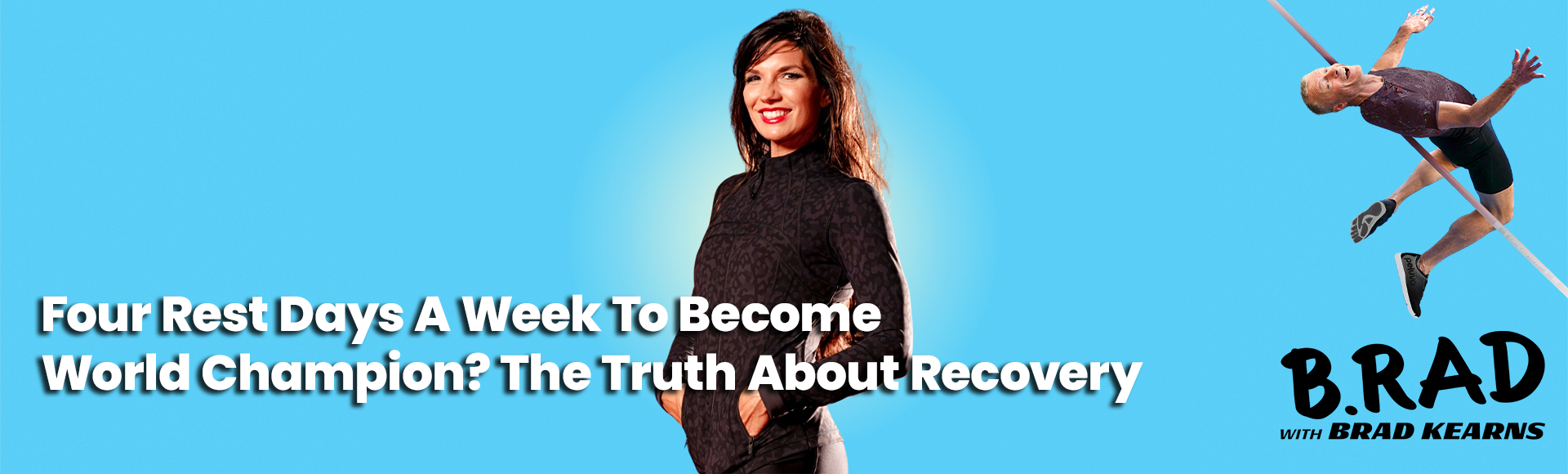
I am so excited to welcome back to the B.rad Podcast, Cynthia Monteleone, my good friend and sprinting mentor coach to numerous Olympic and world champion masters track and field athletes, and a former world champion herself in the 400 meters for women aged 45 and over!
Our last show was dedicated to discussing the dangers of chronic endurance training and the wide-ranging physiological benefits of sprinting. This conversation is focused on another hugely important topic: recovery.
The workout is the signal. The recovery is where the adaptation occurs.
You’re going to learn how Cynthia became a world champion in sprinting while taking four days off per week to recover, why cortisol is not the enemy, and the difference between the productive stress of training and the chronic stress that can interfere with health, hormones, and performance.
We also get into sprinting for longevity, chasing youth versus chasing longevity, and the simple recovery habits that matter most: sleep, walking, sunlight, spending time with family, and creating space where your body and nervous system can rebuild.
TIMESTAMPS:
The body doesn’t know whether the stress comes from sprinting, scrolling, financial pressure, or a difficult conversation. It simply responds to stress. [03:37]
Cynthia publishes a free newsletter with educational information on various topics such as the importance of recovery. [05:51]
There is a difference between chasing youth and chasing longevity. [08:44]
The problem of taking outside hormone replacements is common. [12:23]
There are natural ways to get around some symptoms like those that hit women in midlife. Men often aromatize testosterone into estrogen, thus the spare tire. [18:10]
Cynthia uses a metabolic pinch to analyze what is going on in a client’s body. This is based in Chinese medicine. [21:04]
The workout is the signal and the recovery is where the adaptation occurs. [22:03]
There’s a lot of misunderstanding and misinterpretation about what cortisol does in the body. Learn to use Eustress in a positive way. [24:07]
Beer creates this enzyme aromatase that changes the testosterone to estrogen. [33:27]
If anyone wants to track their longevity potential and their overall wellness and vitality, test your sex hormones frequently. The more calories burned, more classes attended, more miles run, still creates worse results, especially for the menopausal female [34:80]
Aging with a broken body is not the best quality of life. [39:04]
How can someone become a champion and win the medal but take tremendous amount of recovery time? Don’t you have to train every day? [43:18]
Walking after meals is such a great habit to adopt. [47:27]
Walking in those barefoot shoes basically strengthens your foot. [50:17]
Getting the right amount of sleep is essential for all your endeavors. [56:86]
Find joy in what you are doing. Decompress, let go of stress. These are very important for recovery and longevity. [01:03:11]
Some people think if you have a good diet, you don’t need supplements. Some are based in ancestral medicine. [01:03:47]
LINKS:
- Brad Kearns.com
- BradNutrition.com – 20% OFF Your First Order!
- B.rad Superdrink – Hydrates 28% Faster than Water—Creatine-Charged Hydration for Next-Level Power, Focus, and Recovery
- NEW: B.rad Real Rad Gummies – Creatine + Nootropics for Focus, Motivation, Performance, and Recovery!
- B.rad Whey Protein Superfuel – The Best Protein on The Planet!
- Brad’s Shopping Page
- BornToWalkBook.com
- B.rad Podcast – All Episodes
- Peluva Five-Toe Minimalist Shoes – Save 10%
- Instagram @FastOverForty
- fastover40.com
- Brad’s Podcast Cynthia Monteleone
- Eustress vs. Distress
- Primal Endurance
 LISTEN: We appreciate all feedback, and questions for Q&A shows, emailed to podcast@bradventures.com. If you have a moment, please share an episode you like with a quick text message, or leave a review on your podcast app. Thank you!
Check out each of these companies because they are absolutely awesome or they wouldn’t occupy this revered space. Seriously, I won’t promote anything that I don’t absolutely love and use in daily life:
- B.rad Nutrition: Premium quality, all-natural supplements for peak performance, recovery, and longevity; including the world’s highest quality whey protein!
- Peluva: Comfortable, functional, stylish five-toe minimalist shoe to reawaken optimal foot function. Use code BRADPODCAST for 15% off!
- Ketone-IQ Save 30% off your first subscription order & receive a free six-pack of Ketone-IQ!
- Get Stride: Advanced DNA, methylation profile, microbiome & blood at-home testing. Hit your stride the right way, with cutting-edge technology and customized programming. Save 10% with the code BRAD
- Mito Red Light: Photobiomodulation light panels to enhance cellular energy production, improve recovery, and optimize circadian rhythm. Use code BRAD for 5% discount!
- Online educational courses: Numerous great offerings for an immersive home-study educational experience
- Primal Fitness Expert Certification: The most comprehensive online course on all aspects of traditional fitness programming and a total immersion fitness lifestyle. Save 25% on tuition with code BRAD
I have a newly organized shopping experience at BradKearns.com/Shop. Visit here and you can navigate to my B.rad Nutrition products (for direct order or Amazon order), my library of online multimedia educational courses, great discounts from my affiliate favorites, and my recommended health&fitness products on Amazon.
TRANSCRIPT:
Brad (00:00:00):
Welcome to the B.rad podcast, where we explore ways to pursue peak performance with passion throughout life. I’m Brad Kearns, New York Times bestselling author, world number one ranked masters age 60 high jumper and former number three world ranked professional triathlete. You’ll learn how to stay fit, strong, and powerful as you age, transform your diet to lose body fat and increase energy. Sort through hype and misinformation to make simple sustainable lifestyle changes and broaden your perspective beyond a fit body to experience healthy relationships, nonstop personal growth, and ultimately a happy, healthy, long life. Let’s explore beyond shortcuts, hacks, and crushing the competition to laugh. Have fun, appreciate the journey, and not take ourselves too seriously. It’s time to be wrapped. It’s time to B.rad!
Cynthia (00:00:51):
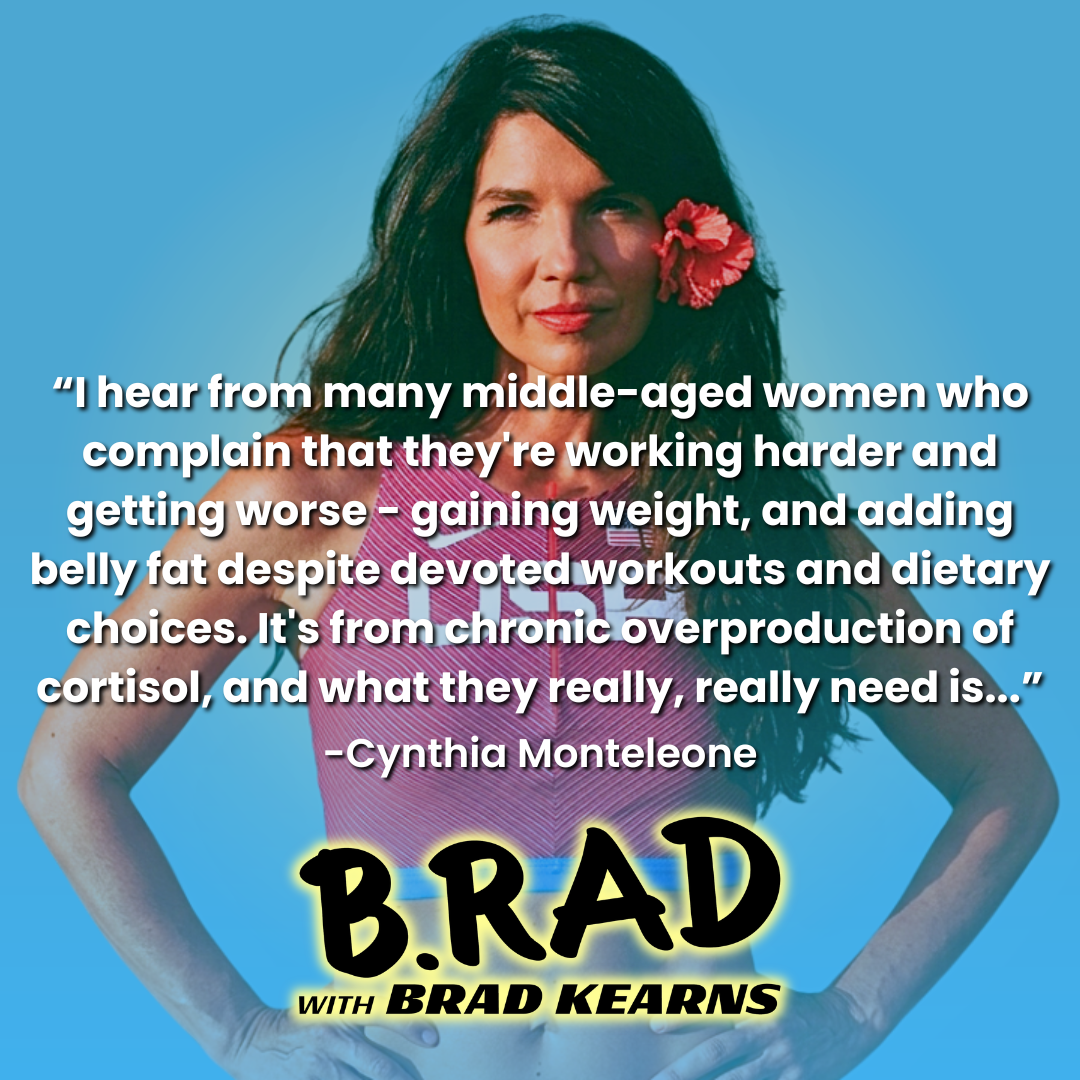
I hear all the time about these women who are like, I don’t understand. I’m working harder and it’s getting worse. My belly fat’s getting worse. I just keep gaining weight, and it’s because you, they really, really need that.
Brad (00:01:03):
I am so excited to welcome back to the B.rad Podcast, Cynthia Monteleone, my good friend and sprinting mentor coach to numerous Olympic and world champion masters, track and field athletes, and a former world champion herself in the 400 meters for the women age 45 and over. She ran a stunning time of 50. That backstory during this conversation. I sure hope that you enjoyed our one across the water from her home in Hawaii to the B.rad Studios here in Sacramento, California. The next best thing, the last show was dedicated to discussing the dangers of chronic endurance training and the wide ranging physiological benefits of sprinting. She detailed a list of, I think, nine amazing benefits of sprinting. It was really highly educational and inspirational, and this show is dedicated to the topic of recovery, and it was inspired by her wonderful newsletter article.
Brad (00:02:28):
We’re gonna get into that and cover many facets of the importance of recovery. The workout is the signal, the recovery is where the adaptation occurs. And that line got me so strong, I wrote her right away and said, look, we gotta do a podcast covering all aspects of this message. It was really a great blog article, and yes, indeed, people still sit down and type out articles themselves and create something of tremendous value amidst all the AI driven commentary and information that we’re getting. So it was a real nugget to go in deep and get further clarification and explanation from Cynthia about her recovery principles. You are going to learn how she became a world champion in sprinting, taking four days off a week to recover. You’re also going to learn about some of the misconceptions that we have about the preeminent fight or flight hormone called cortisol and the dangers of chronic overproduction of cortisol versus the appropriate spikes in cortisol that we prompt when we are pursuing peak performance.
Brad (00:03:37):
We didn’t get to this in the show, so I’m gonna kind of finish this intro with a wonderful quote that came from the article. And then you’re gonna see that we cover all aspects of this during our conversation. Beyond physical body to nervous systems, spending time with family, watching something easy in the evening, reading, getting outside and creating space where my brain isn’t constantly processing problems, notifications, breaking news and stress, she’s defining what recovery really means. The body doesn’t know whether the stress comes from sprinting, scrolling, financial pressure, or a difficult conversation. It simply responds to stress. Recovery is a lifestyle. It’s a collection of habits that tell your body it can stop fighting and start rebuilding. And as I’ve gotten older, continuing this quote, I’ve become less interested in how much work I can survive and more interested in how well I can recover from the work that matters and feel strong and rested.
Brad (00:04:37):
Ironically, that’s also when my training results improved. The people who improve the most are rarely the people who train the hardest. They’re usually the people who recover the best after smart training. Let’s hear more from Cynthia Monteleon at her home in the big island of Hawaii. Cynthia Monteleon, you’re back. I enjoyed having you come to the Sacramento Studios on your mainland podcast binge many months ago. We had a wonderful show. I encourage everyone to watch that. And now we’re connecting over the screen. And I think the, the wonderful occasion is this awesome article that you wrote in your newsletter about recovery with so many wonderful takeaway points and just highlighting the topic of recovery and helping us understand, because we talk so much about mechanics and logistics and how to train and how to get better and how to prepare. And we kind of put recovery like sort of in that same category as like, yes, sleep’s really important, everyone should sleep a lot. Okay, onto the next topic. So this is gonna be a show highlighting that great article, but if you want to get this newsletter yourself on a regular basis, how do we, how do we subscribe?
Cynthia (00:05:51):
Oh yeah, thanks Brad. It’s on my website Fast Over Forty.com and it’s the number 40. And it, it should pop up, join our mailing list or you can kind of scroll down to the bottom of any page on the website and join. And the thing is, is that I, I have written a lot of articles with citations and things like that, and that is, those are available also on the website for like, I think it’s like a $25 paywall for all of them. And then you can get ones in the future, but the newsletter is free and I put a lot of information in that newsletter, so I get asked for general advice all the time, and I don’t have time to respond to everybody’s questions. And a lot of times it’s like an individual case for metabolics or something, and I can’t respond because I need more history and need to do an individual consultation.
Cynthia (00:06:38):
But the newsletter is my way of blanket educating everyone on a certain topic for that week. And I send it every Thursday. And yeah, so this week, well, the week before was a hard challenge for the summer. And then, you know, assuming everybody’s like sore, they need to know how do I recover. The following week I followed up with the recovery article, which I’ve gotten a great response on from people emailing back, ’cause you can email me back after the newsletter. And they’re, they’ve just been like, you know what? This one really resonated with me. I’ve gotten that a lot.
Brad (00:07:10):
Yeah. And I have to say, like, especially this day and age when AI is writing a lot of the content that we are fed and every company has a newsletter, a lot of them go into the promotions folder, which I’m glad for because I, i I can focus, but like, this one needs to get set to go right into your inbox because I know that you take a lot of time and effort, you actually write it and it’s coming from your own personal experience as an elite athlete, a coach to many other elite masters and Olympic level athletes. And so it’s real and it’s, it’s it’s valid by in many ways. And so it, it’s, it stands out from a lot of the, the fluff that we get. Thank you.
Cynthia (00:07:52):
I really can’t, I, I’m so over AI already. I just, whenever I see you can kind of tell when chat GBT writes a caption on Instagram because it’s got the same pauses and the same drama and like I just scroll right past it. I cannot stand it anymore. And I used it like at first, maybe like six months ago or like for a couple captions, and I was like, this is so not me. I can’t do this <laugh>. Yeah. I, so, so sometimes I use it to organize my thoughts, but I have to do my own writing and, and be my own person because I’m just already over AI I really am. I’m, I’m after the authentic, like what is making us authentic and individualized. I am so antico cutter, everybody the same. That whole like, you know, Kardashian Botox, you know, everyone’s the same looking person. Can’t stand it. So let’s celebrate our indi individuality <laugh>.
Brad (00:08:44):
Well, that’s funny ’cause just before we hit record, we were talking a little bit about the big issue of doping in sports and now really doping in life with hormone replacement and the increasing popularity of peptides and things that you can put into your body. And for both of us being immersed into the masters track and field world, there’s, you know, an honor code, there’s morality and there’s, there’s drug testing. So, you know, we’re, we’re pretty much out there as proclaimed natural people for many reasons. And I can, we can, we can get into that more. But now we have to sort of compare contrast to people who are dosing with outside agents and then not only winning competitions, but also giving health, fitness, recovery and performance advice. And I have a pushback there, just like you have a pushback with AI ’cause it’s like, wait, but this is, this is not an authentic playing out of your lifestyle behaviors, your training decisions, your sleeping decisions, because you’re, you’re doing an override. And so we’re kind of at that fork in the road too, where it’s like, look, you know, we gotta turn to like authenticity and choosing a path through life that is not laden with shortcuts and things like that.
Cynthia (00:09:59):
Yeah, I, I see a lot of, oh my gosh, the longevity scene on social media has exploded with peptides. And, and you know what, like I, I actually am a fan of BPC 157. I think it’s great. Charles taught us about it 10 years ago, 15 years ago. It was like a long time ago. So we’ve known about it a long time. I used to use it before it was banned in a patch form and, you know, periodically. And, and it, that was, it’s not performance enhancing, it just repairs tissue, right? So like not all peptides are bad, but you know, if you go to TB 500, that one is performance enhancing. So it’s just like they can’t, they haven’t done enough. I guess they, they say they haven’t done enough research, although BPC 157 has a ton of research. But my point is, is that now it’s testosterone, now it’s all these things. And I feel like there’s a difference between chasing youth and chasing longevity. So I feel like between, like for instance, chasing youth is like Botox, getting Botox or plastic surgery. You’re chasing the youth, not the longevity. For me, I like, you know, like my skin, I have tallow that I made tallow skincare, you know,
Brad (00:11:11):
Uren Uren Hawaii. Yeah.
Cynthia (00:11:12):
I think my skin looks pretty good for age 50, being in the sun all the time. And I make my own skincare. I take great care of my skin. And it’s not because I am desperate to look younger. I don’t care. Like I love getting older, you know, I’m 50. I love it. I look forward to the, the beautiful wrinkles that my Navajo mom and aunts have. You know, like I love that look that they have this beautiful aging Native American look. I look forward to that, but I’m not chasing youth. I’m chasing longevity for taking care of my skin. I wanna take care of my skin as I get older so that I have healthy skin for as long as I can, if that makes sense. Not trying to chase youth. And I feel like this, this whole testosterone thing, even for women, I’ve had it out with women that I know that are like in the longevity space and they’re like, oh yeah, I’m gonna start taking testosterone because I was told that that’s what I need for perimenopause.
Cynthia (00:12:09):
I need estrogen, I need progesterone and I need testosterone. And it’s a crime that we haven’t been able to take it all this time and this and that. And I’m like, how about try the natural ways? Oh, I’ve tried everything. And I’m like, I guarantee you haven’t tried any everything. I have a, you know, 75 page for menopause guide that is like the natural solution to every single symptom. ’cause there’s a lot of ’em, but do you need that testosterone replacement? And anyway, she was, she wanted to join Masters track and I said, well, you can’t join Masters Track now. And she was like, what do you mean? And I was like, well, testosterone is banned and you know, that you, it’s, you can’t get a temporary exemption, which is like or a therapeutic use exemption, which is an exemption to use it for masters athletes, which do exist.
Cynthia (00:12:53):
We talked about that. We were just before this and we were looking it up, it exists, but it’s not for age related lowered testosterone. So you can’t, you basically can’t get a TUE. You’re gonna get drug tested and if you win, you’re gonna, or you know, if you get tested, you’re gonna fail. But just ethically, that’s wrong because all of us are natural and we figured out the way, we have all figured out the way to be healthy and to excel in life even more than these longevity experts, in my opinion. Some of these performances from these Masters athletes who are testing, you know, they’re clean ’cause we’re tested all the time and we’re killing it naturally. And all these guys are like, no, we need this testo. We need this TRT, we need this peptide, we need this band, this DHEA, we need these other band substances.
Cynthia (00:13:43):
And I’m like, we’re Masters athletes are out there proving that you don’t need it because we are tested. You know? So I don’t know, sometimes people test negative or, you know, they test for drugs in our sport. Unfortunately they’re cheaters, but they’re caught. So what I’m saying is that it’s possible I’m there with you. And she was mad that she couldn’t compete in track after taking testosterone. And I’m like, it’s not fair for the rest, the rest of us. And to be honest, Brad, it’s possible for someone to go all the way up to, say my age, age 50, right In they, in their forties they start taking testosterone as a, we’ll just say as a woman in my age group, they take testosterone in their forties. They build muscle tissue, they build bionuclei, which are the satellite cells that are responsible for building muscle tissue, which makes it, once you take that testosterone or steroids or any kind of performance enhancing, it builds those bionuclei so that it’s easier to create that muscle mass later. So that is, it doesn’t even matter. So they can go all the way up to and say, okay, I wanna join Masters track at age 50. I’m now gonna become A-U-S-A-T-F member. I’m gonna stop taking this because I’m gonna be tested and still win because they have an advantage from that TRT that they took before. Does that make sense?
Brad (00:15:01):
Oh, sure. I think the listeners hopefully are following carefully. But you know, that was the thing that happened in all sports where the, the cyclists would go and dope their asses off all winter and preparing for the season coming and have a tremendous benefit even though they were clean as a whistle when they peed in the cup during the competitive season. That’s why it’s great that the world Anti-D dopa agency now has random, unannounced year round out of competition testing. Yeah. Anytime any place, and you might have listeners, viewers might have seen occasions where an athlete gets suspended for what they call whereabouts violations. Like you have to say where you are all the time, every single day so that a doping tester might knock on your door anytime they feel like it and test you. So they’re doing a good job trying to keep the sports clean and yeah.
Brad (00:15:50):
Sorry, you know, the enhanced games brought this into light recently because mm-hmm <affirmative>. They were touting all kinds of nonsense about how these magical steroids can shatter all the records. And the whole thing was a big flop and a farce. And there’s plenty of things that we could continue to talk on those subjects, but I know we gotta get back to the more hit off on our recovery path. But it, it is sort of related to it because in the big picture, these hormones are what, you know, drive recovery and performance and adaptation. And I, before we transition, I wanted to ask you like your personal opinion. ’cause I talk about this on the show a lot. You know, my, my chosen path through life has been the clean path all the way. And that’s a big decision. ’cause like back when I was a triathlete that included, I did not consume caffeine and I did not consume nonsteroidal anti-inflammatories ever because I wanted to feel the full impact of my stiff lower back mm-hmm <affirmative>.
Brad (00:16:45):
From riding my bike 84 miles in the hills, such that I would make a good decision the next day rather than bomb a couple 800 milligram mm-hmm <affirmative>. Advil and be able to go out and run 12 miles and then pay the price later. Same with even something like caffeine, where if I woke up and felt tired and groggy, I knew that I needed more recovery and that was just, you know, a, a choice I made to try to be a better athlete. Not to mention, I mean, you can make a choice to go to the dark side and be a way better athlete, but that has all those ramifications we talked about. But my question, the longest posing question ever Cynthia’s had is, you know, if someone like me is doing everything I possibly can to perform and recover and excel and every five years I’m gonna reopen the subject and say, Hey, you know, I’m 75, I don’t feel great.
Brad (00:17:36):
Aging is hitting me hard. Maybe I’m gonna, you know, step aside from my competitive dreams and just wanna be a more lively, energetic, vibrant person. Is there a justification at some point to say, Hey, let’s look at what modern pharmaceutical intervention can do. And now I’m kind of referencing close friends and associates of mine who are really big fans of hormone replacement and they make a really excellent case. Like, look man, I feel great. We know the side effects aren’t what they tried to scare us with for many decades that oh, you’re gonna get prostate cancer if you take hormone replacement. Actually research is now showing the opposite, that keeping your hormones optimized or protective against cancer. So is there ever a time like in your life or if Brad calls you up and asks you for advice in 15 years that you might have a different perspective than let’s say what we just present so far in the conversation?
Cynthia (00:18:30):
That’s a good point because while I am sympathetic to people that are like, Hey, I feel so much better taking this, you know, hormone replacement, I do think that it’s the easy way, and I don’t say this lightly because I have been hit by the perimenopause train <laugh>, like, it’s like a train wreck. Like one day you’re getting hit with this symptom, another day, this symptom, and you’re like, wow, what this, this is nuts. You know? But there are natural ways to get around it. And when I say natural, I mean sometimes those are supplements that are relying on ancestral medicine. And so I just have more faith in ancestral medicine and natural things that we can take from the earth rather than something that’s like, I don’t know, the pharmaceutical intervention. So like I can sympathize with that, Hey, you know, your friend’s 75, he just has a better quality of life on it maybe.
Cynthia (00:19:28):
And like, yeah, okay, that sounds great. But also I look at Kenton Brown who’s, you know, the viral reel that’s still going viral. He’s 81 and he’s sprinting at 200 meters in 29 seconds. And I’m like, you know, and everyone’s like, oh, testosterone this and that, whatever. And I don’t know him, but I just know that he’s tested. So <laugh>, I’m assuming he’s clean and I see performances you do too at Master’s track meets where these people are aging naturally without it. And it’s pretty amazing and it just shows that it’s possible. I don’t wanna sound harsh, but I feel like people just don’t wanna do the work. They just want the GLP injection. They want the easy way out. They want, you know, the magic diet pill. It’s, life is hard and they want the easy way to get there, but there’s always a cost for that in my opinion. Whereas if you go a natural way, there’s no cost or a very minimal cost.
Brad (00:20:28):
<laugh>. Yeah, well said. And it’s super funny when, so if you
Cynthia (00:20:31):
Ask me, I’m gonna give, you’re my client, you hired me, you’re my client, so I would, I know your history, we work together. If you said, Hey, I am having X, Y Z symptoms, it’s affecting my quality of life, I would give you a list of natural things to do that would work.
Brad (00:20:47):
Love It. Yeah. Yeah. It’s also fascinating as, you know, if you’re a male and you have some spare tire going and you take outside hormones, you are likely going to aromatize some of that testosterone into estrogen. That means the conversion of testosterone into estrogen in an unhealthy body as evidenced by the spare tire. So the visceral fat secretes these inflammatory cytokines into the bloodstream and the intended effect is gonna be like a little spike and then you’re gonna level back to your, lazy Yeah. Unhealthy lifestyle, even though you are, you know, trying to, to dope your way out of it.
Cynthia (00:21:24):
Right. And I can tell with my metabolic pinch that I do, I can tell by pectoral measurements and a knee measurements, if somebody drinks, if they’re a male, what they drink <laugh>,
Brad (00:21:38):
She’s going around at parties pinching Yeah. Pinching pecs and saying, Hey man, what’s your problem?
Cynthia (00:21:43):
Well, it’s funny you say that. ’cause if I, you know, if I’ve been known to like pinch somebody in a parking lot or something and just, you know, I don’t know, <laugh> be like, let me see <laugh>. But yeah,
Brad (00:21:54):
So what’s going on there?
Cynthia (00:21:56):
Yeah, I can, I can actually, I usually use calipers obviously in a official consultation, but I can tell just by looking at them, I have like almost x-ray vision and I can tell by definitely with a finger pinch I can see. But there’s 14 different places that I analyze. It’s based in Chinese medicine. A lot of people don’t know that, but Charles, my mentor, made it popular with his bio signature and then metabolic analytics. But I’ve taken it a step further from that and I integrate it with Chinese medicine.
Brad (00:22:23):
You’re talking about your mentor Charles Paula Quinn, who we spoke about in detail at the last show. And he’s a legend in the peak performance health, fitness, strength training industries, unfortunately no longer with us. But you’re carrying his work forward wonderfully. And so I think people who are aware of him will take that connection nicely. So here’s what, here’s what caught me early into this reading about the recovery. Maybe there was a spicy lead in. So I’m gonna say like, look folks here, here’s the deal. The workout is the signal and the recovery is where the adaptation occurs. Pretty obvious, but it opens up this can of worms, right?
Cynthia (00:23:06):
Well, I think people don’t realize that like you’re tearing the muscle fibers, then they have to grow back stronger. What if you keep tearing them and you don’t give it a chance to connect the way they should, then you’re not gonna get as strong, you’re not gonna have as great of a performance. So this is, that’s what that means.
Brad (00:23:27):
Yeah. And I want to raise my hand and admit that like, I’ve had to learn this the hard way I an endurance athlete, of course, we’re always pushing the limit of what our, our hormones and our musculoskeletal system can handle mostly the fatigue factor of training for many hours. But, you know, in transitioning to becoming a sprinter and a high jumper, especially over the past six years of heavy focus on those events, I’ve had to work hard to leave my endurance mentality behind and appreciate much further where the high intensity exercise, when you did that thing with your fingers, if you’re only listening and not watching, Cynthia made a nice strong fibrous collagen showing a healthy tendon and muscle tissue, rather than the frayed stuff that we get when we have lingering injuries. And Right. I’ve had to learn the hard way,
Cynthia (00:24:17):
If you’re listening, you can think about me linking my fingers together. Right. Like a strong bond. And then Yeah, if you’re, if you need to give your, your body a chance to do that.
Brad (00:24:27):
Yeah. And of course we’ve talked as you’re trying to support me and my recovery from injuries and, and perform when I do things that cause lingering soreness and tightness and stiffness for too long after the workout, it’s literally an example of exceeding my capabilities and now needing to spend time in repair rather than growth and adaptation to become a faster, stronger athlete. So that was kind of the lead in to the importance of recovery. You mentioned cortisol, so maybe you could give us some tidbits about what what is now, like everyone, you know, talks about cortisol where, you know, 30 or 40 years ago when I was an overtrained triathlete, I got a book about cortisol and I’d never heard the term before and, and learned all about it, but now it’s, everyone knows it as the preeminent fight or fight hormone. But I think there’s a lot of misunderstanding and misinterpretation about what cortisol does in the body and the pros and the cons like you wrote in the article.
Cynthia (00:25:30):
Yeah. And I just kind of wanted to briefly touch on that in the article. ’cause there was so much information I wanted to put in that newsletter. But I say cortisol is not the enemy. People think a cortisol is the enemy because they, they’ve learned through TikTok or whatever. I don’t know that, you know, you store cortisol in your stomach if, if they’ve learned that, which I don’t know what percentage now knows, but I feel like it’s like a good percentage of the population, especially if you’re into fitness, knows that cortisol makes you hold belly fat. And so, and that is true, but what type of cortisol is it? Is it the cortisol spike that happens during exercise? No, that one is good. Cortisol is good. You need it to have that spike for exercise, especially for sprinting, that sort of thing. But the thing about sprinting is that the cortisol spikes and then it drops off dramatically back to baseline.
Cynthia (00:26:22):
Whereas endurance training elevates the cortisol and then you get lingering cortisol. And that’s what stores the belly fat lingering cortisol also comes from if you are stressed all day from your job or you’re checking these emails or watching the news and you’re getting these hits of stress, stress, stress, stress, stress that creates lingering cortisol. So not all cortisol is bad. You need that cortisol to, I mean, it’s, it’s in our bodies for a reason, you know, we do need it. But if you have lingering cortisol that is going to disrupt your other sex hormones leading you to possibly think you need hormone replacement because your hormones are all over the place, you know, and yeah, you do have age related decline in estrogen for women and testosterone for men and that sort of thing. But I do believe that our bodies are designed a certain way for a reason and to embrace longevity and quality of life for a long time and not try to become young. If that makes sense. Again. But yes, so the cortisol, we do need it and sprinting is when it or high intensity work, you know, an explosive high jump session, same thing. You’re gonna spike that cortisol for your energy and you know, your drive and then it’s gonna drop off because you’re getting adequate rest in between. But if you don’t get the adequate rest and you’re doing endurance training, it’s gonna stay lingering. And studies have shown this, there’s plenty of studies out there if you look up, look it up.
Brad (00:27:50):
And added on top of that is modern life is essentially driving the chronic overproduction of cortisol because of the nature of our nonstop stimulation hyperconnectivity. And the thing I learned, I remember years ago in the book that I, that I got when I was burnt out and didn’t know why stress can be both positive and negative. Yeah. So exactly. They, they had a, they have a stress scale. You can Google these things and they have a chart of the most stressful events in life and usually up there near the top, you know, death of a close family member, loved one. But getting married is one of the most stressful events because there’s so much energy, attention intensity. And it’s, you know, you’re, you’re on stage, you’re performing the whole thing is a very positive, wonderful day. Hopefully sometimes, sometimes, not always, but it still counts on the scoreboard.
Cynthia (00:28:45):
I, yes. Mm-hmm <affirmative>. Yeah, I could see that. I could, I, yeah, I could definitely see that there’s like all these expectations. You have all this planning, these guests and that sort of thing. I am definitely a fan of anybody wanting to elope. I support that <laugh>, <laugh>, having small ceremonies, that sort of thing. I just, I feel like, yeah, I actually, when I married my husband, we had a very small ceremony. We did not spend very much money. We had close friends and family and I wouldn’t have it any other way. I just totally loved it. And I feel like I had a really happy day. But let’s talk about that. It’s called, I actually have a, an article on my website, it’s called Eustress versus Distress. Mm-hmm. And eustress is a term
Brad (00:29:25):
E-U-U-S-T-R-E-S-S.
Cynthia (00:29:28):
Okay. Eustress. Yes. And that means you’re excited. So picture me lining up for my 400 meter world championship race. I’m actually really excited to be there. I feel great, even though I ran rounds the day before. Everybody else was struggling to put on their warmups. And I cruised a 60 seconds flat, you know, slowed down at the end in my 400, like it was the easiest thing and won my heat. And that was the day before, I believe. And so, yeah, I had to run the final the next day. I was totally recovered. I had great sleep and I was happy to be there. I was like almost like, like a horse getting ready to race outta the gate. Like, yeah, let me outta the gate. I’m excited to be here. People were screaming, Wonder Woman. And you know, waving at me and I was like, yes.
Cynthia (00:30:19):
I was aloha giving my chaka to the camera. I was happy to be there. Other people. And by the way, I’m fueled all day. This is a little tidbit that I find that a lot of people make this mistake. They get nervous and they won’t eat because they’re nervous and they let those butterflies take over and they show up to the line depleted. Not me, let me tell you, I have my steak, my nuts, my berries. I have my protein shake. I eat all the way up to that line. I probably have a couple sips of protein during my warmup. And that’s my, you know, and I have my meal about an hour to hour and a half before. But I am fueled when I step to that line. And that I think creates a more stable environment for my, you know, my hormones and my, what am I trying to say?
Cynthia (00:31:07):
Like how I feel, my excitement. I’m not anxious because I’m fueled, I’m ready, I feel good, I’m recovered. And so I have eustress ’cause I’m excited. So I’m, I’m using that cortisol in a positive way. Hmm. They did a, a study, a research study on wrestlers and they measured eustress versus distress if they the same excitement right there. ’cause they’re all excited before their match. Nobody’s not excited, right? So they’re excited before their match. And the ones who had a positive outlook and had eustress won and the ones that had a negative outlook, and they were worried, they tended to lose more. So it was almost like unanimous. It was a very high percentage. So I thought, wow, that’s, that’s pretty solid evidence right there. So if you can go into your day or your workout with excitement and happiness as opposed to negative outlook, that actually makes a huge difference in how your cortisol performs too.
Brad (00:32:02):
So I guess the big takeaway here is that we need to count all forms of stress in life on one side of the balance scale. And then we have, you know, the restorative behaviors and all those recovery strategies on the other side in order to try to keep that in a healthy cortisol balance. You mentioned the spike of cortisol that occurs in and around performance. And we also have a spike when we wake up, which is also a positive intended thing to help us awaken and feel refreshed and energized.
Cynthia (00:32:30):
Yes, exactly. And things like, you know, light at night and things like that will disrupt that cycle. We, you know, our circadian cycle and then our cortisol is like a little, you know, we’re like, they’re a little, a little confused. Our body’s confused about when we wake. That’s why it just, it feels like right to return to a natural form of things in any way we possibly can. So, and that includes sleep. Sleep is the best thing for testosterone <laugh>, you know, like these men are out there going like, I don’t know why I have low testosterone. But then they’re not sleeping enough. They’re sleeping less than seven hours. They’re doing endurance training because they think that’s what’s gonna make ’em fit. They’re like all of these things that don’t, they can get sunlight. The more sunlight they get, the better their testosterone. There are so many natural ways to do this in addition to ancient medicines, supplements, that sort of thing that are legal <laugh>.
Brad (00:33:22):
Yeah. And I’m proud to,
Cynthia (00:33:24):
I’m these, they’re simple things like zinc. You talk about, I’ll give you a little tidbit for your listeners. When I measure someone, and let’s say they have a, a man, he has a PEC measurement, he has a high abdominal measurement, he has a high tricep measurement and he has a high knee measurement. This means that he’s a beer drinker and that is the number one thing, beer for creating this enzyme aromatase that changes the testosterone to estrogen. Estrogen. So it doesn’t matter what he does to maximize the testosterone, it’s gonna be changed to estrogen. And then he is gonna have a whole host of problems. And zinc is one of the first things that I would put that person on. Supplement protocol and high zinc fruits like shellfish,
Brad (00:34:08):
Because it’s easily depleted through stress. The, the chronic chronic overproduction, the cortisol is depleting these important minerals and just, you know, kind of putting you up in too much fight or flight time.
Cynthia (00:34:20):
Mm-hmm
Brad (00:34:20):
<affirmative>. Yeah, I think this is, you know, the essential scoreboard for males. I’ve done a lot of shows on this, of course as my listeners and viewers know, but I test my serum testosterone and, and free testosterone all the time. They, they know my name at the blood lab. ’cause I feel like there are some variables that, that affect the, the number quite a bit. Mm-hmm <affirmative>. I think mostly in my case, it’s the training cycles and whether I’m, you know, pushing a little beyond capacity and I’ll notice a decline in my, in my sex hormone accordingly. So if you can kind
Cynthia (00:34:52):
Of, because cortisol is also stopping that
Brad (00:34:55):
Right. Antagonizes testosterone. Right,
Cynthia (00:34:57):
Exactly. And estrogen, yeah. Sex hormones, estrogen.
Brad (00:35:00):
So if, if anyone wants to track their longevity potential and their overall wellness and vitality, test your sex hormones frequently. And then also the other fantastic scoreboard is the accumulation of visceral fat, which we wanna stave off for our entire life. It’s not supposed to be there, but for most of us, it, it’s a, it’s a problem in modern life due to all these stress producing behaviors and processed foods and and so forth. So keeping the, the belly fat at bay and keeping those hormones high is, you know, essentially doing the same thing as drug intervention would do. But you’re doing it naturally.
Cynthia (00:35:40):
Right. And I would like to note that perimenopausal women, they are, they’re more sensitive to the stress and the cortisol. This is why it’s really important to switch from endurance work. Even if they thought they could do marathons earlier in life and they did well and got fit. I hear all the time about these women who are like, I don’t understand. I’m working harder and it’s getting worse. My belly fat’s getting worse. I just keep gaining weight. And it’s because you, they really, really need that recovery for a lot of different reasons. Antioxidants are at an all time low because of the declining and fluctuating estrogen. It’s not always a decline. Sometimes it’s estrogen dominance and because it fluctuates, a lot of people don’t know that they think it just declines, but so it’s that it’s, they’re overdoing it and that cortisol is, is too high lingering. They keep working out, they work out harder, longer. And it’s getting worse. I hear this all the time. It’s very, very important to get the recovery as a perimenopausal woman,
Brad (00:36:39):
Right? So this is more calories burned, more classes attended, more miles run, creating worse results, especially for the menopausal female. But really for, for anybody that’s thinking that there’s a, a work harder, go longer way to fitness and boy, you can see it everywhere you look, you look in the exercise classes and the people who are have attained a high fitness level, but the body composition doesn’t match that. And especially it’s the worst kept secret as we talk about on page one of the book, Primal Endurance, when Mark Sisson and I wrote that had my cartoonist draw an elephant in the room of marathon runners with their race bib and all that. And it’s the elephant in the room that 30% of even, even high performers like marathon runners have unhealthy body composition because their training is just driving them to a high stress hormone production and dysregulated appetite and excess consumption of processed carbs and all the things to fuel that ill-advised training program,
Cynthia (00:37:41):
Right? And then they’re not getting nutrient-dense foods there ’cause they’re carbohydrate, you know, fueling, which is a whole other subject. But yeah, that recovery is really, really important as we age. And, and that’s why I promote sprinting or high intensity work because really it’s about, if, I don’t know, if you look at who’s living the longest with the best quality of life out there, they’re not necessarily like giant jacked muscular people. Like they don’t have that muscle mass. And yes, we do lose muscle mass as we age, but what I talked about on your last show too is it’s that neural firing and you’re gonna get that through those fast explosive movements followed by rest. It’s just overall the best scenario for aging. And we’ve seen it time and time again. So crushing your body in your 40 thirties, forties, fifties, even twenties, you know, in order to become this like superhuman goggins type that is not longevity.
Cynthia (00:38:37):
So I don’t know, I don’t really understand that. I do understand like the mental toughness challenge, but I think that that gets taken out of context. And then these people are, are like Goggins and you know, we talked about Cameron Haynes before the podcast. He is one of these ultra endurance athletes that is a bow hunter. So he was doing it for that, but then he just like kept taking it and he’s breaking his body and these people are looking up to it like, oh yeah, okay, that’s a hero because maybe I’ll break my body too because then I’ll be tough. And I think there’s something missing there of why do you wanna be like that? He did it to prepare for bow hunting. Although I think there is probably a better training strategy for that than just running miles and miles and miles, especially on a broken foot.
Cynthia (00:39:24):
But yeah, I think that as we age, a broken body is not going to be the best quality of life. <laugh>, you’re gonna have arthritis, you’re gonna have all kinds of degenerative diseases. It’s, it’s not, yeah. The, the prescription or the recipe, it’s not the recipe for a quality of life where you’re moving. Well I was so proud. My dad is 83, he got in an airplane and it took him, gosh, nearly 24 hours of travel. Him and my mom, who’s 86 this year, they traveled from North Carolina to my island, the big island of Hawaii. Took them almost 24 hours from start to finish of travel because of where we live. And they traveled all that way on the airplane, got here, settled in a little bit, went and played tennis with my kids at the park down the street. So my dad’s out there playing tennis with my boys who are 12 and 13.
Cynthia (00:40:18):
And I thought, this is it you guys, this is it. You know, I taught him how to sprint, I do all their supplements, but I thought, what more could you ask for? This is the point is that I have my parents, my kids have their grandparents and they’re able to travel all that way to see us and play tennis with my kids. Like isn’t that the point? I don’t know, maybe it’s not for some people, but it’s not to have a broken body at age 50 or 60 or you know, even before that. It’s not that, it’s not to be in a wheelchair at, by the time you’re 80 and you can’t play tennis with your grandkids. What do you think, Brad? Yeah,
Brad (00:40:54):
That is really well said. And I’m gonna give you some extra points for being as polite as possible because it really is a major, a disgraceful issue that’s of great concern for me. And that is this messaging that’s getting pounded into especially the younger viewer listener where this is the path to, you know, being a true, a true warrior and your manhood. And, um, David Goggins, I, I try not to criticize him too much ’cause he gets people up off the couch feeling sorry for themselves. And he had a rough, he had a rough go through life and he, he came back and fought hard and persevered. But you know, if you listen to one of his three hour shows on Joe Rogan, the first two and a half is Joe Rogan fawning over this guy who’s so amazing. And when goes bad, you just duct tape the up and you, you tape your knee up.
Brad (00:41:44):
And I went 20 more miles and, and Joe Rogan’s like, man, that’s awesome. And he’s the bestselling author and he is got a great following, but like the last half hour of the show is his detailing how his hormones are all effed up. And so he is taken this and he’s taken that and he’s pieced together by, by duct tape, uh, literally. And to make a figurative comment there, this is a really tough deal to absorb. And so I’m gonna talk for the, the 60 plus crowd now to say a lot of this stuff that we’re idolizing is a young person’s game only and it really should be a bucket list accomplishment only even for young people. But it’s taken over culture to become this incredible fascination and extreme popularity of even something like the marathon where most of the time you’re gonna get accolades, you’re gonna be talking about, you’re gonna show your finisher medal in your office, but a marathon is completely antithetical to human health and longevity. Of course, we wrote a whole book about it, Born to Walk and talking about how if you crossed the finish line at the marathon and you walk over to the hospital, you would present, if they took your blood, you would present as someone having a heart attack because your enzymes and your inflammatory markers are off the charts. So I’m glad for it
Cynthia (00:43:01):
Doesn’t happen after a hundred meter sprints, <laugh>.
Brad (00:43:03):
I’m just that. Exactly. That’s a great transition. And I was gonna say like if you’re a skeptical viewer right now, thinking that your weekly mileage is gonna get you to aging gracefully, I want to jump right in with one of the comments from the newsletter where you’re establishing credibility without even knowing it. Where you win the world championship at 400 meters for females, you run a 57 second and you were taking four days off per week as you prepared for that epic performance that was faster than you ran as a collegiate athlete. Yeah. Mm-hmm <affirmative>. So let’s kind of jump into the discussion of how someone can become a champion and win win the gold medal, but taking a tremendous amount of recovery time rather than the messaging of you gotta be consistent, you gotta get up at 4:00 AM you can’t miss a day. And all the stuff that’s floating around the internet these days.
Cynthia (00:43:56):
I have to give credit to my track coach Rudy Huber because he’s the one that taught me to take that day off in between. But he pushed me so hard on the track, he knew I needed it. And, and I learned that and I did have a strength coach too, and my strength coach wanted me to work out and lift certain times and I would have to do it basically. And it, I figured out that it worked well this way. I would run in the morning on say a Monday and strength train in the evening and then I would run in the morning on Wednesday, strength train in the evening, and then I would have all that Tuesday in between off. And it actually worked really well. My mentor Charles taught us that as long as you have four to six hours in between, you’re recovered enough to do another workout.
Cynthia (00:44:40):
But do I definitely do not approve of strength training before sprinting or right after. I know a lot of people do it, but that is not something I approve of for my clients and it gets results to put them far apart and then take the next day recovery. So yeah. So a lot of people think, okay, world champion, she must have been running every day. Hard workouts, long workouts. I don’t know what they thought, but it wasn’t that I was taking, sometimes I would have to lift on an extra day, but basically four days off.
Brad (00:45:10):
Yeah. I think the, the brain has to kind of get away from it too. Especially as you go up in, you know, the sophistication of your goals and, and how hard you are training and preparing for these intense competitions. It, it’s, it’s a welcome respite from the grind to have 24, 36 hours where you’re not thinking about it and, and trying to maintain balance as a person and focus on other areas of your life as a parent, as a, as a coach and all that. And that worked well for me when I was a triathlete too. Like it was so hard to, to try to hit this weekly schedule of some killer swim workouts and a long bike ride and a fast bike ride and a long run and a fast run. And then it just got to be too much and I’d fall apart.
Brad (00:45:53):
So then I’d start stacking the hard work, like put Tuesday and Wednesday together and then Thursday and Friday and Saturday might be easy and you’d have these better waves where you’re just getting the work done and allowing the body to rebuild. I guess everyone has to figure out that individually, but these basic principles that have had such a great impression on my approach to the, the high intensity sports especially where, you know, you gotta have the ebbs and flows and probably any type of fitness enthusiast at any level can reflect and take something of value here because Right. And those days, the muscles, the tendon,
Cynthia (00:46:30):
It’s like they do it every day. Oh, I train every day. Like they end up getting overuse injury. It just happens. I mean, really like 100% of the time they’re gonna get you overuse injury. And one of the things, you know, knock on wood, I never got injured in that whole time from going from a minute and 30 seconds down to 57 seconds in the 400, all those intense workouts. I did not have any overuse injuries. The only time I got injured in my whole Master’s career was falling from the sky in pole vault and Yeah,
Brad (00:47:02):
Yeah. Was the violent fall
Cynthia (00:47:03):
It’s totally different, you know. So I never had a, an, an injury otherwise. And that’s like more, what, nine years of running in my forties.
Brad (00:47:14):
That’s incredible. ’cause it’s pretty high injury risk, especially since you took 20 years off and then came back and started hitting, I guess a casual viewer reporting that you improved from 90 seconds to under 60. Would wouldn’t know if that was impressive or not. But like if for anyone who, who doesn’t appreciate that, go to a running track and see if you can run a 90 second, which is way out of range for most people. And then the idea of improving down to a minute is just beyond belief really.
Cynthia (00:47:46):
Thank You.
Brad (00:47:47):
So I think we have a bunch of bullets that I’d like to Okay. Uh, kind of hit those quickly inspired by the article. And the first one was what we’ve been talking about is, you know, you’re pushing your body hard, you’re doing the high intensity work that’s good for the hormones, good for the musculoskeletal system, great for longevity. And then we wanna pair that with real recovery where we’re taking care of ourself. And then you put a nice plug in there for walking, especially after meals.
Cynthia (00:48:13):
Oh my gosh, I’ve been such a huge fan of that, of walking after meals. Especially as, again, a woman in going through perimenopause, it’s been a game changer to add that walking in. And I, you know, I just walk my dog and, but I’ve tried it with clients and adding in the walking has just been tremendous for digestive system, for decompressing, for just letting the thoughts come. It’s been huge and lowering that cortisol spike for sure. And it’s, and easy, it’s not like, you know, it’s something that’s accessible to most people. We won’t say all people because some people can’t, but it’s accessible to most average people… This walking.
Brad (00:48:59):
Yeah. And that’s the, the best part about it is you’re getting a wonderful health benefit and a wonderful cardiovascular exercise stimulation without teetering over into that chronic overproduction of stress hormones. And I think a lot of people may fail to appreciate the difference between a nice medium to brisk walk versus trying to become a jogger and shuffling along and huffing and puffing. And I say many people, ’cause when I go into a gym
Cynthia (00:49:31):
Neurological system too.
Brad (00:49:33):
Yeah, right. We talked about in the last show, it’s, it’s the difference between like stress management and adding more mm-hmm. Uh, cortisol to your scoreboard. So, um, that’s a pretty easy to do. That’s a, yeah.
Cynthia (00:49:46):
Yeah. And there’s, we’re both fans of Peluva so I have found that walking in the Peluvas, I actually am not an advocate of sprinting in barefoot shoes. That’s just my personal coaching. I think it’s too much impact, too much pressure on it, on your joints and everything. And I think there’s probably a very, very small percentage of people that could sprint in them because their mechanics and their muscles and tendons are so strong that they could, but I advocate for walking in them, lifting in them. And they are a game changer as well for connecting your kinetic chain, which is, you know, like how you’re connected through, especially through the back of you, your posterior kinetic chain. Huge. And I walking in the Peluvas has made my, everything connects so well that it’s increased my knee injury recovery, which is another story for another day.
Cynthia (00:50:37):
But walking in those barefoot shoes basically strengthens your foot. So sometimes people are like, how do you suggest I strengthen my achilles that I’ve had problems with, or my planter that I’ve had problems with, or even calves. And, I tell them, get these palas, they’re the best ones out there and just start walking them. And I, I get emails all day long from all these companies asking me to promote them and I don’t promote them <laugh>, like I promote like three companies or something because I only promote who, what I really believe in. So I sound like a commercial a little bit, but it’s only because I truly believe it that these shoes are a game changer and the walking is a game changer. So if you can combine those two, you’re gonna have a better quality of life because you’re gonna strengthen everything that you need for longevity and for injury prevention as you get older. Does that make sense? That’s like you’re strengthening from the ground up.
Brad (00:51:32):
That’s well said. Because you’re strengthening it in a safe and progressive way. And I’ve had to learn this because with my foot injuries that are coming directly from sprinting, the more time that I can walk in my Peluvas more time I spend barefoot in the house, which is all the time in the house, and then all the time when I’m walking, I’m not traumatizing the tendon connective tissue. So that’s all contributing to strengthening, like you mentioned. And then I have slowly over years of resiliency integrated the Peluvas into doing things like, uh, running technique drills that are in low impact. I show those on the Peluvas YouTube channel, but that’s taken so long and like you recommended to me, dude, don’t even try that stuff. Uh, you know, use elevated cushion shoes because we’re already asking a lot from the body, especially in the, in the Masters age categories. And so it’s a delicate balance that I think would benefit many people from getting out there, putting more time on your feet. There’s all those recommendations anyway, that more step count is one of the biggest health transformations you can do. But definitely doing ’em in the right shoes so that your gait pattern and especially your big toe function, when you have that independent big toe allowed to dorsiflex and get stronger, that’s exactly what you need running.
Cynthia (00:52:50):
I’m gonna say from my experience spreading out the pinky toe. Have you had that feedback? Oh,
Brad (00:52:56):
Oh my gosh.
Cynthia (00:52:57):
Because runners particularly will be like, I don’t know if I can wear these shoes because my pinky toe won’t go into the last, you know, slot. And I’m like, that’s exactly why you need to be wearing those shoes because then Oh yeah, it’s not okay. And you know, ’cause they’re, as runners we’re squished into those shoes. Our toes are all mashed together for long periods of time. Especially if you’re a marathoners or endurance learners absolutely need these shoes to get that spread, which again, activates the whole kinetic chain all the way up through the foot, through the leg, all the way to your back, all the way up to your shoulders. It’s through the whole chain. So
Brad (00:53:37):
Yeah, you can really,
Cynthia (00:53:38):
About the pinky toe,
Brad (00:53:40):
Oh my gosh. I mean my, my pinky toes folded over and underneath the plane of the four toe. And that’s from a lifetime of squeezing into running shoes and especially cycling shoes. ’cause those things are nasty and you’re Yeah, that’s true. Um, but you know, it’s taken many years for that thing to be able to slide into the Peluvas And now like at, you know, at a trade show I show off with the foot on the ground and I just slide my foot into the five slots. But at first I am wedging and digging and grinding with my hands to force that pinky toe in there. But once it’s in there, then you’re getting, you know, a foot functionality exercise. Mm-hmm <affirmative>. Like wearing toe spreaders all day long. So, uh, yeah, we need to fix our feet, especially the athletes. And just to kind of close the point, like, we’re not recommending that you go and play your pickup basketball game or do your sprints in a minimalist shoe, but it is the path to overall long-term foot functionality and injury prevention. I would say start,
Cynthia (00:54:37):
Start with strength training in it.
Brad (00:54:39):
Right, right. Huge. Yeah. Like your videos with rocking the pink ones in the, in the Outdoor gym. I love those. I love those videos.
Cynthia (00:54:47):
I love all of them. I love all of them. And then they’re my favorite thing for the beach too, because I do like to a barefoot on the sand for the grounding. But where we live, our beach is lava rock <laugh>. Mm.
Brad (00:54:58):
Yeah. We’re not talking about Panama City folks. We’re talking about some. Yeah.
Cynthia (00:55:02):
It’s very important that I’m able to actually grip on those rocks. And especially for my, again, my recovering knee injury, which is doing great, but like I need that stability and it provides so much stability just by wearing them. It’s just, again, like, it’d be sound like a commercial, but I’m just telling the truth. <laugh>, I think this is just how
Brad (00:55:20):
It, what’s really cool is you’ve had such an awesome influence and your code, your discount code, which is Cynthia, right? No, it’s Fast. 40. Or is it, oh, sorry. It’s Fast Over 40. Mm-hmm. Four zero. Yeah. when you go to pva.com and, and shop for your shoes, that’s a, a generous 10% discount. And you’ve had such an impact. A lot of people have used that code mm-hmm <affirmative>. And we’re like, you know, you’re, you’re right up there with like the, the world famous influencers with a million followers because people really take what you have to say to heart. So, listeners, viewers, I
Cynthia (00:55:53):
Track the sales with my code, um, ’cause I’m able to with Peluvas which is great. It’s about the same as the people who are downloading my free sprint protocol every day.
Brad (00:56:05):
Nice. Yeah.
Cynthia (00:56:06):
I, not my free sprint protocol with my free dynamic warmup for sprinting. I have it for free on my website and that’s about the same amount of people that are buying the Peluvas. Uh, maybe a couple more on the warmup, but I have people every day, you know, on both. So it’s awesome.
Brad (00:56:21):
Yeah. The free materials are great. And also the purchase, like, it’s been such a great investment for me to pop for a couple, few hundred bucks and get everything laid out from a, you know, someone who’s been there. Yeah. So we have the Sprint protocols and everything’s pretty well organized on the website. Is it ma’am strong? 8 0 8? Is it fast? Over 40?
Cynthia (00:56:42):
I’m fast. Over forty.com now. Yeah. I just changed.
Brad (00:56:44):
That’s easy to remember. Yeah. Fast Over four zero.com. Yeah. And then the code, um, uh,
Cynthia (00:56:51):
Fast.
Brad (00:56:51):
Over 40. Over
Cynthia (00:56:52):
40. Yeah.
Brad (00:56:53):
Right. So go get yourself some Peluvas and also visit it.
Cynthia (00:56:58):
Yeah.
Brad (00:56:58):
Get some Earth in Hawaii skincare products. The, the best, the best, uh, skin stuff I’ve used in a long time. Yeah.
Cynthia (00:57:06):
My nice
Brad (00:57:06):
Glow. Glowing. Glowing on the thing. Okay. We’re, uh, we’re working our way through the bullets, but that walking is a huge one. I’m so glad to read this one because sometimes I feel insecure about my sleep requirements. But Cynthia’s out there putting up nine to 10 hours a night just like me and prioritizing that above all else, huh?
Cynthia (00:57:27):
Yes. I am a stickler for my sleep <laugh>. I like to go to bed at eight and wake up about six, but sometimes it’s nine to seven. Last night it was nine to seven. Even when I compete, like in Europe for world championships or something like that, I am really, really adamant about getting my sleep. So I will go ahead of time, a couple weeks if necessary with the time change to acclimate if I know my race is gonna be a certain time of day. Luckily when I won my world championships, I actually, it was kind of a last minute trip that I was going. I wasn’t planning to go before that, but last minute decided to go. So I kind of got the flight I got and it turned out my race was in the evening, which is the same time I would normally practice in the morning in Hawaii. So I actually slept all day and then raced at like seven or eight at night. And it was this, I didn’t even have to acclimate ’cause I got there only Oh God, a few days before. Before.
Brad (00:58:18):
That’s so funny.
Cynthia (00:58:19):
Yeah. Isn’t that funny? Yeah, it was exactly the same. I mean, but if I did have to, and I teach this to my Olympians too, if you have to acclimate, go ahead of time, get your sleep. I think it’s important to sleep on the plane if you can sleep like on the plane, yes. Sleep when you get there. Don’t try to stay up for like 48 hours just because you need to try to adjust to the time. Just get your sleep when you can get it. And then try to adjust afterwards. And I use Mind Mag from ATP labs to Wind down combined with Yin Reserve, which my mentor Charles formulated for ATP labs. And that is a great combination for winding down and sleeping when I need to. So I take it on the airplane. Very funny with my little baggie of white powder of the airplane, enough taking it.
Cynthia (00:59:01):
People are like, what is that? But yeah, it’s just like anytime. I don’t take the, I don’t take it all the time, but when I had a particularly hard workout and I need that recovery, that extra recovery, I’ll take it. But yeah, sleep is the most important to me. I, I will not make plans on purpose for sleep. And I’ll tell you a story about New Year’s Eve. Really funny. This past New Year’s Eve, we had a, a little party in our cul-de-sac here and I did not drink alcohol. I just wasn’t feeling it. And so I had lollipop in my little champagne glass and I was dressed up to the nines. I had my hair done, my sparkly dress, you know, I was looking good. I went outside until about 9, 9 30. And then I went back inside and I slept through all the neighborhood fireworks and everything. I had the air filter going. So I had white noise. I slept until 1145, got up, celebrated New Year’s Eve with everybody for about 30 minutes. And then I went back to bed.
Brad (01:00:05):
Go back to bed.
Cynthia (01:00:07):
Yes.
Brad (01:00:07):
Love it. That’s how I, what better New Year’s Eve. Can you get Yeah. You
Cynthia (01:00:11):
Had the best time. I had. I really had so much fun. And I got my sleep and I felt amazing the next day. So <laugh>,
Brad (01:00:17):
I always look forward to going to bed before midnight and then waking up to the the next year. It feels great. Yeah. Nothing against, people want to celebrate once in a while. And of course you can recover from that. And the sleep researchers say if you miss, you know, a sleep here and there, it’s, it’s not gonna be detrimental. But I, again,
Cynthia (01:00:35):
It’s a way to preserve it. It’s so important for so many different functions of your body and hormones are one of ’em. And so if you see one of those people out there who are like, Hey, I still ran a marathon on two to three hours of sleep, then that is not who we need to I idolize like, that is not good for longevity and quality of life or, and health. Like, I like to merge performance and health. So for me, for my clients, I address their health first. Whether it’s a Master’s athlete breaking records or like, you know, any of my Masters athletes, I’ve got so many 400 meter champions, Sue McDonald, Christina Trucks, Emma McAllen. We address the health first and then the performance comes after that because they’re healthier. Their, their cells are communicating better, everything’s working better. They’re rested, they have the proper nutrients, they have things that are, you know, like Sue has a, a buggy hip sometimes. I just reminded her, Hey, you haven’t been taking your anti-inflammation supplement. You need to get back on that. So what, you know, they’re particular in what they need for their health. But I don’t think these, those need to be separate things. So I don’t like when someone’s like, Hey, I ran this marathon on two hours of sleep. I still did it. I’m a hero, you know, kind of thing. That is not
Brad (01:01:55):
Much of me.
Cynthia (01:01:56):
Yeah. That’s not much of me. Yeah. If you tell me I got 10 hours of sleep and I ran a 29 second 200 meters at 81 years old, I am way more impressed with that <laugh>. Like, let’s go. Yes. Because that’s why again, I’m able to enjoy my parents in their eighties playing tennis with my kids, traveling across the world to do it and still getting out there and doing it and talking to them every day. And they’re like, oh, we feel so great. You know, like that’s, yeah. It’s, I feel like isn’t that why we do it? What, what’s these, these influencers are missing the point. I feel like, you know, they’re missing the point of this.
Brad (01:02:35):
Simon Whitfield, my good friend, Olympic gold medalist triathlete, Olympic silver medalist in another Olympics, his great one-liner. I asked him how his training’s going and what he does for fitness after his retirement from the pro circuit. And he said, you know, Brad, today I am coached by my 80-year-old self. So his decisions and his behaviors today, he wants to make his 80-year-old self proud. And I love that. It’s also great to have, yeah. Yes. It’s the best one liner for Yes. You know, the training decisions you wanna make today and you don’t duct tape up joints that are bulky, you take care of them and hope they’ll last. And yeah. Yeah. It, it’s all up to us at whatever age and yeah. And
Cynthia (01:03:11):
Let’s find joy in it that, you know, find joy in what you’re doing daily. And you know, that’s, some of those bullet points have to do with that too. It’s decompressing, letting go of stress. Those are really, really important for athletic recovery, <laugh> for longevity.
Brad (01:03:28):
Yeah. We’ve actually hit on many of the points over the course of the show you, since you mentioned your New Year’s Eve party, there’s bullets like spending time with family and friends, you know, managing stress instead of accumulating it, taking the right supplements and getting the nutritious diet, which you talk so much about. You also like the hot and cold stuff. Let, lemme
Cynthia (01:03:47):
Touch on Brad if you don’t mind. Some people think if you have the right diet, you don’t need supplements. But our bodies change all the time and our environment changes all the time. And so it’s my experience that I, you know, I’m not a big time supplement pusher. I like to use them when needed. So supplements are just that, they’re a supplement to your diet. So I do feel like a strong foundational nutrition plan is great with your food, but you are just by the nature of the soil and the environment that’s toxic, you are, in my opinion, probably going to need something at some time. So that’s why I like the supplements because a lot of them, again, are based in ancestral medicine. So they’re little spices or something that have been recombined into a supplement like curcumin, right? It’s turmeric, which is very big, very big spice, anti-inflammatory. So things like that where it’s used for a period of time and then it’s cycled off maybe, you know, like it depends on the person and then maybe they need something different at a different point for whatever their goal is. So it’s always changing. And I don’t believe that if you just eat food, you’re probably gonna get your optimization. I do think that probably at some point you’re gonna need a supplement.
Brad (01:05:01):
Yeah. That’s hard to dispute, especially the more you’re asking of your body, which that, that might mean a hard training competitive athlete, but most people who are watching aren’t that. But if you are under a lot of stress, you could be even worse off because of the depleting nature of being a high stress lifestyle. And then more justification for trying to, trying to battle back with supplements as part of your arsenal along with getting as much sleep as you need, daily sunlight and fresh air. All those, all those great things.
Cynthia (01:05:33):
Right? And it’s not because trying to sell supplements, I only have supplements on my website because people need them. Not that I’m just trying to sell supplements. Not that I should need to defend myself or anything. I’m just saying like, I just don’t really feel like, you know, 99 point, 99% of the time, I really don’t think a diet is gonna cover you if you’re a perimenopausal woman and you’re declining estrogen is causing you to need more magnesium, for instance. You know, like there’s only so many leafy greens and other forms of magnesium you can intake and absorb. So sometimes that gives you that little boost, you know, and it’s not, it’s just, yeah, it’s fun to be able to give that opportunity to people as a metabolic practitioner.
Brad (01:06:16):
Yeah, that’s great. You’re doing great work. I think if we pair this show with the first show, the viewer listener is gonna get tremendous foundation for how to pursue especially fitness goals and do, you know, direct their exercise energy in the right way rather than just grinding away and, and getting tired and having those bad results that you talk about with the, the perimenopausal women. So, thanks for, thanks for spending the time with us. Do you think we covered, do you have any other things that were hot on your list? ’cause um,
Cynthia (01:06:47):
No, there are, I think gadgets, I’m not really too into for recovery, but I do like certain tools. Like I do like the sauna once a week if I can. I like an ice bath when we have the sauna ice bath rounds, I’ll, I’ll do a three minute threequarter body ice bath that I prefer an 18 minute lower body ice bath. And I have,
Brad (01:07:09):
I’m trying Cynthia, I’m trying, it’s getting, it’s getting cold.
Cynthia (01:07:11):
Just the lower body, just the lower body for 18 minutes is less shocking to the system.
Brad (01:07:18):
Yeah,
Cynthia (01:07:18):
Sure. And, and better overall for that vasodilation and that adipose brown tissue, you know, sparking. So all of the benefits basically, I find that for my, with my clients and myself, the 18 minute lower body is better. So I’ll try that sometimes. And then depending on how hard I’m training right that week. And then sometimes I do like the body lever. Have you seen that? And SEMA introduced that to me. No, it’s okay. So you know what ART is like if you go to an ART
Brad (01:07:47):
Or Yeah. Active free release technique it’s called. Yes.
Cynthia (01:07:49):
Yeah. So I find that with this body lever, it’s like two, well he gave me the wooden one, so it’s like two wooden sticks that are kind of, they look like nunchucks <laugh>. I was like, did you send me nunchucks? What is this <laugh>? And he’s like, no, it’s for recovery, it’s body, it’s the body lever. And I was like, oh, okay. So I use it especially on anything that’s sourced. So like if you have a tight shoulder from pull-ups or something like that, you can actually get ART done with it on yourself because of the way it’s made. It is literally a lever. So it puts pressure. It’s really cool. Anyway, he gave me a code for that too. It’s fast over for you as well. I’m not trying to just, you know, be a commercial, but that has helped tremendously with my IT band on my, on my knee side because my kneecap shifts a little bit.
Cynthia (01:08:33):
So my IT band is tight and I release that. I release my shoulder, I get a lot of tension in my shoulders ’cause I do a lot of upper body work, pole vault, you know, when I’m doing my pole vault drills, especially, even though I’m not pole vaulting, I still do the drills for strength. So that’s helped me a lot. Of course the walking, I’m trying to think what else, what other tricks I have that are not, they’re not necessarily gadgets. ’cause I don’t actually, I’m not a fan of red light. I’m a fan of stones which produce far infrared light, but I don’t like near red light. That’s another time for another, another topic for another day, I think. And I am not that big of a fan of anything electric because I was injured by PEMF, by a high voltage PEMF. So I can’t do anything.
Cynthia (01:09:17):
Like I can’t do TENS anymore. I can’t do anything like that. So for me, the recovery is better with the, you know, anything that’s winding me down. And I think that’s for most people because if you think about it, we’re surrounded by electronics all day and surrounded by things coming at us. So whatever you can do out there to get away from that, get into nature and be at peace and be happy and full of joy, that is where you’re gonna have your best recovery because it’s gonna allow your body to release your nervous system energy. Hmm. So that’s my biggest
Brad (01:09:52):
Excellent
Cynthia (01:09:53):
Piece of advice, I would say.
Brad (01:09:55):
And those are free what you just mentioned. Oh my gosh. Incredible.
Cynthia (01:09:58):
Yes. And, and sprinting’s free by the way too for an exercise.
Brad (01:10:01):
They do
Cynthia (01:10:02):
Form. Pushups are free, squats are free. There’s all kinds of things that you can do that are
Brad (01:10:09):
Free before you start going, going super high tech. I love it. What a great, great conclusion. Do it. Stick to the basics everybody.
Cynthia (01:10:15):
Sometimes, yeah. Tracking Brad has been found to actually make a worse nervous system outcome. So if you’re tracking on the watch all the time, you’re, oh my gosh, you’re hooked up to, what is it called? Like garment or Strava or whatever it is where you’re competing with other people in your workouts. Mm-hmm <affirmative>. That’s really not great for your back off. Yeah. Go out and get some sunshine and get some grass under your feet and think about all the things that bring you joy, your family, your friends, what you like to do. That’s the best form of recovery.
Brad (01:10:47):
Love it. Follow Cynthia on Instagram fast over 40. Go to the fast over forty.com website. Use that code@pva.com. Get yourself some Peluvas, start walking and join the fresh air, the sunlight. Thanks for a great show. I look forward to catching up and learning more about your, your miracle healing without surgery from your terrible knee injury and maybe seeing you back out there on the, the competitive arena someday.
Cynthia (01:11:12):
Yeah. Yes, you will. <laugh>,
Brad (01:11:17):
Thank you so much for listening to the B.rad Podcast. We appreciate all feedback and suggestions. Email podcast@bradventures.com and visit brad kearns.com to download five free eBooks and learned some great long cuts to a longer life. How to optimize testosterone naturally, become a dark chocolate connoisseur and transition to a barefoot and minimalist shoe lifestyle.