Please enjoy a great conversation and in-person show here in the Sacramento studios of the B.rad podcast with my good friend and sprinting mentor Cynthia Monteleone, coming to you all the way from the beautiful Big Island of Hawaii.
We had a long, wide-ranging discussion on health, fitness, peak performance, and longevity—especially in Cynthia’s area of expertise, acting as a truth seeker and naysayer in the health and fitness scene. She isn’t afraid to speak straight, challenge prevailing opinions, and back it up with deep research and her experience working with elite athletes. We talk about the popular idea that preserving muscle mass is the key to longevity, why that insight is incomplete, and why muscle power, explosiveness, and strength are the real drivers of healthy aging. Cynthia also explains why jogging can actually make you slower and age faster—while walking does not—and why tired training backfires, along with the idea that recovery is just as much about the brain as it is about the muscles.
As a Team USA world-champion sprinter and coach to Olympic and world-champion Masters-level athletes, Cynthia shares her thoughts on sprinting as an anti-aging strategy, creatine and why it’s not for everyone, diet—including dairy—and we even have some fun breaking down Dr. Rhonda Patrick’s viral green smoothie and the potential downside of consuming large amounts of plant toxins. She also talks about how she trains everyday people the same way she trains elite athletes, and why we should all think of ourselves that way. Cynthia has been a huge source of inspiration and reason for me over the years, and I really appreciate her willingness to think deeply, challenge trends, and always speak honestly about what actually works.
A Team USA world-champion sprinter, Cynthia Monteleone is a highly trained metabolic health analytics practitioner who coaches numerous Olympic athletes and world-champion Masters-level athletes. She goes deep into the nuances of what delivers peak performance and helps people overcome health challenges to reach personal goals, especially weight loss and excelling in athletic goals. You can follow her at @FastOVER40 on Instagram and learn more at mamstrong808.com. Cynthia also has a healthy, natural skincare line: Earthen Hawaii.
TIMESTAMPS:
We talk about the difference between just holding on to muscle mass and maintaining muscle power. [02:24]
After being a college athlete, Cynthia married and had children. When her 11-year-old showed interest, she went back to the track. [06:52]
There are many people who aren’t reaching their genetic potential. [13:04]
Walking versus jogging: when you are jogging you are preserving slow twitch muscle fibers. [19:43]
The power matters more than the muscle size. [26:18]
When you do slow eccentrics (lowering the weight during the bicep curl), you are recruiting more muscle fibers. [29:48]
Unless you are doing the Olympic Lifts in perfect form, the injury risks outweigh the benefits. [34:11]
If you’re an advanced sprinter, and you’re training by doing hills and doing sled pushes, it’s important at some point closer to your season to follow that resistance with flat work that’s fast. [36:59]
People often overdo jogging. It can be detrimental to your health. [40:03]
It’s good to do a dynamic cool-down. Little drills, like instead of jogging, you duck walks or toe walks. All manner of static stretching is ill-advised. [42:02]
It takes years for medical textbooks and journals to be updated to current findings. [46:12]
Cynthia is a metabolic practitioner. She works with elite athletes as certified strength coach, encouraging diet and supplements. [50:58]
What is wrong with the basic dietary notions we’ve been taught to believe are healthy? [53:02]
Earthen Hawaii produces healthful skincare products rather than chemically laden things. [53:41]
When working with a client’s diet what Cynthia does is specifically pinpoint to that individual what they need most of and what is holding them back? [57:48]
She teaches her clients to eat for neurotransmitters. [01:02:33]
What about fasting? A workout of an hour gives a similar autophagy effect to fasting for 48 hours. [01:09:12]
AI and algorithms are causing a problem with misinformation. Be careful. [01:17:20]
The best athletes are always open to hearing all the information they can use for their competitive lifestyle. [01:21:35]
Every supplement is not right for everyone. [01:25:06]
What other foods and what other dietary patterns come up that you would suggest some experimentation and some trial and error if I’m trying to optimize my diet all the way? [01:28:22]
There’s a huge disparity in the quality and purity of whey protein. [01:32:21]
Venison is highly nutritious. [ 01:35:11]
Limiting grains is the key. [01:38:26]
The type of exercise we do affects what kind of gut bacteria we produce. [01:40:05]
Sugar can affect the hormones. [01:44:56]
What is the difference between muscles and brain recovery? [01:55:39]
LINKS:
- Brad Kearns.com
- BradNutrition.com
- B.rad Superdrink – Hydrates 28% Faster than Water—Creatine-Charged Hydration for Next-Level Power, Focus, and Recovery
- B.rad Whey Protein Superfuel – The Best Protein on The Planet!
- Brad’s Shopping Page
- BornToWalkBook.com
- B.rad Podcast – All Episodes
- Peluva Five-Toe Minimalist Shoes
- Earthen Hawaii
- IG @FastOver40
- Nourish Balance Thrive
- Maui Nui Venison
- mam808.org
 LISTEN:We appreciate all feedback, and questions for Q&A shows, emailed to podcast@bradventures.com. If you have a moment, please share an episode you like with a quick text message, or leave a review on your podcast app. Thank you!
Check out each of these companies because they are absolutely awesome or they wouldn’t occupy this revered space. Seriously, I won’t promote anything that I don’t absolutely love and use in daily life:
- B.rad Nutrition: Premium quality, all-natural supplements for peak performance, recovery, and longevity; including the world’s highest quality whey protein!
- Peluva: Comfortable, functional, stylish five-toe minimalist shoe to reawaken optimal foot function. Use code BRADPODCAST for 15% off!
- Ketone-IQ Save 30% off your first subscription order & receive a free six-pack of Ketone-IQ!
- Get Stride: Advanced DNA, methylation profile, microbiome & blood at-home testing. Hit your stride the right way, with cutting-edge technology and customized programming. Save 10% with the code BRAD
- Mito Red Light: Photobiomodulation light panels to enhance cellular energy production, improve recovery, and optimize circadian rhythm. Use code BRAD for 5% discount!
- Online educational courses: Numerous great offerings for an immersive home-study educational experience
- Primal Fitness Expert Certification: The most comprehensive online course on all aspects of traditional fitness programming and a total immersion fitness lifestyle. Save 25% on tuition with code BRAD
I have a newly organized shopping experience at BradKearns.com/Shop. Visit here and you can navigate to my B.rad Nutrition products (for direct order or Amazon order), my library of online multimedia educational courses, great discounts from my affiliate favorites, and my recommended health&fitness products on Amazon.
TRANSCRIPT:
Brad (00:00:00):
Welcome to the B.rad podcast – where we explore ways to pursue peak performance with passion throughout life. I’m Brad Kearns, NY Times bestselling author, world #1 ranked Masters age 60-plus high jumper, and former #3 world-ranked professional triathlete. You’ll learn how to stay fit, strong and powerful as you age; transform your diet to lose body fat and increase energy; sort through hype and misinformation to make simple, sustainable lifestyle changes; and broaden your perspective beyond a fit body to experience healthy relationships, nonstop personal growth, and ultimately a happy, healthy, long life. Let’s explore beyond shortcuts, hacks, and crushing competition to laugh, have fun, appreciate the journey, and not take ourselves too seriously. It’s time to B.rad!
Cynthia (00:00:51):
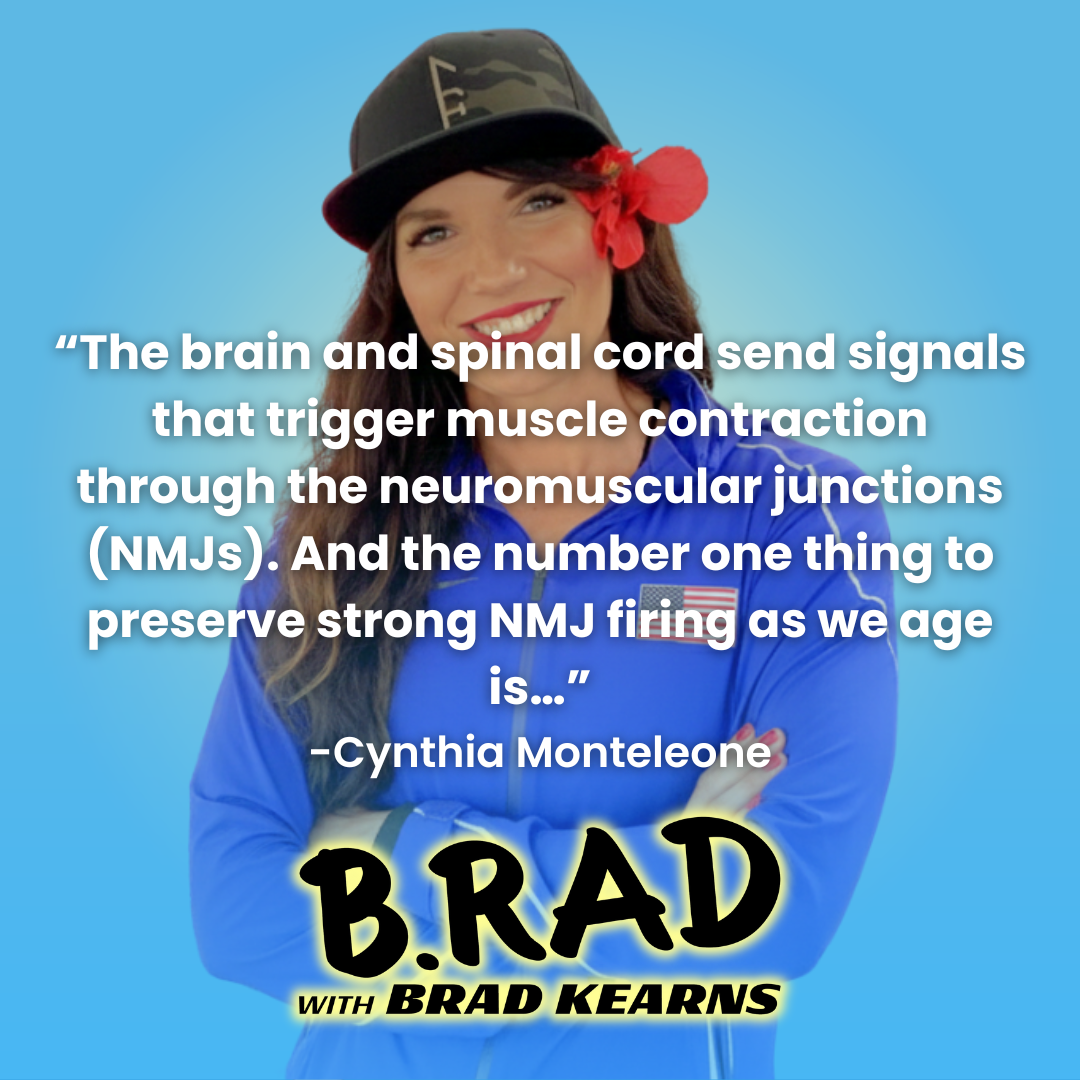
The signal from the brain and the spinal cord goes through these m and js, the neuromuscular junctions, that’s where the nerves tell the muscles to contract. So that’s that junction. So that signal gets interrupted as we get older. But what they’ve found, Brad, is that the number one thing to preserve the njs and that firing is, guess what?
Brad (00:01:14):
Aloha. I am so happy to introduce a great in-person show here in the Sacramento studios of the B.rad podcast with my good friend Cynthia Monteleon, traveling all the way from Hawaii to California for a podcast binge, and she killed it at the Model Health Show down in LA with Shawn Stevenson and the Power Project Show up here in the Sacramento area with Mark and Nsima and Andrew. And we had a great talk in person. So she returns to the podcast, and when you get in person, you really have a chance to go deep. And that’s what we did. So we have a lengthy, wide ranging show on all aspects of health, fitness, peak performance, longevity, especially in Cynthia’s area of expertise, which is kind of being the naysayer and the truth seeker in the health and fitness scene. She’s not afraid to speak the truth, speak it straight, reference her deep research and her experience with elite athletes and talk about some things that are kind of counter to the prevailing opinion.
Brad (00:02:24):
And I love getting into that because it really teaches us to think critically and not take these popular trending insights at face value. One of ’em that comes to mind that we talked about was how everyone’s obsessed with the idea that preserving muscle mass is the key to longevity. It’s the number one thing you can do. You gotta eat a lot of protein and keep your muscle mass. And the insight is scientifically validated, and it’s true, but we have to be a little more specific and talk about the difference between just holding on to muscle mass and the true and most driving catalyst for longevity, which is maintaining muscle power and explosiveness and strength. It is not directly correlated with just having a lot of size. Maybe you see some big people walking around that are carrying muscle, but they’re not very fit. So that’s just one thing.
Brad (00:03:19):
Another one, she’s talking about how not everyone needs or should take creatine. What? She goes, I don’t want to talk about it on your show ’cause you have creatine products. It’s okay. Bring it, bring it girl. So she brought the heat, not afraid to be counter to culture. We spent a little time ripping on Dr. Rhonda Patrick’s viral YouTube video about her super nutrition green smoothie and why consuming high levels of plant toxins can sometimes be a bad thing and what the true dietary centerpieces should be. Spoiler alert, it’s red meat, and that’s how she coaches her athletes to peak performance. She’s a coach of numerous Olympic and world champion Masters level athletes. She’s been a great inspiration to me and a source of knowledge and reason, and I really appreciate her deep thinking and progressive insights about all manner of health and fitness.
Brad (00:04:20):
I think you’re gonna love this, just like if you listen to our other show. She definitely talks about one of our favorite topics here, especially honoring the book Born to Walk, where she describes how jogging can actually make you age faster and cause a decline in the all important anaerobic strength, power, explosiveness, muscle fibers, not so with walking but jogging because it’s on that borderline where you have to recruit what might otherwise be fast twitch muscle fibers and convert them into slow twitch. We get to talking about her mentor that she mentioned so frequently. Charles Poliquin, the strength training legend who passed too early, but he passed on so much knowledge to Cynthia. So it’s great to see her continuing to honor the legacy of all the education and information provided by Charles Poliquin Many more interesting insights and controversial topics. So here we go in the studio with Cynthia Monteleone, follow her at Fast over 40 on Instagram.
Brad (00:05:29):
Check out her new line of healthy natural Skin Cares from Hawaii called Earthen Hawaii. And her website with her information about the metabolic health practitioner services that she offers at MamStrong808.com. Here we go. Cynthia Monteleone, Cynthia Monteleone in person High five coming all the way from Hawaii to the B.rad Studios, Hawaiian style fist bump. Yeah, <laugh>, we got so much to talk about. Thank you for making the trip. You’ve come out here to do a podcast binge. I can’t wait to watch your show on Shawn Stevenson Model Health Show. You got Power Project with Mark Bell and, and Nsima and Andrew, and thanks for making a stop here.
Cynthia (00:06:15):
Of course. I’m so happy to be here in person.
Brad (00:06:18):
<laugh>. As some listeners know, you’ve been a great inspiration for me in my foray into Masters track and field with you having those world titles and also the extensive coaching of other great Masters athletes. We’re gonna definitely talk about that, but I think it’s really interesting how you got into Masters track and field with that gap in the timeline. So you were an` athlete back in the day in college. Let’s talk, talk about your collegiate career and then how 20 years went by and then you, you started throwing down again.
Cynthia (00:06:52):
Yeah. So a lot of people assume that because I ran track in college, I just kept on running and I just was good at track and that’s why I became
Brad (00:07:00):
<crosstalk>. Well, that’s why she beat me in the last race. Yeah.
Cynthia (00:07:02):
<laugh>. Yeah. So, um, but that’s not true. I actually, once I finished college, I was a 400 meter specialist in college of course, but I went to a division one school, UNCW and
Brad (00:07:14):
You know, for North Carolina. Wilmington.
Cynthia (00:07:16):
Wilmington. Yep. And I was all East Coast in the 500 indoor, by the way. But I wasn’t good enough to go on and go to the Olympics or anything like that. And, um, so I thought, okay, well that’s, that’s that. And onto my career and getting married and having kids. And so 20 years went by, as you said, and here I was 40 and my daughter was 11, and she said, mom, I wanna run track in college like you did. And I said, okay, well let’s go out on the track and run a 400 because that’s what I ran. Um, and see how we do. And we went out to the track and we painfully crawled across the finish line in about a minute and 30 seconds. It might have been even been a little bit more
Brad (00:07:58):
Both of you.?
Cynthia (00:07:58):
Both of us.
Brad (00:07:59):
That’s a pretty good time for an 11-year-old.
Cynthia (00:08:01):
Not bad, right?
Brad (00:08:02):
Not bad, yeah. Nor a 40-year-old, uh, retired athlete. Not bad. I mean, not not like you to your standard later, but okay. We had a 90 second completion of the lap that’s, that’s moving for those of you. Yeah.
Cynthia (00:08:14):
And the track coach out there said, oh, well you started out good <laugh> <laugh>. And as, and.
Cynthia (00:08:19):
I was like, thank you.
Brad (00:08:20):
I mean, six minute mile pace. It’s not, it’s not slow. You, you call it slow because you eventually chopped a lot of time off, but you had a a starting point that gave you a little inspiration. Yeah. Starting point.
Cynthia (00:08:31):
And I was, you know, listen, I was like 20 pounds over, we won’t say overweight, but over my normal, maybe 15 to 20 pounds over my normal weight because I had just finished breastfeeding my third child. And I always tell women out there like, don’t be in a rush to,3 you know, to lose that body fat because what happens is our fat, our toxins are stored in our fat, and so you’re actually releasing toxins into the breast milk, so you really don’t wanna lose body fat rapidly, by the way mm-hmm <affirmative>. And so I, but I had just finished breastfeeding, so I was like, okay, all systems go. We’re going to, you know, get in shape and lose body fat and all that. And so we just started training together three times a week. We would run, actually it started out just one time a week for the first few months, and then it increased it three times a week only.
Cynthia (00:09:13):
Um, a lot of people think that I work, I I sprinted every day to become a world champion three years later. But it was really just showing up those three days a week consistently and my daughter with me. And so we trained together. And of course, so at age 43, I became the fastest woman in the world for my age, which I did not see coming. I couldn’t even believe it. I mean, you know, back then at, at age 40, but, uh, and then she ended up running track in college for our first year. So yeah, it was good. She, in the 400 hurdles
Brad (00:09:45):
Oh my gosh. At UNW
Cynthia (00:09:46):
At it turns out.
Brad (00:09:47):
She chose UNCW of all places coming from Hawaii.
Cynthia (00:09:50):
Yep, she did.
Brad (00:09:51):
That’s a long trip away. That’s six time zones wanted,
Cynthia (00:09:53):
She really wanted to be. Um, well, you know, she had established comfort in that track because my parents retired there, so we went every year to visit my parents and do track workouts. So she was familiar with the coaches and familiar with the track, and she really found that to be like a second home. But yeah, so, uh, I think a lot of people think, okay, yes, I did work hard and we can talk about what kind of workouts I did, if you wanted to know, but, um, but really it was just a process of showing up all the time and just being consistent in that sort of thing. Not giving up when it was painful because it was painful. I mean, I remember at one point thinking, wow, it feels like my bones are moving back together after having three kids.
Cynthia (00:10:36):
Mm-hmm <affirmative>. You know, like it was really something. But I remember like my first year, this coach from a neighboring school said, I think you could be a world champion. And I was not running that fast. I was running, I think my, I ran a 200 in a local meet at that point, and I ran like 29 mm-hmm <affirmative>. Or something like that. And, um, he said, I think you can be a world champion. And I said, yeah, right. And then he, I said, all right, well if you believe it, I believe it. And then he started coaching me and he was right, <laugh>. So,
Brad (00:11:09):
I mean, that’s a really fast progression from get getting out there knocking the, the dust off. You think so? And going a minute and a half down to, what did you win the world title in? Well,
Cynthia (00:11:21):
I was indoor, which if you know, track indoor is slower. Um, so it was a 58.1 <laugh>, which translated, turns out outdoor that season to a 57.4 mm-hmm <affirmative>. But a lot of people might, if you know, track out there, you might say, well, 57, you know, second 400 is not like, you know, the, you, you wouldn’t, that wouldn’t be very competitive in division one athletics in college now.
Brad (00:11:45):
Yeah. But you’re 43 years old. What? What? Right. Who says that? I mean,
Cynthia (00:11:48):
Well, I’ve, I’ve heard People
Brad (00:11:48):
What kind of idiot says that
Cynthia (00:11:50):
One Master’s track guy once was like, oh, are you just slow in college? When I said, ’cause I forgot to mention Brad, I ran that 58 1 that was faster than my indoor 400 college time uhhuh. And so I said, well, I wasn’t slow in college, but that was my genetic potential. But I’m running against women who ran 51 to 53 in college. So they’re now running slower than 50. Yeah. Eight. Yeah. They’re running 59, 60, 63. And they used to run 51 to 53. Yeah. So I’m running past my genetic potential by running faster than I did in college.
Brad (00:12:23):
That’s a good feeling. I could, I I know what you mean with, with high jump. I was so bad in high school that I couldn’t compete for the team. I was a distance runner.
Cynthia (00:12:31):
Oh, okay.
Brad (00:12:31):
My height was five feet in high school, which is good for a girl. And so I would practice with the girls ’cause we would have the same bar height, but I never competed in a meet until Masters track and field. And I noticed a guy on the national rankings who was jumping a little higher than me, like maybe he was five three and I was five one or five two. And um, I remember him from the state meet. He was like a six foot eight high school guy. Oh my gosh. So
Cynthia (00:12:54):
He wasn’t even choose to his
Brad (00:12:54):
He’s still doing great in the fifties. Right. And, um, so am I I’m better than I was in high school, which is not saying much, but, um, anyway, he
Cynthia (00:13:04):
Is saying much. That’s my point, Brad. It’s like, if you can come close to what you did in college in your forties and beyond, or, you know, within a certain percentage, I would say, like, that is, you’re a superhero. Because, uh, we talked a little bit about this before the podcast, but we talked about how I’m kind of in this bubble where a lot of people around me are very healthy, and I just don’t see standard American diet and things like that in my little bubble circle in Hawaii. But I, it’s like, I can’t believe how many people are out there that aren’t reaching their genetic potential or their, or we’ll say, epigenetics, right? Because I learned how to turn my genes on and off in order to surpass what I was in my twenties through food and supplements and protocols. So like, what is the potential for all these people out there that are listening or other people who don’t even listen to wellness podcasts? What are, they’re losing out on so much of what they could be in their life by not choosing things that are gonna impact their genetics. Well, does that make sense?
Brad (00:14:07):
Oh my gosh. That you just described. I mean, this is the state of affairs in United States, especially any country you can mention, but we’re ranked 36th in longevity, despite being the most advanced and having the, the most sophisticated medical care we’re, we’re like below, you know, Costa Rica and some underdeveloped countries. <laugh>. Yeah. But like, it’s so normal to disregard our genetic expectations for health and engage in these modern lifestyle practices like eating too much processed food and not exercising enough that now the normal aging curve is what we all see around us. And so it seems normal. Like you just get a bigger and bigger spare tire every, every 10 years as a male especially, or you take more and more medications. I, I saw an article that said like, medications, um, the average American takes 12 medications, or I think it was 12 or 17 or some unbelievable thing. Gosh,
Cynthia (00:15:02):
At what age? Just average.
Brad (00:15:03):
Average. And so like, period, the average if I’m on zero or one or whatever, the person, that means someone else is taking 24 to make that average. I mean, true. It’s, it’s pretty rough to see. But I’m glad we’re on this topic because, what I see in Masters track and field are these outliers. But it’s like, no, this is what’s possible. And there’s so few people doing it. And I, I joke with people like, well that’s great. You, you went to the meet and you got second in the high jump in the nationals. Yeah. Yeah. And I said, by the way, you would’ve got fifth if you showed up and cleared a bar at the lowest height because there was only five people. Right, right, right. Yeah. The, the people at top, like, you are so impressive and just mind blowing. Thank you. And then who’s eighth in, uh, in the, in the world in your division? It’s someone who uh, got a ride there from their cousin and, and said, I’ll, I’ll sign up. Yeah, yeah. But it’s not, it’s not deep world you national. Right. Or or typical meet. Yeah. Like, you know,
Cynthia (00:15:58):
A local meet. I have to be like, I have gold medal for my regional,
Brad (00:16:01):
No, no. I go out there to the track meets and there’s four guys in the, in eight lanes. I’m like, oh. Right. Yeah. Well, where, where’s the other 60-year-old male, 400 meter contestants. Yeah. Well, why aren’t they here?
Cynthia (00:16:12):
But we wanna get more of people showing up for those. Yeah. Because like Yeah,
Brad (00:16:15):
But I mean, in terms of high jump, like it takes so much just to get out there and to be able to warm up and compete. Yeah. Because the injuries and the impact trauma and all that. So like, I celebrate anybody who’s able to participate. I love that Um, yeah. My, my friend Dave just finished the High Rocks Okay. In an hour 23. And he was hoping for faster whatever. I’m like the fact that you could finish that at 64. Yeah.
Cynthia (00:16:41):
What do you think about, about
Brad (00:16:43):
Iraq? What’s, talk about what ever time, um, let’s I up
Cynthia (00:16:46):
Those of you.
Brad (00:16:46):
Uh,
Cynthia (00:16:47):
I have a client, a new client who is Yeah.
Brad (00:16:49):
Describe what it is too. Yeah.
Cynthia (00:16:50):
Wants to win the High Rocks Championship. Yeah. She, and she’s 49 and she’s, she’s pretty fit actually. She’s to be a distance runner, but she’s finding that she’s actually increasing her power as age, which we, I would love to talk to you about too. But, um, so she explained it to me ’cause I wasn’t that familiar where you run a thousand meters and then you do a station four times and they’re like explosive stations. Like when burpees slash something, I don’t know. Yeah,
Brad (00:17:15):
Yeah. You, you do burpees for a certain number of meters. It’s just amazingly hard. Yeah.
Cynthia (00:17:21):
Yeah. So what do you think about that?
Brad (00:17:23):
I am fascinated by the exploits of the, today’s so-called hybrid athlete. Hybrid. It is so amazing. Is that a
Cynthia (00:17:31):
Classifying as hybrid? I
Brad (00:17:32):
Think so, yeah. Yeah. I mean, ’cause you need the endurance. Yeah. Because same with like a CrossFit I would say
Cynthia (00:17:36):
Too. But unlike CrossFit, High Rocks doesn’t change. So you can actually train for those stations and train for those,
Brad (00:17:41):
Which I, I would say is a plus, especially when dudes drown in the, in the, in the water and in the CrossFit games world championship. And that’s hard, hard. They, they make surprise challenges like swimming at the end of a a, a hard, challenging competition. It’s absolutely stupid and insane. But, uh, High Rock seems to have this template where you can practice for it, you know what to expect. And then you can look at your time. But the challenges, what’d you call ’em? Stations Yeah. Are stations, yeah. Are extremely grueling, requiring explosiveness, fast twitch fast. Like one of them is you push the sled with a ton of weight on it for I think 50 meters or a hundred meters. But then you finish this thing where your muscles are just torched and then you have to go run another K. Yeah. And then another K and another K. So it’s extreme endurance and power.
Cynthia (00:18:27):
Yeah. So, I don’t know. I wish it were not a K. I Wish it were like a hundred meters. Yeah. I mean, that’s the only thing is because then she’s gonna have to, she has to tap into the endurance training. Yeah. Yeah. World a little. Yeah. Too much for my taste for longevity, I’d say.
Brad (00:18:40):
I agree. Yeah.
Cynthia (00:18:41):
But, um, it was, it’s fun to work with her because it’s something new for me to write programs for. ’cause I’m helping her with the track part of it. Yeah. ’cause those High Rocks coaches do not know that thousand meter track part. Mm-hmm <affirmative>. In my experience. I’m sure there are some out there that do. Yeah. But, um, but whatever. Yeah. So it’s, it’s fun. So, uh, they’re saying we had
Brad (00:19:00):
Off topic, you know, Chris Hinshaw, his thing is called, um, aerobic. Aerobic Aerobic Conditioning is his, is the name of his brand. Okay. He’s coached a lot of CrossFit world champions building their endurance. Right. Because these CrossFit people are rip city in the gym and they’re good at Olympic lifting, handstand pushups, but the CrossFit games and the competition Yeah. Last for a fricking hour or something. Oh yeah. That’s, so he got them to build their aerobic base so that they can thrive more Yeah. On these long duration workouts and competition. So ev everyone, every athlete needs an endurance base, but as we talked about the last, at the last show and the book Born to Walk.
Cynthia (00:19:41):
Yeah. I love this
Brad (00:19:41):
Book. Like the endurance base. Wait,
Cynthia (00:19:42):
I have
Brad (00:19:43):
From have my pva Oh yeah. Plug for the Peluvas <laugh>. Um, we can build endurance from walking around. Yeah. Right. Oh, you don’t need to, to push ourselves and sweat and huff and puff, like talk about
Cynthia (00:19:54):
About that for a second. Yeah, yeah, yeah. But we have a lot to talk about. But walking versus jogging. Okay. So what’s happening is that if you’re jogging, you’re actually preserving slow twitch muscle fibers, which we is terrible for aging because we already lose fast twitch muscle fibers and they get converted to slow twitch. So
Brad (00:20:15):
They get converted anyway. They get converted and now we’re doing further conversion is what you’re saying. Yes.
Cynthia (00:20:20):
You’re training your body to say, go slow and <laugh>, and
Brad (00:20:24):
Literally Yeah.
Cynthia (00:20:26):
Go slow. And this is important. I’ll talk about why it’s important for a second. Remind me neural output. But, um, when you walk, you don’t, it’s not the same process. You’re under the threshold for teaching your body to preserve slow twitch. So you’re not, you’re not making fast twitch like would be with sprinting or explosive work, but you’re also not changing it to slow twitch. Does that make sense? Yeah. We have
Brad (00:20:49):
These, so walking is great. Yeah. We have the type two A and the type two B fast twitch muscle fibers. The quick insight is like, yeah, we have fast twitch muscle fibers Yeah. That can be used for endurance when needed. Right.
Cynthia (00:21:02):
So they can convert and so
Brad (00:21:03):
They can actually, if you keep training with endurance Yes. You can convert the composition of your muscle fiber Yes. To more endurance oriented. Right. Endurance athletes and guys in the tour love that because they, they, they’re, they’re doing extreme endurance. Uhhuh <affirmative>. But you may make a good point with aging. Yeah. It’s not that hard to maintain a decent level of aerobic conditioning such that you have maximum longevity potential. The, the research from, um, cited by, Dr. James O’Keefe, the, uh, run for your life, but not too far and at a slow pace, is his TED talk that has millions of views. He says, look, in two and a half hours a week, you can basically get an A plus in aerobic conditioning with just basic walking, fundamental walking. Yeah. Do doing one. I love that bike at the gym or whatever. Yeah. But then we’re hugely deficient on your area of expertise, which we’re gonna focus on in the show is like, look, I I see a lot of, especially seniors and people who aren’t inclined to do explosive, powerful exercise. They, they’re good. They do their walking around the park every day, or they put in their steps or whatever the explosive, but they have zero explosive, fast twitch. And so if the fast twitch is lost at a greater and quicker rate as we age, that’s the rationale for not jogging.
Cynthia (00:22:17):
That’s where I am in the area of expertise in the science on this. And that is that. So not only it’s, it’s called dynapenia and sarcopenia. Right? So right now you’ll see in the wellness communities and out there, like everybody’s pushing protein and muscle mass. I don’t know. It feels like that to me. Yeah.
Brad (00:22:34):
To you. The hot new the hot new thing.
Cynthia (00:22:36):
Even the Kardashians have a protein popcorn, which,
Brad (00:22:39):
Who’s that? Kardashians. Who’s
Cynthia (00:22:41):
That? Who’s the Kardashians? Is
Brad (00:22:42):
That a coach or an athlete or, yeah, yeah. Oh, oh, it’s a cultural phenomenon. I forgot.
Cynthia (00:22:47):
No, it’s, there’s nobody that important. Probably. Yeah. <laugh>. But what I’m saying is that the point is that it’s so mainstream. Yeah. That they’re like, oh, we’re gonna make a protein popcorn. And I don’t even know it’s in it. I wouldn’t go near it, but it’s probably got plant protein, which is not the best quality protein that you can intake. But everybody, the point is,
Brad (00:23:05):
Why are you being so nice today? Everybody? Why don’t you tell us what you think about plant nasty, disgusting plant-based protein.
Cynthia (00:23:10):
Charles used to say, my mentor Charles Poliquin, we’re gonna
Brad (00:23:13):
Talk about him shortly too.
Cynthia (00:23:14):
He used to say, it’s not worth the cardboard box that came in. You’re better off eating the cardboard. That was one of his lines. He had, um, anyway, so yeah, no plant protein for, you know, optimal performance and longevity, but I digress. So protein and muscle mass is what’s being pushed right now. And you know, hey, rightly so, we do lose muscle mass as we get older, but what scientists and researchers are finding out right now is we’re not losing muscle mass because we can’t generate muscle mass. We’re losing muscle mass because we’re missing the neural output. So what’s happening is that our nerves fire to contract our muscles. So as we get older, our nerves fire less and the firing our nerves get converted to other nerves. I’ll explain that in a second. And it slows us down. So then we’re not as powerful and we can’t contract that muscle as fast and well.
Cynthia (00:24:05):
So that’s how we lose the muscle and the power mm-hmm <affirmative>. So it, they think, they don’t think it’s actually the physical building of the muscle. Mm-hmm <affirmative>. They think it’s the fir the neurological firing of it that’s keeping us from being strong as we get older.
Brad (00:24:18):
Makes sense.
Cynthia (00:24:19):
So what they found out is, this is a good analogy. So think about when we’re young, you are wired with fiber optics, right? And you’re, everything’s high speed internet, high speed. So like, you know, you can game live and as soon as you press that button, that character’s doing whatever you want to do. So you, your brain and your spinal cord both are telling your muscles to contract and it’s saying, go, go, go. And when we’re younger, they go mm-hmm <affirmative>. They go fast and they go as soon as we tell it to, Hmm. As we get older, we become more like dial up.
Cynthia (00:24:51):
Okay. The signal from the brain and the spinal cord goes through these M and Js, the neuromuscular junctions, that’s where the nerves tell the muscles to contract. So that’s that junction. So that signal gets interrupted as we get older. But what they’ve found, Brad, is that the number one thing to preserve the M and Js and that firing is, guess what? Sprinting, it’s at the top of the pyramid. Mm-hmm <affirmative>. Of exercises that will preserve that power. So then that means not only are you preserving your muscle power, which is, I’m sorry, it’s more important than how big the muscle is because you could have
Brad (00:25:31):
Two different things
Cynthia (00:25:32):
Hypertrophy, right. All show no go. Yeah. Girls would say, yeah. You can have that and not have the proper power to execute what you wanna do. So I think all these wellness influencers or whatever they’re saying, muscle mass is the key to longevity. Yeah. I, I don’t think so. I think it’s the muscle power. It’s the
Brad (00:25:50):
Oversimplification. Yes.
Cynthia (00:25:52):
It’s the muscle power. So yeah. So sprinting and then followed by things that coordinate explosiveness with the whole body. So not explosiveness with just the upper body, it has to coordinate the whole body. Mm-hmm <affirmative>. So, um, things like jumping rope maybe, rowing or assault bike. Mm-hmm <affirmative>. You’re doing it. You know, so Yeah. I’ve
Brad (00:26:14):
Been obviously sprinting you’re using your arms in a very powerful maker. So
Cynthia (00:26:18):
Yes, you’re, but you have to coordinate the whole system Yeah. At a, at a high demand. And that’s the key to preserving this neurological firing. And they’re finding that the, the best longevity, quality, longevity comes from that’s preserving this neural output.
Brad (00:26:34):
That’s something you heard here first from Cynthia <laugh>. Thank you very much because You’re welcome. That we’re, we’re totally obsessed with
Cynthia (00:26:41):
Kind of what I, what I wanted the message I wanna get out on this podcast tour is that Yeah. It matters. The power matters more than the muscle size.
Brad (00:26:50):
Yeah. And I, I think if we challenge the main promoters of this who have the, the, the, the big following, um, they would certainly agree, and they would probably say that we’re just kind of short cutting to, to, to slam this basic inside, especially on people who are growing old and frail and getting smaller. Mm-hmm <affirmative>. It’s like, yeah, you gotta keep your muscle on your body Yeah. And all that. Yes. But I think it’s important to distinguish between growing a muscle and getting it big. ’cause most people look at people in the gym with giant muscles, right. And they think they’re super strong. Right. Which they are by comparison. But then go watch some video of the Olympics in the a hundred meter final. Yeah. And some of those guys, Trayvon ve is 5′ 9″ 155, he’s one of the fastest humans of all time. He’s not a large person. He does not have large muscles mm-hmm <affirmative>. But it’s all about the explosiveness, the power, the ability to fire quickly. Um, so muscle mass is definitely a good thing as we age. Right. But if you’re just doing slow bicep curls and thinking that, you know, if you keep your bicep at 12 inches, that’s you, you your dial. Talk about slow big difference.
Cynthia (00:27:54):
Let’s talk about slow. So, you know, my mentor was Charles and, uh, Charles
Brad (00:27:58):
Poliquin for the transcriber, which also has to be my mom having to go and look up these. Thank you. These quick names. P-O-L-I-Q-U-I-N. Give us a quick bio of him and then talk about your relationship and then the insight that you’re gonna share about Charles.
Cynthia (00:28:12):
You know, long story short, a legend in the strength and conditioning world especially, but he started out, I think he for years wrote for Muscle and fitness, uh, a column. And, um, just trained so many Olympic and world champions in so many, like 36 different sports. I believe. So, um, a genius. He spoke 12 languages, and so he was able to read research in other languages that never got translated into English. So a lot of people will be like, well, how did he find this research? We can’t find it, or something like that. And it’s because it’s in Russian or something like this, you know? So, um, he was, everyone who knows Charles’s work knows he was like 20 to 30 years ahead of the research. And even he has a story he tells about, or he used to tell about, um, this doctor who yelled at him about, there’s no research for high dose fish oil, and how could you recommend high dose fish oil?
Cynthia (00:29:04):
And he said, if I waited for the research, I would’ve missed, you know, 18 Olympics or something mm-hmm. Like that mm-hmm <affirmative>. If I didn’t give my clients the advice for, to win those Olympics mm-hmm <affirmative>. Anyway, so, uh, it turns out years, of course, like literally 25 years later, the research comes out that up to 60 grams a day is actually safe of fish oil, which if you take a one pill capsule is 1000, like one like pill 60 pills a day. But this is for, this would be for like a morbidly obese person. Yeah. Not for the average person. Um, but anyway, so yeah, Charles was really ahead of his time and, um, I was, you know, blessed to be able to learn from him. Um, but, uh, what was I saying about he
Brad (00:29:43):
Passed early? Yeah.
Cynthia (00:29:44):
But before that, yeah. I was saying something about Charles,
Brad (00:29:47):
Uh, about firing of that. About
Cynthia (00:29:48):
Yeah. Slow. So one of the things that he pointed out that a lot of people don’t understand is that when you do slow eccentrics, so not slow, you know, concentric, you were saying bicep curls, but on certain muscle groups, especially if you do do slow eccentrics, particularly a Romanian deadlift, let’s say you’re doing a six second eccentric, that
Brad (00:30:09):
Actually eccentric is the lowering of the weight, if you’re not familiar with that term. Yeah. So the bicep curls going up and contracting the muscle and then lowering it back down, would it be the eccentric portion of the lift? Yeah. Yes.
Cynthia (00:30:21):
So, um, in when you’re doing the eccentric, you’re actually recruiting more muscle fibers, including fast twitch shoot. So you’re going slow, but you’re actually recruiting more fast twitch fibers mm-hmm <affirmative>. Which people don’t really realize. They think I have to move the bar or move the weight fast in order to train explosiveness. Mm-hmm <affirmative>. This is actually not true. Another thing he used to say is it’s the neurological firing of the intent to move the bar. Mm. So if you have a heavy bench press and you’re trying to explode, but it’s heavy in the box not moving,
Brad (00:30:54):
You’re not really Yeah.
Cynthia (00:30:55):
Then you actually are training that neurological explosion better than if you were moving the fast bar fast.
Brad (00:31:02):
Does that count for my sprint workouts where my times aren’t that impressive, but I think I’m running really fast and I’m, my intent is to fly around the track like an Olympian, actually. Yeah,
Cynthia (00:31:11):
Yeah. Yeah. And you know what, the difference between that 29 second 200 and my PR Master’s PR at 26.0 was, um, this, I had the same intent in both of those races. I just was a little bit stronger and had, was metabolically more prepared by the time I, you know, got to the 26.0 mm-hmm <affirmative>. Uhhuh <affirmative>. So, um, yeah. So I’m just saying like, that intent matters, that explosive intent. So it has to be an explosive intent though. Um, but it doesn’t mean that if you move the bar slow that you are not recruiting fast twitch fibers. Yeah, yeah. Or neurological input.
Brad (00:31:47):
It’s sort of like you’re trying your hardest Yeah. As an explosive intent. You gotta get the bar off the ground. Yeah. And so it’s, yeah. Dead lifted. It’s a fast moving brain, I guess you would say. Yep. Yeah. Um, that quote
Cynthia (00:31:58):
From, there’s, there’s another interesting exercise, which I thought was, it was a little surprising to me, but medicine ball throws overhead backwards and, and rotational Yeah. Are close to the top of the pyramid. Uhhuh <affirmative> for Wow. This neurological output.
Brad (00:32:14):
Those are pretty safe for most people. Yeah. Yeah. Uh, and when you say sprinting, yeah, we have, our preference would be sprinting on flat ground for bone density, fat reduction signaling, but those people who aren’t adapted, you can certainly go on a continuum of doing low or no impact sprints and get similar benefits.
Cynthia (00:32:36):
Yes. Um, so, well, we don’t want anyone out there to just start sprinting <laugh> tomorrow as fast as they can and pull a hamstring. So we wanna have a preparation of strength first. So I trained my 82-year-old dad to sprint last year, and he joined me at the World Championships in a 200. It was such a just wonderful moments in, in a memory that I’ll have forever, you know? But of course I can’t tell my 82-year-old dad just go out there and run as fast as you can on the track. Mm-hmm <affirmative>. So what we did do is first we did a lot of pelican, uh, things I learned as a strength coach from him to prepare, uh, VMO work. So Poliquin, step ups, um, do you know about those? They’re like you, you raise the he, uh, heel of the working leg and then your other leg goes down.
Cynthia (00:33:26):
So say my right heel is raised on like a wedge board, or you can stack plates if you need to. Yeah. And then your other foot, the, my left foot, the heel is in line with my toe, and then I lower gradually. And then my right foot that’s raised on the slant board, I’m targeting the little muscle right above my knee. It’s called the VMO bass, mid part of the quad that really prepares you for sprinting, it helps stabilize all of your attendance and everything in your knee because it’s doing most of the work.
Brad (00:33:59):
Yeah. You can see this on YouTube. Yeah. There’s people demonstrating that. And my physical therapist had me do that. I didn’t, I mean, whatever you, you terminology it Right. That’s great. Middle. Yeah. Uh, but
Cynthia (00:34:07):
He did a lot of those
Brad (00:34:08):
Body control mm-hmm. Exercises and get ready.
Cynthia (00:34:12):
Yeah. Yes. And you could even see, like, I have a slowmo I like to share of him sprinting. And he’s, you know, you see it popping and I’m like so proud. Oh my gosh. How many months did he do that? Probably about eight months. Wow. Before he even really started running. Wow. He’s doing that. He did, um, shoulder presses, but with eccentric he did. People think sprinting’s all lower body, but it’s a lot of upper body. Yeah. The bicep curls. Um, not a whole lot. He did a little bit of squatting to the chair and, uh, so things that really prepared him, but again, like slow eccentric so that he could recruit those fast fibers safely. A lot of people think you need to do explosive Olympic lifts and that sort of thing. And, and you know, I can tell you my strength coach had me doing zero Olympic lifts between 40 and 43 mm-hmm <affirmative>. Because I was just getting back into shape. Yeah. And that sort of thing. He added them in a little bit later, but, um, I didn’t need to be doing that for explosiveness. Yeah.
Brad (00:35:06):
Olympic lifts are right. The
Cynthia (00:35:08):
Clean and pull, clean, uh,
Brad (00:35:11):
Events. They compete in the Olympics and they require a ton of technique mm-hmm <affirmative>. And they’re very difficult to, um, execute. It takes a while. Right.
Cynthia (00:35:21):
Difficult because you need to have perfect form or else you’re gonna get injured. Right. Yeah. So a lot of people, that’s the, the injury risk outweighs the benefit. Yeah. Because unless you’re doing them well then Yeah. You know, you really shouldn’t be doing them. Yeah. To be honest. So strength training to prepare. And then he started walking up the hill in his driveway. He had a long driveway hill. So he did that. And then eventually he started jogging up. So this walking and jogging up a hill is a safe way to start because you’re not gonna be able to go full speed and your foot’s gonna be pushed into dorsi flexion. Mm-hmm <affirmative>. And all of those tendons and muscles are gonna start to get conditioned for when you do sprint flat. Mm-hmm <affirmative>. And then I like to have my clients move to grass after that, so it’s not hard on their shins and that sort of thing mm-hmm <affirmative>. But already their shins should have gotten strong from that form, and then they move to the track after that. So he actually would do the tracks up once, once a week, and then those other days he’d do the hills or he’d walk around his neighborhood. He liked to walk <laugh> and then just do sprints in between. Yeah.
Brad (00:36:25):
So, I mean, anyone listening, watching who realizes that might be a, a bit of a void in their fitness program. They have a commitment to fitness of some sort. They, they play a sport or they get their time in the gym. You can integrate sprinting safely by doing some preparatory exercises and then using the quote resistance like a hill or mm-hmm <affirmative>. I like pushing the sled when I’m dealing with my little injuries. ’cause you finish and you’re completely outta breath, like you just sprinted. So maybe that’s one of the checkpoints we could go for is like, something that’s challenging, right? Yeah.
Cynthia (00:36:59):
Yep. For sure. Now, if you’re an advanced sprinter, if you’re out there listening and you’re advanced sprinter like yourself or someone like me and you’re training in doing hills and doing sled pushes, it’s important at some point closer to your season to follow that resistance with flat work that’s fast, or light sled pushes. So say you’re doing like, uh, four 30 meter sled pushes as hard as you can heavy. Then you wanna actually take all the weight off and then do four really fast with no weight or lightweight. Because then that actually helps your neuro neuromuscular firing to remember that it still can be fast mm-hmm <affirmative>. So you don’t want it to sort of imprint that slow. Does that make sense? Oh yeah. That slow rhythm. Yeah. Because our bodies remember the rhythm through our nervous system. So we don’t wanna remember that slow rhythm.
Cynthia (00:37:55):
We wanna, so my coach would have us do these long hills, they were about 110 meters. We would do about eight of ’em and we’d either have to shuffle, jog back down. Ooh, brutal. Or we could walk fast. Yeah. That was like the good days where we could walk fast. And, if we tried to guess how many we were gonna do, like, usually it was eight, but like one day we were like, okay, there’s only two more. He heard us say that and forget it. We had 12 that <laugh> because he did not like that. We guessed that, you know, we were trying to guess the workout as, anyway. So we would do these hills and then he’d have us go to the track and run in flats, um, a 30 second, 200
Brad (00:38:31):
Rest to finish off. Yeah.
Cynthia (00:38:32):
A minute to three minutes depending on the day and try to do it again sometimes. So sometimes we’d have to run a 30 second in flats, 200 wait a minute, and then run another 30. That’s a lot of rest. It’s brutal. But it, what it did is it trained us to not get stuck in that pattern. Mm-hmm. But if it, if it’s like off season or pre-season or sometime around the, you know, months away from your competition season, then it’s okay to just do that resistance
Brad (00:38:58):
Work, I think related. I want to ask you what you think the, I I was talking to the track coach at, uh, university of Redlands, my friend Tommy Whitmore’s colleague there. And, he was saying that after the track workout, he just has his athletes walk. Yeah. My to cool down instead of jaw. My god, my ’cause he doesn’t want them jogging my after the workout. Yes. I’m like, wow, that’s brilliant. I’ve never heard of that. Yeah.
Cynthia (00:39:22):
I, Always have.
Brad (00:39:22):
You just ran fast the whole workout. Yeah. Now you’re gonna teach your brain to run slow. I’m like, okay, now I just walk it off. He’s great every time. Yeah. Thank God. Yeah. You also got me to completely quit jogging in my life. Yes. Mm-hmm <affirmative>. No jogging up. So
Cynthia (00:39:36):
I do like how many times you see sprinters, their coach makes them jog a 400 meter warmup, 800
Brad (00:39:41):
Meters. You know, I, I don’t know about the Olympic guys, but certainly the high school kids who knows what they’re doing. They’re just having fun. But, now I do walking and, uh, drills and walk recovery in between the drills. Yeah.
Cynthia (00:39:53):
Or skipping is good.
Brad (00:39:55):
All the skipping drills, all the, all the running drills Yeah. Mean
Cynthia (00:39:57):
Instead walking back from your drill, you could just light skip Yeah.
Brad (00:40:00):
Something. Yeah. Mm-hmm.
Cynthia (00:40:01):
Yeah. Something that’s not jogging.
Brad (00:40:03):
So I guess back on the jogging theme, because many of the fitness enthusiasts that I associate with people that really have a, there, there’s a huge swath of society on the 36th ranked country that they need to get off their butts and do anything. And I’m not even gonna critique what you’re doing if you just take off and run down the street. That’s fine for now, you know, get moving. Yeah. But then a lot of people who are gym members, they go this many days a week or they put in their miles and they, they’re jogging their way to the next 10 K that they enter, or even worse, half marathon or marathon. Right.
Cynthia (00:40:38):
Or Ultra Marathon.
Brad (00:40:39):
Yeah. Yeah. I mean ultra marathon could be I think, more healthier in many ways than what the half and the full marathon research because they’re so slow. Nope. Not quite. They’re so slow that it’s like walking
Cynthia (00:40:51):
Detrimental to health markers. It’s what? Detrimental to health markers.
Brad (00:40:54):
Yeah. I mean, it depends how fast you’re going. And I think if you’re going to trek across the big island of Hawaii in nine days of hiking 20 miles a day, it’s not as health destructive as huffing and puffing and running in a running group.
Cynthia (00:41:09):
Maybe the ultra marathoners that are walking,
Brad (00:41:11):
They’re so slow that they’re, yeah. Yeah. Well, I mean, if they’re, if they’re trying to train for a 50 mile run, not, not the leaders who are extreme athletes, whatever they’re doing, but the longer you spend out there and the slower you go, the less destructive to your health than the chronic cardiac.
Cynthia (00:41:28):
But If you’re trying to use your elastic force, you’re still training, you’re still above that threshold of walking. That’s what the research says. And
Brad (00:41:37):
The impact too. The impact, yeah. The impact of jogging Yes. Is correct. A lot bigger than walking. Yeah. And you’re not even that much faster. Right? Yeah. Yeah.
Cynthia (00:41:45):
So yeah, I would say unless they’re actually walking, it’s still gonna be detrimental to their health. Yeah. But yeah. So, but yeah, jogging even in the cool down, I saw Matthew Boling post mm-hmm. Last year that, um, he’s, these are Olympic,
Brad (00:42:01):
He’s Olympics sprinter for USA. Yeah,
Cynthia (00:42:02):
Yeah. Uh, tremendous talent. Yeah. And so I saw him posting his cool down, which was dynamic, and I said, thank God somebody’s doing a dynamic. Cool. Mm. Because
Brad (00:42:13):
I don’t dynamic meaning what in his,
Cynthia (00:42:15):
You know, he’s like doing some kind of like little drills Yeah, yeah. To pull down. Yeah. And so for instance, like I have my athletes and myself instead of jogging, we would do duck walks mm-hmm <affirmative>. And, and um, you know, like toe walks mm-hmm <affirmative>. And maybe just 50 meters four times. And that was pretty much it. Mm-hmm <affirmative>. For our dynamic Cool down. Um, because if you like, not only just teaching your body the jogging, but I do feel that stretching is still pulling the rubber band too thin. So I don’t, I’m you’re against jogging at any point. I’m against static stretch stretching at any point.
Brad (00:42:51):
Even after the workout.
Cynthia (00:42:52):
Especially after the workout. Oh. Especially before if you’re trying to keep explosiveness. Yeah. But especially after, if you’re trying to prevent injury. Yeah. So one of the key things that I see makes a difference in my clients that I coach is that if they stretch static stretch after the workout, when they stop doing that, their injuries, their little nagging injuries go away. Ah. Yeah. So the stretching after the workout just keeps, if you think about your muscles, like that rubber band, you just fatigue them and now you’re stretching them super thin. Like, we don’t want that thin, we want it strong. Right. We want it strong and explosive. Always. You don’t wanna stretch it thin. So, so you can do mobility, but keep moving as long as you keep
Brad (00:43:32):
It moving. Dynamic stretching, mobility
Cynthia (00:43:34):
Exercises. I even have a yoga flow in my warmup uhhuh.
Brad (00:43:36):
Oh yeah. I’ve seen it on YouTube. Right. I’m not holding The whole thing is you’re showing there in the high school stadium. Yeah. Yeah. Um, so in general, you’re coming out saying that all manner of dynamic stretching is ill-advised
Cynthia (00:43:49):
No. All manner of dynamic stretching is good, but all manner are static. I’m sorry,
Brad (00:43:53):
Static all manner static stretching is ill-advised
Cynthia (00:43:56):
In my opinion. Yeah. So,
Brad (00:43:57):
So like, um, maybe this is a transition, I don’t know, but like, we’re getting to this point where like the pillars of fitness for decades, you’re gonna systematically take down a lot of them jogging of course. And, and, uh, endurance training, especially as you get older, is more and more destructive because of the conversion of the the fast twitch fibers to slow twitch. Right. And also the, all the stuff we talked about in the other podcast about born to walk, where, um, it’s just too stressful for most people. They shouldn’t be jogging ’cause it’s the heart rate’s too high in the impact load. Mm-hmm <affirmative>. Okay. So we, we took care of that one. Yeah. And now stretching, again, when I talk to most people, yeah. I like to go in the gym. I get my stretching in or I, I I stretch every morning and thinking we’re, we’re doing a solid, but let’s describe further why that’s, that’s bad for the muscles. You talk about the rubber band being stretched too, too many times or too, too far. Yeah.
Cynthia (00:44:52):
And you’re not gonna maintain your explosiveness because you need that power. Right. So if you think about, if you’re stretching that rubber band, it’s not gonna snap back as well. If it’s stretched out too thin, you want it to snap back.
Brad (00:45:03):
So when I say on YouTube Yeah. Or even live attending like an elite track and field competition, you see these, these elites spending a lot of time in a stretch type of situation. What do you have to say about that?
Cynthia (00:45:16):
Not the elites I work with or I’ve seen. Right. They do not do that. So I guess
Brad (00:45:21):
Yeah. They’re doing, uh, quite a lot of dynamic stuff. Yeah. They, they’re
Cynthia (00:45:25):
Doing all the ones I’ve seen. Maybe good ones Yeah. Are not sitting there just stretching out on right before their race.
Brad (00:45:31):
Yeah. There’s a subtle difference between doing this Yes. Five times uhhuh if you, if you’re not watching the sink, or like they’re, I’m just pulling my leg up toward my head or with the band Yeah.
Cynthia (00:45:41):
They’re moving it. Yeah. They’re not bouncing it, but they’re moving it up and down. Yeah. And they’re not just holding in my experience, maybe there are some out there and maybe, you know what, they’d run a heck of a lot faster if they stopped doing that. So this, and how dare I say that, but I do, I work with the top Olympians in the world Yeah. In track and fields. And, I know the coaches of the other top sprinters, and so I pick their brains all the time mm-hmm <affirmative>. And I just, you know.
Brad (00:46:09):
Yeah.
Cynthia (00:46:09):
I mean, I dare say that because that’s my world
Brad (00:46:12):
<laugh>. That that’s also what you’re all about, I think is, you know, you’re, you’re the resident skeptic and true seeker. And I think you’re honoring Charles in that way. Thank you. Because like his quote, um, he’s 20 years ahead of the research. And another one of my guests, I think it was Dr. Doug McGuff, he said, look, um, all this stuff we’re talking about, I think he was talking about the general ancestral diet and mm-hmm <affirmative>. And breakthrough principles that are not well established by, by western medicine mm-hmm <affirmative>. He said, look, we’re all going to get there in 20 years. Yeah. But that’s how long it takes for traditional expensive, uh, absolutely. Mainstream research. He goes, we’re all gonna find out that, uh, uh, uh, dietary cholesterol is not correlated with blood cholesterol. Right. Like the Framingham study came out with after 48 years of studying people and still,
Cynthia (00:47:01):
There’s the doctors
Brad (00:47:02):
Are and still talking about it. Yeah. But in 20 years time Yeah. There’s not gonna be any doctors left. Correct. Spouting 40-year-old information. True. It has to be 60 years old before they finally go to their continuing education class and realize, Hey, look, um, blank blank. Um, we gotta stop saying don’t eat eggs. Yeah. Because humans have eaten eggs for 2 million years, among other reasons. It has a lot of nutrition and it doesn’t, doesn’t increase your risk of heart disease, whatever. Right? Yeah.
Cynthia (00:47:29):
Charles used to say it takes 20 years for the medical journals to be updated, but I don’t know if the
Brad (00:47:35):
Medical, like textbooks and stuff. Yeah. Yeah. I don’t, yeah,
Cynthia (00:47:36):
I remember. It’s so true because technology’s changed a little bit, but like, I mean, that’s how it used to be, is that that’s one of the reasons why he was so, oh, yeah. And the other thing, Brad, is that like my doctors asked me for research because they are so busy seeing patients mm-hmm <affirmative>. They’re like, oh, like Cynthia,
Brad (00:47:52):
That’s a good open-minded doctor.
Cynthia (00:47:53):
Oh, I, I only surround myself with those kind. Yeah. Um, but uh, they’ll say like, what’s the, you know, my ob GYN will be like, like, oh yeah, don’t forget to send me the latest on my Antal and PCOS, you know, and yeah. Like he and, or he’ll, my other general practitioner that I’ve had for years, she said like, oh gosh, I can’t do, like, nothing’s worked for my kids’ allergies. Can you send me like, what he would recommend? So these doctors are, I think the younger generations are more open to this, because I actually have a new general practitioner since I moved islands, and he’s super young. We, he’s like a Doogie Hauser <laugh>. He looks so young, but he is really open-minded Yeah. To all of the, the ongoing, you know, new things. And I have great conversations with him. Yeah. So, but I wanted to go back to Charles and being, working with these athletes and things like that.
Cynthia (00:48:43):
One of the highlights, or probably the highlight of my professional career was recently, a couple months ago, um, I got a text from Helen Maroulis, who Charles was so proud of. She’s the first woman to ever win an Olympic gold in wrestling in 2016. He worked with her. He, he said that she was like 30% body fat. She was fluffy, she could barely do one chin up. And when he got done with her in like six to eight weeks, I think it was she was like an ox. She was so strong. And she went and defeated a Japanese opponent that had not lost in the past three Olympics. She was undefeated. And when the match was over, and Helen won that first gold medal for women’s wrestling and for the team USA,. The wrestler said my opponent was much stronger than me.
Cynthia (00:49:32):
Hmm. So it was like a commercial for Charles, you know? Mm-hmm <affirmative>. Um, meanwhile her other, her, uh, wrestling coach, I remember told my husband at a clinic once, oh yeah, Charles, you put too much weight on my wrestler or something, you know, like, he was like grumbling about it, but she was strong and that was the bottom line. And so fast forward, it’s been 10 years, right? 2026 next year, so almost 10 years. And she shows up on my doorstep, so to speak, this summer through contacts and said, Hey, I heard you were great. Like, I need some help preparing for the world championship. I’m having X, Y, Z issues. And I said, all right, I got you. Like, and to me I was like Charles is shining down on me. Like he is like, you know, here you go. Here’s one of my favorite clients ever.
Cynthia (00:50:12):
’cause Charles loved working with her, and again, was so proud of her. And after I helped her win the world championship with the protocol, of course she did all the hard work. But, you know, I did, I was part of that team. She said, I, I’m just so grateful because I haven’t felt this way since Charles passed. Mm-hmm <affirmative>. Like I’ve, I haven’t felt anyone’s understood what to do since Charles passed. And I thought, okay, like professional gold medal right there, you know? And so, yeah, that’s what I like to do, is help other people thrive. And especially since she’s been doing it for 10 years, she actually left wrestling to do Juujitsu last year, and then came back to wrestling this year feeling it was still calling her and won the world championship. So, still best in the world. Um, very inspiring.
Brad (00:50:58):
So you call yourself a metabolic practitioner? Yes. Mm-hmm <affirmative>. Um, highly inspired by, uh, the Charles methods. And you, you worked with him for a long time. And so, uh, with these athletes that you’re working with, the, the elite athletes at the highest level, um, what kind of stuff do you get involved in? I know it’s broad based and it goes into diet and supplements and also training.
Cynthia (00:51:22):
What are you, what do you do? Yeah, yeah. That’s really, yeah, so when I, when I meet people on the street, they’re like, what is, oh, well, what is your job? I, I go, I tell people what to eat and what supplements to take. <laugh>. Like, that’s the basic, but it, with the elite athletes, it goes beyond that. So I am also a certified strength coach under Charles. And so sometimes I have to, the metabolics encompasses so much of life. So it’s not just what are they eating and what supplements they’re taking, but what kind of light are they exposed to at what times of day are they, is their nervous system recovering? That’s a huge one that we can revisit when we talk about sprinting again, is that recovery, right? Mm-hmm <affirmative>. Let’s put a pin in that and we’ll come back to that CNS recovery. Are they, like, they usually have their own coach and their own strength coach for
Brad (00:52:12):
Their sport,
Cynthia (00:52:13):
For their sport, but if they have a nagging knee issue or something’s going on, they’ll ask me and I’ll give them a protocol. So, uh, you know, I mean, I am the shoulder to cry on if the boyfriend’s acting up like I’m or girlfriend or, you know, I’m the one that says to my Olympic decathlete, what are you doing moving boxes to move apartments one month before, you know, the world championship or the decal. Like, you know what I’m saying? Like, what? Stop that. So I am like their mom. I’m like, I don’t even know. I do a lot. So, but mostly it’s telling them what to eat, what supplements to take. But it does encompass a lot more than that because metabolics is more than that. If their lifestyle is totally messed up then, and that needs to be fixed, I put them on a lifestyle protocol for that, if that makes sense.
Brad (00:53:02):
So even a high level athlete still has some work to do, tremendous amount of work to do in the area of diet. What do you usually see as the themes that are coming out with most people that are somewhat well-meaning and interested in optimizing performance? But great question. Yeah,
Cynthia (00:53:19):
Great question. Because there are themes. There is the, you know, the standard American diet. Our athletes are doing like the standard, what they think is nutritious diet. I don’t know what the acronym for that would be, oh my gosh. I eat healthy. I don’t know why I’m not performing like I want to, but I drink smoothies every morning. I eat cottage cheese, I eat yogurt.
Brad (00:53:41):
It sounds good so far, but stay tuned. We’ll be right back after this commercial as Cynthia starts slamming on some of our basic dietary notions. But it’s fascinating ’cause even maybe this is a good time for a commercial Peluva, five toe minimalist shoes worn by elite athletes and champions. You gotta have the five separate toes. That’s just how it is. If you wanna really get Yes, the rant, walking and gait patterns. Look at
Cynthia (00:54:05):
My skin in the light. Oh, I got my Earthen Hawaii
Brad (00:54:08):
Earthen Hawaii.
Cynthia (00:54:08):
Oh, it’s, maybe, I may, might look like I’m actually covered in grease, but it’s actually, um, tallow with,
Brad (00:54:15):
I love that stuff.
Cynthia (00:54:16):
It’s shiny because there’s mica in,
Brad (00:54:18):
It’s the green stuff called the
Cynthia (00:54:19):
Oh, the Gotu Kola. That’s a, that’s a Charles thing. Gotu?
Brad (00:54:23):
No, no, they, the earthen product. Yeah,
Cynthia (00:54:25):
It’s Gotu Kola. It’s called whipped body butter. It’s called
Brad (00:54:27):
Gotu Kola Whipped Body Butter. Yeah. But it’s Gotu Kola it’s the best skincare product I’ve put on my body ever. And, you just started this new venture called Earthen Hawaii. Yeah. So it’s skincare, healthful skincare rather than the chemically laden skincare. That’s one of our biggest offenders. Yeah.
Cynthia (00:54:43):
Very, very handcrafted at the moment. But, you know, small batch. But all, you know, our, our skin is an organ and what we put on it, we inject the
Brad (00:54:53):
Biggest one. Yes,
Cynthia (00:54:53):
That’s correct. Yeah. Some people say muscle, but it is muscle and skin if you look up the research. But, um, and so we’re already bombarded by toxins and things like coconut oil, shea butter, cocoa butter that I use as the base. And tallow, of course, they create a breathable barrier on your skin that blocks bacteria mm-hmm <affirmative>. And can block some of these toxins. Yeah. As opposed to putting on like was like Lubriderm or whatever it is. Yeah. I don’t know if the commercial lotion is Aveno, this type stuff. Even CVA lot of people use that. Yeah. It’s like full of chemicals. And Charles used to call it chemical castration when bodybuilders would go work out and then go to the locker room. I guess we used to have the lotion in the locker room or whatever and put all this on. Oh,
Brad (00:55:38):
Sure. They still do pump chemical castration.
Cynthia (00:55:41):
They do.
Brad (00:55:41):
Okay. Oh, yeah, yeah, yeah. I dunno. Hair wash, body wash and lotion at the end. Yeah, that’s
Cynthia (00:55:46):
What he called it. Chemical castration, because there, it’s such an endocrine disruptor or, you know, disrupts the hormones. So I just, I got tired of, like, my clients would be like, what should I use? And I’m like, you know, know what? I’m just gonna make my own mm-hmm <affirmative>. And you can use this <laugh>. So,
Brad (00:56:01):
Yeah. And is there, is there like Hawaii sourcing? Oh,
Cynthia (00:56:06):
Absolutely. Yeah, yeah, yeah. I put Hawaii honey and my soap that I may can, any kinda local ingredients I can come. But the Gotu Kola is something I learned from Charles. And to backtrack, I didn’t just learn the things from Charles. He taught me how to keep going in the research. Mm-hmm. Like, that’s the main thing is he taught me how to, so even the metabolic protocol that are, or evaluation that I do is loosely based on what he taught me, but it takes it above and beyond. So I’m not just using the metabolic analytics system that he came up with, or some people call it bios. I’m not actually just using that. I went beyond that and I did the research ’cause that’s what he taught me, do the research. And I found the traditional Chinese medicine roots of it, and then expanded on that. Mm-hmm <affirmative>. So, um, that’s what I actually use when I do my in-person protocols or evaluations. Um, but the Gotu Kola was one of the actual things that he taught
Brad (00:57:01):
Is that one word spelled
Cynthia (00:57:02):
Gotu Kola It’s Ella Tica is the scientific name, but go to is GOTU KOLA. Okay. And it’s the Chinese herb of longevity, uh, <laugh>. So it’s good for Absolutely. Where do you get it? Everything is, is
Brad (00:57:16):
It a, a plant or a treat
Cynthia (00:57:17):
Naturally in Hawaii?
Brad (00:57:18):
No way. Yeah.
Cynthia (00:57:19):
It’s like a almost a
Brad (00:57:20):
Weed people. You gotta check out a weed status, but kind of it birds in Hawaii. What’s website? Oh, thank you. You gotta check it out and, and order some of this. Yeah. Whipped, it’s called whipped body butter. Yeah. But it contains Gotu Kola.
Cynthia (00:57:29):
Right. And so what Charles found is that the cutting edge supplement research was in burn victim units. Mm-hmm. So he went straight to that. And Gotu Kola repaired the skin and burn victims better than anything else. But it’s also good ingested as like a, you know, like a supplement type Wow. Tea or something like that. Yeah. Anyway, so we didn’t have to do a commercial, but thank you. Appreciate
Brad (00:57:48):
It. It wasn’t even a commercial, it just flowed naturally. Uh, but back to the diet Yeah. Part mm-hmm <affirmative>. And you mentioned cottage cheese and yogurt and this and that. And so let’s keep going. All right. So with
Cynthia (00:58:00):
Your theme of what’s, so we’re asking what do they think it’s is? Right. You know? Yeah. One client said, I’m really frustrated because I go to the Olympic Training Center and the nutritionist looks at my food log, and she says, looks great. She’s like, but I don’t feel great. Like, I’m doing fine, but I’m not, I don’t have the body I ever, like, I always wanted like the, my competitors, you know? Mm-hmm. And so I looked at her thing, her food log, and I said, Nope, nope, nope. Not enough. Too much of this, you know? Oh, yeah. I mean, and she was doing things like brown rice and salmon and broccoli for dinner. And she’s like,
Brad (00:58:31):
Also, so far sounds good to almost all, all viewers and listeners mm-hmm <affirmative>.
Cynthia (00:58:36):
Yeah. And, um, I take it and I pinpoint what foods do they actually need for them. Some people need more liver support foods like beets, walnuts. Mm-hmm <affirmative>. I specifically pinpoint to that individual, what do they need most of what is holding them back. So, I mean, this is gonna be controversial, but that yogurt and all that cottage cheese, it is a high protein source, which again, is in vogue right now mm-hmm <affirmative>. But we figured out a long time ago that it can be very inflammatory. And if you keep that inflammation,
Brad (00:59:08):
Just the dairy aspect. Yeah. The dairy
Cynthia (00:59:09):
Aspect of it. Yep.
Brad (00:59:11):
Especially, especially mainstream dairy.6t43 yeah.
Cynthia (00:59:13):
And some people say, well, what about raw dairy? And I’m really, really sorry to tell you, <laugh>, the raw dairy does also increase that inflammation, especially in joints. So a lot of times if they have, um, you know, like a torn hip labrum or, you know, achy joints or things like that, they eliminate the dairy for at least 90 days and they find that that pain goes away. And it’s pretty amazing. So the more that’s happened, the more I recommend kicking that dairy, it could be longer than 90 days. It depends on the athlete. The Olympic athletes, they never return. I’m gonna tell you, they perform so well off it that they never return to that dairy. Will they have ice cream after their world championships when they win? Sure. But are they having ice cream consistently throughout the year? No, they never return. And, uh, so yeah, like smoothies again, you’re probably getting too much carbohydrate and sugar and not enough of the proteins and fats. So my athletes thrive on, we’ll say protein first, fat second, carbohydrates last. Mm-hmm <affirmative>. So they’re not strict carnivore. There’s nothing wrong with that if that’s what you wanna do. But they are not that. They usually have quality, carbohydrates, carbohydrate timing, and individualized carbohydrates, if that makes sense.
Brad (01:00:30):
I can’t imagine anyone disputing that. That’s very well said. And you’re also conveying that an athlete is burning up a lot of energy and will have a need or desire for carbohydrates. And I think that’s a better way to put it than the, the, the carbohydrate wars. And, um, we, we think carnivores stupid or we think, you know, this and that because you’re, you’re restricting. I’m something
Cynthia (01:00:56):
I talked to Sean about too.
Brad (01:00:58):
Sean Baker is a leader in the carnivore movement, you mean? Oh, Shawn Baker I talked
Cynthia (01:01:02):
To. I actually am very good friends with Shawn Baker. Yeah. And you know what, he’s this the poster child of being athletic on Oh yeah. And there is, like I said, there’s nothing wrong with it. And
Brad (01:01:12):
He’s pretty strict too, huh? He’s
Cynthia (01:01:13):
Very, oh my gosh. We went out to dinner once when he was in Maui. And, we went to a really fancy place and he ordered a steak, of course. And I felt kind of bad ’cause the steak came out kind of small with filet or something.
Brad (01:01:24):
He’s 6′ 5″, 260 guy that eats a lot of days, eats pounds of meat every day. Literally order a few those. He’s been fasting all day too. And, um,
Cynthia (01:01:33):
He did a workout with me. Oh yeah. Yeah.
Brad (01:01:35):
You worked him
Cynthia (01:01:35):
Hard. He, they put, you know, they put little microgreens on top. Yeah. And a little sauce on the side. Yeah. Oh, he picked all of that off <laugh>. But he did not, he was not even missing anything. No rabbit
Brad (01:01:45):
Food for
Cynthia (01:01:45):
Shawn. No. He just,
Brad (01:01:47):
At least he’s true the brand. I appreciate that. Oh yeah.
Cynthia (01:01:49):
He scraped that whole state.
Brad (01:01:50):
Yeah. No, no. Fooling around. Yeah.
Cynthia (01:01:51):
Yeah. So, um, but Shawn Baker is great, but I was talking about Shawn Stevenson Uhhuh, I was just model health
Brad (01:01:56):
Show
Cynthia (01:01:57):
Baby. Yeah.
Brad (01:01:58):
She’s still warm from the Model health show. She vapors coming off after that great show in la Yeah.
Cynthia (01:02:04):
I was a little hyper and in the whole podcast episode. ’cause I know he likes to keep it to an hour. So I was like, oh my God, how much information can I cram in this? So I talk a a million miles an hour, but it’s fine. Um, so Shawn Stevenson, we were talking about, what were we just talking about right before
Brad (01:02:19):
That? Uh, the dietary hydrate. Dietary,
Cynthia (01:02:22):
Yes. So the wars, you mentioned the wars.
Brad (01:02:24):
I can’t believe I remember what we were talking about. We’re doing, people we’re moving fast. Thanks for staying with us. Yes. We are going to town today. We are, we’re talking about so many. You came this far. We gotta go to town. We gotta We are, and we extract.
Cynthia (01:02:34):
We a great, we have, because we’re both Masters athletes, we, we have a good friendship, you know, kind of thing where we, we understand the world and each other that the world we live in, you know? Mm-hmm <affirmative>. Masters track world, and mm-hmm. Ness and longevity. And we’re, we’re both this all small. We’re all minds, right? Yeah. So we like to talk about all this stuff. Um, so when I talked to Shawn, we talked about, you know you mentioned wars. Everyone’s arguing carnivore versus vegan versus keto. And then now there’s the sugar diet. And which don’t even get me started on that. But, um, so all these wars, but no one’s talking about eating for neurotransmitters. I teach my clients to eat for neurotransmitters. Have you ever even heard of that? That’s,
Brad (01:03:15):
I haven’t seen a book title. That name may, maybe it’s not taken yet. You should grab it.
Cynthia (01:03:19):
I don’t think anybody’s talking about it. Yeah, of course. Charles did his main thing, even stimulus with training, with strength training was the neurological system, which we are now obviously talking about for neural output and aging and sprinting and things like that. But, what about eating for neurotransmitters? This is what this schedule that I have my elite athletes on, and the lady next door who needs help with her autoimmune disease, they eat for neurotransmitters. What does that mean? Okay. So that means in the morning, I’m strategically eating foods to spark acetylcholine. Mm-hmm <affirmative>. And dopamine. So I need motivation from the dopamine, and I need lasting energy from the acetylcholine. Mm-hmm <affirmative>. So what, we don’t want something that spikes dopamine and then drops it like a rollercoaster. That would be like a sugary mm-hmm <affirmative>. Type breakfast,
Brad (01:04:07):
Sugary coffee or something. Sugar
Cynthia (01:04:09):
Coffee. Yeah. It could be oatmeal with honey in it. <laugh> maple
Brad (01:04:13):
Syrup because the carbs and the Yeah.
Cynthia (01:04:15):
It’s gonna spike you. It’s put
Brad (01:04:16):
You on the, and you also have a cortisol spike when you wake up. And then you’re getting more yeah. Yeah. Too much. So
Cynthia (01:04:22):
We wanna, we wanna really kind of eliminate that. Yeah. And, um, when you spike dopamine, it acts the same as like drugs, like cocaine. Mm-hmm <affirmative>. It drops you below baseline and then you need more to light yourself up
Brad (01:04:35):
When you do a dopamine spiking behavior. Correct. Such as eating lot sugar gratification, lifestyle habits. There’s lot addictive behaviors. Correct. Addictive behavior. You’re getting the pleasure hit mm-hmm <affirmative>. And then you’re getting a corresponding lull, which makes you like an addict. ’cause that’s the definition of an addict. Correct.
Cynthia (01:04:52):
Yeah. That is true. Yeah. And then you have to get more to, so I always tell people like, Hey, it’s not your fault if you crave a donut at 10:00 AM if your breakfast was not your fault feal. It’s your neurotransmitters telling you that you need that dopamine spike again. Yeah. And so
Brad (01:05:08):
To feel mm-hmm <affirmative>. Not high, but normal. Normal. That’s the definition of an addict. You need a hit. Everyone thinks they need a hit to get high, it’s to get normal. Yeah. So you had your Yeah. Oatmeal with honey not
Cynthia (01:05:18):
As good as the first time or something they say. Right? Yeah,
Brad (01:05:20):
Yeah. Yeah. You, you went to the Olympic Training Center, you went to their cafeteria, you had their oatmeal with honey. Oh no. You know,
Cynthia (01:05:26):
Big serving there. Can I tell you what I
Brad (01:05:28):
Thought? Is it the sponsor at the granola bars or something? The Oh, well,
Cynthia (01:05:31):
The sponsors for sure. Powerade Smoothie is there Powerade slushies to the pack. Yeah. Yeah. But Rainbow sprinkle pancakes is
Brad (01:05:38):
What you Oh yeah. You told me that I got,
Cynthia (01:05:40):
And I said, what are the, what the,
Brad (01:05:42):
Uh, our beloved Olympic team
Cynthia (01:05:43):
Are working in the kitchen, right? Yeah. Sabotaging it. Yeah,
Brad (01:05:46):
Exactly.
Cynthia (01:05:46):
And they were like, oh, this is like how breakfast is all the time. Yeah. And then if they are getting bacon and eggs and things like that, like there’s, they’re cooked in like the seed oils. Right. And Yeah. Highly inflammatory things. I’m sorry, Olympic Training Center. But you just gotta get your act together a little bit better.
Brad (01:06:03):
Hire some good consultants and
Cynthia (01:06:05):
Yeah. So the problem is, is that those nutritionists are trained by big food companies. So
Brad (01:06:10):
Yeah. Traditional medical educational system, you get a degree in, uh, exactly. Dietetic or,
Cynthia (01:06:15):
Exactly. It’s kind of not even their fault either.
Brad (01:06:16):
Right. They’re very well-trained. They’re down the line, they’re very astute on the, on the graph of like, you know, this is what’s Right.
Cynthia (01:06:22):
Yeah. And, and when I say like, don’t eat the Powerade, don’t drink the Powerade slushies, or don’t Yeah. Eat the rainbow sprinkle pancakes. ’cause they’re telling them athletes need sugar. Yeah. This is what we were taught. Yeah. Then they look at me like, well, she’s wrong. Yeah. But, but then they’re leaving that the Olympic Training Center nutritionist to come to me and then having the best years of their life and saying, oh yeah, okay. Well, they were wrong. That’s why we’re, that’s why I’m sitting in this seat today, because that keeps happening. <laugh>. Yeah. And, and it’s my gift. My, I’m humbly grateful that I was given this gift and still able to help others thrive. ’cause that’s what my true passion is, helping others thrive. Mm-hmm <affirmative>. But, so talking about eating for neurotransmitters, so we don’t wanna spike the dopamine, but we do wanna preserve and make dopamine. And the precursor to dopamine is L-tyrosine. Mm. Which the number one food for that is red meat. Meat. Yes. Red meat. So if you’re having your red meat for breakfast, and then you have a handful of nuts with it, or a couple eggs, I don’t, my clients don’t eat eggs every day. ’cause they can actually also be inflammatory if eaten in excess. Then, you know, a handful of nuts and maybe some berries for some carbohydrates, full antioxidant power, the thinner the skin, the more antioxidants that has
Brad (01:07:41):
The thinner the skin. Mm-hmm <affirmative>. Like blueberries, the
Cynthia (01:07:43):
Antioxidant raspberries, yeah. That sort of thing. Um, grapes even are berry. So, uh, so that when they’re starting their day like that, then they have motivation and they have lasting energy. Mm. And what Charles used to teach about the research was that, uh, for instance, there was a, a study about productivity making chairs in a factory. And when they ate protein rich breakfast, specifically meat in the morning, they had more energy and more productivity throughout the day, even if they ate, ate a carbohydrate rich lunch. So that morning breakfast it’s set the tone day. And I also don’t agree with fasting for most people. Mm-hmm <affirmative>. I think it’s, uh, you know, an option for some, but it’s not necessary. You can get autophagy so many other ways. Mm. And, um, it’s just, it’s detrimental to thyroid health and all kinds of things. But, so we have that, and then at the other end, we wanna wind down in the evening mm-hmm <affirmative>. So people talk about there’s the war, carbohydrates are not in the evening. And I’m on, I’m like not even talking about that. I’m like, where’s the tryptophan? Okay. Because we wanna spark serotonin and gaba and all the winding down neurotransmitters. So let’s hit the poultry for the evening. Uhhuh, <affirmative>, and the, these are two, there’s a lot more nuances for each individual client, but these are two pillars of eating for neurotransmitters. So everybody’s out there arguing about protein and carbs and vegan and carnivore, and I’m like, we’re, let’s talk about neurotransmitters. Mm-hmm <affirmative>. So mm-hmm <affirmative>. Yeah.
Brad (01:09:12):
So regarding the fasting, let’s put aside the Olympic athletes and their high caloric needs. And, uh, you, you, your multi-sport, multi-event athletes who are training for seven hours a day, literally they’re gonna, they’re gonna have different dietary needs than like, you would think, let’s say an average similar.
Cynthia (01:09:30):
It’s actually similar.
Brad (01:09:31):
Yeah. They just maybe need more calories of the same type of composition maybe.
Cynthia (01:09:35):
Yeah. Maybe. Yeah. But it depends on what they’re, you know, how they’re, you think that they’re training hard for seven hours, but they’re, they’re
Brad (01:09:42):
Coaches. It’s a lot of downtime. Yeah.
Cynthia (01:09:43):
Yeah. Their coaches are making sure that they’re recovered and they’re doing, you know, technical work and
Brad (01:09:48):
That sort of stuff. Yeah. It’s, it’s not the triathlete training seven hours with the elevated heartbeat. Not at all. Exactly. No. Yeah.
Cynthia (01:09:53):
Yeah. So it’s similar in the fact that I treat my clients, whether it’s like the everyday like person next door, the next door neighbor, I treat them and I tell them they need to be athletes. So they need to strength train just as many times as my Olympic athletes. Mm-hmm <affirmative>. Which is not as much as you think again, and they need, well,
Brad (01:10:11):
A few days a week or something. Yeah. Few days a
Cynthia (01:10:13):
Week. Yeah. Three to four days a week. And then they need to do high, uh, high burst, explosive out, you know, like output. Yeah. On those
Brad (01:10:21):
Other things, you’re Yeah. You’re talking about the next door neighbor type person. Yeah. Three days. A anyone who comes to you for help at any fitness level. Right.
Cynthia (01:10:26):
That’s part of their suggestions for metabolic protocol.
Brad (01:10:29):
And, um, this is, this is now getting a little more popular where even a, a novice or someone who wants to drop excess body fat mm-hmm. Fasting needs to be second guess. It’s not the magical end all way to, uh, to succeed because you have those, uh, those, those fallback or those reactive Yes. Responses to fasting, which maybe you can describe some more of the drawbacks or the second guessing of fasting.
Cynthia (01:10:55):
Yeah. So unfortunately fasting puts our nervous system, unfortunately.
Brad (01:10:59):
I know you did a good job waiting till 12 noon, but unfortunately,
Cynthia (01:11:04):
Oh my gosh. Or what about all those people that are like, I’m on my second day of fasting, you know, and I just feel bad for them. And because it’s just not necessary. Jump in the sauna if you want autophagy, you know, jump in the sauna for, oh, I mean,
Brad (01:11:19):
10 minutes. I mean, my t’s great punchline on his video. I, I think of a similar title. We can put it in the show notes, but he said that the research on autophagy. Autophagy is the Oh yes. Natural cellular internal detoxification process. So you, you clean up damaged cellular material, you get a cleansing type of thing. Yeah. So, uh, the benefits of autophagy peak at 48 hours fasted. That’s when like vaulter Longo and the fasting experts say, yeah, that’s expert. The organs actually shrink because they’re Yeah. Discarding inflamed cells. And you get a renewal anti-aging. It’s all great and all true. And they shows the research showing that an hour of high intensity exercise Awesome. A slam and workout of an hour gives a similar autophagy effect to fasting for 48 hours. Which one do you choose? I think I’d choose the hour slamming in the gym rather than two days of starving myself. Well, it’s
Cynthia (01:12:11):
Just better for your body and your nervous system. So your body wants to work hard and then rest, work harder than rest. It just definitely does not wanna feel like it’s dying by not eating for 48 hours, which is what’s happening is you’re actually getting into where it’s in survival mode. And that’s why all those chemicals are being released and everything. It’s like, okay, we’re dying ’cause we’re not the
Brad (01:12:31):
Autophagy other spots.
Cynthia (01:12:32):
Yeah. Yeah. Right. And so, like it’s just not necessary. So, and for females that are perimenopausal, menopausal, um, they find that at the early stages of perimenopause, it’ll work the, you know, for maybe like the first time they do it, they’ll be like, okay, I finally lost the five pounds that I haven’t been able to lose by doing the same thing I did in my twenties. Mm-hmm <affirmative>. Right. Because that’s one of the things most perimenopausal women complain about is whatever I did before is not working, and now I’m starting to get a, you know, a tire spare tire. Yeah. And so they’ll try the fasting, it’ll maybe work or maybe not the first time, and then they try it again and it doesn’t work, right. So, oh, there’s like some perimenopausal influencers out there, menopause, and they’re pushing the fasting, but really what that’s doing is restricting the calories and then you’re not gonna be able to build the muscle mass or the muscle power, which we now know is the most important thing. Mm-hmm <affirmative>. Right. So You’ve
Brad (01:13:27):
Protein is necessary for both muscle mass and muscle power, muscle recovery. Right.
Cynthia (01:13:31):
Right, right, right. Exactly. But why not, Brad? This is what my passion is, is teach everyone how to be their superhero warrior self. Why say I’m not an athlete. I’m not like those Olympians. I say, can I curse on this podcast?
Brad (01:13:47):
Absolutely.
Cynthia (01:13:48):
Absolutely. I say, F–k, yeah. You’re setting those Olympians. Like, what the?
Brad (01:13:52):
Yeah. That’s a great, I love it.
Cynthia (01:13:53):
Yeah. Let’s go. You are as good as those Olympians. Just because you’re 61 years old Yeah. Doesn’t mean that you can’t run of the best time in the whole world in the 400 I’m talking to you and I’m talking about Sue McDonald’s. Right? Yeah. So if she can do it, then if she’s one of my clients, yeah. Like you can do it and it say you’re sitting on the couch, you’ve never sprinted, you wanna start, guess what? You can do it, you can get up and you can start, you can go on the assault bike if you don’t like to run and get on the rower, but you can be an, the
Brad (01:14:25):
Assault bike is the one where you pump that the arm don’t wanna, don’t
Cynthia (01:14:28):
Wanna heat. No problem. Make, I have my clients who are not ath like competitive athletes make a mock peak in say, June or July, which is when the normal track peak would
Brad (01:14:37):
Be. That’s fun. All right. Yeah.
Cynthia (01:14:38):
They have a mock peak, they have mock peak Olympics and they have periodized workouts. Yeah. Creating foundations to keep them, uh, you know, like really healthy and strong. And they build strength every year and they peak they time trial themselves, whatever it is we decide on, they have their peak, then they take their rest period of eight weeks, and then they go back into their next cycle. And they are athletes, let me tell you. And they become, feel their best selves become their superhero warrior selves. That’s what I’m all about. Let’s empower everyone to do it. So yes. What you got after that, Brad ?
Brad (01:15:10):
<laugh>? I mean, what would you say to like and I don’t know if you get this, you said you surround your, your life is surrounded with health-minded people on the big island of Hawaii. Yes. In the bubble. For sure. I wonder what you would say to a naysayer who pops off right now with a counter opinion. Like, like what? I don’t have the freaking time to live like an athlete. I have to bust out every morning, get the kids on the bus, and then I go work a stressful job and I take the subway and, um, I don’t have time to train for two hours a day. Right. So you have like, you recommend
Cynthia (01:15:42):
To be sick? That’s what I would say. Do you have time to be sick? Do you have time to have, or Well,
Brad (01:15:46):
That’s productive too.
Cynthia (01:15:47):
Heart disease. Do you have time to have take time off in 10 years? Yeah.
Brad (01:15:50):
Because that’s we’re headed heart tech.
Cynthia (01:15:51):
Yeah. Because that’s exactly what happen.
Brad (01:15:52):
That’s a good, sorry. That’s a good wise smiley answer. I love it. I mean,
Cynthia (01:15:57):
That’s what I’ve seen. I’ve, I mainly what I do is I assess patterns and with my knowledge and experience and research come up with the answer to that pattern Yeah. And what’s going on. ’cause it’s all patterns. And so, um, I see the same patterns happening mm-hmm <affirmative>. Over and over.
Brad (01:16:13):
You mean amongst different people too, you mean?
Cynthia (01:16:15):
Yeah, yeah. And like, it’s just data. It come becomes data. I don’t know how to describe it, but like all my client cases, thousands of clients, they become data. And I know, okay, this, wow, this is the same pattern. For instance, I can tell someone over the phone at, in a 45 minute consultation if they have a nickel allergy or not. I’ve been 100% accurate in answers that they give me if they have a nickel allergy and heavy metal issues and things like that. Mm. Like, just because I can read the pattern of their answers and predict what’s, and they go test it. How did you know and this and that. I’m like, because it’s patterns and experience and reading those patterns.
Brad (01:16:52):
This is now coming to the forefront of, uh, you know, progressive medicine like Chris Kelly, Nourish Balance Thrive. He’s feeding all this information into algorithm. And so the questionnaire that comes out says, oh, algorithm does your stomach sometimes blow up after an evening meal? And, and you say, you know, three out of 10 or something, and if you answer enough questions, it’ll show that you maybe have SIBO or all these things. Yeah. So your brain is doing the same thing as the Yes. As the chatGT
Cynthia (01:17:20):
Right now that, AI is not totally correct all the time. So <laugh>, um, it’s a, it’s a
Brad (01:17:26):
Good, I scolded AI ’cause I wanted scolded ai. I go, gimme the list of, I I was just talking about high. I said, gimme the list of the top 10 male high jumpers of all time. Oh, okay. Sure. Here you go. And I go, wait, I have a OV jump 2 42. Why isn’t he on the list? Oh, oh, you’re right. Yes. I’m sorry about that. And I, I wrote back, I go, don’t you ever take shortcuts and give me insufficient information again. I’d rather have you take longer. So funny. Sorry about that’s, thank you. First. And I won’t do it anymore. But like, yeah, it’s not always, it’s not always spot on anyway. It’s not
Cynthia (01:17:57):
Always spot on. And, um, algorithms who, I worry about algorithms because Instagram has just become all algorithms mm-hmm <affirmative>. And I feel like, uh, in the bigger picture are, is everything just getting spewed into the algorithm and everyone’s information. So you say like, well, I talked about the standard of American, what they think is healthy nutrition diet like that is, it’s getting thrown at them through this algorithm. Mm-hmm <affirmative>. So even if you, if I were to not, not on my AI, ’cause my AI already knows how I like to do things. Um, but on a, just a ra random AI standard American diet, I could say, what is the best healthy diet? What do you think it’s gonna say?
Brad (01:18:40):
Wow, that’s interesting. If you just hit it with that question fresh out. Yeah. I don’t know what would it
Cynthia (01:18:44):
Say Mediterranean, because that’s what’s in the medical research, you know? Yeah. Well,
Brad (01:18:49):
Medical research. Yeah.
Cynthia (01:18:51):
Mediterranean diet. Yeah.
Brad (01:18:52):
And like that’s such a, yeah. That’s such a balanced catchall statement that means very little
Cynthia (01:18:56):
Balanced, this and that. Like, its just, it’s very vanilla. Yeah. Not individualized, but think about all the people that are getting that information. You know what I mean? Yeah. And because it’s just all about the algorithm. So for instance, on Instagram now, if I post anything about I ride horses or brush horses on, you know, on the weekends mm-hmm <affirmative>. And if I post about the horses and there’s, it’s the most beautiful horses you’ve seen, uh, you know, leopard appaloosas and white gorgeous horses. And the rolling green hills of Hawaii and Instagram hates it because that’s not my followers. My followers don’t, don’t follow me to look at horses. Okay. They follow me to get, you know, kind of like health and fitness advice or whatever it is, you know, that kind of thing. The metabolics aging well fast over 40, fast over 50, that kind of thing. Mm-hmm <affirmative>. Um, hates it. I get like hardly any views on it because of the algorithm. And I, I worry that everyone’s gonna be getting their information from this algorithm. What Do you think?
Brad (01:19:57):
Well, I think, on the, on the other side, on the human side, we’re already kind of abusing it by crafting content that we, we know like, uh, I won’t say who, but a leading podcaster, their staff informed me that the negative title works twice as good as a positive title. Oof. Because I kind of said, do you really have to title it? Yeah. You know? Yeah. Negative, right. This is terrible. And the answer is yes, because any negatively titled video is twice as watched as a positive. Like Yeah. Great health tips from Cynthia. Yeah, no, it stopped doing this stupid diet stuff that’s wrong. Oh,
Cynthia (01:20:38):
Please. If I say don’t eat cottage cheese, like Yeah.
Brad (01:20:41):
Maybe we should title it like cottage cheese, other falsehoods of Yeah. Yeah. Yeah. So, is that something that’s individualized or are you comfortable saying like, most people, uh, have the potential for inflammatory dairy reaction? What if I come back and say, I say, well, I feel fine and I eat my, this is how I eat and I just won the gold medal when I
Cynthia (01:21:01):
Have throwers like say shot putters or something like that, that need to hold body weight <laugh>
Brad (01:21:08):
As you recommend. Yeah, go ahead. Yeah, go
Cynthia (01:21:10):
Ahead and have the dairy, but when it comes time for competition, you need to cut it out ’cause of the inflammation, uhhuh, <affirmative>, you need to, your cells need to be able to communicate the best that they can mm-hmm <affirmative>. During the competition and they can’t with inflammation involved.
Brad (01:21:22):
So, what other foods?
Cynthia (01:21:24):
Truth, the messenger. I’m just telling you my opinion. You could go ahead and Right. Try to
Brad (01:21:27):
Cheese, it’s just an observation from the data. It
Cynthia (01:21:29):
Doesn’t affect me. Yeah. I’m fine with it. Whatever. Yeah. Okay. Well down the line. So eventually things happen. So,
Brad (01:21:35):
Have you experienced the, the personality profile of an extremely competitive elite athlete can also be hardheaded at times and difficult to con convey information or get them to change?
Cynthia (01:21:47):
I’ve been blessed with
Brad (01:21:48):
Like, maybe ’cause you pre-screen, someone came to you because they’re already open-minded.
Cynthia (01:21:52):
I do pre-screen a little bit, but they, the really, the best athletes in the world, they’re at the top of the world. They want to know every single meticulous detail and they follow it.
Brad (01:22:04):
And they’re open-minded to it.
Cynthia (01:22:06):
Let’s see. Like Sue, for instance, yeah. She’s, you know, broke whatever it was 17, 18 world record Yeah. Or something. That year she turned 60. Yeah. And before that, I think we’ve already talked about this story, but she was plant-based for seven years. Oh yeah. Yeah. And she was, and I said, oh,
Brad (01:22:20):
She ran marathon. She was plant-based. Yeah. I don’t, it was so sad. I said, I’m sorry to hear that you were a great marathon runner and triathlete.
Cynthia (01:22:29):
She was great. Everything though. Yeah. Yeah. She says, yeah, just so, um, but she was plant-based for seven years. And I said, oh. And you know, I found out, and I, we were had an appointment, it was like a Tuesday, we had an appointment for Thursday. And I said, I’m so sorry I don’t work the plant based athletes. Like, I basically told her no,
Brad (01:22:45):
You know, that she took a screenshot at the steakhouse. Said, she said, I’m with you. Oh no
Cynthia (01:22:49):
Wait. She said, oh, I really think that you’re gonna be key to my success and I really wanna work with you. I’ll eat a steak tonight for dinner.
Brad (01:22:59):
She was rethinking it already. And
Cynthia (01:23:01):
I said, well actually poultry is better at night. ’cause transmits, and guess what? That night she sent me a picture of her chicken dinner and I said, all right, let’s keep the appointment. And, um, you know what, she has been the best client. Yeah. Again, meticulous to the team. Yeah. She thought was everything. She just has just been a gem of client. She asked me about, you know, I don’t know. She just dialed it in, you know. Yeah. Pretty quickly. And, she had some hip inflammation that went away. Mm-hmm <affirmative>. So when I talk about things that are like these inflammations or night injuries that keeps you from training at your capacity, which you know about this, which keeps you from performing at your capacity. Mm-hmm <affirmative>. So it was limiting her training at the time, um, right before she turned 60. And without that hip inflammation, after I took her off of dairy, gave her mm-hmm <affirmative>.
Cynthia (01:23:46):
Anti-inflammatory supplements, you know, she had a particular protocol. She was able to train hard again, she did the hard work. I’m not taking credit for every everything, but, um, she loves her red meat before races. Now you can ask her and she’s like, oh, I love my, my steak before races to, you know, carnasine, carnitine, creatine, B12, Foley, all these things that are the perfect super package. Mm-hmm <affirmative>. As a supplement before you run like maybe an hour, hour and a half before you run. Like, she loves that. And so, um, she ended up breaking, you know, 17, 18 world records, whatever it was from Yeah.
Brad (01:24:22):
400 up to miles.
Cynthia (01:24:23):
She kept going and ran that 61 last year at age 61. Yeah. Which is like so fast. You guys, like, you don’t even know. But if you watch her videos, even now she’s 62, I guess. Yeah. 63. And then she, she moves like a 20 something year old mm-hmm. 30 year olds.
Brad (01:24:39):
Right. Well, she’s in the meets with the, with the college kids, yeahing them, <laugh>. I’m like, I didn’t see that meet on the schedule, Sue. I’m trying to plan my, do you have any meets around California? You can suggest, well, I’m going to Westmont and then I’m going to this. I’m like, I didn’t see that on the Master’s list. That’s because it’s a college meet. She, how do you get into that? I get let in ’cause I’m just as fast as them. Oh, okay. Good to know. I’ll be looking for the, uh, other opportunities, but Yeah. Um, yeah,
Cynthia (01:25:06):
One thing, um, we can talk about if you want to is that, uh, I took her off of creatine. Yeah. She is, uh, you know, of the age where most people say, okay, you need creatine. But what happens is that, and I find at least 50% of the population, it can potentially cause some side effects because there’s an osmotic water shift, you know, it’s taking, uh, cellular water and putting it intracellular and then you’re, that extracellular, uh, imbalance causes things that, um, like headaches, bloating, you know, um, sometimes some kidney issues, thinning hair, acne, double periods because the progesterone is sensitive and it, uh, doesn’t, you know, react Right. That women have a system called RAAS and this is controlling our water. So it’s tells us, uh, to retain fluid or not retain fluid according to our hormones. And sometimes hormones are sensitive to that.
Cynthia (01:26:03):
So she’s one example of, you know, maybe every supplement’s not right for everyone, but other people do fine with it. So, um, I’m also on the, you know, the unpopular list for disputing all the other influencers out there saying everyone should have creatine. Give it to your kids. Yeah. Give it to everyone. Um, I think it’s good for some people, but, uh, with genetic variations Yeah. In the future, Brad, I think it’s gonna come out that these genetic variations dictate like what’s gonna be individualized good for us or not. Mm-hmm <affirmative>. So if you have a mutation in your SLC six A R gene, which, uh, is your creatine transport gene, then you are not gonna, you’re gonna actually hold the creatine and it’s gonna make you bloat. Yeah. Right. Instead of processing it. Well, yeah. But we don’t know because nobody does this research. How many people in the population have this genetic variation? But this is, this can be applied to a lot of things, you know? Yeah. Almost everything. So that explains why maybe somebody out there will be like, Hey, not to pick on the cottage cheese again, but I do fine with cottage cheese or I do fine with creatine or whatever. Like, I’m not saying you don’t Yeah. But I’m saying that, um, in some, most a certain percentage, percentage of people it could be inflammatory and have side effects and that sort of thing. So I had three athletes set world records going
Brad (01:27:21):
Off.
Cynthia (01:27:21):
Creatine went that went off creatine. So just know that it’s, I, I think I’m passionate. I know you have a product with creatine, so I feel bad, but product
Brad (01:27:28):
I
Cynthia (01:27:28):
Great. You know, your way post creatine
Brad (01:27:30):
Great. It,
Cynthia (01:27:30):
It’s, but it’s maybe not for everyone is I’m not the person that’s gonna blanket recommend it.
Brad (01:27:35):
I mean, the follow up questions would be, um, in the absence of symptoms, are you still concerned? I don’t have bloating, I don’t have a a, this, this. Then you probably processed the call. Yeah. Uh, but, but I also have another follow-up question, which is like,
Cynthia (01:27:48):
Shouldn’t be done long term though.
Brad (01:27:49):
What? Creatine supplementation. Yeah. Yeah.
Cynthia (01:27:51):
None of the research is long term. Oh, yeah. And what I’ve found, I have like throwers, Masters, throwers, that are clients that’ll do none
Brad (01:27:58):
Of the thousands of creatine studies are long term. No, they’re not. Except for the people that have been taking it for the last 10, 20 years. Right.
Cynthia (01:28:05):
And then those people are coming to me because they have kidney problems and their doctors are trying to tell them they can’t eat protein ever again and all kinds of things. Wow. So I’m seeing the negative Yeah. Results. And I have to fix these people, so I want, I don’t wanna fix anybody, you know? Yeah. I would rather them just be good preemptively.
Brad (01:28:23):
Uh, the other question, let’s say as a, just for hypothetical, we could say yogurt, cottage cheese and all these things are present in the diet. Um, I don’t have any overt symptoms of mm-hmm <affirmative>. Horrible inflammation. Right. Right. After I have my cottage cheese mm-hmm <affirmative>. However, um, we don’t know what we don’t know. So I, I’m, you know, like I might be at level seven, I want to be at level nine and I think I’m at level eight or might be at level five. Mm-hmm <affirmative>. I don’t know. So like what other foods and what other dietary patterns come up that you would suggest some experimentation and some trial and error. If I’m trying to optimize my diet all the way,
Cynthia (01:29:03):
Smoothies are a big one. All
Brad (01:29:05):
People, well, you talking about what’s in the smoothie, right. Tell us what I, I, I’ll, I’ll, I’ll volunteer. I had the Rhonda Patrick, green smoothie, this is now seven or eight years ago, Uhhuh with all the raw produce thrown in there. And, uh, you know
Cynthia (01:29:20):
Where I’m going
Brad (01:29:20):
With this. I, I inspired my friend to try it too. Uhhuh. And we both experienced like massive stomach bloating for hours right after drinking it. ’cause it was all raw. Yeah. kale, celery, carrots. Beets. Yeah. Spinach. Um, and it was, you know, in the name of the most antioxidant rich mixture you can drink on the planet, drink this green sludge. It has a million views on YouTube video. We could even put it in the link if you wanna get bloated really fast. But we were talking after and my friend said, yeah, um, I get that severe bloating too, but it’s so healthy, it’s worth it. And after that phone call I hung up and I was like, dang, um, something’s wrong with the picture here because if it is super healthy, we shouldn’t have this. You know, I had, well there’s
Cynthia (01:30:04):
All camp of people that floating is, is normal.
Brad (01:30:06):
Well, it is normal. It’s normal. Three months. It’s common belly
Cynthia (01:30:10):
And
Brad (01:30:11):
Yeah. Yeah. All that stuff.
Cynthia (01:30:12):
That raw. Yeah.
Brad (01:30:13):
Yeah.
Cynthia (01:30:14):
Well, yeah. So like, let’s take that. So for instance, I had a client that came to me for help that she was doing that the raw spinach with almond butter and almond milk and um,
Brad (01:30:25):
Oxalate, some other stuff. Oxalate.
Cynthia (01:30:26):
Yeah. So she ended up with kidney stones. O yeah. Wow. I
Brad (01:30:30):
Not saying it had anything to do with your smoothie every day, but oxalates and almonds are the highest levels of in the diet. It was smoothies, spinach. Yeah. Yeah.
Cynthia (01:30:39):
She was having that every day. Yeah. And once she cut it out, you know, she didn’t, she had success of course, but that was what, and because I’ve heard now, like I had like 10 people come to me in a row with that, that I was like, wow. Pattern, pattern, pattern. Yeah. That’s what they were having because it was, again, it was about six or seven years ago, like you said. Yeah.
Brad (01:30:58):
Yeah. I mean, I mean still like, you know, well,
Cynthia (01:31:00):
No, that’s what I’m saying. I think still people do that. Oh,
Brad (01:31:02):
At the gym they have one choice for liquid almond milk only one. Oh yeah. I’m like, can you put, how about water? Uh, I guess I could do that. You know, but like, it’s one of the, like it or not, or maybe we have the almond milk lovers out there, or the almond council’s gonna be my next sponsor, but Yeah. Um, like it or not, it’s one of the highest ranked foods for the oxalates, which can cause kidney problems among other things. Right. Yeah. Okay. Mm-hmm <affirmative>.
Cynthia (01:31:29):
Yeah. I mean, so
Brad (01:31:30):
Smoothies with
Cynthia (01:31:30):
Just have, I like a little splash of almond milk in my coffee. Yeah. I prefer coconut milk. Yeah. Because it’s got better bacterial profile. But, um, my, well my absolute favorite of course is keto brains. I was showing you earlier, it’s like a M CT. Mm-hmm <affirmative>. Coconut based ct. It’s like a creamer. L-theanine. Yeah. It’s like a creamer. Uh, L-theanine alpha GPC and lions mane. So like a really powerhouse pack. I got that in here to get my, that’s
Brad (01:31:52):
Why she’s still cranking. Yeah. OhYeah. <laugh> still cranking the controversy. <laugh>. But, um, yeah. So basically those, any kind of type of smoothie like that, um, I do like a protein shake. Mm-hmm <affirmative>. I love whey protein, um, for most clients. But it, if the bacteria profile in the gut is not balanced, it’ll feed the bad bacteria. So you gotta be careful that your bacteria is mostly
Brad (01:32:16):
What specifically will feed something in a protein? Yeah. General protein or
Cynthia (01:32:21):
Yeah. The whey protein. Okay. Because the, just the types of bacteria that it produces and the fermentation aspect of it. So it’ll feed that bad bacteria because there’s more of them. Mm-hmm <affirmative>. But if you have the good bacteria, it’ll feed the good bacteria. Mm-hmm <affirmative>. So you just have to have that balance. Mm-hmm <affirmative>. Um, so I say tell people like, hey, if whey protein makes you bloated, you have a couple choices. You could either go to beef protein, which is, doesn’t do that mm-hmm <affirmative>. Um, but then you’re missing the leucine. ’cause the leucine is higher in the whey protein. Mm-hmm <affirmative>. And you need that for that muscle mass and power, um, better, uh, amino acid profile. But then, um, the beef protein has more glycine because it’s made from hydrolyzed to collagen usually. Um, so that’s good for people with like tendon issues or something like that. I, I push the beef protein more on them and have them supplement the leucine with amino acids separately, but I digress. So the whey protein, if they do wanna stick with it, then they usually take a probiotic with it and then it’s feeding the good bacteria and then they’re Okay. Um,
Brad (01:33:19):
We also have huge disparity in the quality and the purity of whey protein. Oh yes.
Cynthia (01:33:23):
We do. You know about
Brad (01:33:24):
That? Yeah. I am recommending grass fed whey protein isolate from trusted source where most of the whey protein on the market Yes. Besides the chemical sweeteners and all the crap they put in there to make birthday cake and caramel swirl and cookies and cream. Yeah. It’s whey protein concentrate, which is way less pure and cheaper. Mm-hmm <affirmative>. Than whey isolate. Yeah. So, um, I know
Cynthia (01:33:43):
Especially the good quality ones.
Brad (01:33:45):
Well I think if she says that, appreciate that, that’s good. Yeah. Because she don’t mess around <laugh>. Um, but especially with supplements in general, because you’re getting a concentrated dose of whatever, you really gotta go top tier, like not big box store to buy your No, exactly. make a dose of, uh, fish oil. That’s not gonna be a winning move unless you’re going for the very best oil. Yeah, yeah,
Cynthia (01:34:07):
Yeah. Sorry. But it’s just not the same. We
Brad (01:34:09):
To Costco for, uh, what can we get at Costco? Stainless steel water bottles. This is from Costco and Maui. Oh. And I have a whole bunch of these from when you got your earthen from, you know, sponsors and, and Wonderful. This is the best one. And it was like two for 30 bucks. Costco and Maui. It’s several years old. We got the Maui on there representing, we got the Peluva, we got the Earth in Hawaii. We got a little sip as we continue. Yeah.
Cynthia (01:34:31):
And I got my coffee with creamer. I’m <laugh>, but, um, yep.
Brad (01:34:36):
So other, um, dietary areas to focus on besides the inflammatory dairy. Yeah. Crappy morning smoothies with a lot of raw produce that bloated
Cynthia (01:34:45):
Eating for neurotransmitters. Eat for neurotransmitters.
Brad (01:34:48):
Right. So you mentioned the meat morning and evening. Yeah. So meat being a dietary centerpiece, high protein. Yeah.
Cynthia (01:34:54):
Mm-hmm
Brad (01:34:55):
<affirmative>. Quality
Cynthia (01:34:56):
Meat. We talked earlier quality meats before the podcast about dys and venison.
Brad (01:35:01):
The red meat being higher ranked. Yeah. Yeah. And the alternative animals being superior to the mainstream cattle that are,
Cynthia (01:35:09):
Because they’re wild. They have more nutrients. Yeah. Yeah. Meat,
Brad (01:35:11):
Maui Nui venison, like probably even for, um, people who are for humane reasons, choosing not to eat meat. Like if you don’t know about this problem, overpopulation of the deer on Maui ruining the ecosystem. Yeah. They’re humanely harvesting these animals so you can eat it in good conscience that you’re helping the planet. Yeah.
Cynthia (01:35:31):
I humanely harvest them with my bow. Really?
Brad (01:35:33):
You pick up some, some, yeah. Is it the same deer, deer from Big island? Do they live on the big island here? Well,
Cynthia (01:35:39):
There’s no deer
Brad (01:35:40):
On the Oh, so this overpopulation thing was Maui specific Maui disaster that someone introduced to
Cynthia (01:35:45):
Yes. And they’ve tried, people have tried to sneak deer onto the big island and they, for hunting reasons Yeah. To populate them for hunting, but Oh my goodness. No, we have, um, boar to hunt.
Brad (01:35:55):
Oh, the boar
Cynthia (01:35:56):
And Yeah. People, uh, hunt the wild goats and things like that. Uhhuh <affirmative>.
Brad (01:36:00):
Yeah.
Cynthia (01:36:00):
But yeah, the, the deer population is explo still exploding? Yeah. On Maui. Yeah. In fact, this is a fun side story. I don’t know, there’s no relevance to anything, but I was walking my dog in Lahaina, and we were in a temporary trailer before we moved to the big island, but it was on a big piece of property. Mm-hmm <affirmative>. Uh, but it was in Lahaina right off the highway. And I was walking my German Shepherd off the leash because it’s again, a big property. So we were walking the property around sunset and we came kind of like, not around a corner, but sort of, there was like a little dip in the hill and there were a herd of deer. They made it all the way from up country to Lahaina because the explosion of the population. I mean, that’s like, it just, it’s miles and miles and miles Yeah. That these deer
Brad (01:36:42):
Crossing some highways and stuff.
Cynthia (01:36:43):
Yeah. And so the, it turned out it was the highway, that little dip, and then my path and then a fence behind me to the mountain. And that’s their escape. That was their escape route. ’cause then there was another mountain on the other side. So they started running towards me. Oh.to get over the fence behind me. Yeah. And I was like, oh my God, deer. And then of course I’m like, my bow is shoot my bow’s like a quarter mile away <laugh>. Yeah. Didn’t think of bring my bow on the Yeah. Walk with the dog. And one, uh, one, some of ’em are jumping behind me. And then one kind of went to the side, got hit its head, stumbled, hit its head a little bit, and then ran straight at me. It was disoriented. And my German shepherd launched and grabbed the deer by the neck Wow.
Cynthia (01:37:28):
And pinned it on the ground like 110 pound axis deer. Yeah. Wow. Just like you would see a police dog grab a, a criminal uhhuh. And I was just, oh my God. So my first thought was, what do you think? Like, oh, I really need to eat that meat. Probably <laugh>. So yeah. So she had it pinned and it had kind of like a head injury thing going on or something, but she had it pinned and um, I ended up dragging it Oh. A quarter mile back to the temporary trailer we were in. Wow. And, uh, had my son call FaceTime my husband, and he was like, oh, okay. Like, actually my friend’s cleaning a pig right off the road. So he came down and took care of the deer and we ended up getting meat, but she kept it pinned, so every time it would try to escape, she would just pin it like she, and then sit there like she was just doing her job.
Brad (01:38:11):
Natural hunter. Yeah.
Cynthia (01:38:13):
So impressive. Anyway, it’s a story that’s not related to anything except for that. I wish I had my bow
Brad (01:38:19):
<laugh> for the, the red meat being the dietary centerpiece. Yeah.
Cynthia (01:38:22):
Yeah. The venison is, is highly, uh, nutritious. Yeah.
Brad (01:38:26):
Uh, and of course we’re eliminating nutrient deficient processed food goes without saying Yes. But is there anything else to wrap up diet that you like to see your your clients transitioning away from common recommendations and what have you? Oatmeal. Oatmeal with honey in the morning Yeah. Gives you that. Just oatmeal, instant gratification. Don’t make spice full
Cynthia (01:38:45):
Of glyphosate. Even the glyphosate freely oatmeal,
Brad (01:38:48):
Glyphosate,
Cynthia (01:38:48):
Yeah. Is not glyphosate free. Yeah. It’s low parts per,
Brad (01:38:53):
Would that be a lot of grains? Or, or with glyphosate? That’s the that’s round up is the familiar name. Yeah. People use in agriculture. Yeah.
Cynthia (01:39:01):
Yeah. I’d say limit limiting grains is a key. Sure. Okay.
Brad (01:39:05):
Uh,
Cynthia (01:39:05):
Yeah. Perspective of mine. Limiting. Limiting to sometimes eliminating, it depends on the client, but, um, that oat that the oats particularly that people think, well, well, I get the glyphosate free brand and I’m all like, if you look at the fine print, it is not glyphosate free. It’s low parts per million of lower parts per million of glyphosate. So, um, yeah, the roundup, it, it inhibits glycine, which is a key element to everything, all of our processes in our body, but particularly our epithelial lining. Mm-hmm <affirmative>. Which is that one cell thick lining of our gut. So when that’s compromised, then we get pathogenic, uh, things like h pylori, um, which causes ulcers and stomach cancer. It’s very bad. So we wanna keep that nice and smooth. That, that lining. Yeah. No sandpaper, ripping through it.
Brad (01:39:52):
Other things that irritate gut lining or cause gut inflammation,
Cynthia (01:39:57):
Other things? Well, the dairy of course, <laugh>, um, and endurance running.
Brad (01:40:02):
Right.
Cynthia (01:40:03):
The type of
Brad (01:40:04):
Right
Cynthia (01:40:05):
Exercise we do actually affects what kind of gut bacteria we produce. And it turns out that endurance running, the longer you go, ultra endurance is the worst for gastrointestinal problems.
Brad (01:40:17):
I’ve seen the studies comparing like the rugby players with the great gut diversity and then with the endurance athletes, one of the problems is, well the crap that they have to ingest to fuel that long distance part, the problem. And then the other one is like the elevation of body temperature when you’re exercising for a long period of time, you do have leaky gut at those times. Mm-hmm <affirmative>. And so if you’re doing that for hours a day, unlike the heptathlete who’s training for seven hours, but it’s Yeah. Bits and fits and spurts and they’re not like Yeah. Blowing their guts out for a three hour ride at 155 heartbeats a minute or a seven hour ride, whatever. Is that what
Cynthia (01:40:55):
They’re resting, exploding. Resting,
Brad (01:40:56):
Yeah. Is that what’s going on with the endurance athlete? Is that why the gut is so traumatized by Well,
Cynthia (01:41:00):
Yeah. It has to create bacteria to fuel that type of stress and that cortisol, like, it’s just, it changes the whole bacterial profile. And there’s, there was a great, uh, article, I think it was the academy of, uh, the when, I’m sorry, the journal, the nurse? No, the journal of like, uh, I forgot what it’s called. It’s like athletics, the Journal of Athletics. So, um, exercise science, the Journal of Exercise, I believe it was that one. And it had a whole review of types, things that affect gut bacteria, types of foods. And they were finding too that the power athletes were having more whey protein and more mm-hmm <affirmative>. meat and things like that where the endurance runners were having more carbo carbohydrates mm-hmm <affirmative>. And so all of these high plant foods were high carbohydrate foods, were contributing a type of bacteria called Prevotella. And if you have Prevotella over abundance, you’re gonna have arthritis. Mm-hmm. If you look up rheumatoid arthritis and prevotella overabundance, you’re gonna find link there. So I try to keep the bacteria in line with type of foods and type of exercise. Mm-hmm <affirmative>.
Brad (01:42:06):
Yeah. That’s pretty much custom. But a good tip to take away is don’t overindulge on the processed carbs and and so forth
Cynthia (01:42:14):
. What do you think about this new sugar diet? Have you seen it?
Brad (01:42:17):
Uh, yeah. And it’s, that’s, that’s fine. And, and sugar, the reflection that I have is that any ultra restrictive diet, what though, is gonna cause a, let’s say a loss of body fat because you’re re by definition you’re restricting same with time restricted feeding mm-hmm <affirmative>. Extended fasting name, anything. And you might have a health improvement from departing from your disastrous standpoint of unfettered access, access to indulgent foods and lack of activity. Hmm. And so I think we misunderstand and misinterpret all these fads because we’re so gnarly and in such bad shape to start with mm-hmm <affirmative>. That even training for a marathon, people might immediately experience reduction in excess body fat, better energy, they’re moving whatever, and they’re moving. But then we start to try to climb up that tier optimal of health optimization, superhero work, and then it’s like, you know, come on.
Brad (01:43:14):
Yeah. I do like to reference evolutionary biology, ancestral health. When we get into it, if there’s anyone interested to say like, you know, I, I don’t eat so many eggs now. My mom made her world famous butter scotch brownies. Not, not necessarily the healthiest thing, but she gave it to someone she appreciated and the person said, oh, I can’t eat that. ’cause it’s got eggs in it and I’m plant-based and my cholesterol’s too high anyway. Oh. And it’s like, yeah. The correlation between egg intake and blood cholesterol Yeah. That’s was destroyed by the framing Framingham study. There is no longer or exactly. Larger study. Yeah. But we still have physicians and people in position to power and authority spewing data that’s 40 years old. Yeah. So I wanna, you know, wake people up to the idea that like, but
Cynthia (01:44:01):
Then people or might be listening to me today, and they’re, they’re saying creatine is safe for everyone. She’s wrong because the research says, but I’m telling you, the research is gonna come out. Uh, you know, so I’m that person. Yeah. Yeah. I mean,
Brad (01:44:14):
You’re
Cynthia (01:44:14):
Barking up that tree that
Brad (01:44:15):
Here’s another one since
Cynthia (01:44:16):
You can, it’s okay. You don’t have to tell me that I was right. 10 years from now, but Yeah. You know what I’m saying? But yeah. That I’m just saying like this, I’ve, listen, I’ve done so much research and had so much experience with clients. Yeah. This is why I have my opinion on, I can have my opinion and my opinion is that sugar diet is junk. Because look at telomeres, you know, telomeres, they’re the caps and the ends of our DNA
Brad (01:44:36):
Yeah. It’s a way to measure, apparently a way to measure aging rate. Yeah. Yeah.
Cynthia (01:44:40):
Uhhuh. Right. So, um, things that lengthen telomeres are, uh, exercise, particularly high intensity red meat, actually things that lower or cut short
Brad (01:44:51):
Telomeres. Short telomeres.
Cynthia (01:44:52):
Yeah. Uh, that would be sugar for sure. They’ve done extensive research on
Brad (01:44:56):
That. Are you saying like excess sugar? Mm-hmm <affirmative>. Yeah. Uh, as opposed to a spoon of sugar in your coffee before you go train for seven hours excess sugar. It’s a big difference. Correct. Yeah.
Cynthia (01:45:06):
Excess sugar. Yeah. Yeah. But if you’re, if you’re coming from, uh, you know, we have mutual friends that are coming from a keto type diet, and then they’re saying, my glucose is still high in the morning, so I’m gonna do this sugar diet so my glucose will be lower. Okay. So now you overcompensated your insulin and that’s why your glucose is lower. Oh, I get,
Brad (01:45:26):
That’s why, why, that’s why lower glucose. Yeah. Yeah.
Cynthia (01:45:28):
Yeah. It’s an, it is actually not a good thing. It’s an insulin overcompensation. Yeah. Um, and then you’re actually now increasing all your inflammatory markers Yeah. And cutting your longevity short. Yeah. Not worth it to me just saying there. You can Yeah. But that’s my opinion. Everybody after
Brad (01:45:43):
You can talk to Mark Bell about that tomorrow. Yeah. Yeah.
Cynthia (01:45:44):
Oh, I will. Oh, don’t worry. I will
Brad (01:45:46):
<laugh>. Um, but I don’t,
Cynthia (01:45:48):
I think he’ll appreciate me giving, giving it to him straight my opinion, which is all this is, is my opinion. You don’t even have to agree. Yeah.
Brad (01:45:54):
But on that topic,
Cynthia (01:45:55):
It’s no sweat to me. Just like it was no sweat that, you know. Yeah, yeah. Saying like, he had his opinion. Yeah. He got yelled at by doctors, other fitness influencers,
Brad (01:46:03):
I’ll say, say, I told you so in 10 years. But, um,
Cynthia (01:46:06):
So, you know, it’s just my opinion on the, at the bottom line. You don’t have to believe me, but if you wanna try it and be your superhero warrior yourself, then give it a, give it a shot. Yeah.
Brad (01:46:14):
I think it’s also important when we talk about the, our obsession with research now, and the studies show this, so I’m right. And we have people really shouting loudly on their platforms. But we mentioned Sue McDonald, so we have kind of the Sue McDonald factor where here’s a woman that’s 61 and can run a 61 in the quarter. So whatever the research says about delaying aging or lengthening telomeres or, you know, this is how you achieve longevity. Now we have to also look at the practical example of what practical example people excelling in the Master’s athletic realm as well as, uh, the Olympians. So when I, when I was training for triathlon, um, there would be magazine cover stories saying six weeks of interval training to, uh, skyrocket your power output on the bike. Mm-hmm <affirmative>. Read the study. Oh my gosh. So they took a bunch of college kids that wanted to make 60 bucks the hard way.
Brad (01:47:11):
Yes. Yeah. And put ’em on the, the stationary bike. And in six weeks they had extreme improvement versus, uh, the kids who are just pedaling slowly or whatever the simple example is. But like the people who are winning the races, were doing something differently mm-hmm <affirmative>. And so I value the Yeah. The scientific data of the outlying performance champions just as much as a mountain of research. Yeah. Because there’s so many confounding variables with research, but there’s only one variable when, when we time Sue and she ran a 61 at 61. Yeah. You don’t have to say anything else except what’s up and what’d you have for breakfast that day? Yeah, yeah. And, um, did, did you have, but Flo
Cynthia (01:47:51):
Miler, who loves to eat red meat before her competition, right, right. Yeah. And
Brad (01:47:55):
So anyone can
Cynthia (01:47:56):
Flo is 90
Brad (01:47:57):
Anyone can criticize that. Yeah. But then it goes directly in the face of what the athlete just did. Right.
Cynthia (01:48:03):
Yeah. But, and let, but let’s say like, uh, for instance, I had a client who is Ohio State, um, track champion. And, uh, she went, she goes to a very high prestigious school and for track and, um, she had some health issues her first year that were related were related to her intaking sugar. So she was not my client as a state champion, high school athlete. So you could argue, well, she was eating all this sugar and still being state champion and got recruited to this division one school, but guess what? Everything fell apart. And this, the sugar had cascading effects on her hormones. Yeah. And she started getting stress fractures and I was able to pinpoint the problem, fix the nutrition, put her on the proper supplements, and she’s smashing it now in her second year, um, coming back, you know, so, that I love that story. I love to, to help fix people and bring them to their true ultimate self. Because you, some people will say, well, like, I don’t know so and so, or people like to say, Usain Bolt ate McDonald’s right before
Brad (01:49:06):
He Chicken McNuggets, but
Cynthia (01:49:07):
He did not really, that was like a show thing, you know what I mean? Like, he was like messing with people. Oh,
Brad (01:49:13):
Interesting.
Cynthia (01:49:13):
I’ve never McDonald’s all
Brad (01:49:14):
The time. I’ve never heard that take. But even if he did, or like Michael Phelps and his famous story on the cover of the newspaper that he ate 12,000 calories a day with giant stack of pancakes. Right. Um, and I should qualify it my statement’s
Cynthia (01:49:26):
61. I wonder. Yeah.
Brad (01:49:27):
Yeah. Right. I mean, so I, I wanna qualify my statement looking, looking to the great performances of the athletes. But let’s also with reasonability look at, because the Game Changers documentary was, was Oh yeah. The best example of like, well, here’s proof. This MMA fighter kicked the other guy’s and he’s a, he’s a plant, but good for him. He’s also a badass that can kick anybody’s. Well,
Cynthia (01:49:48):
Most of them are, you know, that the aftermath was, most of them are steroids.
Brad (01:49:52):
Oh, yeah. Yeah. Among other, yeah.
Cynthia (01:49:54):
The track athlete they featured just fell off the, the face of track. She moved from the 400 to the 800 and then just fell off because she couldn’t perform.
Brad (01:50:01):
Yeah. And there’s, you know, there’s people that thrive with different approaches. My friend Rip Selten, one of the leaders of the plant-based movement with his plant, strong brand and Whole Foods, and he’s broken world records in Master Swimming, he looks great. He feels great. His blood work is great just like mine. Mm-hmm <affirmative>. But if we sit down, which we did have a friendly conversation for a long time, and I’m like, well, dude, you know, my calcium score is zero also. Yeah. And so is yours. But I eat a ton of hamburger and, and, and yeah. Bison and lamb every single day. And I don’t touch your mainstream staples, but you’re doing well also so we can agree to agree that we’re both badass in our sixties Yeah. Without necessarily mm-hmm <affirmative>. You know, attaching everything to some perfect diet. There’s a lot of ways to get to the gold medal, is what I’m saying. Even if Usain Bolt did Right. Throw down some extra chicken, McNuggets, <laugh>, um, you know, he earned them by running 27 miles an hour. Right. Right.
Cynthia (01:50:56):
Or athletes that eat the ice cream after their like, oh, and let’s talk about this for a second. So, a lot of people might think that what I’m talking about in my opinion, is restrictive. And what I’ve found is I, and I’ve worked with many athletes that are, it’s lip eating that are, yeah. They’ve had eating disorders college, because they’re told you’re an athlete, you need to eat sugar. They eat the sugar. Um, they, you know, they drink the power, the Fairlife protein. That’s the new thing. Yeah. Fairlife chocolate milk. That’s after. Okay. After. That’s like in all the colleges athletic rooms, it’s Yeah. Garbage. So, um, it’s definitely not your whey protein. Right. Prete high, you know, I didn’t get that
Brad (01:51:34):
NCAA deal. Sorry. Yeah.
Cynthia (01:51:35):
Fairlife protein garbage. Throw it out. Anyway, so <laugh>, um, so they’re, they’re consuming all this processed sugar. ’cause they’re told they need sugar, they need carbohydrates, they need glucose, right? Mm-hmm <affirmative>. And then, uh, you know, they’re, they’re just kind of like basically falling off in performance and, you know, cascading their negative effects. So I like to look at like, the longevity of it. Mm-hmm <affirmative>. And what’s, you know, what’s, what’s the ultimate long goal? Like for me, my dad running at 82 and being able to teach him how to sprint and, um, coming across from Hawaii to from mainland to Hawaii to play tennis with my kids at 82. Like that’s what it’s all about, is being able to help my family and help other people thrive. So it is an opinion and you have to think, well, okay, we’ll find out long term, is that vegan diet gonna be okay for him?
Cynthia (01:52:24):
Mm-hmm. It might be okay for him now. Mm-hmm. But long term, is it going to be, I’m more concerned about how are my athletes gonna be long term, even my 20 something Olympians mm-hmm <affirmative>. If they’re female, I’m like, Hey, great. Oh, I was talking about eating disorders. I’ll come back to that. Hmm. So, uh, great. You’re doing well, performing well, winning gold medals, but also I want you to be able to have children. I don’t want you to have PCOS from too much sugar. ’cause you know, PCOS is an insulin issue. Mm-hmm. Uh, that causes a lot of infertility in women. Mm. How are we setting up our young female athletes if we’re telling them you need sugar? Okay. So all these women are being told they need sugar. This is where I was going. And then they’re, um, they’re in this circle of, they gain weight and then they have to lose the weight by cutting calories, and then they gain the weight and then it becomes an eating disorder because they’re like, okay, I’m not, I’m too fat, like to do this event or whatever they’re thinking, or I gain, you know, I gain this weight, but they’re gaining it because the nutritionists are telling them they need sugar.
Cynthia (01:53:21):
And so I’ve found that while I’m saying, don’t eat this, don’t eat that. You know, you’re asking me specifics. There are so many foods that I say, yes, do eat this and eat it for these reasons. Mm-hmm <affirmative>. Neurotransmitters, mental health, nerve health, I mean B12 folate great for nerve health. The myelin sheath is made from, you know, we need that B12 that comes from red meat. There’s so many reasons why I say eat this, this, and this, and don’t eat this, this, and this. So it’s not actually restrictive. What they find is they’re properly fueled Mm. They have satiety. Mm. Which I think maybe in the plant-based, they don’t have underrated
Brad (01:53:58):
Yeah.
Cynthia (01:53:58):
You know, satiety. So they have this satiety and they’re losing body fat and maintaining muscle power mm-hmm <affirmative>. Because otherwise if you’re just cutting calories, you’re not really maintaining that fuel. Right. Or if you’re fasting, you’re not maintaining the fuel needed for the power output. And this is the problem with ozempic, the ozempic crisis. Mm-hmm. You’ve seen the celebrities.
Brad (01:54:20):
I don’t pay much attention to that stuff, but yeah. Okay. iPic, I know the basic notion of Right. Short cutting
Cynthia (01:54:26):
<inaudible>. And so, you know, if you look at the cast of Wicked, the girls are like, you know, is thin Is my bracelet here? Yeah. They’re so thin. And I talked to a friend in the mainland that was like, ma, you know, mainland is means the, the mainland of the state. Yes. That doesn’t know. ’cause I’m in Hawaii, which is also a state <laugh>, so we just call it the mainland. So, and, uh, my friend in the mainland said, oh, Cynthia, it’s so tragic. I used to have all these friends in my yoga, hot yoga and my other exercise class, but they don’t come anymore because they just stopped. They start, they started taking ozempic and they lost the weight. They’re tired really quickly. Yeah. And now they don’t exercise because that was the only reason they were coming, was to try to lose weight mm-hmm <affirmative>.
Cynthia (01:55:07):
So now you have this twofold where you have not enough muscle because it eats away muscle. You know, this, it causes gastrointestinal seizure too. That’s the problem I’ve had to fix most clients that have come to me on it. But all kinds of side effects. But the main thing is that it eats away the muscle. So it’s catabolic and you might lose your weight and that could improve health markers for some people that really need it, but eventually they’re really gonna have to like, keep up the strength work and the explosive power. Yeah. So this is the problem is now they’re unmotivated to exercise. Yeah.
Brad (01:55:39):
Yeah. Same with taking statins and depleting coq 10 in the heart and making your muscles tired. And those are the side effects that people don’t talk about, but Yeah. Yeah. Yeah. Before we wrap up, I wanna go back to that. Um, we were talking about Charles and the importance of recovering the central nervous system as particularly applied to sprinting. So when we do, when we are convinced that we need to get out this bubble of just building the aerobic system with rote steady state cardiovascular exercise and the many potential drawbacks, now we want to get in there, hit it hard in the gym, get that muscle strength and muscle power going, muscle pack, integrate sprinting, whether it’s the dynamic, what is it called? The bike? The assault bike. The assault bike.
Cynthia (01:56:22):
Yeah. ’cause it’s full or the rower.
Brad (01:56:24):
Yeah. Or doing your progressions. Like going up the hills Yeah. Going up the stairs. Yeah. Um, we need to be more mindful of recovery than recovering from our slow jog the next day and doing the same thing. So how does that work in Yeah. What’s the difference between like muscles and brain recovery?
Cynthia (01:56:40):
Um, well, the central nervous system needs complete recovery. So Charles was the Master at creating, strength programs where if you did a heavy leg workout one day, you probably weren’t doing legs again for like four days. Mm-hmm. Um, because you, your central nervous system needed that recovery. So he structured and periodized programs really well. Um, and so I follow in that with my clients as well whenever I do their strength programs. But, um, yeah, so if you’re grinding it out every day, like I hear these women go like, I don’t understand why I’m not losing weight. I do orange theory every day. You know, uh, or like even people saying I sprint every day, which I feel like if you’re actually truly sprinting, you have a recovery cost. So, uh, if that, you know, that means the effort wasn’t there probably. Right. So, um, yeah.
Cynthia (01:57:27):
So grinding it out every day just causes lingering cortisol, just like endurance training, lingering cortisol, uh, cortisol’s not bad. We need cortisol wake up in the morning. We need it for exercise, but we don’t want it to linger because it dis it’s a hormone. It disrupts our sex hormones. Mm-hmm <affirmative>. Um, causes a ca cascade of problems. Um, but talking about the neural firing, our, our bodies like to work hard and then rest. So if you’re not taking that rest, think about that fiber optic optics. Right. Firing, firing, firing. It’s gonna fire less strong. Like it’s not, not as strong. And with less intensity, with less frequency. So you’re actually inhibiting your own performance. Um, and if you’re, uh, you know, non-athlete, athlete, like, you know, I’m trying to get everybody to be an athlete, uh, you still want quality performance Sure. As you train. So Charles used to have, we, I think we talked about this before, this saying like, if you’re in the gym longer than an hour, you’re making friends not progress <laugh>. So this was just his way of saying like, you can get quality work done with super sets and different methods mm-hmm <affirmative>. Uh, that are, uh, yeah. Just quality instead of quantity. And
Brad (01:58:35):
Also, just making sure to shorten that duration. Correct. So we don’t have that prolonged elevation of cortisol harder it is to to to, to get back to homeostasis. Yeah.
Cynthia (01:58:45):
Right. So what they found is that sprinting, for instance, spikes the cortisol that’s needed and then it blunts really fast. Yeah. And one of the best ways to blunt cortisol after a workout is whey protein, Brad, yours.
Brad (01:58:55):
How about that? Yeah. Yeah. So it’s good for during that recovery window. Yeah.
Cynthia (01:58:59):
They say, yeah. So again, people argue whey protein right after training because of the absorption, but Charles talked about it blunts cortisol. Hmm. Like, so nobody’s talking about that either. I’m like, how is it now at this point? And Charles has been, has taught us this 15 years ago, and still nobody realizes that whey protein blunts cortisol. And that’s why it’s important, you know? So sometimes I hear huberman say, we’ve just discovered this. Yeah, yeah. Right.
Brad (01:59:25):
But almost here in here in my lab.
Cynthia (01:59:27):
Great. Charles taught us that 15 years ago, you
Brad (01:59:29):
Know, would replacing,
Cynthia (01:59:31):
I taught some of you today, you know, some of these cutting edge things that you can say, Cynthia taught me that 15 years ago,
Brad (01:59:37):
<laugh> someday, uh, would replenishing glycogen, also blunt cortisol. If you’re in that depleted state after a workout, at whatever level you need to replenish glycogen it.
Cynthia (01:59:47):
Yes, of course it could. And Charles, uh, for certain athletes used this, uh, great A-T-P-A-T-P labs as a supplement company that Charles helped formulate, um, what he wanted to see for supplements for his athletes. I still use it because, especially for my elites, because it’s informed sport approved, it’s made in Canada, super high quality. Mm. But, um, he, there, he helped develop something called Penta carb, which is like pure carbohydrate. Mm-hmm <affirmative>. So for some athletes, he used that pure carbohydrate. Mm. For my athletes, um, I specialize in keeping them in that protein fat zone and limiting the carbs again, as I said, to quality carbs mm-hmm <affirmative>. But it could, yes, definitely potentially blunt that cortisol, but you’re also gonna be maybe increasing inflammation depending on what, if you’re drinking the chocolate milk
Brad (02:00:32):
It’ll buy choices. Yeah.
Cynthia (02:00:34):
Right. If drinking the chocolate Fairlife milk or whatever, chocolate milk in general post-workout. Yeah. Like
Brad (02:00:38):
Highly nutritious, high quality carbs, like having a handful of blueberries or, or whatever.
Cynthia (02:00:43):
Acne. Acne. Seriously. All these college athletes with all their acne, and I’m like, oh, you do not have to have acne. Mm-hmm <affirmative>. Like, first of all, cut the chocolate milk. Mm-hmm <affirmative>.
Brad (02:00:52):
Yeah. Yeah. Yeah. So,, Cynthia, we’ve, we’ve, I know we’ve gotten a lot outta you. Thank you. We, we gotta keep your endurance for, for more podcasts on your, on your Mainland tour podcast tour. Thanks for joining us. I’m sure we’ll have a lot of questions, comments, so hit us up and we’ll get you back on someday when you’re, when we, when we meet again at some championship meet. Hopefully we’re both healthy and competing,
Cynthia (02:01:16):
You know, years ahead. Insight <laugh>.
Brad (02:01:18):
Yes. Thanks for watching everybody. A aloha. Mahalo. Thank you so much for listening to the B.radpodcast. We appreciate all feedback and suggestions. Email, podcast@bradventures.com and visit brad kearns.com to download five free eBooks and learn some great long cuts to a longer life. How to optimize testosterone naturally, become a dark chocolate connoisseur and transition to a barefoot and minimalist shoe lifestyle.