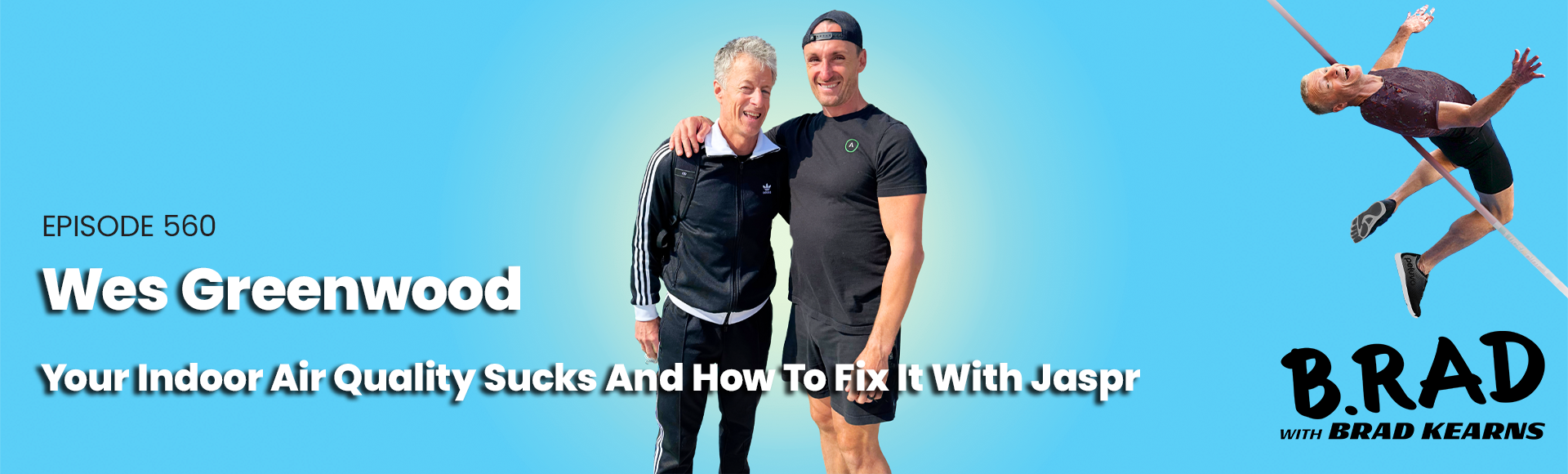
During this episode, I talk to former firefighter and chief breath officer of Jaspr, Wes Greenwood, about the unseen world of air quality and what’s really in the air we breathe—both indoors and out.
You’ll learn how air filters like the Jasper actually catch pollution, what particulate matter is, how cooking (even clean, grass-fed steak) produces airborne compounds, and how most kitchen range hoods are either undersized or vent directly into your house. If you’ve ever wondered how smart air filters work without Bluetooth or Wi-Fi, or why your sleep might drastically improve just by cleaning the air in your bedroom, this is the show for you.
Wes also shares the personal story of how his health was deeply affected by mold exposure in a home with a dirt-floor crawlspace, explaining how most of the air in a two-story house actually comes from below due to the “chimney effect.”
If you’re curious about breath, air, ions, and the electric charge in your body, and how they all connect, this is an episode you won’t want to miss!
TIMESTAMPS:
Indoor air is not as clean as you think. When did you last change the filters on the HVAC? [02:21]
The sun and trees are good for neutralizing bacteria and viruses. [05:50]
Most people don’t realize how much they are asking of their lungs. [09:46]
If it is a polluted day outside, is it better to exercise inside? [10:59]
Even months after a fire, during the cleanup, we get much exposure to the pollution depending on how the wind is blowing. [13:01]
How does a filter actually catch the pollutants? [19:40]
Even when you’re cooking healthy nutritious food, you’re still creating these volatile organic compounds. [25:54]
Some air purifier machines have very sophisticated filters that can distinguish the amount oif dust currently in your air. [28:16]
Hot air rises and creates a pull. The system, especially in a two story house, is filtering in a different way. [31:57]
You should get your indoor ait tested for mold and other particles that make people sick. [36:09]
Learning proper breathing exercises is very helpful. [37:53]
Wes, as a fireman, was terribly ill from not breathing clean air. [40:38]
Breath work was the mainstay of his recovery. [44:37]
People need to understand the importance of breathing. [52:21]
Breath through your nose rather than your mouth. [58:30]
What size area is covered by one JASPR purifier? [59:57]
LINKS:
- Brad Kearns.com
- BradNutrition.com
- B.rad Whey Protein Superfuel – The Best Protein on The Planet!
- Brad’s Shopping Page
- BornToWalkBook.com
- B.rad Podcast – All Episodes
- Peluva Five-Toe Minimalist Shoes
- JASPR.co
- Biology of Belief
- Elijah Nissenblum
- What Doesn’t Kill Us
- Breathwork- Giovanni Bartolomeo
 LISTEN:
We appreciate all feedback, and questions for Q&A shows, emailed to podcast@bradventures.com. If you have a moment, please share an episode you like with a quick text message, or leave a review on your podcast app. Thank you!
Check out each of these companies because they are absolutely awesome or they wouldn’t occupy this revered space. Seriously, I won’t promote anything that I don’t absolutely love and use in daily life:
- B.rad Nutrition: Premium quality, all-natural supplements for peak performance, recovery, and longevity; including the world’s highest quality whey protein!
- Peluva: Comfortable, functional, stylish five-toe minimalist shoe to reawaken optimal foot function. Use code BRADPODCAST for 15% off!
- Ketone-IQ Save 30% off your first subscription order & receive a free six-pack of Ketone-IQ!
- Get Stride: Advanced DNA, methylation profile, microbiome & blood at-home testing. Hit your stride the right way, with cutting-edge technology and customized programming. Save 10% with the code BRAD
- Mito Red Light: Photobiomodulation light panels to enhance cellular energy production, improve recovery, and optimize circadian rhythm. Use code BRAD for 5% discount!
- Online educational courses: Numerous great offerings for an immersive home-study educational experience
- Primal Fitness Expert Certification: The most comprehensive online course on all aspects of traditional fitness programming and a total immersion fitness lifestyle. Save 25% on tuition with code BRAD
I have a newly organized shopping experience at BradKearns.com/Shop. Visit here and you can navigate to my B.rad Nutrition products (for direct order or Amazon order), my library of online multimedia educational courses, great discounts from my affiliate favorites, and my recommended health&fitness products on Amazon.
TRANSCRIPT:
Brad (00:00:00):
Welcome to the B.rad podcast – where we explore ways to pursue peak performance with passion throughout life. I’m Brad Kearns, NY Times bestselling author, world #1 ranked masters age 60-plus high jumper, and former #3 world ranked professional triathlete. You’ll learn how to stay fit, strong and powerful as you age; transform your diet to lose body fat and increase energy; sort through hype and misinformation to make simple, sustainable lifestyle changes; and broaden your perspective beyond a fit body to experience healthy relationships, nonstop personal growth, and ultimately a happy, healthy, long life. Let’s explore beyond shortcuts, hacks, and crushing competition to laugh, have fun, appreciate the journey, and not take ourselves too seriously. It’s time to B.rad!
Wes (00:00:51):
I help people use the power of their breath as a tool for inner exploration and healing. Mm-hmm <affirmative>. Ultimately. Mm-hmm <affirmative>. And one of the things I’ve been contemplating, and this is why I’m grateful for this,
Brad (00:01:02):
Wes Greenwood, glad to talk to you, the chief Breath officer of Jaspr. Yeah. I want to get right into it. Learn about the great work that the company’s doing. Yeah. I just met you guys. Yeah. Down in Austin at the Health Optimization Summit. You had this amazing booth with this beautiful, tasteful looking chamber mm-hmm. That turns out to be the most powerful home-based air filter you can get. Yeah. So I was visiting you guys, I was around the corner at Peluva booth and got to know Mike and Yeah. Uh, Sarah. And, um, you guys looked like you had a tremendous, uh, interest in the product at the show to those biohacking crowds. Mm-hmm <affirmative>. So now we bring it to all you listeners, viewers to learn more wonderful about Jaspr, and then all the other cool stuff you’re doing with your breath work and your, your background that got you into this stuff. Yeah. Yeah. It’s great.
Wes (00:01:49):
Yeah. It’s good to be here, Brad. Thank you. Yeah. Thanks for taking the time to talk.
Brad (00:01:52):
Oh, so fun. Yeah.
Wes (00:01:53):
I wanna ask you where to begin. I mean, like, you know, as far as like, you know, uh, what you want to know about clean air, you know, I really want to answer your questions and I also wanna speak to your audience. Good, good. Directly. So, I mean,
Brad (00:02:04):
Like, good we come back at it, man.
Wes (00:02:05):
Yeah, yeah. Like, so,
Brad (00:02:07):
You know, I have like five of these air filters in my house from Amazon.
Wes (00:02:12):
Okay.
Brad (00:02:13):
Because I want clean air. Yeah. You know, and I’m, I’m like, I’m, I’m trying to look cover all aspects of my health.
Wes (00:02:18):
Great.
Brad (00:02:18):
So I think I’m, I think I’m doing a solid
Wes (00:02:20):
You’re doing solid
Brad (00:02:21):
Y.ou know, Mike said they’re not the most powerful thing. Yeah. But, you know, we have the awareness that indoor air might not always be the most, most tidy. Um, I like to get window circulation in the right times of year, but like now we’re here in the spring allergy season. Yes. And it’s brutal. So I have all the windows locked down. I’m like, what’s best? Should I open the window? No, I can’t, man. I keep sneezing. So we have like indoor air quality. Outdoor quality’s now a big deal. ’cause we’re here in Los Angeles in the aftermath of the Palisades fire, which is only a few miles away. Absolutely. Lots, lots to talk about and learn about. This
Wes (00:02:53):
Is great. Um, f irst, like, I, I just wanna highlight the fact that you’re actually filtering your air. Yeah. Yeah. And that’s putting you like leaps and bounds above most. Yes. Besides
Brad (00:03:02):
The HVAC with the, you know, the thinking. Yeah. The little remove, try to remember to replace.
Wes (00:03:05):
That’s it. And if you look at most people, and I would challenge most people. Yeah. They’ll look at what your furnace built looks like. When was the last time you changed it? Yeah.
Brad (00:03:12):
And
Wes (00:03:12):
It’s not really doing anything. Oh, really? Like, not for your indoor air quality. It’s protecting your furnace. Oh. From getting too much buildup in the fan. Yeah. Like, it’s not a HEPA filter. Right. It’s not catching the small particulate, you know, it’s catching gross dust and all that stuff. And people’s duct work would be the revealer of that if anyone hasn’t had their ducts cleaned. Yeah. If you have a, he a central heating system Yeah. Look into getting your duct work cleaned and get your ducks in a row. Yeah. Seriously. Yeah. Get them in a row. But like, and
Brad (00:03:37):
You do that like every year or some? Well,
Wes (00:03:39):
So it depends. Now this is the cool thing about filtering your air. Yeah. If, if we had proper filtration in the house, the duct work wouldn’t need to be cleaned. Oh. Very often. If at all. Right? Yeah. Um, most people don’t. And that furnace filter reveals it if you look how dirty the duct work is and most people’s houses. Yeah. It’s so gross. And if they haven’t had it clean, and most people don’t clean it ever. Right. They don’t think of it as a routine task. Yeah. It tells the story of what’s in there. Um, but the reason I say like, you know, it’s awesome that you’re filtering air. We’ve been to so many summits, so many conferences, so many trade shows. And the most common answer we get when we ask people about like, what are you doing about your indoor air quality?
Wes (00:04:15):
Nothing. Yeah. And this is from people like, you know, that, that are think that you think it would be in the know. And it’s been something that, um, you know, like I just started, I’ve known Mike for eight years. I’ve known him since he started the company. And I’ve just started with Jaspr personally, you know, like back in the winter of 2024 mm-hmm <affirmative>. Um, and, and just getting exposed to people at these trade shows and like customers that we’re serving in the local Austin area. ’cause that’s we’re centered out of Austin. Um, how many people, particularly at these conferences that should be in the know that aren’t doing anything about their indoor air quality is mind boggling. This is a foundational thing of health. <laugh> the air we breathe. Yeah.
Brad (00:04:53):
You’d think so. Yeah.
Wes (00:04:55):
Not think. Yeah. It’s a
Brad (00:04:56):
Fact. Yeah. Yeah.
Wes (00:04:57):
Food, water, air, how many variables
Brad (00:05:00):
Are there, right?
Wes (00:05:01):
Yeah. Movement. Yeah. Sleep, connection, relationships, community. Yeah. Sunlight. Sunlight. You know, like these things. Right. I mean, it’s, it’s at the foundation though, but like breathing, like that’s on the, that’s like, it doesn’t get more foundational. Yeah. Yeah. And we’re breathing dirty indoor air. We’re spending more time indoors than ever, you know? Right. Not five plus percent of people’s time. Unless you’re conscious about it. Yeah. And if you live in a climate that’s like favorable. ’cause people love being comfortable, you know, if it’s too cold, they don’t wanna go out. If it’s too hot, they don’t wanna go out. Yeah. A lot of times spent indoors. Yeah. And not many people are filtering their indoor air.
Brad (00:05:37):
There’s a study from uk it was like 87 and seven, 87% indoors and 7% in a vehicle. Exactly. That’s 94% of your life is indoors. Exactly. Yeah. So, and then the 6% outdoors, then we still have some potential concerns.
Wes (00:05:50):
That’s it. Depending where you live. Yeah. You know, so what would be ideal is if we all lived amongst nature, you know, nature’s a great air purifier. The sun is very good at like neutralizing bacterias, viruses, you know, and, and trees. They’re very good at like filtering in carbon dioxide and breathing out clean oxygen and, you know, they capture dust partic and all that stuff. Yeah. And I mean, you know, we’re not, if you’re in a forest, the forest is not burning, you know, carbon products as if combustion byproduct of lead cars and rubber flex coming off and industrial pollution and all this stuff. Right. Um, that’s what we live amongst. Yeah. And we’re not filtering all that stuff out. Yeah.
Brad (00:06:25):
I mean, it’s crazy. I had one of those sophisticated blood tests Yeah. From Nourish Balance thrive years ago, and I came back fairly healthy mm-hmm <affirmative>. Uh, but some of the reports that, you knoT, no one would ever get this kind of test until you go way to the highest level ly a patient. And it said you had plastic particulates in your blood mm-hmm <affirmative>. And also petroleum byproducts mm-hmm <affirmative>. And so then I went off to, you know, functional medicine Yep. And been like, what the hell’s going on? What could
Wes (00:06:52):
Be the cause of this?
Brad (00:06:53):
One of the main conjecture was that growing up in the Los Angeles, San Fernando Valley mm-hmm <affirmative>. When the smog was horrific, the whole, my whole upbringing. And I was a long distance runner. Yeah. And we’d do these cross country races three miles, and then when you finished, you would cough for a couple hours. Wow. And I thought that was from hard running. Yeah. It’s part of the sport. Yeah. My lungs would just be coughing and, you know, at the pizza place that night. And then I’d finally finished coughing after a couple hours. Wow. And pain would go away. Yeah. And then I did my first cross country race in college for uc. Santa Barbara team. Yes. Right on the ocean up there in Santa Barbara. Yeah. And I crossed the finish line, no pain. And I’m like, Hey, why am I, why am I not coughing? And I’m like, oh my God. It was all the smog in the valley.
Wes (00:07:36):
Oh my goodness.
Brad (00:07:36):
So that was a heartbreaking realization that to think how much poison was going in my, in my body. That’s
Wes (00:07:42):
Such a powerful story. Yeah. That’s such a powerful story. That was, uh, you know, that. I love that you shared that. So thank you. Because that actually is something that came up on a podcast this morning. Mm. Um, you know, part of what, what I do, like, I facilitate breath work experiences for people. So I help people use the power of their breath as a tool for inner exploration and healing. Mm-hmm <affirmative>. Ultimately mm-hmm <affirmative>. And one of the things I’ve been contemplating, and this is why I’m grateful for this product of Jaspr, you know, depending on the time of year, I love doing experiences outdoors. Mm-hmm <affirmative>. But you know, if the season dictates, you know, if it’s like, you know, 105 degrees outside and sunny, a lot of people, you know, don’t wanna lay outside. ’cause it’s, I mean mm-hmm <affirmative>. It’s intolerable for some we’ll go indoors. And it’s known that the indoor air can tend to be, uh, worse than the outside air. Mm-hmm <affirmative>. And particularly depending on the house you live in and how well your ventilation system works, um, you know, it can actually tend to concentrate. Like, so say you live somewhere like, you know, LA and there’s a lot of smog, a lot of smoke, very high levels of pollutants in there, they can concentrate in your home Yeah. To be a higher levels in they’re outside. Yeah.
Brad (00:08:45):
Makes sense. Less circulation. That’s
Wes (00:08:47):
What I mean. You
Brad (00:08:48):
Don’t get lucky with a breeze one morning if there is. Yeah. And
Wes (00:08:50):
Particularly in older houses, right. They didn’t have very good ventilation systems as in like, exhausting air from inside to the out. Yeah. And usually you’d have to turn them on manually, like your range hood or your bathroom fan. Mm-hmm <affirmative>. Mm-hmm <affirmative>. Most people forget after 40, 50 years. Yeah. They break. People don’t fix them. You know, your furnace systems, they just move the air inside and they’re not really replacing, you know, so if someone doesn’t like open the windows to get that going, it tends to accumulate. One of the things I’ve been fascinated by, and you just highlighted this, is the potential of someone engaging in deep breath work as a practice, for instance, running, you’re breathing deeply too and driving that particular matter into the deeper lobes of the lungs. Yeah. You know? Yeah. And that, that you just, you just highlighted that is still what’s happening. Yeah. How many people do you think run in LA that potentially have that problem, that have no awareness of Yeah. That being a thing? Yeah. They’re engaging in a healthy exercise.
Brad (00:09:41):
Yeah. They’re eating well drastically worsening the damage. That’s what I mean. ’cause they’re asking so much of their lungs. Exactly.
Wes (00:09:46):
And, you know, you develop a certain amount of willpower so you can push through pain. You get that runner’s high, so you don’t really feel it in the moment. Mm. You know, you engage in this exercise that’s supposed to be good for you for a long time. Like, this is just something I think about. Mm-hmm <affirmative>. You know, making the invisible visible. That’s why I love this particulate counter. It does show some evidence of, like, that there’s particulate in the air mm-hmm <affirmative>. There’s better laboratory testing you can do to see what it is actually. So what is the real concentration of like certain contaminants, not just how much is in the air, but what is it? So this, what do you
Brad (00:10:16):
Do? Like just take a exactly. A jar full of air and then bring it into That’s exactly.
Wes (00:10:20):
It basically. Don’t spill it a grab sample. Well, it traps it in a container. Right. Like an airtight thing. So like, you know, this will show the quantity of particulate. Those tests will show the quality Mm. What it is. But all I’m getting at is there’s always this saying in like health conscious circles of like, you know, the person that did everything right and somehow died of lung cancer. Yeah. It’s like, you know, and these people get demoralized, like, what’s the point? Yeah. It’s like, this is what’s happening. Yeah. People are getting exposed to things that they can’t see. Yeah. You can’t feel necessarily in the moment, or at the very least you come up with some other justification like, oh, I must have just ran too hard. Mm-hmm <affirmative>. No, no. You just breathe in a bunch of garbage. Mm.
Brad (00:10:59):
Now if it is a polluted day outside Yeah. Um, can it be better inside? I’m gonna go exercise in the gym today. ’cause the air is so bad outside. Or are they generally, is it generally like anything outside is getting into most inside, um, besides the temperature, which we always think, oh, the air must be exactly cooler and cleaner because I feel the air conditioning. That’s it.
Wes (00:11:22):
So it can be. Is it usually? Not necessarily. So again, because of like, just the way we are here in
Brad (00:11:30):
This proper hotel, it’s gotta be way nicer. It’s
Wes (00:11:32):
Definitely better.
Brad (00:11:33):
Jaspr filters
Wes (00:11:34):
Everywhere we’re working at, they’re not, they’re not in everywhere yet, but we’re working on it. So this is something that we’re trying to bring awareness to. Right. Particularly in health facilities. And I think it’s very important, particularly where people are going to exercise and they’re engaging in a deeper level of respiration mm-hmm <affirmative>. Than they might otherwise. That that’s why I love what you shared. Yeah. That is such a critical story to think about. Like, and, and the truth of the matter is, most gyms are not filtering their air. Most yoga studios are not filtering their air. You know, I certainly know a lot of places I went to to do breathing experiences, they’re not filtering their air, you know, so this is not a common thing. Yeah. This is a, this is a piece that’s being missed on many levels. Yeah. You know, so, um, I mean yes. The potential’s there, we just need filtration. Yeah. Indoors. I mean, ideally the contamination that’s happening, the pollution, we take steps to like, you know, move away from that. Yeah. You know, if I take this meter, this, this particulate counter out to like an old growth forest, you know, and it’s a little bit dry, say it’s midsummer and a wind like a gusta of wind comes up, it’s gonna kick up all kinds of dust mm-hmm <affirmative>. All kinds of particulate, you know, but it’s not necessarily the type that’s really harmful for you. Mm-hmm <affirmative>.
Wes (00:12:38):
Some might even say it’s beneficial. There’s a whole bunch of stuff coming out about like, you know, the microbiome of the soil and you’re breathing that in, you know? Mm-hmm. But when that happens, like you said, the Palisades fire, that dust comes in, well, it’s kicking up all kinds of combustion byproducts, you know, like all the things that burned Yeah. You know, like all the things that were there before from like, just the cars driving, you know, the pollution happening in the factories, the power plants, all that stuff. Right. And it’s blowing around.
Brad (00:13:01):
So right now, we are three and a half months removed from the fires. They’re cleaning it up like crazy. Yeah. And we’re five miles away, let’s say mm-hmm <affirmative>. Three miles away. Really? Um, are we still dealing with that massive toxic air problem from months ago due to the cleanup and the stirring up of the likely burn up car, almost
Wes (00:13:25):
Unquestionably
Brad (00:13:25):
Distance,
Wes (00:13:26):
Depending on the way the, the wind’s blowing. Yeah. It’s literally simple as that. Yeah. Uh, yes. Um, you know, every time it rains, every day, the sun’s out shining. It’s gonna degrade some of the stuff more like nature’s a very good, uh, yeah. Very good at diluting things. Yeah. You know, but some things take a very long time to dilute. Right? Yeah. So, uh, yes. And especially in these areas where like, you know, essentially a disaster has happened. It’s very important, even like, critical to begin to look at how can you protect yourself? And that’s not really being talked about. More people think, oh, it’s no longer a fire. It’s like, it doesn’t end when the fire’s over, or it’s
Brad (00:14:01):
Like, Hey, when are we rebuilding? Let’s get this done quick. And then that’s it. Well,
Wes (00:14:05):
It’s not just a killing, like there’s a demolition that happens. Yeah. So every time they demolish it helps. Like they’re not doing it in a bag. Yeah. Right. They’re not, they’re not, you know, like watch a house get demolished. Yeah. Look how much dust comes outta that thing. And then a burned down there.
Brad (00:14:16):
Or the casino building in Vegas that they imploded
Wes (00:14:18):
. Yeah. That’s it. Right. And people love watching it. They think it’s cool if it’s like, man, you know what’s in that stuff? Yeah. It’s not good. Yeah. So, yes, there’s still a risk here. It’s hard to say exactly what, you know, there’s a lot of combustion byproducts that still are gonna be liberated from the fact of the cleanup happening, you know, and like, wind blowing it mm-hmm <affirmative>. Um, it’s not like as much of an issue as when the fire was ongoing and all that fire and smoke’s, like, you know, constantly coming. Yeah. We talked with a woman here today, about like how she noticed every day when the fire was going, she would come home and her whole countertop would have a layer of black soot on it. You know? So that’s like indoors, right? How,
Brad (00:14:56):
How did it get onto the counter? Exactly Right.
Wes (00:14:59):
Well, through the houses, when you open your door, you know, like stuff comes in, there’s always like houses. Um, even though now they’re much more airtight than they used to be. And that’s part of the problem with like, you know, indoor air pollution. Right. We’ll talk a little bit about that. Yeah. Even though they’re tighter than they used to be, they still leak. They still have in like outdoor air coming in. Right. And particularly when there’s a high concentration of stuff in the air from a fire, it makes it in and settles it. And if you don’t have an air filter, well now your counter collects it, your couch collects it, your carpet collects it, your clothing collects it, your bedding, walls, that becomes your filter. That’s it. Anything porous. Yeah. Now becomes your filter.
Brad (00:15:35):
<laugh>, it becomes your filter. That’s
Wes (00:15:36):
It. Yeah. So if you don’t have something like, you know, whether it’s a Jaspr or whether it’s a a, a central mounted air purifier or some other thing, like you mentioned you bought a bunch from Amazon. If you don’t have something running in your house, your contents of your home become the filter. So every time you sit on your couch, a little bit goes in the air. Yeah. You know, every time you walk in your carpet, a little bit goes in the air again.
Brad (00:15:57):
Yeah. I heard Mike tell me that you shouldn’t have dust in your house or something.
Wes (00:16:02):
In an ideal world. Yeah. Yeah. Like dust is the symptom. Wow. Like, you know, like, and that, and that’s what we’re highlighting in fact, like dust in your house is indicating that nothing is picking it up. Nothing’s filtering it for you. You know?
Brad (00:16:15):
So could you create a test environment for fun over at the office in Austin where you had six filters in a room? Very small. Yeah. And get like the most pristine completely non dust
Wes (00:16:28):
You definitely could. Yeah. Yeah. Yeah. Yeah. I mean, I mean, or
Brad (00:16:31):
Is there an overkill point? Like I,
Wes (00:16:34):
I think like, you know, there’d be a point in like, what I don’t wanna have someone do is get like, hypochondriac about dust. Yeah. You know, as in like, if you look into the natural world Yeah.
Wes (00:16:43):
There’s dust. Yeah. It’s a product of life. Yeah.
New Speaker (00:16:46):
people are really focused on mold, uhhuh, <affirmative>, you know, so mold, mold, illness, it’s a very big thing right now. Yeah. Um, truthfully, it’s been a thing for a long time. We just didn’t know. We just didn’t know about it. It Right. We’re kind of, uh, we’re, we’re, again, that’s another thing of making the invisible visible uhhuh <affirmative>, you know, we could see mold growing somewhere. Right. But we didn’t build like the mycotoxins and the effect they were having on our body. Yeah. You know, and then the airborne mold particulates, you can’t see them. You know, so these things, so we’re starting to be able to see that stuff now. Yeah. And what I’m getting at here is like, it’s not so much that we wanna remove all dust, ’cause then we’d essentially be living in a vacuum.
Wes (00:17:18):
Right. What what Mike means by that is that, especially indoors, and especially in the environments we live in, the dust that’s in there and the dust that’s created, like, I actually believe there’s a beneficial dust, and it’s what I mentioned mm-hmm <affirmative>. Right. Um, about like, you know, being in like say an old forest out nature, someone that’s clean, we’re interfacing with the environment. Yeah. When we’re in a downtown environment where we’re in a city, when we’re in an urban area, a lot of the dust that’s in there is the stuff that’s not good for us. Right. It’s the things that make your lungs burn, like what you mentioned Yeah. After that. Right. We don’t wanna see that in our house. We don’t wanna see that dust accumulating on anything. That’s what we’re trying to get to.
Brad (00:17:54):
I read a book about the negative ions versus positive ions. Yeah. Is that also a factor in the, in the pollution of an urban area? Yeah. And maybe describe what each of those are. Um,
Wes (00:18:05):
I don’t know enough about that to comment. For me the
Brad (00:18:09):
Positive. Now, now we know we have a smart guy. That’s it. Yeah. Because the people that spout on everything. Yeah. Yeah. I, I mean, generally the negative ions are generated by natural areas like windy mountaintops Yeah. And oceans and large bodies of water. Definitely. Even your showers Yeah. Is creating this energetic particles in the air that are good for you. Yep. Yep. And then the positive ions, even though the term positive Yep. Connotes something that’s good, it’s terrible. Yeah. And you get high readings in polluted air or confined indoor space. Yeah. And, uh, this is
Wes (00:18:39):
New for me. Yeah. Like, I’m very much about like, you know, in breathing, like the inhale, the exhale, the positive, the negative, the charge that creates like, you know, like electrically in the body. Okay. Like, you know, this kind of PIO electric charge that happens Yeah. Just as far as your question is concerned. Yeah. Like, I, I don’t know the answer as far as how that pertains to like, say pollution uhhuh. So I just don’t wanna Yeah. I don’t wanna go down that path to comment on it because
Brad (00:18:59):
That resolution is energetically depleted air. Yeah. So I’ll, that
Wes (00:19:03):
Intuitively makes sense for me. Yeah. So actually I’m, I’m learning a little bit here too, right? Yeah. And, uh, that’s interesting to think about as far as how, Jaspr’s concerned in it. I mean, you know, it’s essentially catching pollutants. And what I’m just imagining right now is, you know, if those pollutants are that positive charge Yeah. You know, like they’re capturing them in the filter Yeah. So that maybe they don’t interface with your body messing up, whatever, you know, electrical balance is, is created from, you know, maybe creating or contacting negative ions Yeah. From again, the sea Yeah. The mountain. You know, that’s at least what I’m intuiting right now. Yeah. Um, it’s not, that’s a good question. So
Brad (00:19:39):
Scenario
Wes (00:19:39):
For expiration, um,
Brad (00:19:40):
Yeah. The filter. This is, here’s a dumb question coming up off the heels of that. Like how is it actually catching the pollution? Yeah. Are these molecules bigger than clean air or something like Exactly. Turn on the filter and what happens inside? Its actually
Wes (00:19:56):
Clean air, you know, like, I mean, a lot of people say we’re breathing oxygen, you know, like Yeah. Air is so much more than oxygen. It’s actually like 70 plus percent nitrogen. Oh, okay. You know, we live in this band where we need, you know, about like, uh, anywhere from like 2018 to 20% oxygen is ideal. Yeah. In the air concentration and there’s some carbon dioxide, there’s a bunch of other crap. Right? Yeah. So that’s air, that’s like an unseen clear gas molecule. Yeah. Super tiny, you know? Okay. Then you have the particulate that’s in it. Yeah. So what the filter’s doing is it’s removing all that particulate
Brad (00:20:27):
And particulates larger.
Wes (00:20:29):
That’s it. Yeah, exactly. Right. So we’re talking like, you know, this thing here measures, um, usually particulates, uh, measured in micron mm-hmm <affirmative>. Microns a size, like a size unit mm-hmm <affirmative>. Um, we’re talking like 0.3 microns. This thing measures up to 10 microns and there’s even bigger molecules, you know mm-hmm <affirmative>. So, um, it’s catching like a hepa air filter is, is catching like 99.99% Okay. Of these micro microns down a 0.1 micron. The
Brad (00:20:53):
Advertisements are correct. They’re very catching a lot of that
Wes (00:20:55):
And, you know, one of the things I like doing is bringing this tester into homes. Yeah. Um, you know, again, showing what the air is as far as particular count, and then showing someone like by holding it over the air purifier Yeah. Where it isn’t, most of the time everything is zero coming out of the filter. Right, right. Not showing again, all that particulate that’s in the air Yeah. Is gettingr caught Yeah. Trapped held Yeah. In this filter. Yeah. So it’s not going throughout your house, not going into your lungs, not going into your furniture, you know, so that essentially that’s how it works. A fan circulates and it pulls all the air into this medium, you know, which is a pre-filter, a HEPA filter, and a carbon filter built into one, and then it comes through the fan and the air coming out the top is clean.
Brad (00:21:39):
You were doing some demonstration with mm-hmm <affirmative>. Was it like tap water or something?
Wes (00:21:44):
Exactly.
Brad (00:21:45):
Yeah. And it was, it was giving a, a pollution reading on the
Wes (00:21:49):
Well, totally
Brad (00:21:49):
On the display. Yeah.
Wes (00:21:50):
So like, you know, so
Brad (00:21:51):
That’s pretty gnarly. Yeah.
Wes (00:21:53):
So there’s all kinds of things in tap water, right? Yeah. Um, you know, so basically what we do is even the
Brad (00:21:57):
Stuff that, you know, here in a big city, they’re blasting, of course, chlorine. Chlorine call it very safe, but it’s still a chemical. It’s
Wes (00:22:05):
Still, yeah, yeah. Chlorine’s not good for us. Right. It’s great at killing bacteria. Yeah. It’s like, you definitely don’t have a chlorine, like a recommended daily amount of chlorine required, you know? Um, and there’s, there’s a great argument. It’s like terrible for our microbiome, you know, like for the health of our mouth, like our gut, all that stuff. Right. So, um, but it’s very good at killing bacteria and we don’t want salmonella in the water. We don’t want any echolie in the water. Yeah. Um, you know, so it’s a critical piece of like our water infrastructure to keep people safe. ’cause I mean, there’s people dying in the world mm-hmm <affirmative>. From dirty water mm-hmm <affirmative>. Um, but it’s in the water and there’s other things in the water. You know, there’s a big talk about like, uh, old city water pipes containing lead.
Wes (00:22:43):
Mm. You know, so, um, anyways, when we do that test, what it’s doing is one, it’s, uh, it’s showing people how our sensor works. Yeah. It’s also revealing a little bit about the things that are in the water. Yeah. Because there’s definitely things in there that’s not so much the important part for this thing. But basically what we’re doing at the show is we’re, um, we’re using, um, a diffuser, like a water diffuser, and it’s, you know, basically Right. Aerosolizing water steam coming up. Yeah. Yeah. You know, like if you think of like your essential oil diffuser Yeah. Or anything like that. Yeah. Or humidifier. Yeah. It’s basically just like vaporizing the water mm-hmm <affirmative>. Um, our unit is picking it up and it’s picking up the concentrated particulate in it, you know, and when it’s that close, like basically we have the unit right beside the Jaspr and those aerosolized particles are going right into the sensor at their highest concentration mm-hmm <affirmative>.
Wes (00:23:28):
So our Jaspr unit, like, you know, goes to the red line and you see how the smart mode works, and then we’ll pull it away and it’ll kind of clean out the sensor pick up, like there’s no more particulate in there and it’ll, you know, move the, the fan speed back down to low again. Right. Yeah. Um, and we’ve got all kinds of reviews on our, on our website, you know, from people having this unit and it’s really an air education device, you know, ’cause it has the smart meter on it. Yeah. Like showing like how much airborne particulate particularly, uh, PM 2.5, which we’ll talk about in a moment. Um, how much air particulate is in your indoor air. So like many people, you know, they start cooking, you know, and they forget to turn their range hood on. Yeah. Which is a big thing. A lot of people have range hoods don’t have one. Well, a lot of people don’t have one. Yeah. Like a lot of people don’t have one. Yeah. A lot of people have one, but it vents into the house. Yeah. Like, so it’s just literally got like a little Yeah. Like
Brad (00:24:15):
It, it should vent outside.
Wes (00:24:17):
It should vent outside one. It should be properly sized. Yeah. It should work and it should vent outside. Yeah. Yeah. Yeah. And most people are missing one of those things. Yeah.
Brad (00:24:27):
<laugh> we discovered, uh, that ours vented inside. Yes. And the way I discovered it was I removed this, uh, section of the, uh, above the oven hood in the cabinetry. Yep. They sealed it off Yep. To hide the fact that it wasn’t, it, it appears like it would be the way the pipe goes outside. Exactly. And they, they said, oh, let’s just cover this so no one looks. Yeah. And then just, I don’t even know. Is that doing anything if you’re No. If the
Wes (00:24:52):
Fans, it’s essentially doing nothing. I mean, other than, um, at, at most if you were to be cooking something like quite greasy on a frying pan, um, it would capture some of the grease in like the, there’s usually like a little mesh sort of filter Yeah. Before it goes and shoots out. Yeah. I’ve watched that out before. Exactly. So what you washed out is basically all as it does, it catches some grease and that’s all it’s doing. Right. I mean, it’s just essentially blowing it in the ceiling and you know, it’s staying in your house. So the difference between that and not having it at all is maybe saving a little bit of grease from dispersing on your counters. Yeah. You know, but other than that it’s doing essentially nothing. Um, and then if it’s not there at all, I mean, it’s not really any different than having a vent in your house mm-hmm <affirmative>. And then if it’s venting outside, that’s ideal. Mm-hmm <affirmative>. But most people’s are, um, not strong enough to really even work. Mm. Like if you can smell the food, like, you know, say, say if this is our house here Yeah. You know, our kitchen was there and Yeah. You know, someone was cooking food and you walked in the door and you can smell the food. Yeah. Your rain sugar’s not sized properly. Right.
Brad (00:25:49):
Yeah.
Wes (00:25:50):
Like, you shouldn’t be able to smell anything. Yeah. Like, as far as that it should only be getting exhausted outside. So
Brad (00:25:54):
Even when you’re cooking, uh, healthy, nutritious food mm-hmm <affirmative>. You’re still creating these absolutely. Volatile organic compounds.
Wes (00:26:02):
Absolutely. Yeah. Yeah. Yeah. Proteins when they’re getting, you know, like
Brad (00:26:04):
This is grass fed steak. Exactly.
Wes (00:26:06):
Exactly. It still has those polycyclic aromatic hydrocarbons, you know,
Brad (00:26:10):
When the process of cooking is what’s releasing things usually
Wes (00:26:13):
Heat. Yeah. And, you know, I mean, um, depending on someone’s level of consciousness and how they cook, you know, so most people I find cook at too high of a temperature. Oh. You know, so like every, like the higher the temperature, the more of these compounds get produced. Yeah. Uh, the interaction of fats with proteins particularly too, can cause it, you know, even fats and carbohydrates. Yeah. Um, exactly. So they’re going into the air now. I mean, they’re not the worst things in the world. Like there’s way worse things, but that’s a typical hazard most people are constantly doing every single day. That with a properly functioning rangehood could be preventing it. Yeah. And then if you don’t have that, you definitely need an air filter
Brad (00:26:48):
Crank it up right.
Wes (00:26:49):
To you. Like that’s it. So, and that’s the thing. So that’s what one of the things we love about the Jaspr, and that’s what people are frequently saying to us the most. Um, you know, when someone gets one, we always say, put it in your bedroom. Put it in your bedroom, because that’s the place you spend your most time, spend time there most people. Right. Um, and if you’re getting two, definitely one in your kitchen. Yeah. And the other one in the bedroom. Um, but the one in the kitchen is the one that constantly blows people’s minds. Right. ’cause that’s where you’re engaging in your cooking. And they’ll have it on smart mode and the thing will go crazy <laugh>, you know, it’ll go, it’ll
Brad (00:27:16):
Get amped up, it’ll get amped up, it’ll go smart mode, meaning Exactly. It works just what it needs to. ’cause we tried that at night. Yes. And um, you know, it goes, it goes nice and it’s always quiet even at the highest power.
Wes (00:27:28):
That’s it.
Brad (00:27:28):
Yeah. But the smart mode is doing what it needs to be.
Wes (00:27:31):
Exactly. Yeah. So smart mode, basically what it does is it always, it it just modulates itself based on the airborne air particulate. Right? Yeah. So, generally speaking, especially in a house like with the windows and doors closed, one of the things we love about air purifiers, it’s, it’s, it’s, it’s big.
Brad (00:27:46):
Yeah.
Wes (00:27:46):
You know, uh, people ask, are we making a smaller one? And we say no, because if we make a smaller one Yeah.
Brad (00:27:51):
Thanks for the question.
Wes (00:27:52):
It’s not gonna move as much air. Right. You know, and it won’t be as quiet. Yeah. So even that, that Jaspr running on its lowest fan speed, which is one which is generally when someone has it on smart mode. Yeah. It’s gonna be on fan speed one. Yeah. You know, ’cause it does a great job at moving the air.
Brad (00:28:05):
So the physical size of the fan Yeah. Is one reason. Then I noticed the filter’s quite large. Exactly.
Wes (00:28:11):
Four and a half pound filter. Yeah. It’s got a lot of surface area circular, a
Brad (00:28:15):
Foot or more tall. Exactly. Yeah.
Wes (00:28:16):
So it’s a robust filter. Yeah. So this stuff matters and we’ll, we’ll go back to that. But as far as the smart mode, you know, it runs on fan speed one. And what we love about it is it’s got the reading on it too. Yeah. You know, it’s how much air particulates in there. And then when someone’s cooking, when someone say, opens a door and there’s a lot of like pollen in the air, dust or cellular, there’s construction going on in the neighborhood, whatever your dog comes in. Yeah. Just rolled in the dust of the park. Yeah. Shakes off, you know, it’ll pick up and cranks up
Brad (00:28:41):
Again.
Wes (00:28:41):
Crank up. Yeah. You might see it go to like, you know, like fan speed two, three or four. Yeah. And it’ll keep running there until the sensor picks up. There’s clean again.
Brad (00:28:49):
That’d be funny. To program it. Like if someone annoying starts talking too long turns, you use your smartphone and crank it up really high. Like, okay, that’s a lot of hot air coming outta your mouth. That’s
Wes (00:28:58):
It. Yeah. Yeah. It can. Yeah. I guess it could be a real good filter.
Brad (00:29:01):
Yeah. Right. <laugh>. Yeah. Yeah, yeah, yeah. And, and you pretend it’s automatic. Like you’re That’s super fun underneath the desk. Yeah. Yeah. Oh, there goes the fan again. No. So, um, guess you’re full.
Wes (00:29:09):
You know? So that, that really highlights something too. So this, this, um, we call it like kind of a, it’s a smart filter, but it’s actually dumb compared to like modern standards. We don’t have EMF coming from it. ’cause there’s no wifi, there’s no Bluetooth connectivity. Right. And
Brad (00:29:22):
That’s intentional. Intentional to minimize your WIFI and Bluetooth. Thank you. Absolute. That’s nice to know somebody’s out there. That’s it.
Wes (00:29:28):
Particularly when it’s in your bedroom, you know, coming it down. We tell people to have it in their bedroom. Yeah. It’s got a smart sensor in it, but it’s integrated into the system. Yeah. It shows it on a, a reading on the screen. Yeah. You know, and, um, that’s it. Yeah. So it’s smart in a sense, a sense that it can intuitively run based on the conditions in your house and it can tell you what their conditions are. Yeah. But it doesn’t connect to your phone, you know, it admits basically no EMF. Yeah. Um, and it, it’s quiet. Yeah. And it goes dark.
Brad (00:29:55):
That, that’s nice. Is my favorite thing. Because I should show you some pictures of these filters Yeah. That have these stupid LCD emissions all over constant. And I have electrical tape and cardboard. Most of ’em blue. I need to get to the, I need to get to the buttons. Yeah. But I can’t have any light. It’s horrible. And they crank out pretty strong blue light as well. Very strong. And when we say blue light, we’re talking about it literally like the color blue Yeah. Of the buttons. And so all, I have all this crappy cardboard draped around the emissions of light. Exactly. Like no one cares. Exactly. So when I saw that light button, I’m like, what’s this? I’m like, oh, it’s still going. It’s going. And it’s dark. And it’s dark. Oh, yeah’s. It’s huge, critical, huge problem
Wes (00:30:33):
You know, it’s, uh, it’s unbelievable that people aren’t thinking about that. Right. Yeah. But that’s one of the pieces why, like, the more of these things that a filter has, like, you know, like the annoyances, the blue lights, the noise, you know, the, the fact that it’s ugly. Yeah. It all leads to people shutting them off, people not using them. Yeah. I’ve gotten to so many places. People
Brad (00:30:52):
That have, people that have bought,
Wes (00:30:53):
People have bought, um, air purifiers, you know, you mentioned you bought from like Amazon or something like that. Yeah. How many people I’ve delivered Jasprs to where I go into their house and they’re unplugged, they’re off <laugh>. They’re not on, you know, like
Brad (00:31:04):
Dirty and dust’s dusty.
Wes (00:31:05):
That’s you asked them about it. Like, oh, the thing’s too noisy. Or it’s like, you know, like, I, I just forgot about it. Yeah. It’s crazy. Yeah.
Brad (00:31:12):
Well, I mean, I went from smart mode to manual. Yeah. High fan. Yeah. Because it’s a beautiful Yeah. White noise for the whole night. Absolutely. And, um, it’s, you know, so that’s
Wes (00:31:22):
One of the things we find. I think that’s what really contributes to, uh, you know, we ran an aura, um, sleep study basically. I mean, so what we did is we basically, um, got a bunch of people from our customer list. We reached out, you know, we, uh, inquired about who had ora rings, and we asked people, and this was, uh, actually people who didn’t have Jasprs yet, they were like kind of on our mailing list looking to purchase. We gave them all free Jasprs mm-hmm <affirmative>. You know, and we had them basically, uh, send us their sleep data from the ora ring the week before they got their Jaspr. Oh. they sent us their information for the week they had their Jaspr. Yeah. And then they shut it off for the third week. And we had this like kind of a BA sort of
Brad (00:31:57):
Yeah.
Wes (00:31:57):
Right. And their sleep metrics were improved by like 20% across the board. Wow. You know, and we think it’s from like, not only breathing cleaner air Yeah. But also, like a lot of people like the white noise. We’re staying at a hotel downtown LA Yeah. And it’s so noisy. Yeah. But we brought our Jasprs with us. So you got them in the Hotel roo
Brad (00:32:14):
So what, how did you do that? You have like, we brought ’em in play a golf bag or something.
Wes (00:32:18):
I always brought in a box. Yeah. Like
Brad (00:32:19):
The, the box.
Wes (00:32:20):
Quite a robust box. Yeah. We’re thinking about maybe making travel bags for people are saying, but it’s kind of a thing that, I mean, the
Brad (00:32:24):
Golf bag would be perfect, wouldn’t it? Yeah.
Wes (00:32:26):
Yeah. Like a nice neo
Brad (00:32:28):
Clean golf bag. Golf bag. Yeah. This, this filter. Yeah. So,
Wes (00:32:30):
So we just check it in the plane as check luggage, you know, we bring it with us, but we set it up and we put it on fan speed four. Yeah. And it drowns out all the noise. Yeah. And it cleans the air and it really helps with the sleep. You sleep better, you breathe better.
Brad (00:32:43):
So you became a big fan of, uh, clean air Yeah. As well as breathing Yeah. Due to some misfortune that you had in your career. Yeah. So let’s kinda Yeah. Get into that whole story. Yeah, absolutely. Because it’s pretty heavy. Yeah.
Wes (00:32:54):
You know, I worked, um, I worked as a firefighter for 10 years, um, and actually in where this, um, in, uh, Canada, so three hours west of Toronto, uh,
Brad (00:33:03):
In an urban or, uh,
Wes (00:33:04):
rural area. Kind of an industrial setting. Right? Yeah. So, so I mean, um, truthfully, like my job, actually, I was fortunate, whereas like there wasn’t a lot of on the job exposure, just based on the environment I worked in, I was well aware of these hazards. I actually ended up getting sick from moving into a home Oh. That was filled with mold uhhuh. So I like was friends with Mike, you know, Mike’s the founder of Jaspr. Yeah. And I already knew about mold. I knew about some things around air in some ways. Right? Yeah. Um, I wasn’t into like doing, uh, breath work as a practice. This is something that came later. Um, I had a good amount of knowledge on health and wellness, and somehow I still miss, this is the thing, we moved into a house. Yeah. And the crawl space was filled with mold. It was missed on home
Brad (00:33:41):
Visible.
Wes (00:33:41):
Like it was missed on home inspections. It wasn’t like visible in the house. Oh. You know, I didn’t know about some of these things. Was
Brad (00:33:46):
The crawl space visible when you got in there and see? It
Wes (00:33:49):
Wasn’t apparent. So this is the thing, dark colors. So actually what happened was it was a dark crawl space. Yeah. With a dirt floor. Yeah. So it was an open air dirt floor. So like, you know, it wasn’t apparent, like there was black mold growing on the walls and we’re like, oh, duh. We just didn’t look. Yeah. Like we were down there. Yeah. What I didn’t realize was this, there was a high concentration of mold from the soil. There was a furnace down in the crawl space. So a source of heat mm-hmm <affirmative>. And we slept on the second, uh, story of this home. Mm-hmm <affirmative>. So, um, what happens in a home is this thing called the chimney effect. Um, most of the air in a a two story house from that comes from the, the, the crawlspace via the chimney effect. Hot air rises. Yeah. And it creates this pull. Okay. So actually pulls most of the air that arrives in the upstairs from the crawl space. So we’re sleeping in this environment. It was getting all this moldy air pulled up in and I had no idea.
Brad (00:34:35):
You’re not talking about through a duct, but you’re talking about just in general underneath your house. Yeah. It’s somehow getting its way to the second floor.
Wes (00:34:43):
That’s it. So like, you know, you have duct work running through it circulating, but also like heat, like typically think of any two story house. Yeah. Even though you have a central ducting system, it’s usually cooler on the first floor Yeah. If the heat’s running than it is on the upstairs. Yeah. ’cause heat accumulates. Yeah. And the furnace isn’t always running. Like if you listen to anyone’s central ducting system, it only runs when the furnace is heating mm-hmm <affirmative>. And then it typically shuts off. Mm-hmm. So it’s not circulating all the time. So then naturally that, that convection pattern of heat rising takes over. Yeah. And it keeps pulling air up. Yeah. So this is something I learned. So I ended up sleeping in this bedroom, you know, I ended up getting sick three months after we moved in this house with this autoimmune condition. Now, you know, I mean, there’s a lot of things about my career and like, you know, other things too as far as like stressors I had in my life and all that.
Wes (00:35:24):
Right? Yeah. But it really got me tuned to indoor air quality and how much of an effect it has. I was doing a lot of things right. And somehow missed that mark, you know, and there’s a lot of people that are in that, that situation too. Right. And one of the things I learned, and thankfully I was friends with Mike at the time, you know, he sent me five Jasprs for the place. Mm-hmm. Um, you know, and, and basically I kind of ran my own study with this. It didn’t like make me better immediately. Like I got really sick. My wife, you know, she had some like sensitivities occur. My, daughter, my first daughter was 10 months old at the time. Oh wow. She had some nasal congestion, but thankfully they didn’t get like as ill as I did. Like I got taken out. You know?
Brad (00:36:03):
Did you have any sense that it was related to the move-in since it was five months later? I mean,
Wes (00:36:09):
It was one of the things that was on our radar and Mike actually helped me do that. Indoor air testing. Yeah. It was one of the things Right. You know, so we actually did some indoor air testing. So I had him send me an air tester. We did that kind of what I talked about earlier, a bunch of samples in the house that captured them into these little containers that we then sent to a lab and it confirmed. Yes. There’s mold and there’s a lot of it, you know, there’s statue Boris, there’s like, you know, aspergillus, like all this stuff in there. Aspergillus is the one like black mold. Yeah. So that’s the thing that’s just known to make people sick. So it’s one of those things. So like, I mean, that got me really on this whole thing of like Wow. Like indoor air quality. Yeah. How it affects you, how it can really like ruin your health. Yeah. Potentially. you know, and then went down this whole path too. I ironically, one of the things I learned actually begin to heal my body was breathing practices. Oh. So, you know, I don’t know.
Brad (00:36:56):
I mean, besides, did you, uh, get away from the mold when you found out and Yeah.
Wes (00:37:01):
We moved out. Like we, we like moved into a, there’s two structures on the, on the, yeah. On the property. My wife would hate to recount the story, but we basically moved my wife and my daughter out to this like loft that we had in like a basically a yoga, yoga studio on the property. Yeah.
Brad (00:37:15):
Everybody started sleeping in there.
Wes (00:37:16):
That’s it. Right. So we all started sleeping in there, you know, so we had to basically like, you know, get rid of furniture, have the whole crawl space, like basically encapsulated, which means they come in and separate the, the outside walls of the foundation and the dirt floor from the inside. Cleaned everything, sprayed it down with this benef effect disinfectant, which like actually breaks down mold. Yeah. Purified everything in the house with the air purifiers, you know, like got that air flowing. Yeah.truthfully, we never ended up moving back into the house <laugh>. Um,
Brad (00:37:44):
I mean, I could see like, you know, the freak out Yeah. Factor. Even if you’re carrying your fancy advice that’s going, you guys are welcome to move back in now. That’s it.
Wes (00:37:52):
That
Brad (00:37:52):
Could mess with your head so Bad.
Wes (00:37:53):
It can. So that’s one of the things I found breathing exercise has helped with, right. So not only was there a physiological effect on my body, right. There was psychological trauma of like fear of an environment and fear of other environments. And you see this a lot in like the mold healing space. People will get so scared the second they smell mold. ’cause like it triggers them Yeah. Triggers their nervous system. Yeah. They remember everything that happened to them. Right. Yeah. And there’s like this psycho neuro cascade of things that affect the physiology. Yeah. That like, I feel air purifiers can really help someone with when they’re in that state. Right. Like, knowing that there’s this thing that’s running constantly defending your air for you so your lungs don’t have to do it. Right.
Brad (00:38:32):
I can relate. I see like, it is, it’s a, it’s a great calming feeling to have push the button and have the sound go. That’s it. It it, it registers in my brain that Yeah. I’m trying to take care of my health.
Wes (00:38:45):
That’s It. And that’s, that’s why I love, like, I love taking this thing. ’cause it’s, it’s one thing. Um, we really want to like make the invisible visible for people. Yeah. So, you know, for some people there’ll be a bar of, you know, they just trust that it works. Yeah. That’s enough. Yeah. One of the things I love about doing this is ’cause like it does work and we can show people how it’s working and that’s powerful. And that, that for me is very important. Right. Because like, I had a lot of trust issues around things too. Right. Yeah. So, um, this was important for me to see, whoa, this is actually removing things from there. Yeah. And it’s running constantly. And it’s like my system was like, ah, okay,
Brad (00:39:20):
I can relax now. Yeah. That
Wes (00:39:21):
Sound now has like, some sort of effect on Yeah. Like knowing it’s protecting my air and
Brad (00:39:26):
It’s gonna turn down your stress hormones. That’s it. Yeah.
Wes (00:39:28):
And that’s important programming And what does that mean? You know, the body can begin to heal and restore. Yeah. We actually go back into a parasympathetic state now. Yeah. You know? Yeah. And that’s important.
Brad (00:39:36):
You know, Bruce Lipton Biology of Belief? Absolutely. In his work. Yeah. So he says like, our cells have perception switches on them and they take signals in from the outside environment and some of ’em are, uh, uh, a dirty air. Yeah. Right? And, and, and some of it is a, a thought Yeah. That you send. Yeah. Yeah. Like, am I gonna be hosed moving back into this house that we cleaned up? Absolutely. And so if you send that, uh, defend, it’s, it, it creates a defense response in the cell. He talks about it. Absolutely. Which means a stress response. Absolutely. So it’s like, it’s just as bad as if the thing read 200 instead of zero ’cause you’re worried about it. Absolutely. And it’s pretty heavy. ’cause we go through life and we don’t wanna be cavalier about All right. I’ll have a I’ll have a cigar with you too. ’cause I don’t care. Yeah. And therefore the cigars not gonna affect me. Yeah. That’s, he might argue that he might say, oh, that’s next level. Like, maybe it is true that cigars gonna affect you less. Yeah. If you’re in a celebratory mood, you just won the NBA finals. Yeah. Yeah. It’s going in your lungs. Yeah. Yeah. But your body’s gonna be like, all right. Process this and then get it out tomorrow. Absolutely. Okay. But, um, I genuinely
Wes (00:40:38):
Believe that stuff. Yeah. Yeah. And that’s where the breath work came in for me. Right. Oh, that ties in some of Bruce Lipton’s work. You know, Jim spend talking about rewiring ourselves. Yeah. So, it was ironic that like, you know, one of the things that got me sick Yeah. Was my breath breathing in dirty air. Sure. And the thing that allowed me to heal was connecting with my breathing, the effect it had on my consciousness and my ability to then, you know, basically reprogram the stress signals. Like it was like, Hey, I’m safe now. So things are in place now.
Brad (00:41:02):
You you tested, you realized you had a problem. Yeah. You moved to the studio. Yeah. Uh, but then you had some time that was required to recover both psychologically and and physically.
Wes (00:41:12):
Yeah. Yeah.
Brad (00:41:13):
So one, now you’re breathing clean air. Mm-hmm <affirmative>. How did you, how did you heal all
Wes (00:41:17):
The way? It was, uh, it was kind of wide ranging things. Like I threw a lot of stuff at it. I mean, I already had a broad background and like knowledge on things. Yeah. So thankfully for that, so I started going into it. So one of the things I started doing, um, when my body was very sore, like from this autoimmune condition, my joints essentially started swelling up. Like I had What that was your condition? Either a rheumatoid arthritis or a psoriatic arthritis like condition Right outta nowhere. Huh? Ex Yeah. Literally no one. Wow. My God. Um, you know, so like, when it first came on, I spent about three weeks on a couch, just like multiple joints, swelling up, excruciating pain, neuropathy, like all this stuff, you know, like burning electric sensations from a whole body. Like, it was insane. Did you go straight to medical help and, uh, not really.
Wes (00:41:58):
Like, in a sense because it was like, like I had some intuition that like, it wasn’t gonna help. Yeah. Like, it was almost like weird. Like I didn’t know what was going on, but like, I knew that wasn’t the vector I had to get at. So we like shot outta the house. Yeah. Um, truthfully, I started doing a lot of saunas, uhhuh, cold plunging that helped with some of the inflammation I already knew about dietary procedures. Like, I knew about like, things like Dave Asbury’s, Bulletproof Diet mm-hmm <affirmative>. This stuff. Right. So I already knew how to like, employ these things. Yeah. Started going to see my natural path about getting like IV therapies, you know, things that help my body detox. Yeah. Um, it still took a year. Oh, a year. See a year like with like chronic flares, you know? Yeah.
Wes (00:42:36):
Like it would go through these cycles of like a joint flaring up or multiple joints and then like having a two to three week process of that coming, going, and then rehabbing a joint. Yeah. You know, so um, we, we moved outta the house. We mediated, we didn’t move back into the house. We moved into another property. There was a lot of stress in moving around. Yeah. So employing all these things as far as like, well, I mean, I met with a psychologist every week to deal with the fallout, you know, of like how my body was essentially falling apart. Yeah. So there’s like kind of a holistic approach to it. Yeah. Naturopathy, osteopathy, chiropractic care, massage. This is in Canada? This is in Canada. Was that all covered or are you It was not all covered for these kind of things. Um, thankfully, like I was, I was employed by a fire department that had a great, like secondary benefit plan.
Wes (00:43:18):
Yeah. were you able to work or did you have No, I was off. Yeah. I was off on medical leave. Yeah. It was not good. Yeah. It was really challenging even though it wasn’t connected to your job. Yeah. ’cause sometimes people have problems with that here too. Yeah. Yeah. No, this is a difference in Canada yet. Um, and it wasn’t really, we had great, like also a really good employer. Yeah. So there’s different differences there, but typically they’re very well covered for that stuff. Right. Nice. So I was able to take time, employ like these health benefits. Yeah. Feel some of it was outta pocket. I mean, I probably did end up spending close to like, well, I mean with the remediation efforts, some of the stuff that wasn’t covered, a lot of the other stuff, you know, like I bought like a red light therapy device.
Wes (00:43:54):
Yeah. You know, like, I bought a cold plunge, the sauna, these things like to, to use it at home, you know, it was probably like a 60 to $70,000 some cost of like medical devices and other care. Right. Yeah. But like kind of that all hands on deck approach. Yeah. I feel like really helped. Yeah. Um, I’m not sure that’s a common approach that people have access to, you know, when they experienced something like that. But what I loved was, um, breathwork seemed to be the thing that was like the foundation of it, really breathing fully and deeply using breath as a tool to help my nervous system come back into states of regulation. To use it as a tool to alter my consciousness in a way that would allowed me to like reprogram the fear I had. Yeah. Of environment and my body.
Brad (00:44:37):
That’s cool. It was pivotal. You mentioned a bunch of expensive stuff. Yeah. And then it comes to breath work, you’re, you’re ranking very highly and
Wes (00:44:44):
That’s the thing, right? Yeah. And that’s kind of what was, uh, I think that was one of the things like with hindsight now, you know, like, that happened in 2020, you know, so we’re five years removed from that Right. This summer. my body’s doing much better. I still notice. I, I’m very sensitive to things. Like, and so it’s not like a hundred percent. Yeah. And I’m not sure, you know, really there’s ever a getting back to a hundred percent. Like we’re always changing and evolving. Yeah. But, I feel much better than I did before. I’m much more aware of things, but I’m also, with that awareness comes the sensitivity. Yeah. What I find is ironic is those foundational things are really what works.
Brad (00:45:18):
Yeah.
Wes (00:45:19):
Great. Breathing, clean air, you know, getting the body hot and cold.
Brad (00:45:23):
Yeah.
Wes (00:45:24):
You know, drinking the clean water. Yeah. Eating the pure food, moving my body.
Brad (00:45:28):
Imagine that. Yeah.
Wes (00:45:29):
Like those are the things of like Yeah. The foundation. Yeah. That like, there was some big piece that was really off with that, you know, dirty, moldy air. And truthfully at that time I had no awareness of breathing, proper breathing mechanics. Yeah. I didn’t know anything about it then. And I spent my whole life in athletics
Brad (00:45:45):
Uhhuh <affirmative>.
Wes (00:45:47):
So it was a huge learning for me to like really address that part of my, my wellness routine.
Brad (00:45:52):
I like how, um, Patrick McCune and Oxygen Advantage talks about how athletes are often worse off because we breathe so aggressively. Yes. So we’re over breathers, which the premise of his book, you’re gonna talk about it Yeah. Than I, but like, um, it was amazing to me to think like, yeah, I can, I can circulate, uh, my VO two max is off the chart. Right. And I can, I can pull in this many liters of oxygen per minute. Uh, and then how does that carry over into everyday life? It’s actually, uh, a, a strike against you. Definitely. Yeah. So, so tell me about how you got into the breathing. Well, I
Wes (00:46:26):
Love that. So one thing I wanna ask you too, I I, I, I’m fascinated by this. You know, like I, I spent a lot of time in gyms. Like, I spent, like, a lot of my teens were spent in gyms. Yeah. You know, and I, I just had a, I I love being here in this
Brad (00:46:36):
Good place to hang out beach.
Wes (00:46:38):
Yeah. Like, I was very enamored by like Arnold Schwartzenegger. Right. All this stuff, you know, like, so this is like a mecca of this. One of the things I just find amazing is when I’m in the gym now, how many people are walking around like this
Brad (00:46:49):
Right.
Wes (00:46:50):
Just like breathing through their mouth. Yeah. And I wonder like you running like, you know, like when people get to that point of fatigue, it just naturally happens. They go a little unconscious Yeah. And they start breathing through their mouth. Sure. Like over, over-breathing. Yeah.
Brad (00:47:02):
I mean, it’s associated with sympathetic response.
Wes (00:47:05):
Exactly.
Brad (00:47:05):
So you’re gonna be shallow panting breaths. Mm-hmm <affirmative>. In the example of the traffic jam comes and you guys are gonna miss your flight. Oh. Look at the map. Should we take another thing you’re typically going? Exactly. And then parasympathetic, as most of us know, is associated with, uh, a deep diaphragmatic breath. That’s it. And bringing the calming
Wes (00:47:24):
Slowly be breathing a tolerance for higher levels of carbon dioxide in the body. Like all these things. Right? Yeah. So, um, yeah. As far as like employing that, those were all things I had to learn. Yeah. Like a lot of my life was spent like doing heavy weightlifting, slam
Brad (00:47:37):
Looking weight, a
Wes (00:47:38):
Firefighter. Oh, yeah. You know, very sympathetic driven. Yeah. Like lines of work and Yeah. And, and, you know, and, um,
Brad (00:47:43):
Recreation. That’s
Wes (00:47:44):
It. Right. Like I, I found like myself gravitating towards adrenaline things, skydiving, snowboarding, you know, like I needed those things Yeah. To like help me kind of feel alive. Yeah.
Brad (00:47:52):
Yeah.
Wes (00:47:53):
And realize what that meant as far as the state of my nervous system mm-hmm <affirmative>. And how breathing can really affect that. Yeah. So that was kind of the thing. And I got really intrigued by that. ’cause it was like, not only was it totally missing from my awareness, it really, really made a difference in my ability to heal.
Brad (00:48:10):
Wow.
Wes (00:48:11):
To self-regulate. Yeah. To engage my parasympathetic nervous system. Yeah. And to do that in a time where my body was compromised in the presence of clean air <laugh>, that was a missing piece. Okay. It was incredible. Yeah. So that’s something we’re really like, you know, to circle back to what you mentioned, I love the story again, of you running, you running marathons here in this dirty air and like having literally burning
Brad (00:48:31):
Air. Yeah. Right.
Wes (00:48:32):
This is something we feel that we really wanna make an area focus, right. Is this is becoming more and more of, um, it, it seems like it’s getting talked about more. I don’t know. Like you, you’ve got much more experience to me. How much, um, how much, I guess language was there around how to properly breathe and your experience, you know, in athletics? Yeah.
Brad (00:48:50):
I mean, you know, close, close to zero. Yeah. Um, I remember reading this crazy book called Body-Minded Sport mm-hmm <affirmative>. Like 25 years ago. Yeah. John Julliard. Mm. And he talked about nasal diaphragmatic breathing during your workout mm-hmm <affirmative>. To lower the stress impact of the workout. Absolutely. So I was exposed a long time ago and I remember going out and trying to breathe through my nose Yeah. To keep my mouth closed, which today has blown up to be a fantastic way to regulate your intensity level to stay in zone two. Absolutely. Not to mention zone one. Mm-hmm <affirmative>. Um, but, you know, it’s kind,
Wes (00:49:22):
You don’t
Brad (00:49:23):
Air by mistake. <laugh>. Yeah, yeah, yeah.
Wes (00:49:24):
You don’t in monitor, you just allow your body to give the feedback.
Brad (00:49:26):
But it’s been, it’s been so widely disrespected and, and especially the, you know, like the takeaway I mentioned where you’re sucking air doing all these things mm-hmm <affirmative>. And when you go and play, pick a basketball or pickleball or run a race or whatever mm-hmm <affirmative>. It’s a sympathetic engagement. Mm-hmm <affirmative>. You know, I’m not trying to keep my nervous system calm when I’m on the starting line about to run the 400 meters. I want to kick butt and in fact do max. Yeah. Yeah. Yeah. Carsten Warhol, the great hurdler from Norway, he’s seen before the Olympics slapping his body as hard as he can, getting his buck snapping his chest, and people are thinking like, wow, that guy’s just a showboat. Mm-hmm <affirmative>. But he’s actually doing a dopamine triggering response. Absolutely. By, by the, you know mm-hmm <affirmative>. I guess that comes into play in other areas too. Mm-hmm <affirmative>. Like the bedroom, whatever you, you know. Absolutely. Okay. And let’s get, let’s get riled up here. Absolutely. Um, so that’s sport. Mm-hmm <affirmative>. And that’s peak performance. Mm-hmm <affirmative>. And then there’s the rest of our life, including recovering the moment we stop playing. Yeah. And so how did you get exposed to this idea that like, hey, your lungs and your breathing pattern can help you not only as an athlete recover Yeah. Get Healy healed from
Wes (00:50:34):
Yeah. Um, you know, uh, Wim Hof is a big name, so Wim Hof is very known like, you know, for breath work and cold immersion. He was one of the people that, like I first came across as far as when I began to hear about breathing mm-hmm <affirmative>. Conscious breathing. And then I, I just, it was like the door opened in a sense. I had some very powerful experiences with Wim h breathing where I was like, oh my God, breathing this way, laying on the floor Yeah. In a state of disease, like my body was wrecked. Yeah. I remember having so much pain in my body, like one of the only things I could do was lay on the floor and breathe. So, um, I, I know what it feels like to have that sense of the runner’s side. I used to do long distance running in grade school, so I remember like going out for a run and the body feels a little achy and stiff and, you know, you shake off kind of, you get a little bit of a cramp and then eventually you hit a stride Yeah.
Wes (00:51:18):
And everything kind of goes away and you’re just in a flow. Yeah. Um, I’ve had that in the gym, lifting weights. I’ve had that like on the job firefighting going through like some hard evolutions of stuff. Like, you get to these points through hard physical exercise Yeah. Where you reach that. When my body was in so much pain, I couldn’t do any of these things. I remember laying down on the floor for a whim hop breathing experience and I had that feeling like, of like, kind of this sense of relief in my body. And I was like, oh my God, my breath can do this. And then like the door opened, I started meeting different people. Righ t. I started meeting a guy that had a, a brand, his name was Giovanni Bartolomeo Elemental Rhythm Breathwork. I started learning more about integrating meditation into the breathing experiences, altering my consciousness with breathing and very targeted meditations. You know, I learned another method through a guy named Elijah Nisenboim F&G Breathwork, a more intense practice actually clearing trauma through very vigorous sympathetic breathing. Yeah. Like, you know, and like studying from these Patrick McKeown and I’ve heard him on many podcasts Yeah. Books, you know, learning about more of the, the science behind it, the physiology behind.
Brad (00:52:17):
He was around the corner from us at the health optimization summit. Yeah. It’s incredible.
Wes (00:52:21):
Right. So it’s cool to see all these people coming into these rooms. Right. like, so it’s remarkable and a lot of it was just like too self practice, just a lot of experimenting with is on my body Yeah. And feeling it. And one of the things, like, I have a deep hope that like, I don’t see the quality of the air being talked about very much in these spaces. Right. And that’s why like, I’m actually like grateful for you sharing your story about the breathing. ’cause this is something we really wanna start bringing awareness to. Yeah. That like, as this, um, rising awareness of, uh, the importance of breathing Yeah. Continues, you know, people learning about the effects in athletics, people learning about the effects of how it can, you know, basically shift our consciousness Yeah. Our nervous system state. How’s the quality of the air that we’re breathing also affecting that? Yeah. How can we improve that? Yeah. How could a product like Jaspr, you know, really provide a cleaner indoor air environment for people that are engaging in these breathing activities. Yeah. Until we get the outdoor environment to the point where we don’t need it anymore. Yeah. Yeah. Which,
Brad (00:53:16):
I mean, generally we’re gonna do pretty well, especially on the yoga class Saturday morning at the beach, or Absolutely. They, they’re trying to find, you know, absolutely. Outdoor environments. My sister used to do yoga in San Francisco every weekend in this beautiful grassy park at the top of the hill. That’s, that’s the best area you’re gonna get in San Francisco. That’s beautiful. Right. Absolute. And it’s gonna be pretty darn good compared to in some apartment with a crappy filter. I
Wes (00:53:40):
Was in San Rafael a few, a few months ago on actually a breathwork retreat, and I want her to walk in mirror woods with my wife. And I just had like an imagination of doing that. Like that would be just an optimal environment. Yeah, yeah. Amongst these old growth forests Yeah. Trees, you know, there’s very removed from the city pollution. Yeah. That would be ideal. Right. This is not what most people are working with. The majority of the population of the earth is in urban environments. Yeah. You know, I mean, like,
Brad (00:54:00):
Oh my gosh, I get this stuff on Instagram. Yeah. Have you’ve seen these where it has the, um, uh, the counties of the United States? Yeah. And, uh, one’s blue and one’s yellow. Yes. And it says, uh, more people live in these blue spots than the rest of the country. All yellow combined. Basically you’re looking at a yellow United States of America map. That’s it. With this blue coloring around the edges, like, you
Wes (00:54:21):
Know, most of the country’s empty.
Brad (00:54:22):
Yeah.
Wes (00:54:23):
You know, I lived in, I lived in a van for a year in 2018 and actually got to see like how empty this country really is. There’s a
Brad (00:54:29):
Space between cities. It’s,
Wes (00:54:30):
And it’s immense. Yeah. There’s so much space in between. Yeah. Everyone’s crammed into these urban environments, like, you know, with all the cars running all the tires burned in particular, factories running, I mean, geez. Yeah. And no filtration.
Brad (00:54:43):
Right. That’s great. Yeah. And then packaging it with some intentional practice, which I love.
Wes (00:54:52):
This is like, I think the biggest missing piece from people’s help.Absolutely.
Brad (00:54:52):
Maybe we’ll just, uh, before we wrap up A little basic overview. People have heard of Wim Hof. Yeah. And, uh, his amazing, uh, parlor tricks like Scott Carney wrote about in his book, What Doesnt Kill Us mm-hmm <affirmative>. Where you do that controlled hyperventilation, is that the right term? Yeah. And he was able to, this was a novice journalist mm-hmm <affirmative>. Who specializes in debunking fake gurus mm-hmm <affirmative>. And, and blowing the lid off. He’s still doing great work on YouTube Yeah. To kind of look at what scams were getting Yeah, yeah. Pitched at in the health scene. Yeah. But he went to debunk this crazy guy from Holland at his winter retreat in Poland. And, and then a week later he’s climbing up to the top of a mountain in a snow storm. Yeah. Wearing, running shorts and shoes. Absolute. And that’s it. And saying that I was, I was, my skin was hot the whole time. Yeah. Because he got his body into that magical state through the intentional breathing mm-hmm <affirmative>. And that’s the kind of stuff that you may mm-hmm <affirmative>. Are referencing with your, um, healing trauma and Absolutely. Having this breakthrough experiences. Yeah. Yeah. So it’s kind of like you’re tripping out too. Like you’re making, what, what are you making the chemical if you do it well,
Wes (00:55:57):
You do this whole neurochemical cascade to take effect. Right? Yeah. I mean, essentially in like the, I mean, so, one of the things I’m really intrigued by psychedelics are having a very big sort of cultural revolutionist sense again. Right? Yeah. Went through a seventies psychedelics thing. The reemerging, um, well
Brad (00:56:13):
That means I’m missing it twice. ’cause I was around in the seventies. Yeah. I remember some older people around Yeah. That were going to town. Well, so this
Wes (00:56:19):
Is one of the things, the
Brad (00:56:20):
7-year-old wasn’t doing it, and now that’s right. I’m on the sidelines again. Gosh.
Wes (00:56:23):
So Wim Hof, and what he says is get high on your own supply. Yeah. Yeah. So this is what he is talking about. He’s talking about the neurochemical cascade gets released, released in response to very intense breathing practices. Right. Ancient yogis knew this. Yeah. Um, you know, so we can breathe in such a way. Joe Dispensa talks about this a lot too, and engaging in breathing exercise that help the pineal gland release endogenous DMT dmt. Right. DMT that’s the molecule. Yeah. So, you know, I mean, which
Brad (00:56:47):
Is also available in drug form.
Wes (00:56:49):
Absolutely. So certain things, ayahuasca is a DMT drug. Yeah. Yeah. Uh, five EO d mt. Yeah. Yeah. There’s all these directives
Brad (00:56:55):
And you literally can produce this in your bloodstream Absolutely. Through, through breathing exercise,
Wes (00:56:59):
Aggressive breathing, you know, so it takes a while. It’s not something you’re gonna do like here in like two minutes. I couldn’t do it now in two minutes. Right. Yeah. Like, what, what would happen, particularly for someone, in a 30 to 60 minute experience, there’s a high likelihood if they engage in a depth of breathing that could happen. Yeah. And that’s an experience that just shows people Yeah. How powerful your breath is, you know, like the effect it can have on our consciousness and our connection to, you know Yeah. Something greater. Yeah. You know, and the fact that we’re breathing dirty, contaminated air, like to me that’s something that’s like kind of a, I’m more on the esoteric level Yeahh, Interfering with our connection to whether a god’s spirit universe Yeah. Whatever. Yeah. Um, but, uh, yeah, I mean, what, what are you asking as far you want me to do a brief?
Brad (00:57:41):
So, so we have the um, or point, I just want to get that into the right category. Yeah. Um, and you, you’re, you’re talking about hormonal cascade of that. Yeah. And then there’s like the Patrick McKeown side, which I’m familiar with, which as we go through daily life, we wanna avoid this habitual over-breathing.
Wes (00:57:57):
Yes.
Brad (00:57:57):
And so that’s
Wes (00:57:58):
The other, that’s, so I love that. Okay. So the distinction would be there. Yeah. So there’s these periods of time you mentioned running, there’s times where we, where we have this beneficial stress Yeah. We can engage in these high levels of sympathetic activation and be very intentional about it and have a benefit. You do not wanna be there at the rest of the day. And the things that Patrick talks about, which I love, you know, are about how to increase your carbon dioxide tolerance, you know, to help your body basically exchange oxygen better, you know, so your cells run more efficiently Yeah. To breathe properly. Yeah. Breathe through your nose to use this thing that’s made for breathing to keep this thing shut. I know.
Brad (00:58:30):
Do you know, mind blowing like that? I’ve, I’ve made it this long without really being aware that Right. The mouth is for talking and eating and I think he’s referencing like all other animals, right. Like your, your dog at home Totally. Is not breathing through their mouth Nope. Until they need it. Mm-hmm <affirmative>. And so I think that’s an important thing to set up here too. It’s like when I’m doing my sprint workouts mm-hmm <affirmative>. I’m warming up mm-hmm <affirmative>. Trying to breathe through my nose only and, and stay cool. And then, uh, uh, when it’s time to sprint mm-hmm <affirmative>. You suck in as much air as you possibly can. Absolutely. So that you can perform mm-hmm <affirmative>. And then you try to downregulate again and have, that’s be your pattern through life. That’s it. Yeah. That’s it. Yeah.
Wes (00:59:06):
It’s Magic.
Brad (00:59:06):
I mean, there’s a takeaway from his book says, uh, Stripe to breathe through your nose only mm-hmm <affirmative>. As minimally as possible at all times for the rest of your life. Mm-hmm <affirmative>. I’m like, okay, well I didn’t know that before. No one told me that. No one. But that’s, that’s what we want is our baseline mode of existence. Totally. Until we go into the room and you’re leading us through the Wim Hof thing. That’s, and you’re doing controlled hyperventilation for That’s it. A chemical response. That’s it. But I, I like to put both those out there. Yeah, yeah.
Wes (00:59:32):
They’re definitely totally different things. Yeah.
Brad (00:59:34):
Yeah. Yeah. Oh, and then the third thing, yeah. Breathe clean, freaking air. Clean air with the Jaspr filter, J-A-S-P-R. That’s
Wes (00:59:40):
It. Yeah. That’s something we really want to get out, you know? Yeah. Like, again, I, I brought it up before how many studios I’ve been in, yoga studios, gyms, fitness areas where people are engaging in indoor environments Yeah. With deep exercise where like, you know, the respiration rates increase the breathing deeply. Yeah. It’s like, let’s clean that air up.
Brad (00:59:57):
So a unit that we described mm-hmm. The size of mm-hmm <affirmative>. About a golf bag mm-hmm <affirmative>. Um, does that have some somewhat of a square foot coverage that you can It
Wes (01:00:06):
Does. Okay. Yeah. So generally what we say is 1200 square feet with eight foot ceilings. So, you know, um, room is measured in volume, which is cubic feet, so it’s a 9,600 cubic feet. Oh. So someone could kind of do their own self-assessment of a house. Right. Yeah. Yeah. So, um, that’s what one unit can cover optimally. Yeah. Not to say that it’s not gonna have an impact, you know, again, if someone, uh, financially can’t afford, um, you know, enough units to cover their full square footage Yeah. Having one in your bedroom Yeah. Sleeping in there, you’re gonna have the cleanest air in your bedroom and it’s gonna have an effect on the rest of your house. Yeah. Like, you know, and then from there, we genuinely believe once people experience the benefit Yeah. The increase in the amount of sleep they get, yeah.
Wes (01:00:43):
The ease at which they begin to breathe, you know, seasonal allergies tend to go away. We find a lot of people like, you know, that maybe have issues with snoring like that may, you know, feel like they need A-C-P-A-P machine or something like that. Yeah. We find that they’re not filtering their air, it’s not even talked about in the process. Like, we’ve had many people, many wives particularly that ordered a Jaspr Yeah. That then send a review, say my husband stopped snoring Wow. And I’m sleeping better. Yeah. Because he’s not snoring. Yeah. He’s sleeping better. Yeah. Because he is not snoring. All right. And life is much better. Like, it’s like, whoa. Yeah. Like those are like the stories we’re getting from people, right? Yeah. So it’s like, you know, like get one in the bedroom. Yes. It covers 1200 square feet. Yeah. You know, so if you have a bigger house, you might need more than one for optimal coverage.
Brad (01:01:23):
I mean, bedroom, kitchen, if you have a 2400 square foot living area, uh, especially that kitchen Absolutely. Increased need. I
Wes (01:01:31):
Like that. Absolutely. But yeah, I mean, especially if you have someone in your house, whether it’s a person that’s, you know, sensitive already to things like they know they have a respiratory issue. Yeah. Or if you have like a child Yeah. You know, that wakes up with like, you know, chronically runny noses or like, you know, bags under the eyes. Oh yeah. That
Brad (01:01:46):
I had some of that with my daughter mm-hmm <affirmative>. And we ripped the carpets out one day. Um, maybe she was three years old. Mm-hmm <affirmative>. So those first three years was nonstop. Mm-hmm <affirmative>. Ear infections and, you know, discharge from the nose. Yeah. Oh, no. Here she goes again with another sign. And then it was pretty much gone. Um, and you know, some of that’s growing out of these things mm-hmm <affirmative>. But, just like you with your intuition mm-hmm <affirmative>. Of course there was other things at play here. Healthy
Wes (01:02:11):
God, I had no idea about. My parents had no idea about this. Yeah. I had, I had same ear infections. I had to get those station tubes put in. I had my consoles removed when I was five. Yeah. Yeah. You know, and like no one ever talked about. Right. What was the whole than indoor air? My parents used to smoke in the house. Yeah. You know, this is like, you know, a small rural area. You know, there’s a, we lived like in a farming area, so a lot of dust was always kicked up in the air and in the house. So
Brad (01:02:31):
Jaspr is friendly for smokers too. If you’re gonna freaking
Wes (01:02:34):
Sit, you’re smoke in the house, filter it out, please
Brad (01:02:35):
Put a tank in there.
Wes (01:02:36):
If you enjoy a nice cigar, if you have a cigar or something like that, you know, put in, if you like burning incense inside, it’s like, enjoy the smell. Let the combustion byproducts Oh,
Brad (01:02:44):
By the filter. Right. Because there are some combustion byproducts. Absolutely. Totally. What about like essential oils? Is that also the case?
Wes (01:02:50):
Essential oils depending on, it’s not as, it’s not as much. It’s like, I mean, you’ll actually, you’ll notice this. If you have a Jaspr and an essential oil diffuser, the smart mode’s going to like kick up. It’s picking up on the particulate. Love that. Now again, that comes back to this thing. Yeah. Not all particulate is harmful. Right. You know, and depending on the purity of your essential oils don’t freak out. Yeah. There might even be some benefit. Right. You know, like there’s definitely therapeutic there better be if they’re therapeutic $14 for That’s right. You know, so, um, that’s one thing we don’t wanna turn people into is to think like all particular’s bad particular, but most of it in our modern indoor area Yeah. Is not good. Yeah. Yeah. So
Brad (01:03:24):
Yeah. Wes Greenwood kicking butt, man. Dude, what a great show. Thanks for listening, watching people. Thank you. Learn more at JASPR.co Yeah.
Wes (01:03:32):
Dot co. Dot co. JASPR.co.
New Speaker (01:03:34):
I’m loving mind. And I’m glad we got more education on this. Thanks for listening. Watching. Thanks, Brad. That’s a wrap.
Speaker 3 (01:03:43):
Thank you so much for listening to the B.rad Podcast. We appreciate all feedback and suggestions. Email, podcast@bradventures.com and visit brad kearns.com to download five free eBooks and learn some great long cuts to a longer life. How to optimize testosterone naturally. Become a dark chocolate connoisseur and transition to a barefoot and minimalist shoe lifestyle.