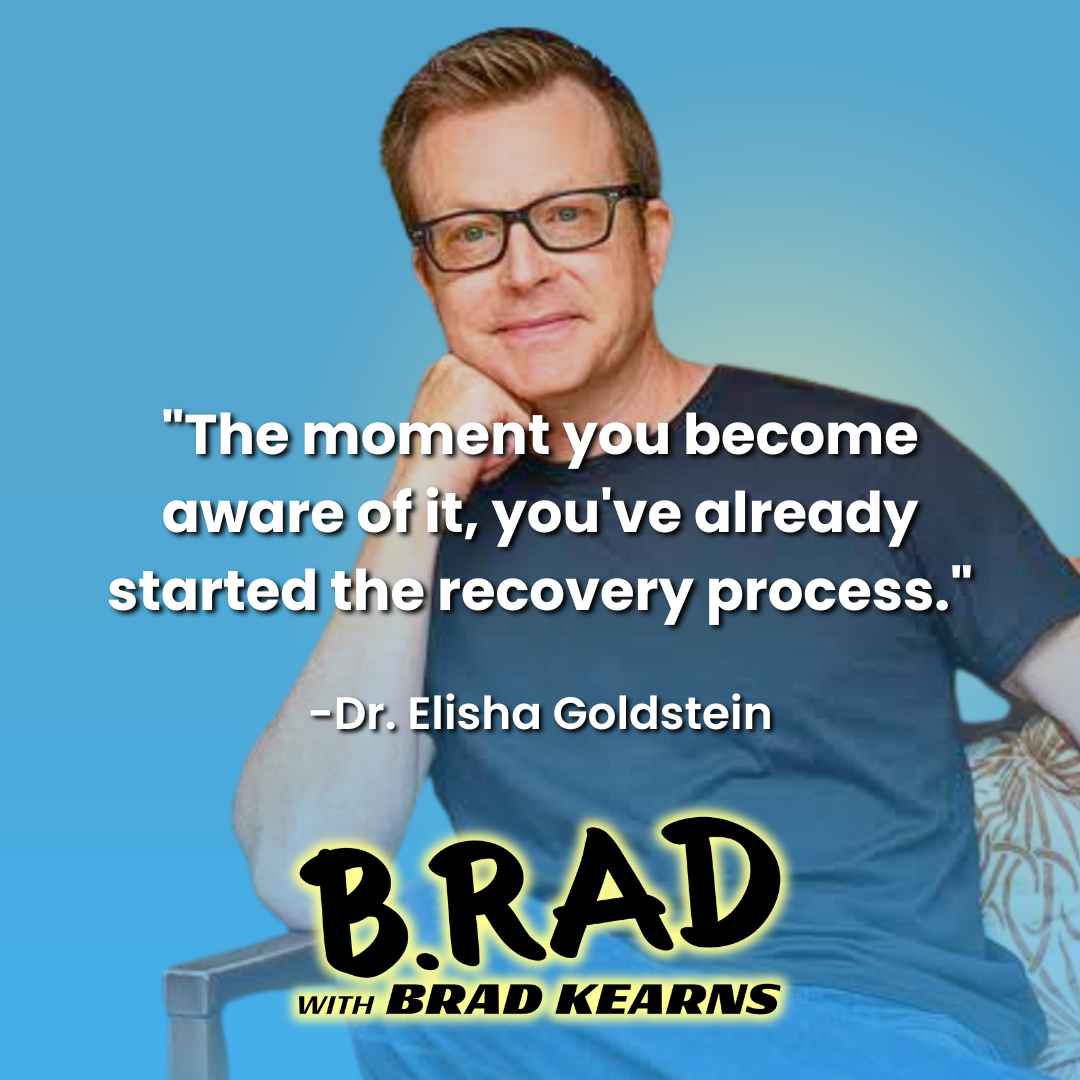
What if the emotional patterns you struggle with aren’t actually who you are? What if they’re just patterns—and patterns can be interrupted?
I’m joined by Dr. Elisha Goldstein, returning to the show eight years after his first appearance, to talk about his new book, Tiny Shifts: How Emotional Health Transforms Stress, Relationships, and Longevity. I’ve spent a lot of time thinking about healthy eating, exercise, fitness, sleep, and all the things we do to live a long and healthy life, but what about the emotional stuff? Because Elisha makes the case that emotional longevity is just as important as physical longevity—and that living in a high-stress, agitated pattern can potentially take years off your life.
We get into his simple 4-R method: recognize, release, refocus, reinforce, which can help you catch yourself in an overwhelmed loop before you spiral into those undesirable, repeatable patterns. We talk about why the skills we learn can easily fail us when we need them the most—when we’re under pressure, agitated, or triggered—and how to create more space between stimulus and response.
Elisha explains why emotions are biology, how getting in touch with what’s happening in your body can change the way you respond, and why asking your brain better questions can lead to better answers. We also talk about the everyday moments that can send us into these patterns, from traffic to social media outrage to difficult relationships, and Elisha shares a personal story about getting scammed online that puts all of this to the test in real time.
This is a fascinating conversation about emotional health, longevity, and learning to recognize the patterns that drive our behavior so we can interrupt them and give ourselves more choice in the moments when we need it most.
TIMESTAMPS:
Can Dr. Goldstein’s 4-R method be the tool we need when we get under emotional stress and dysregulation? [01:03]
We live in stressful times. Even when we see ourselves as living a healthy life, we might not be aware of how this stress is effecting our body. [07:01]
The moment of awareness when you realize that you are tense, your heart rate is up, that’s when you begin to recover. [10:25]
Your body always has a physical response. You can learn to map your feelings on your body. [15:10]
Our responses are just a pattern, not part of our identity. [20:01]
If a label (diagnosis) is helpful to you to identify something so you can better understand the pattern and create an intervention, it can be helpful. [25:24]
Trauma can be passed through generations. [27:14]
We learn to refocus. What do I need right now? [30:47]
When you can identify what you are feeling, your brain is mapping the sensation. [38:33]
Asking yourself questions like “What do I need? “Why aren’t I kinder to myself?” puts you in a more empowering place. [44:15]
When dealing with being taken advantage of, what comes after anger? [46:21]
An example could be if there was friction in your relationship, you can ask yourself, “What would it be like if I just stopped trying to argue and just listened instead?” [47:44]
Social media can be very much a detriment in a lot of ways to our minds and our culture. [49:51]
If you get wrapped up in some news that upsets you, it makes you obsess about it, creating anxiety. [51:24]
If you can overcome a pattern once, and not react with that triggered response, it’s a huge breakthrough. [54:27]
Listen to your experience. [01:02:03]
If your message to yourself is, “I should be able to shift my perspective and feel better,” you are just feeding the feeling of shame. [01:05:39]
LINKS:
- Brad Kearns.com
- BradNutrition.com
- B.rad Whey Protein Superfuel – The Best Protein on The Planet!
- Brad’s Shopping Page
- BornToWalkBook.com
- B.rad Podcast – All Episodes
- Peluva Five-Toe Minimalist Shoes
- B.rad Podcast – All Episodes
- Peluva Five-Toe Minimalist Shoes
- Book – Tiny Shifts: How Emotional Health Transforms Stress, Relationships, and Longevity
- Dr. Elisha Goldstein Podcast
- Uncovering Happiness
- elishagoldstein.com
 LISTEN: We appreciate all feedback, and questions for Q&A shows, emailed to podcast@bradventures.com. If you have a moment, please share an episode you like with a quick text message, or leave a review on your podcast app. Thank you!
Check out each of these companies because they are absolutely awesome or they wouldn’t occupy this revered space. Seriously, I won’t promote anything that I don’t absolutely love and use in daily life:
- B.rad Nutrition: Premium quality, all-natural supplements for peak performance, recovery, and longevity; including the world’s highest quality whey protein! Get 20% OFF your first order with code BRAD20!
- Peluva: Comfortable, functional, stylish five-toe minimalist shoe to reawaken optimal foot function. Use code BRADPODCAST for 15% off!
- Jaspr Air Scrubber: Ultra high-performance air purifier – blows other air filters away! Save $200 on your unit with code BRAD.
- Get Stride: Advanced DNA, methylation profile, microbiome & blood at-home testing. Hit your stride the right way, with cutting-edge technology and customized programming. Save 10% with the code BRAD.
- Online educational courses: Numerous great offerings for an immersive home-study educational experience
- Primal Fitness Expert Certification: The most comprehensive online course on all aspects of traditional fitness programming and a total immersion fitness lifestyle. Save 25% on tuition with code BRAD!
I have a newly organized shopping experience at BradKearns.com/Shop. Visit here and you can navigate to my B.rad Nutrition products (for direct order or Amazon order), my library of online multimedia educational courses, great discounts from my affiliate favorites, and my recommended health&fitness products on Amazon.
#bradpodcast
TRANSCRIPT:
Brad (00:00:01):
Welcome to the B.rad podcast, where we explore ways to pursue peak performance with passion throughout life. I’m Brad Kearns, New York Times bestselling author, world number one ranked masters age 60 high jumper and former number three world ranked professional triathlete. You’ll learn how to stay fit, strong, and powerful as you age, transform your diet to lose body fat and increase energy. Sort through hype and misinformation to make simple sustainable lifestyle changes and broaden your perspective beyond a fit body to experience healthy relationships, nonstop personal growth, and ultimately a happy, healthy, long life. Let’s explore beyond shortcuts, hacks, and crushing the competition to laugh. Have fun, appreciate the journey, and not take ourselves too seriously. It’s time to be wrapped. It’s time to B.rad!
Brad (00:00:51):
So it’s a choice for, you know, like, self-care when you’re feeling depressed or sorry for yourself or whatever.
Elisha (00:00:58):
Yeah, so this is where the method around tiny shifts comes into play. So we say, okay.
Brad (00:01:03):
Recognize, release, refocus, and reinforce. Could these suggestions change your life? Are you ready to make some tiny shifts that can make a huge difference? Then let’s get into it with one of my favorite podcast guests returning to the show eight years later from his first appearance in, back in 2018, Dr. Elisha Goldstein. I hope you’ll go back and listen to our first show, but today we’re gonna talk about his sensational new book titled Tiny Shifts: How Emotional Health Transforms Stress, Relationships, and Longevity. It recently reached number one bestseller in emotional mental health on Amazon. Elisha is a 20-year experienced clinical psychologist in the Los Angeles area, and he runs the Center for Mindfulness Living. His work focuses on how small moment to moment shifts and how we relate to stress and the emotional patterns that we follow can significantly improve resilience, relationships, and long-term health.
Brad (00:02:10):
He teaches this simple framework, the 4-R method, recognize, release, refocus, reinforce, that can help you regulate stress and shift emotional patterns in real time. And I love that aspect because as I consume a lot of content and have a lot of the world’s great experts on here and try to live my life in the best way possible, sometimes I realize that the skills that we’re aware of and learn about can easily fail us when we need them the most, when we’re under pressure, when we’re agitated, when we’re triggered. And that’s exactly what Dr. Goldstein focuses on in his book and in this conversation. I think it’s really gonna be valuable, and these takeaways can really stick with you. I’ve been thinking about some of his insights from our conversation in 2018 ever since, and now with the 4-R method, we can put into practice something, a tool that we can access when we get under that emotional stress and dysregulation.
Brad (00:03:13):
So a quick overview of what we’re gonna talk about. He’s gonna explain what the overwhelm loop is, and this is why we train the nervous system for chronic stress, which trigger subconscious emotional patterns that we use to cope, nevertheless, causing suffering. So we wanna come out of these patterns where we get triggered, default to our behavior that we’ve carried on throughout our lives, and do something that’s a little more peaceful and rewarding. The 4-R method comes in here, so what you’re gonna do is you’re gonna spot the loops. You’re gonna spot yourself going into this overwhelmed loop and apply your skills before you spiral into these undesirable, repeatable patterns. We’re gonna talk about emotional longevity, how making the tiny shifts can actually directly support your physical longevity. And another one that hits especially close to me, because I am so focused on the physical aspects of longevity, healthy eating, exercise, fitness, sleep, and then what about the emotional stuff?
Brad (00:04:25):
Yeah, man, it can take you down and take years off your life if you live in a high stress, agitated pattern, or if you can learn to apply these skills, boy, you can be off for smooth sailing and leveraging all the other great lifestyle practices that you follow to promote health, peak performance, vitality, and longevity. So let’s hear from Dr. Elisha Goldstein down in Los Angeles where he practices, and you can find the book, Tiny Shifts, wherever books are sold. Dr. Elisha Goldstein, I’m so glad to join you again. It’s been like eight years since our first podcast. And the occasion? A lot of the good occasions just to, just to hook up again, but a book, Tiny Shifts – Yeah. Is on the shelves right now as we record this. And it’s a wonderful piece of work representing all this background that you have and helping people navigate stressful modern life.
Brad (00:05:23):
I would love to get into the content and breathe through this show. I’m sure we’ll talk about all kinds of stuff. It’s really well organized. And I think, um, one of the best things I like is the title, because right away, it’s appealing to realize that we can make tiny shifts instead of transform your entire life on 12 hours of work a week. That would be more difficult. So tiny shifts, people, let’s talk about tiny shifts. Are you with us? Let’s do it.
Elisha (00:05:48):
And, if you’re, if you’re watching this and you’re, if you’re listening and you’re not watching, if you’re watching or you see that Brad has not aged a bit in the past eight years. It’s been really cool. <laugh> Uh,
Brad (00:05:59):
But I remember one part of the book talking about your emotional health and how that is directly correlated with health span. And that kind of hit me with some reflection because I’m such a freak about health and fitness and my diet and my workouts and, you know, is my knee injury gonna heal? Mm-hmm. And we’re talking about your son and his running injuries. I’m like, “No, not another high school runner.” So, um, you know, the physical realm and making the good choices when we go to Erwan and we’re okay paying $12 for a chocolate bar instead of three. And then there’s this whole other layer. And I’ve had some stressful events in recent times of my life that have really shaken my foundation of being extremely, let’s say, physically healthy. And you realize, like, man, what a, what a waste if you’re, you know, getting battered in a different direction.
Brad (00:06:52):
So, thanks for the compliment. That’s where we started this rant. Yeah. Uh, but we also wanna have a broader definition of health, I think, is what we’re talking
Elisha (00:07:01):
About. Yeah. I mean, you know, where this all started for me, aside from, you know, evolving this work around supporting my own other people’s emotional health over the last 20 years, was I was probably heading into my late 40s, maybe, and I was starting to get really interested in the field of longevity and health because I wanted to be there for my kids. Yeah. Kids’ kids, like, and be able to throw the football around, whatever it was. And I knew I needed to kind of gain strength in my body. So you’re kind of like an inspiration for that. And,I was reading a lot and listening to a lot of the influencers and authors around the field of health and longevity. And one in particular who I was reading who’s done, he’s so much work around all the different diet plans and exercise regimes and, like, everything.
Elisha (00:07:55):
And he came to the conclusion that at some point, he, he, he realized that his life was a total mess. So he was, he was so into his health and everything and all the research. And he was tossing tables over in his house and he was inevitably snapping at colleagues, like, at the workplace and inevitably went impatient. And realized that, like, you know what? If, if I can do everything right, I can try and, like, do all the big things in life and do them right, but if I’m miserable, what’s the point? And then I started, started to kind of studying the, like, what happens in the body, like, when we’re, when we’re running on high gear. I mean, I think a bit, like, you get a new car, and or maybe it’s like a car with some years on it, and you put it in the driveway, and you just put your foot on the pedal.
Elisha (00:08:50):
It’s just revving. When if you have it in the driveway just with doing that, like – Yeah. And you don’t take your foot off the pedal very often, it just kinda keeps going, you’re gonna run that car down. The engine’s gonna go out at some point much faster than other engines. So we could be doing all this work. And I’m a big believer, by the way, I still work out physically regularly. I eat, you know, pretty decently. But some of the research started showing that some of the elements of longevity have to do with our relationships and our sense of connection. Bob Waldinger’s work has one of the long- longest longitudinal studies on, you know, health and longevity showed that relationships were the core factor. And if you look at some of the areas where the blue zones are and all that, you see, like, the cultures there, like, do relationships really well.
Elisha (00:09:36):
They do community really well. Yeah. And there’s something about that feeling held, so, which allows us to take the foot off the pedal and, and recover because we feel safe. And I think that also impacts our physical health too.
Brad (00:09:50):
Recover in an emotional level too, you mean?
Elisha (00:09:54):
Yeah. Yeah. Meaning, meaning that you’re thinking about all the things that you need to do to be healthy, to take care of your family at the workplace. We’re being inundated right now with, like, all the things in the world wherever you fall politically. In the world, you’re bound to be fed by your social media. A lot of moral outrage that’s there. And you get pretty fired up about it. Yeah. And if your heart rate’s going up at a consistent level and your body’s tense on a regular basis, you’re wearing, you get a lot of wear and tear on your body.
Brad (00:10:25):
If you haven’t seen our first show or listened eight years ago when you talk about bracing, I think about that, um, probably every day for eight, eight times 365 is, you know, thousands of times. And iyou know, it’s important to bring this stuff into our awareness, because otherwise you’re just going through and fighting the battle and, like, you know, here we are in a big city, the city where I’m from, Los Angeles. And, when I come back and visit from, from not being into the mix so much, like, you get on the freeway, all of a sudden you’re in the battle zone again, you know, someone’s cutting you off or whatever. We can always kind of, like, get thrown into the fray instead of noticing and boy, it can, it can take you for a ride.
Elisha (00:11:09):
And that’s the idea Victoria behind tiny ships, is that we are caught in this condition patterning a lot of the times, implicitly and automatically. We’re not really aware of it. It’s not our fault. We’re just caught in the throws of life.
Brad (00:11:22):
I’m glad you said that right after I gave the freeway example, because, like, I’m down here. I grew up driving in this mix. I don’t care about. I’m not the most high attuned aware driver. And it’s just automatic. And my wife’s with me who’s going, “What are you doing? Why are you cutting that person off?” I go, “What person?” It’s just automatic. It’s like patterned behavior. Same with getting triggered and honking the horn and doing all these things that. It takes a toll.
Elisha (00:11:52):
Yeah. And if you know, if you get better at noticing that toll in the moment – In that toll, you talk about bracing. You know, so that was back when I was writing the book, Uncovering Happiness, I think, back then and we kind of bring it fast-forward into Tiny S90hifts and we say, “Okay, so you’re on the…” And, I can bring in some real wisdom here that I borrow from some other people, and I’ll name them. But you’re, you’re sitting on the freeway, and so if this is you also, if you identify with any kind of, like, traffic or, you know, feeling crunched, you know, while driving anywhere, you’re on the freeway, =-and you’re sitting there, and you’re noticing your hands kind of gripping the steering wheel, and you’re kind
Elisha (00:12:35):
And you feel like you’re in a rush, so you’re, you’re feeling anxious about it naturally. The moment you become aware of that, the moment you become aware of that, so we may call this a moment of mindfulness or a moment of awareness, and that’s just this first R that I have kind of in the Tiny Shifts method called recognize. Very well known, by the way, this isn’t, like, even something that I necessarily created. This is something that is in a number of the world’s wisdom traditions. This is the field of psychology talks about this. The f field of neuroscience talks about this. The power of just kind of labeling, noticing, like, how I’m feeling, “Oh, I’m tense. My shoulders are tense right now, or I’m feeling my heart rate up, or I feel like I wanna ram this person in the back of the, in the…” <laugh> You know, like, you know, go up what’s it called when you go right into the back about.
Brad (00:13:19):
the battering ram?
Elisha (00:13:20):
Yeah, yeah, yeah. Something like that. <laugh> So tailgating, I wanna tailgate this person. And, uh, you notice that and you become aware of it. That’s when you can begin to recover. You’ve started a recovery process, and you know this – Mm. Probably better than most people. When physicians are measuring your health, let’s say, and you’re running on a treadmill, not necessarily, like, you know, measuring your VO2 max or something like that, but you’re, you’re measuring your heart rate and all of a sudden you stop and they’re still measuring you, and you’re like, “Well, why are you still measuring me?” Yeah. They’re like, “I’m looking for your recovery.” So how fast does your heart rate recover to go back to a normal pace from being that same thing as for our emotional health? When we get there, we’re on the freeway, let’s say, and you can say, or you’re about to kinda snap at your partner, or you’re feeling worried or you’re, you’re catastrophizing about where the world’s going.
Elisha (00:14:13):
You take a moment, you recognize that. You begin the recovery process by noticing what you were talking about, which is, like, how is my body feeling rightnow? Right. Where we like to go is with our thinking. How do I fix this problem that I have in my head? You know, how do I fix this solution in my relationship? But if you actually start with, how is my body feeling? We begin to widen that space toward stimulus and response, which I just came back from a trip to Poland where I visited, you know, a lot of the different concentration camps and work camps that were there. And it reminds me of, you know, this guy, Victor Frankel, who, who survived the, the Holocaust. And he wrote the book called Man Search for Meaning, but the quote that’s been attributed to him, which you’ve heard and maybe many of your, uh, listeners have heard, which is between stimulus and response, there’s that space, and that space lies our power to choose our response, and our response lies our growth and our freedom.
Elisha (00:15:10):
So that space, being able to recognize puts us in that space, but it’s not enough. So that moment of mindfulness or awareness is not enough to change our reactivity. What most people miss is it’s, we are a nervous system. Mm-hmm. Our body is reacting. If we want more access to choice and perspective, we need to widen that space. And the next thing we have to learn how to do is really release the pent-up tension that’s there from being on that freeway or from going downstairs in my house and after telling my 17-year-old, you know, that it, to do the dishes a few times that he didn’t still seeing the dishes there and my face beginning to, like, heat up, and my body beginning to. And me just wanting to snap at him a little bit to say, “Hey…” Well, you know, because it’s pretty frustrating to be a parent sometimes.
Elisha (00:16:00):
<laugh> And so – If
Brad (00:16:02):
You’re watching children, uh, we still love you, but –
Elisha (00:16:05):
Oh, we love, we love you, but it’s frustrating. So, we react too. But to be able to catch it in real time, that’s the trick.
Brad (00:16:14):
Is this always necessarily connected? Like your body always has a physical response?
Elisha (00:16:21):
It always has a physical response.
Brad (00:16:23):
Yeah. I mean, it sort of could be called a dumb question, but-
Elisha (00:16:27):
But it’s, but it’s not. The reason it’s not a dumb question is because most of us. Look, we go to school preschool, kindergarten, grade school. You know, what we’re taught is that our thinking is everything. Right. Yeah. And to honor that, we’re very disconnected from our bodies. Yeah.
Brad (00:16:47):
That’s what I was. That was behind my question, is, like, sometimes my answer would be I’m disconnected. I don’t know, you know? <laugh>
Elisha (00:16:53):
I have no idea. Yeah,
Brad (00:16:54):
That, I get that. And I don’t know how I feel. Yeah. I don’t know how I feel about it. I just, I’m agitated in the brain and I need to first recognize and then, you know, to release, I guess you gotta acknowledge that your body’s connected.
Elisha (00:17:11):
And to generalize a little bit, men are typically less connected to their bodies than women. And so it’s a little bit more of a lift for men to be able to start to –
Brad (00:17:24):
A lift. Yeah. Okay. Yeah,
Elisha (00:17:26):
There we go. Yeah. And, and exactly. It’s good. Oh,
Brad (00:17:28):
I can lift. All right. Oh, I, I can do the lift.
Elisha (00:17:30):
Yeah. But it’s a good be – it’s a good, uh, metaphor analogy because that’s what we, we are doing. We are, we are training something here. Right? We’re training our ability to be more emotionally aware, more somatically aware in our body because our nervous system as our brain wraps around our spinal cord and down our arms and hands. We, we feel things. Mm-hmm. That’s why emotions are called feelings, because we really do feel them. Mm-hmm. When you think about anger, you think about, um, you know, I might feel it in my fists. I might feel it in my face. Yeah. I might feel like somewhere we think about joy. We might feel this whole lightness all over our body. Like when you start to get in touch with it, and one way to help is to get in touch with that is to think of a memory where something was really frustrating to you.
Elisha (00:18:19):
Like, or where something was really sad. Or where something was a beautiful moment for you. And you allow yourself to really think about this memory, and anyone can kind of do this here. And the more detail, the more detailed you are about who was there, what was said, what was it about this experience that was so frustrating or irritating or sad or joyful or `created laughter. And then you think about it in your mind, and then pay attention to your body. And you’ll start noticing your body will start to respond. The mind’s really powerful, if you think about it. <laugh> So, so you can get in touch with, you can begin to train yourself to get in touch with how emotions map on your body. Mm. How feelings map on your body so that you can begin to recognize them a little bit sooner.
Brad (00:19:08):
Positive and negative.
Elisha (00:19:09):
Both. Yeah. Yeah. Both positive and negative, comfortable, uncomfortable. Yeah. Pleasant, unpleasant. Yeah. Yeah.
Brad (00:19:16):
Then you get better at releasing and, you know, kind of –
Elisha (00:19:20):
So with the uncomfortable ones – mm-hmm. Yeah. You get, you can get better at releasing. And so what releasing means is literally if we think. I really think of it as physiology. Emotions are biology. So if, if I’m feeling angry on the freeway, or if I’m feeling angry with my partner or with my kids, and I’m going to kind of move into that snapping or do something that’s unhealthy for me, or maybe I stuff it with a bag of potato chips, or, like, whatever it might be,I can recognize the reaction sooner because I’ve had a little bit more training and being in touch with it. And then I can notice where am I holding this in my body?
Elisha (00:20:01):
So when the body goes to fight, flight, freeze response, of course, you’re gonna get tension, you’re gonna get blood flow in your muscles, you’re gonna get your heart rate’s gonna go up. So of course our body’s gonna react. So the question is, how do I go back to recovering sooner? So where is it? Like, literally, what I do is if I’m holding in my shoulders, and I think a lot of men, maybe women too, hold it in their shoulders. I literally will take a, a breath in. And again, your listeners might be familiar with this, take and release a little bit longer on the exhalation. But what I’ll be paying attention to while I do that is how my mu – my shoulders will begin to drop, and the muscles from my neck to my shoulders will begin to elongate. So you can kinda try it here.
Elisha (00:20:45):
Watch, watch. Breathe in for a second. Notice how your shoulders slightly rise. And as you breathe out, notice how they fall. And you can breathe out a little bit slower. Notice how the muscle begins to elongate a little bit.
Brad (00:20:56):
That’s exactly the posture tip that I got from awesome personal trainer in Los Angeles here, Jeff Page. He said, you know, show me some good posture and I reflexively go like this because I don’t like hunching over. Mm-hmm. And he’s like, “No, no, no, no. Drop.” And, like, I’ve, I’ve been walking differently ever since that, that comment. But it’s also a tension-free posture where this is like, “Oh, look at my shoulders. They’re so in line with my head.” Big difference.
Elisha (00:21:24):
Yeah. Yeah. And what’s the, what’s the message do you think the brain is getting when your shoulder’s released like that? Does it feel like it’s does it feel like there’s a threat? Or does it feel like it feels safe?
Brad (00:21:35):
Yeah, you’re okay. You’re
Elisha (00:21:36):
Okay. Yeah. Yeah. And that’s where we wanna get to. We wanna get to that place where we feel a bit more calm, a bit more grounded. We wanna feel. We want our, our nervous system to log that we’re okay, that we’re safe. Mm. Because then it won’t, it won’t be reactive. We won’t be in a reactive state anymore. Mm-hmm. So the more safety signals we can send to our brain, like, we’re safe. We do that through our body initially, so we recognize in order to interrupt. We recognize in order to interrupt the reactivity that we might consider, like, “Oh, I wish I didn’t react like that. I wish I wouldn’t. I wish I didn’t, you know, s- stuff my face when I’m trying to, like, reduce my stress. I wish I, I wish I didn’t, like, constantly worry when I put my head on the pillow to go to sleep.
Elisha (00:22:25):
I wish I didn’t say it’s just too much to get outside today, so I think i”ll watch this next Netflix show. You know, unless you need rest and recovery, and that’s really <laugh> that’s an important thing, right? So, but if it’s those moments, and you know those are common loops for you, like the procrastination loop, I call these loops, right? We, so we talked about initially in Uncovering Happiness a number of years ago. I talked about the depression loop, the anxiety loop. But really, these loops, these loops, which are thoughts, emotions, sensations, and the things we do, the actions – Mm. Can be named in any way. I can’t stand it when my kid doesn’t do the, uh, dishes loop. You know, you can kinda make it fun, but we can also make it emotional.
Elisha (00:23:08):
The anxiety loop, the sadness loop, the grief loop, the guilt loop. Yeah.
Brad (00:23:15):
So these are the subconscious programming that everyone talks about, especially in your world.
Elisha (00:23:20):
Yeah, and the patterning.
Brad (00:23:22):
The patterning and the loops come from. I keep doing the same stupid thing, possibly because this is my, my, my coping mechanism every time or something.
Elisha (00:23:31):
I learned this growing up. Yeah. I learned that it worked in a certain way to do this. It keeps me safe in order to, to stay in this place because it’s certain and familiar versus doing something different, which is uncertain and unfamiliar, which is a threat. Mm-hmm. I think the important point is a point that you, you kind of, like, named it as you were talking about it, is this is just a pattern. Mm. This is not, uh, your, this is not part of your identity, this idea that you have anxiety or that you snap at people, that you’ve snapped at people, or that you retreat when there’s, when moments get too intimate. You know, this is not, like, who you are. It’s just a pattern. And patterns can be interrupted.
Brad (00:24:13):
Mm. Do you, would you say this for any such thing that comes across your, your desk as, as a professional? Like, you know, because people are diagnosed and then they label themselves, “I have depression. I have anxiety.”
Elisha (00:24:28):
Yeah. Uh,
Brad (00:24:29):
What would you say to it?
Elisha (00:24:30):
I would say those are patterns.
Brad (00:24:34):
Oh, that’s gotta feel great for many listeners and viewers. .
Elisha (00:24:36):
yeah, I mean not now. Someone who has recurrent depression over time, that’s an ingrained pattern. That’s an ingrained patterning. And so, you know, it is true that research shows that the more often you have depression, the more likely you are to slip into it. That’s, there’s a reality of that.
Brad (00:24:53):
A beautiful way to put it. Yeah. It feels so empowering. Yeah.
Elisha (00:24:54):
‘Cause you’re not identified with it anymore. Yeah. It’s not the contact lenses you’re looking at life through. Now, it’s like, if there’s a pattern, I can do something about it. There’s a choice. I can begin to interrupt it.
Brad (00:25:07):
Even in a you know, a severe example of someone who’s been, been diagnosed with major anxiety disorder or whatever, and they go through life in this manner. It’s just the pattern’s really strong. It’s
Elisha (00:25:24):
Okay. The label’s okay. Yeah, sure. It’s not, I mean, so meaning. Well, let me preface that. Let me say something again. If the label is helpful for you to identify something so that you can better understand the pattern of it, so you can create an intervention that’s been useful to a lot of people. Yeah. Like, with anxiety, this intervention has been useful to a lot of people when, you know, if you have this pattern of anxiety, look, this has been helped try this because this has been helpful. Exposure or whatever. What, if that’s, oh, yeah, OCD or something. The. So that’s where it’s helpful. If it’s not. If, if what it does, if what the label does is makes you feel shame – Yeah. In some way. Oh, something’s wrong with me. Um – Yeah. And you get caught in what, you know, what I would call the shame loop.
Elisha (00:26:08):
If you get caught in that, then, then maybe we need to kinda say, okay, so maybe we need to drop that label and say you have a, you have a series of symptoms that you’re noticing that seem to kind of fall in this way and get triggered by these particular things. Let’s look at that. Maybe the label’s not helpful. But if the label is helpful. So it’s like, it’s different strokes for different folks. Mm-hmm. It’s not, not a one-size-fits-all. Mm-hmm. But for a lot of people, the label is something that says, like, okay, I got some certainty. Finally. Right. Someone’s named what I’ve been experiencing for so long, and it feels relieving to have it. Yeah. Okay. So now we gotta look at the pattern of it and see, okay, how can we work with it?
Elisha (00:26:49):
How can we begin to interrupt it so you can feel more resilient? Right. You don’t need to be imprisoned by this. Right. You know, there’s, there’s, there’s choices that you have. We just have to train you to get in touch with seeing those choices that are gonna be more adaptive for you when these patterns start showing up.
Brad (00:27:07):
So it’s a choice for, you know, like, self-care when you’re feeling depressed or sorry for yourself or whatever.
Elisha (00:27:14):
Yeah. So this is where the method around Tiny Shifts comes into play. So we say, okay, so we’re caught in this loop. Let’s say let’s say depression’s an example, or anxiety, because we brought those up. So I’m in an anxious loop. I, I see that a certain candidate got voted into office again, you know, in a new state, and I’m politically very, like, intense and/or I care, which means I really care a lot. Mm-hmm. And, it makes me really worried that this country’s going to hell in a hand basket. And I’m afraid for my community. I’m afraid for my. All of a sudden, I think, I need to act different, whatever. I go into this catastrophic place. Yeah. So I know I have a history of anxiety. Maybe I have transgenerational trauma from past grandparents who went through certain traumatic experiences.
Elisha (00:28:05):
And I think about, like, Holocaust survivors as an example. Their kids and grandkids can oftentimes be hypervigilant to certain dangers around them because the trauma. Anyone who’s gone through any kind of trauma can be that way.
Brad (00:28:21):
And the trauma can be passed through generations?
Elisha (00:28:24):
Oh, for sure. Yeah. Yeah.
Brad (00:28:26):
Is this a controversial take or is this sort of -?
Elisha (00:28:27):
I don’t think so. It’s a pretty known. Yeah, it’s a pretty known thing now. I mean, and it makes sense to me. Like, okay, so if you look at the field of epigenetics – Yeah. And you say, okay, so I am somebody you has a deep trauma. My cells in body code that. Because there was such intense stress – mm-hmm. In a, for a particular period of time or in a moment that my body encodes that. Well, okay, so then when I go to have kids, I’m gonna pass some of that along a little bit because – Epigenetic level. So then an environment, then the environment that you’re in can trigger that to come alive. It doesn’t mean that kid will necessarily live with a certain level of traumatic stress.
Elisha (00:29:21):
But if they’re in a particular environment, it can make it come alive. Wow. Yeah. It can kinda trigger it to pop up. And I know a lot of people who, you know, in my years as a psychologist and also certain friends or family, that certainly you can see it. You’re like, “Oh, okay, this is, this is clearly from past trauma. The, your hypervigilance or your need,” which isn’t necessarily bad. Sometimes it’s adapt- adaptive. Yeah. I was trained recently in, by, like, some, because I was traveling internationally, you know, there were some guys that came and did a training on, like, just being aware, basically. <laugh> Like, Just be aware when you’re traveling, because there’s people who are gonna come and pick
Brad (00:30:03):
Up a year or whatever. Yeah. You’re the, you’re
Elisha (00:30:05):
The traveler that’s not paying attention. They talk about being in different zones. Like, what zone are you in? Are you that guy that’s sitting by the train and, and sitting there just kind of scrolling on your phone, not paying any attention to where you are because you’re the, you’re potentially, you’re the easier target. And they say, “That’s being in the white zone.” So, like, they say you don’t wanna be in the red zone, which is being super hypervigilant that you’re paranoid. Yeah. Yeah. But, you know, you need to have some of relaxed awareness. I don’t know. It’s hard to do. But anyway, that’s a total side note from what we were talking about. I like it. Yeah. Yeah.
Brad (00:30:37):
So we recognize ourselves when we’re launching into a pattern and release the bodily symptoms.
Elisha (00:30:47):
Yeah. So now, so now what that does is it gives us a little bit of space. Okay. So it recognizes the interrupt. So we see things as patterns, condition patterns. The recognizes allows us to interrupt, so we notice the anxiety arising. We know that that maps in my body as increased heart rate as maybe tension in my arms or fluttering in my stomach. So as an example, like, where does anxiety map in your body? Mm-hmm. It’s as simple as that. So emotions are biology. So we’re able to notice it and begin to interrupt it. We name it, that re – creates a, an initial interruption. When we release it, that creates a bit more space. And now we get to the point of refocusing. So we, uh, we try and make it simple in this kind of four-hour method of recognize, release, refocus so it’s memorable.
Elisha (00:31:31):
Because when we’re having a difficult moment, it’s hard to remember things. We don’t really have access to memory. That’s why we can listen to so many podcasts, so many books and so many things. They still have tough moments. Yeah, you just don’t have access to it. Yeah. So, but, but if you train it – Yeah. So you can listen to this podcast right now and know that, okay, so that’s okay. So, so there’s nothing wrong with me that I don’t remember it in that moment. Mm. That’s just the way the brain works, but I can train it. I can begin to train it. So that just takes repetition, practice and repetition. And in the particular context where this arise, and then you’ll be far more likely to remember. Your brain will naturally have more access to like, “Oh, this is helpful right now.
Elisha (00:32:11):
Yeah, that’s right. Okay, rec – how am I feeling right now? Where’s it in my body? Okay, release. Let me see if I can kind of play with this.” Refocus is now, now we can take the steering wheel, begin to steer it in a different direction. Mm-hmm. And there’s a few ways we can do that. I
Brad (00:32:25):
Still haven’t responded to the guy that cut me off, by the way. I’m gonna refocus now and wave instead of honk. That type of thing, right? I mean – Well, we’re still kind of trying to get organized and navigate a stressful situation that came up.
Elisha (00:32:40):
So in that, in that particular scenario where you’re on the freeway, right? Or on the road or whatever it is, you’re recognizing your, you know, the, the anxiety or stress or frustration that’s there, right? And you’re, you’re noticing, you’re taking a moment and you’re seeing that you are gripping the steering wheel. Mm. You’re paying attention to your body right now. Again, the tiny shift here, if you just loosen a little bit, you’re gonna change the way you’re thinking in that moment too. It’s all connected. Mm. So you loosen a little bit, you take a breath, you kinda soften your shoulders a bit. You’re gonna think differently in that moment. So that now gives us access. So now we have access to more choice. So it’s those little small emotional pivots. So in that moment, you might do something that a friend and mentor of mine, Sharon Salzburg does, which she remembers.
Elisha (00:33:25):
I’m so mad there’s so much traffic and all this traffic here, but I have forgotten that I’m the traffic too. <laugh>
Brad (00:33:31):
Yeah.
Elisha (00:33:32):
And already can make you laugh. It could totally, totally shift, shift the
Brad (00:33:35):
Experience. Or, you know, your contribution to an argument if you’re arguing with a loved one, like, maybe more serious than a, a silly traffic example. Um,
Elisha (00:33:44):
Boy. But these are the, you know, I’ll let you go into that. But the silly traffic example is an ordinary moment of everyday life. Right. And that’s where, that’s where life is lived. Yeah. That’s where life is. It’s actually a good example. Yeah.
Brad (00:33:57):
Yeah. Dan Millman’s book, No Ordinary Moments.
Elisha (00:34:00):
I know that book. I, I know his other book. That
Brad (00:34:03):
Says it all. Yeah. But, um – That’s
Elisha (00:34:05):
A perfect one. Yeah. Uh,
Brad (00:34:06):
But, you know, if we, if we up the stakes and then we’re, um, really diving into pattern behavior because the thread is seemingly bigger, right? That’s where the refocusing, it seems like that’s when we get our access to skills and a big picture.
Elisha (00:34:24):
And they could be simple. And that’s the thing. The whole thing here is we don’t wanna make things complicated. We wanna make them very simple.
Brad (00:34:30):
Right. So we can be, you know – Society.
Elisha (00:34:33):
It’s accessible.
Brad (00:34:33):
Yeah.
Elisha (00:34:34):
It’s accessible and we can do it. The lift has to be low. It’s just so we gotta have – The lift has to be low. And so, and so refocus could be understanding that when we ask our brain questions, it searches for answers. And so if you’re asking what the heck, what are, what, like that, the political example I gave a second ago. Well, w – how is this world going to hell in a handbask? Or how am I unsafe right now in my neighborhood? Or how am I, you know, how am I, how is this gonna then explode to, you know, a much worse scenario? Or if you’re asking the question of, what’s wrong with me? How come I can’t, I know all the things to do and I just can’t seem to do them. Something must be wrong with me. What’s wrong with me?
Elisha (00:35:17):
Your brain has this natural intelligence. So we’re in the age of artificial intelligence, right? So we can kind of – Oh
Brad (00:35:23):
Yeah, natural intelligence. Yes,
Elisha (00:35:24):
We have this that’s still there. So yeah, yeah. Yeah. So the, you know, neural networks that were, that were created by Google are all based on our brain. We’re just, this, this thing is just far more advanced still than, yes, AI can retrieve information that my mind can’t retrieve, but the, but still at this moment, the brain is far more intricate, malleable, and complex than what we have right now. So we call this natural intelligence. So if you ask it these types of questions, it’s gonna give you the answers for it. What’s wrong with you? I’ll tell you all the things that are wrong with you that I think could possibly be wrong with you. Boom, boom, boom, boom, boom. And you’re just, you’re just taking it in because it’s not really not conscious. And so all of a sudden you feel shame.
Elisha (00:36:05):
And then you get stuck. And shame is a slippery slope, by the way, if you’ve experienced depression, to feel it, to sliding into depression, get caught in this shame loop. Or if you, if you ask, you know, how am I unsafe in this world,? you’re gonna come up with all kinds of things to worry about in catastrophic scenarios. And that’s why in cognitive behavioral therapy, we have the term catastrophizing. You know, the brain will kind of go into all those things. So what’s wrong with me? It’ll tell you that. What’s wrong with the world? It’ll tell you that. So if you know that’s how the brain works, and you recognize and you release, now you’re in a different place. There’s a bit more space. You can ask yourself a different question. Oh what would be most supportive to me in the next minute, in the ne – for the next 60 seconds?
Elisha (00:36:51):
Yeah. What, what do I, what do I need right now? What is it I’m actually needing right now? So if I, if I’m craving that, that cookie or that slice of cake, I know in my mind that’s not really what I’m, where I’m wanting to go. What am I actually needing right now? And like, you know, I remember in Charles Duig’s book, The Power of Habit. Mm. And I remember reading years ago when he had this kind of cookie craving. What he actually unpacked was what he was really needing was connection. That’s really what he wanted. He wanted to have a cookie because he wanted to be with his coworkers in the area and all kind of snacking together, but he really didn’t need the cookie. He really needed connection. And so when in the field of nonviolent communication, which is which was created by this guy, Marshall Rosenberg, years ago, he did a great job.
Elisha (00:37:44):
And we talk about this in Tiny Shifts. We lay out the map for, “Hey, I want you to get better at understanding what your emotions are so you can recognize them. And I wanna get you better at noticing what the correlated need is so you can get better at recognizing that. Because it’s like a puzzle piece. If you say I’m sad, or I’m angry, or I’m anxious, or I’m just feeling on edge, I’m feeling a little depressed.” If you’re able to name it, there’s typically a need not being met. If you say I’m calm and comfortable and I feel joyous, typically a need is being met. Mm-hmm. And so if we can begin to unpack that I feel sad, I’m needing comfort. I feel angry. I’m needing to feel understood. Mm-hmm. Or I’m needing an outlet, you know, whatever it might be.
Elisha (00:38:33):
Like for me, when I got caught in this whole Facebook scam thing, which, I don’t know if anyone’s heard any of my interviews might have heard me talk about this. Yeah. You heard me talk about this? No, no. Oh, God. It was a disaster. So I, I got, I got contacted by this, like, celebrity person who wanted me to be on a health panel. Okay. Not – That’s interesting. That’s what I, that was my thing. Okay, this sounds interesting. And, so they said, “We gotta set up a tech check because it’s gonna be on a Facebook Live and whatever.” I’m like, “Okay, cool. Get on with this tech check with this guy.” But the, you know, there was some red flags I started noticing, like, he didn’t show his video. And I’m like, I was like, “Okay.” But I was like, “But this is exciting still.
Elisha (00:39:18):
Maybe, whatever. He’s in the UK. I don’t know, whatever it is.” And so I go through this check, and he has me kinda go into the back end of my Facebook and kinda check a couple things. And then he’s like, “We’re, we’re kinda stalled on something. I’m gonna have to give you a call back and we’re gonna finish this.” I’m like, “Okay, but something felt weird.” So I went to the celebrity’s website. I went to their contact us, and I’m like, you know, let me. Is, this is what happened. Is this real? I, literally, within a minute, I got an email back. It was shocking to me how fast this happened. This is a scam. Oh. Don’t give them any information. Don’t click on any links. It was too late. Of course, I had done some of this. So I’m like, all of a sudden, I get this, so here we go.
Elisha (00:39:59):
The anxious loop arising, right? Are they going to steal my identity? Are, do they have access to my bank records somehow that I don’t realize that that’s happening? Are they gonna take over my whole social media platform and do some weird stuff? And so I started getting really anxious. I could feel up my body. Face was flushed. My heart rate was up. I was in a fight, flight, freeze response in that.
Brad (00:40:23):
I guess appropriately so. I mean –
Elisha (00:40:25):
Appropriately so. Sure. Yeah. Sure. But the question is, how fast can you recover? And so because –
Brad (00:40:30):
What can you do about it?
Elisha (00:40:31):
Yeah. So I, so I took a moment. I kind of, like, recognized it because I was in the middle of writing my book too. This book, Tiny Shifts, has really helped keep this top of mind for me. Okay. So I recognized it. I took a moment, and I was kind of just softening my body. When I see, when I say softening my body, especially for people who have chronic pain, let’s say, as an example, when you breathe them through certain exercises and you’re asking them to soften their body, they can’t soften the pain that’s there. It’s too, too tense, the chronic pain. Yeah. But you say, “Can you soften around it? Can you soften the muscles around it?” And this is kind of similar. Can we, can we begin to kind of shake it off? Can we begin to kind of soften around it just so we can feel a bit more grounded in our bodies? Mm-hmm. So with the refocus, I was “What do I, what do I need right now? What gonna help me? I’m gonna contact my assistant. I need to bring someone else in.
Elisha (00:41:17):
I need someone to help me with this.” I, I told her what was happening. I had her kinda take over a little bit. I was still pretty revved up. And I was like, “What I need right now is to go outside and get some sunshine on my face and go on a walk. I need to move my body just for a second.” I leashed my dogs. Went on a walk. And then something interesting happened. The anxiety that I experienced began to kind of fade and it began to turn into shame. Now these voices in my head were like, “What’s wrong with you? You saw these flags. Yeah, you sucker. Celebrity sucker. Yeah. Celebrity sucker.” Yeah. “You saw these flags. You went with it through, you know, you’re so desperate to want this thing,” you know, whatever. And I was so me – I was like – Wow, that’s wild.
Brad (00:41:57):
Just outta nowhere.
Elisha (00:41:58):
Oh, yeah. I had blown away about how mean these voices are. Yeah. Or were at the time. Yeah. And I was “Wow, this is real shame.” And so I named it, like, “This is shame.” So I was able to kind of. ‘Cause I’m, I’m playing with this work anyway. I’m, and I’ve been teaching it for a long time. And so I was fortunate enough to be actively working with it. It’s really available for me. This is shame. And I took a moment and I knew what was helpful for me. What helps me is when I. And I’ll explain why this works. For me, it may seem kind of a woo-woo thing a little bit, but I’ll explain why it’s helpful for me. When I put my hand on my heart or on my abdomen, what’s happening is my brain is mapping this sensation.
Elisha (00:42:39):
You can’t feel this – Uh-huh. Without the brain mapping this sensation. Mm. So when you’re. The part of your brain that’s maps the sensation of your hand on your heart, your hand on your belly is inversely correlated like a seesaw to the part that is called the default mode, which is more involved with narrating and thinking and planning and creativity, all kinds of great stuff, the wandering mind. So if you wanna kinda help ground the mind, you can become somatic for a second, touch things. I just watched the movie, what’s the Spielberg one, not Resurgence Day. Anyway, whatever. Um, uh, in the movie, the, um. It’ll come to me in a second, but everyone here might know what I’m talking about. She’s having a panic attack on the train. The guy says, “Let me hold your hands. Let me hold your hands.” She’s having a panic attack.
Elisha (00:43:29):
She’s holding her hands, and then he takes her hands and puts them on this accordion type thing. And so she can really feel the sensation of it. Hm. In that moment, I knew exactly what was happening. When you get in touch with sensation, you dial down the thinking, which is causing the panic. So it’s like a seesaw effect. So when I put my –
Brad (00:43:51):
People cut themselves and stuff.
Elisha (00:43:54):
That’s, that’s why people cut themselves, to get away from, right? That this pain is better than that pain. Yeah. that’s why some of my whole block of ice when they’re having anxiety because it just brings you to the sensation of
Brad (00:44:05):
Face and ice.
Elisha (00:44:07):
Water on your face, that kind of stuff. Yeah, same thing. Yeah. Seesaw effect with the part of the brain that’s activating the anxiety. Yeah. Yeah. So,
Brad (00:44:15):
So anything that generates a somatic respo -a feeling or a sensation will help you
Elisha (00:44:22):
Get out of your pure busy mind mode. We’ll start leaning in that direction. We’ll start taking some of the energy away from that part of, the part of the brain that’s spurring on the anxiety.
Brad (00:44:35):
Walking,, for example.
Elisha (00:44:35):
Well, so it’s, you know, walking can be helpful. Yeah.and if you walk while wearing those really cool shoes that you wear –
Brad (00:44:47):
Hey, put a plug. All right. <laugh>
Elisha (00:44:49):
And if you do that, or if you walk without shoes at all, let’s say, too. Or if, like, put them in the, put them in the grass – mm-hmm. And kind of walk on the ground like that. Or if you just pay attention to yourself walking and noticing the sensation of a connection of the feet to the ground, you’re gonna be more likely to have that seesaw effect. Yeah, for sure. So, you know, pay attention to that. So for me, the reason the hand on the heart is helpful, or two hands on the heart, is because not only do I pay attention to the sensation there, the colder my hand is, the better almost. But it’s also associated with caring. And that’s one of the things I needed. I was still being so mean to myself. Mm-hmm. My mind was being so mean that what I, one of the things I needed was to be kind to myself.
Elisha (00:45:32):
I even asked myself, like, “Can you even be kind to yourself?” That was another question I was trying to say, “Huh? Remember, when you ask your brain questions, it searches for answers, so better questions lead to better answers. So I’m asking myself better questions. Can I even be kind to myself?” And a little boy said, “Yeah, I think you can.” Ah. All right. So I started kind of continuing to walk. Anyway, this, this. I began to metabolize these emotions. The anxiety began to metabolize. The shame began to metabolize. Then I became kind of angry because I noticed anger there because I’m like, “How dare these people come and try and steal, come into my world and trying to steal stuff from me?” And that was really healthy, actually. Then I was really, I was kinda happy about that because I’m like, “This is a really healthy emotion.” It’s better than
Brad (00:46:13):
Being ashamed that you got scammed.
Elisha (00:46:15):
That’s right. Now it’s like, all right. Yeah. I’m kind of feeling a little assertive right now. I’m feeling, like, you know, a little stronger.
Brad (00:46:21):
It’s like, you know, the four stages of grief reapplied now to getting scammed on the internet. And I’m thinking, I got, I got scammed, too, by a Chase Bank fraud thing where the call came in a minute after I hung up with Chase somehow. And, I gave him everything they needed. And we need to change your password. You’re on the highest level of security. Oh, man. You know? I can remember feeling like an idiot and then getting super pissed and, it’s getting better, I think, you know, to say, “Hey, man, there’s bad people, bad actors out there. And it’s not your fault. So, yeah. Well, what’s after anger, though? Yeah.
Elisha (00:47:00):
Anger was where it, I said, so the, the key to this framework, recognize, release, refocus, helps you metabolize the emotions sooner so that you can kinda come back into a state of clarity and calm and groundedness. And what ended up happening after the anger, that was the last feeling that I felt. I ended up picking my son up. Yeah. After that, I brought him to his basketball practice, and I remember realizing, wow, that’s all gone. I really felt like I had moved through me, and it wasn’t by accident. It was, it was me kinda just working through it. But not with, again, not with these big lifts, just with these Tiny Shifts. Hey, I recognized how I was feeling. I was noticing where it was in my body.
Elisha (00:47:44):
I was beginning to release it or soften it, or I was understanding this is the feeling, and I have a correlative need. What if I could ask a question that could lead to a better answer? And some, again, some easy questions are, if it’s in a relationship, you could ask something like, “What would it be like if I just kind of stopped trying to argue right now and I just kind of paid attention and started listening? What would I notice that?” Or like, “What am I not, what am I not getting from my partner that I need right now? ‘Cause that could lead to better communication that’s there. Or what’s something that’s gonna…” And I mentioned this before because this is a, an easy one, but what’s something that’s gonna enhance the next 30 seconds of my day?
Elisha (00:48:23):
You know? You might need to take a moment and rest and take a break. You and I were talking about the power of recovery and taking your foot off the pedal when it comes to training physically. Yeah. Yeah. And, you know, same thing emotionally. Sometimes we need, sometimes we need a break, we don’t even realize it. You could be working for eight hours straight in the day and not have taken a sip of water or have moved your body. And if you get better at asking yourself, lchecking in with your body and asking yourself what you need, you might find that you start hydrating more, and you start moving your body more, and you start feeling better when you go home at the end of the day, and you’re less tired and exhausted and snappy with your family. Could be like that.
Brad (00:48:59):
That’s really cool. I’m reflecting that I probably don’t ask myself enough questions. And then I can think of times that I have, and it puts you in a, it puts you in a more empowering place. And your brain starts working in the right way to solve. I mean, it answers questions, but they have to be good questions. Yeah. They’re productive, you know?
Elisha (00:49:26):
And the basic one to have, like,
Brad (00:49:28):
Why, why is this person being such an idiot is one question I might ask in my brain. And it’ll
Elisha (00:49:31):
Find all the reasons they’re being in it. Why do I
Brad (00:49:33):
React this way when faced with a difficult circumstance? It’s a total, you know, I think it’s a good spin, just like moving from shame to anger to acceptance that shit happens on Facebook sometimes or whatever the, you know.
Elisha (00:49:51):
Shit happens on a Man, we’ll do a whole separate episode on the shit that happens on social media. And to me, just the real detriment in a lot of ways to our minds and our culture in specifically around the topic of moral outrage. Specifically because it feeds that and amplifies it and gets people pissed off and divided. And so there we are. We’re in our own emotional loop in that moment. You’re on Instagram, social media, you see someone that you like, something that you love to see because it’s feeding and confirming something that you think about, that you heard on this news channel or that news channel, and so you feel justified and righteous and whatever your view is, but you notice you’re feeling pissed pretty off about it.
Elisha (00:50:39):
At the same time, you’re caught in some kind of loop. Does that feel healthy? N- no, but maybe, maybe, you know, maybe it feels something about it feels good in some way. But it’s not, it’s not healthy because it creates divisiveness. And there’s something about feeding into our own anger that’s there. And just think, is that good for my body and my emotional health to be in this place on a. And then you find yourself wanting to listen to it more. I listen to this podcast. It’s gonna more inflame me and anger – Yeah. Make me feel justifying listening to this. I’m gonna get. And of course, your Instagram and Facebook are all listening, TikTok, whatever, are all listening, so they keep feeding. I went on this, so I’ll tell you an example of this. And this is a side note, but it ties into what we’re talking about.
Elisha (00:51:24):
I went on this, I went on this trip to Poland, and I was talking about certain political things that were happening when we got home. And four out of five of the reels that I saw, I wasn’t seeing your reel, I wasn’t seeing your reels while this was happening. Four out of five were all – They heard you. Moral outrage, politically, like whatever it was. And I was like, “This is putting me in an echo chamber.” And one guy that I really respect a lot, he says, “If you keep surrounding yourself by the same content and the same people that are reinforcing your own thoughts, you’re gonna become an extremist.” That makes sense. Makes sense. Makes sense. By definition. Yeah. And that’s, that’s not a great place to be in my – And
Brad (00:52:11):
I think about this a lot too, and it’s likewhen you match, when you match up with the thing you’re so offended with, you’re right there in the same category. Right. I talk to my son about this a lot because he’s very, you know, opinionated and politically inclined, whatever. Boy, it’s like you’re getting, it’s like you’re getting hit twice with it because I was upset about what the leader did and heartbroken that our country’s heading in a certain direction. And then I’m gonna get upset again by obsessing about it and engaging. And, I mean, I know there’s a balance point where I’m kind of on the apathetic, path here because I don’t wanna get continually flogged. I just wanna get through it and do something, do something positive and not obsess about things I can’t control.
Elisha (00:53:07):
Yeah. So, so we, we want. We ask ourselves in that moment if we are checking in, “How am I feeling right now?” That’s a simple question. Like how, how am I feeling right now? And when I say, how am I feeling right now, I don’t just mean it in the therapeutic way of, like, tell me you’re feeling sad or angry or something. That’s good. It’s good to be able to label and name our emotions, again, because we get better at noticing our needs. Mm-hmm. And then we can put the puzzle piece together to feel more calm and grounded and a little bit more clear and balanced. Yeah. But like, how’s my body feeling? Coming back to that. By the way, repetition is the mother of mastery. We’ve heard that kind of phrase before. Repetition with exercise, repetition with these types of concepts. So if you ever hear repetition, like that idea of coming to my body, softening my body, and you see your mind say something like, “Well, he said that before.
Elisha (00:53:52):
Can you say something different?” Pause for a second and realize that the way you become a master at an instrument, piano, guitar, fitness in your body, it’s repetition. So we want that. We want that repetition. Yeah, give it to me again. Remind me again. Yeah. Because I guarantee you, an hour or two from now or, now, or tomorrow, we’ll want that. We’ll, we’ll wish we had that reminder in those moments. So the more repetition, that’s how we think about positive neuroplasticity in the brain, that all happens with repetition.
Brad (00:54:27):
Speaking of Tiny Shifts, I will say that if you can overcome a pattern once, and not react with that triggered response, with an interpersonal, difficult interaction, I feel like it’s like this huge breakthrough. I can, I can feel it. I’m past that nonsense of, uh, getting offended when someone jumps in and interrupts me before I’m finished. And, like, if you can do it once, it really does set you up to, to kind of, you know, keep moving forward.
Elisha (00:54:58):
‘Cause what does it do? It creates, it creates a memory. Yeah. Of in this context, meaning in the context of my wife and I, or this friend and I, or at my workplace, or on the freeway, I was able to interrupt a certain pattern. Or when I found myself starting to beat myself up and going into that self-loathing place, because I was starting to get depressed, I was able to recognize the depression loop and be able to soften around it and start to focus on things maybe I appreciate, or things I know that are healthy for me, and I start to feel a little bit more accomplished and better. That moment that that happens, you’re talking about is where the fourth R comes in. So this is this moment of reinforcing. Why do we wanna reinforce? Because we wanna strengthen the memory of that experience of relief or of breaking that pattern or of that new idea or thought or perspective that came on for me recognizing, releasing, and refocusing, so that the next time it happens, my mind is more likely to remember it so I can do this repetition thing.
Elisha (00:56:02):
So one way of doing that is if you notice that breakthrough moment, it doesn’t have to be a big breakthrough, right? It could be, I was <laugh> that is a moment of reinforcing if you can do that genuinely.
Brad (00:56:16):
I’m patting myself on the back for you audio listeners. Yeah. Oh, yeah, yeah.
Elisha (00:56:20):
Yeah. So that, anything like that where we’re taking a moment to intentionally acknowledge the shift that happened, the moment of interrupting that self-loathing pattern, the moment of not snapping at somebody because you’re used to doing that, the moment of being able to interrupt the shame loop, the self-critical loop that’s there, and being able to give yourself what you’re needing, and you notice your body beginning to change how you feel – mm-hmm. Or you’re, or the moment you’re able to interrupt certain unhealthy behaviors because, you notice what’s really underneath it is some kind of need to soothe something. And so you’re able to recognize that, release it, and give and replace it with something that’s healthy and soothing. Let’s say talking with someone or connecting or doing, I hate to say this because not, not everyone is into this, but, like, doing a meditation or doing, or ta – or going on a walk or something that felt healthier for you and soothing.
Elisha (00:57:21):
Yeah. Then you take a moment. You can. If, if patting yourself on the back intentionally and that feels genuine, that’s great because it implants a memory. If taking a moment and just kind of closing your eyes and feeling that shift in your body helps so you can encode that somatic memory, that works too. If sharing it with somebody – Mm. Because you’re proud of this change that you made, this little pivot that you made, and that’s a person that’s gonna fan your flame and support this change for you, that’s a fantastic way to reinforce. So reinforcing is strengthening. That’s what it’s about. So we end with strengthening, recognize, release, refocus, reinforce to strengthen that shift that’s there so it’s more memorable the next time.
Brad (00:58:05):
Then off we go, the next time we recognize a pattern kicking in, we, we have the tools to do something different than. Uh, it seems like the opposite would be getting triggered, which is like this pop word now that my wife hates that word. She goes, “Don’t use that word for any reason.” I’m like, “Yeah, you’re right. It’s stupid and it’s sorta, it seems like sometimes it’s used as a catchall or like a cop out. Like, I couldn’t help it. I got triggered because, you know, the traffic was so bad or you, you ratcheted down. Yeah. Yeah. So this is like the antidote to just running around in life being, being trigger happy.
Elisha (00:58:42):
Well, I would say, like, there’s, there’s nothing wrong. And to me, there’s nothing wrong with naming you got triggered. But to say I got, I couldn’t help it because I got triggered. That’s where the issue lies. Yeah, that’s the issue.
Elisha (00:58:51):
What we wanna do is say, “No, no, no. Yeah, no, you wanna be aware of those triggers – Yeah. So that you can help yourself.
Brad (00:58:56):
Yeah.
Elisha (00:58:57):
Because the more you bring awareness to it –
Brad (00:58:59):
Yeah.
Elisha (00:58:59):
That you’re gonna be able to recognize it. Now you’ve interrupted the reactivity. So if it’s like a dominoes thing, I couldn’t help it. The guy pressed his finger on the dominoes and it just went. It’s like, okay, well, what if, what if you know, what if you’re able to do this? You notice the trigger, the domino, person pressing the domino. After the third domino, you put your hand there.
Brad (00:59:17):
Pick up a domino.
Elisha (00:59:18):
Pick up a domino.
Brad (00:59:19):
And the thing’s over.
Elisha (00:59:20):
Pick the domino, did things over. Yeah, that’s a nice little, That’s a good one.
Brad (00:59:24):
Vision Here. I love that.
Elisha (00:59:25):
Yeah. So recognize release. Does release help grab a couple
Brad (00:59:27):
Dominoes if you’re at, you know, while you’re
Elisha (00:59:29):
At it? Yeah. I think the recognizes the picking up the domino almost all on its own. Yeah. Sometimes the recognition on its own can really be all you need. Like sometimes the – Yeah. To interrupt enough. Yeah. To me, it always has to be followed with the release. Why? Because the release, first of all, feels pleasurable – mm-hmm. To take a moment and just kinda like recover your body for a second. Mm-hmm. Like that’s been activated. Mm-hmm. Something about that feels good. Sometimes that’s really all you need. That’s a game changer all on its own to interrupt certain patterning that’s there.
Brad (00:59:58):
Yeah. Yeah. I mean, I’m speaking for the, the, the men, the heavy lifting men that might not be that in touch with it. Yeah. And I do feel like I’m sometimes not that in touch with my physical body when my head is spinning because I’m working on an issue or getting triggered or whatever. So like, is there any other comments you have on that if I help someone who’s like, you know, people say, “Oh, I felt a pit in my stomach when-“
Elisha (01:00:26):
No, I think the stock
Brad (01:00:27):
Draw hit. I’m like, “A pit in your stomach? Why? I was just ” you know, or whatever.
Elisha (01:00:31):
Like, “Why didn’t I buy that IPO?” Yeah. Um – So, uh, you know, I think for. Actually, to be honest, for most men that I’ve worked with, mo- most men do hold. If you’re not paying attention to it, you’ll notice you’re holding it in your shoulders. Oh. Like, or your face.
Brad (01:00:45):
And – Oh, yeah, yeah. Right? Yeah. Yeah. Jaw. She heistening as a jaw. I definitely use that. Shoot,
Elisha (01:00:50):
Too. Yeah. You might notice, like, tension around the eyes that are there, not just between the eyes, but actually like the muscles around the eyes. And sometimes just taking that, that moment to, if you don’t know where it is and just assuming – Mm. And looking for, is it, do I, am, is there tension in my shoulders? Again, like, just like we did here with breath, if you take a breath in, you take a breath out, you’re releasing the shoulders naturally.
Brad (01:01:15):
Yeah, everyone talks about breathing as a huge –
Elisha (01:01:17):
And it’s not even, and it’s not even about the breath in this case. Like, in this case, like, there is a real value. Here, here’s the, there is a real value to breathing in and breathing out a little slower and longer. There is that, that, there is a reality to that, especially if you’re counting, because, like, think about what you’re doing for that second. Aside from the activating the parasympathetic nervous system, which people say, you, none of us can see it, so it might not seem like a tangible – Yeah. Thing. It sounds good, right? But if you do it and you count, your brain has to focus on the counting, which means it can’t think. It’s like that same. Yeah. It can’t think. So you’re really, like, mediating the thinking, you’re neutralizing the thinking, which is part of the reactivity that’s happening.
Elisha (01:02:03):
Yeah. Our, your thoughts are our fuel – Yeah. For all of these loops. And so if you, if you do the counting, breathe in for the count of four, breathe out for the count of six or eight or whatever feels right for you. Yeah. You’re neutralizing the thinking, and then you’re noticing your shoulders come down a little bit. You will start feeling a bit more space that’s there. And when you feel a little bit more grounded, a little bit more calm, we’re looking for, like, five, 10% here. We’re not looking for the epic,
Brad (01:02:32):
Like, I’m- I’m, I’m a
Elisha (01:02:33):
Swammy, you
Brad (01:02:35):
Know, okay, I’m floating six inches off the
Elisha (01:02:37):
Gorgeous, just looking for a little bit. That’s all you want, because that’s the progress you’re looking for. Yeah. So you, so we kind of, like, do that. You’ll notice it. And, and I’ll, I’ll never forget when someone taught me forever ago, um, where they said, “Listen to your experience and allow that to be your guide.” So you listen to these podcasts, you read these books, but if you do that practice and you notice a little bit of ease come into your body, that’s the most important thing. Because now your experience is telling you what, what feels right for you, what the right direction is for you. So you recognize, you release to create a little bit of space so that you can get in touch with the choice, the perspective to do something different.
Brad (01:03:19):
Listen to your experience.
Elisha (01:03:21):
Listen to your experience, allow it to be your guide. Yeah.
Brad (01:03:24):
I mean, there’s a bunch of crappy things about getting older, including the recurring injuries when I’m trying to sprint fast. But I do reference a lot these days. I’ve already been through this, you know, financial crisis or whatever’s going on. And I can handle things better because of my life experience. So I’m gonna celebrate that part of getting older, having, having a block here where, I don’t know, a 20-year-old listening doesn’t, might not have as many memories to reference. And it can be tougher,
Elisha (01:03:56):
You know? And what do you notice when you refocus on that? When you pivot and refocus on that? What’s different for you?
Brad (01:04:03):
Well, less of what’s the big term from deep CBT? The, the long word. Catastrophizing. Oh, less catastrophic. Yeah. Yeah. I have less tendency to catastrophize, which it’s not an issue. I just don’t do that. Mm-hmm. And gosh, I’m, I’m thinking of another one now that, now that you put me on the spot. Like, you know, watching my dad have this great lifespan, he made it to 97. He had a beautiful, graceful, and pretty much rapid decline. So he had 95 awesome physical years. He was playing golf, and then the last two, he got tired and slowed down, and his walks were shorter, and then we said goodbye. I was. You can’t ask for better.
Elisha (01:04:45):
That’s what you want. Yeah.
Brad (01:04:46):
And so seeing that play out in front of my eyes, it has a tremendous impact on me every day. ‘Cause it’s like, look, we’re all headed there. So why, why beat yourself up with shame, anger, and all these things because you got scammed on Facebook? I feel like my dad’s looking down going, “Yeah, yeah, whatever.” You know? Um, and I think everyone can access memories and experiences like that. I’m a huge dog lover as you are. We have a champ sitting here waving after an alarming bark to keep us safe. But, the dog’s lifespan in a compressed manner in front of you happening, you know, my five favorite dogs in my life over my entire lifetime. Um, it, it’s. I don’t know how to describe but it gives me a better sense of peace than just, you know, battling through all the things that you we face in life.
Elisha (01:05:39):
Yeah. But I’ll just add this for anybody. The reason we need the release is because this, because exactly what you were talking about just now around the shift in perspective, basically. What would my dad be saying about these kind of small things, you know, like, whatever. We try and go from I’m recognizing I’m feeling shame, to, just, “I should be able to just shift my perspective and feel better,” that’s when we catch ourselves, like, feeding the shame.
Brad (01:06:09):
Oh, yeah.
Elisha (01:06:09):
Because we,
Brad (01:06:09):
We can’t grasp that new mindset. That’s a shameful suggestion to yourself.
Elisha (01:06:15):
It is. Well, we can’t grasp that mindset. And so what it, what it does is, we say, like, “Look, I’m here right now. Yeah. I should be here because I should be thinking like this. But we, we, we can’t because our, our physiology is wrapped up still in that emotion. So we can’t quite get there. And so what happens is because we can’t quite stick with that, I should just be grateful for what I have. Look, I live in a great place. I had an okay childhood. And, like, so why do I feel depressed or upset? What’s wrong? We get this same feeling, like, what’s wrong with me? I should be able to think this way. Like, oh my God, people went through the Holocaust and we’re resilient through it. These survivors, and they went through the, what’s wrong with me?
Elisha (01:06:58):
I’m upset because I didn’t get the, the promotion that I wanted or whatever. And sometimes that could put things in perspective and kinda kick you out of it. Sometimes it, because we still feel upset – Yeah. We minimize What’s the word? I’m blanking on it right now. But we, we don’t give credit or we don’t honor or acknowledge the, the feeling that we’re feeling. And we, and so we, we tell ourselves not okay to feel this way. Mm. And so we feel like something’s wrong with us. So instead, if you, but if you recognize and you release and you create a little bit more space, you’re far more likely to actually begin to entertain that new mindset. Because you’ve now unwound your body a little bit. You’ve created a little bit more space. And you can ask yourself, can I even entertain the wonderful things I have in my life?
Elisha (01:07:54):
Can I even begin to acknowledge those? Can I both hold the sadness that’s here on the anger, the, you know, whatever might be here? And can I also both hold the wonderful things that are happening in my life? Things I’m blessed with, let’s say. And if we ask that question, you might find, like, yeah, I can hold both. Um, I don’t have to just go put on Pollyanna rose-colored glasses and not acknowledge the difficult things. Yes. Yeah. Just because some people had it harder than me. Yeah. Like, both are true. Can I hold both? Yeah, I can hold both. Yeah. And see what that’s like.
Brad (01:08:27):
Whew. Right when you said that about the rose-colored glasses, I realized, like a lot of times. I’m coming up with my own example again. Sorry, listeners, but you, you’re stuck with it.
Elisha (01:08:39):
Stories are good.
Brad (01:08:40):
I’ve skipped over all four many times by putting on a happy face and being a super positive guy and insisting that I maintain this position rather than get into it and do. I mean, it’s a Tiny Shift, but it’s somewhat hard work when we’re used to doing something else. And the strain and exhaustion of just being always positive. Mm-hmm. Yeah, and it’s hitting me right now that I skipped over all four.
Elisha (01:09:13):
You notice that. There’s a value in these uncomfortable emotions. Yeah.
Brad (01:09:17):
And I’m giving the happy face example, but we have all manner of distractions that we can engage in today.
Elisha (01:09:25):
More than ever. I have
Brad (01:09:26):
No other including addiction to. I do this sometimes when I’m in a group at dinnertime. Ra- raise your hand, anyone here who’s not addicted.
Elisha (01:09:34):
Also a website. Okay. Because we’re, we’re all
Brad (01:09:36):
At least addicted to mobile technology and many other things. But all those things serve a,
Elisha (01:09:43):
A, a, a purpose
Brad (01:09:45):
Of distracting us from doing what, what we can to you know, to transform our lives, essentially.
Elisha (01:09:53):
Yeah. Yeah. I feel, I wonder what the impact is on our kids right now and not being able to experience a lot of boredom or not being able to. Or if they are feeling uncomfortable feelings, they can just go and kind of soothe themselves with their phones. ‘Cause we do that now too, but, like, we didn’t grow up with that. And so, um, I. And the impact on us too, because there’s a, uh, there’s a great quote. There’s a great quote. There’s a great poem by this 13th century Sufi poet named Jalaldien Rumi. You might have heard of this, this guy before you heard him. I’ve heard of Rumi. Okay. Yeah. Where he says, “This being human is a guest house.” You know this poem?
Brad (01:10:30):
No.
Elisha (01:10:31):
“Every morning, a new arrival. A joy, a depression, a meanness. A momentary awareness comes as an unexpected visitor.” So he. joy, depression, meanness, right? Yeah. And he says, “Welcome and entertain them all. Even if they’re a crowd of sorrows who come to violently sweep your house, empty of its furniture,” says still keep something like greet, greet everyone laughing and invite them in. And then the end of the poem says, “Because why? Because each has been sent as a guide from beyond,” which means, like, there’s something to learn from, from our feelings. If we, if we know that we are feeling sad, and we try and just soothe ourselves out of it, we don’t give ourselves the opportunity to realize that, “Oh, I’m feeling sad. I’m naming the emotion recognized. Okay, soften around it. I refocus on what do I need right now?
Elisha (01:11:22):
Well, I’m needing some love. I’m not getting that from my partner right now. I’m not getting that from my kids right now. I’m not getting it from myself right now. So then what can support me in moving in that direction?” So we get to kind of unpack this and we get to learn how to strengthen the muscle of loving ourselves or caring about ourselves, being kind to ourselves, or communicating with people because you get caught in relationships, you get caught in certain habituated ways of being with each other and you stop communicating maybe. Yeah. And, and you can then communicate, “Hey, I noticed we fall into this kind of pattern together. I’m noticing that I’m kind of feeling this way right now, and one thing that I’m aware that I’m needing is a little bit more contact with you.” You know, that kind of thing.
Elisha (01:12:03):
We only can do that if we get, if we lean into what’s uncomfortable. Otherwise, we just kind of go on doing the same old stuff.
Brad (01:12:11):
Or distracting endlessly.
Elisha (01:12:13):
Endlessly, there’s no self-awareness to be able to communicate with people. And again, coming back full circle to one of the cornerstones of longevity is feeling a sense of connection in our relationships. Mm. And if the more we can do to kind of strengthen that sense of perceived connection in our relationships, the better it is for our health.
Brad (01:12:33):
That’s a pretty fantastic finish to memorize a freaking poem. Yeah. <laugh> And spit it out for the users of you. Imperfectly. Yeah. I mean, I memorize rap lyrics, but that’s not nearly as valuable.
Elisha (01:12:45):
That’s pretty cool.
Brad (01:12:46):
My soul’s escaping through this hole that escaping. Ah, wonderful.
Elisha (01:12:51):
Yeah.
Brad (01:12:51):
The Rumi Quote, I mean, if you’re not inclined to go and memorize it yourself, welcome all those different people to the house is – Yeah. Is great. emotions and, and situations. Yeah.
Elisha (01:13:04):
Yeah. I mean, I think that movie, what was it with the cartoon characters? Oh, anyway.
Brad (01:13:13):
Uh, and yeah, I – Look it
Elisha (01:13:15):
Up anyway.
Brad (01:13:15):
I feel good that you blank on a couple movies because I blank on the one I just saw last night. Disclosure Day.
Elisha (01:13:20):
That was the one I noticed really in here. Yeah, that’s the one. Okay.
Brad (01:13:23):
Disclosure Day
Elisha (01:13:24):
Yeah. By the way, the message in that movie was the greatest thing that these, extraterrestrials, came to with this advanced civilization was empathy. Empathy was the strongest muscle you can – Wow. You can flex, to because it creates connection versus disconnection.
Brad (01:13:42):
Right on. Okay, now it’s time to do a tiny act, which is go and purchase the book, Tiny Shifts, Amazon and everywhere else books are sold. Do another Tiny Act and leave a review. Yeah. The authors like that. It helps the profile of the book. It makes a huge difference. So if you enjoyed the show, get the book. Do you wanna talk about the top secret programming that’s coming up the four remaining spots? I mean – Oh,
Elisha (01:14:08):
Great. Yeah. I don’t know if it’ll be four by the time this comes out, but – Maybe. Could be nexttime. Yeah, this is doing a thing. This in late August, we’re, we’re starting the Emotional Longevity Lab. People have been coming in. We have, there’s only 20 spots in the whole lab. So we’re it’s a far more personalized, it’s my most intimate container that I’ve created to really make impact and helping you interrupt any of these loops that you experienced in your life. Anything that are these condition patterns that you’ve worked with over times that over time that you haven’t been able to really kinda crack the nut on. That’s what we’re gonna be working with. All the things we’ve been talking about today are integrated into the program, and it’s all very personalized for you to make the progress you’re looking to make.
Elisha (01:14:50):
So, feel free to contact me at elishagoldstein.com. And we can set up a time to explore it.
Brad (01:15:00):
Dr. Elisha Goldstein, coming at you from LA. Great to get with you and get the book, Tiny Shifts. Thank you for listening, watching. Thanks, everyone.
Brad (01:15:12):
Thank you so much for listening to the B.rad Podcast. We appreciate all feedback and suggestions. Email podcast@bradventures.com and visit bradkearns.com to download five free e-books and learn some great long cuts to a longer life, how to optimize testosterone naturally, become a dark chocolate connoisseur, and transition to a barefoot and minimalist shoe lifestyle.