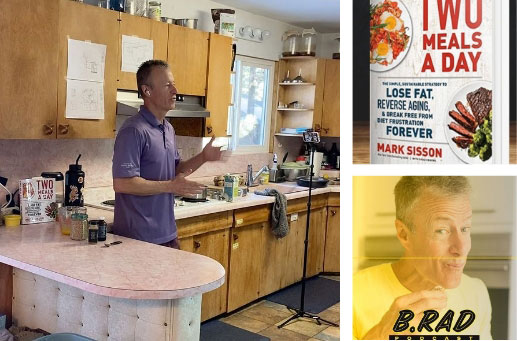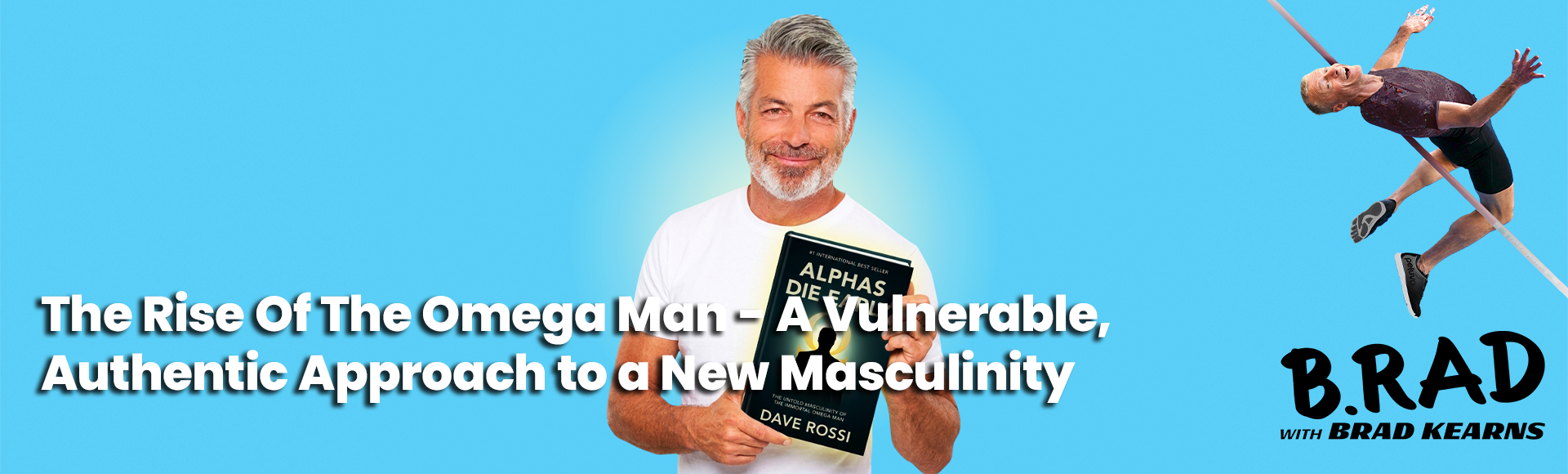
In this episode, I talk with my good friend and greatest mentor for personal growth and self-awareness, Dave Rossi—appearing for his fifth time on the podcast, a new record, in the B.rad studio during his tour for his new book, Alphas Die Early: For the Man on a Mission — And the Women Who Love Him.
The book is so rich and deep, and I strongly urge you to read it—it can be life changing, as it has been for me. I had the great privilege of contributing to the book, and every time I talk to Dave, it’s like a 10-hour therapy session packed into a short conversation, where you get these awakenings and ideas that can help you navigate every single day.
We discuss the rise of what Dave calls the Omega man—a new, evolved definition of masculinity—and the central argument of Alphas Die Early: that the traditional Alpha male model, driven by dominance, control, competition, and relentless achievement, is ultimately destructive. The very traits that create success in business and status—stress, emotional suppression, ego, and constant striving—can also lead to burnout, poor health, and shortened lifespan.
Dave explains the shift toward leading from self-awareness, emotional control, authenticity, and purpose, emphasizing inner calm over constant pressure, authenticity over performance, vulnerability over emotional suppression, and sustainable purpose over endless achievement. It really comes down to this: the traits that help men win in modern society can also destroy them—unless they evolve toward a more balanced, self-aware way of living and leading.
Finally, our conversation ends with me throwing a few “Rossi-isms” back at him—ideas and notes I’ve taken from our many conversations that really stick with me and continue to shape how I think and show up day to day, and Dave shares his perspective on each of them.
TIMESTAMPS:
The traits that help men win in modern society can also destroy them unless they evolve toward a more balanced, self-aware way of living and leading. [01:54]
Society is taking a whole new look at masculinity. We don’t understand what it means to be Alpha. [08:06]
Being masculine wasn’t a behavior 80 years ago like it is today. [12:39]
Learn to not be reactive to pushes that come at from others. Learn about what triggers you. [16:55]
Gratitude stops the landslide of negative thinking. [22:43]
We’re all biologically driven to be Alpha, but then in real life, we learn to cope. [24:42]
Every day is going to be another opportunity to get triggered. [28:52]
You shouldn’t have to compete to survive. When you are competing, it isn’t really you, it’s your identity or your ego that is competing. [32:50]
When you develop your awareness of your reactions, you can begin to slow down and develop techniques. [40:50]
Brad and Dave talk about a coaching method and how it works or doesn’t work. [47:22]
Apologies are nice but sometimes they don’t satisfy. Compassion for the person you hurt is very effective. The only true apology is a changed behavior. [53:33]
It’s not the events that makes us angry, it is the belief in them that does. With that awareness, you can chose your behavior. [56:11]
In the business world the same sense of the need to survive exists. [01:01:21]
Are you doing things for the right reasons? [01:11:13]
Do you have to be successful to like what you do? [01:21:40]
Are you stuck with your desires and don’t know how to get what you want? [01:22:13]
We have to stop looking at the rest of the world as our example for success. [01:27:53]
Don’t react to emotions. They’re not the truth. Emotions cannot exist without thought. [01:29:23]
It is important to let people with whom you deal what your preferences are, what you think, what you want, your values, your principles. [01:34:42]
You don’t have to let go of your beliefs to accept somebody else’s. [01:38:14]
LINKS:
- Brad Kearns.com
- BradNutrition.com – 20% OFF Your First Order!
- B.rad Superdrink – Hydrates 28% Faster than Water—Creatine-Charged Hydration for Next-Level Power, Focus, and Recovery
- NEW: B.rad Real Rad Gummies – Creatine + Nootropics for Focus, Motivation, Performance, and Recovery!
- B.rad Whey Protein Superfuel – The Best Protein on The Planet!
- Brad’s Shopping Page
- BornToWalkBook.com
- B.rad Podcast – All Episodes
- Peluva Five-Toe Minimalist Shoes
- Alphas Die Early
- The Imperative Habit
 LISTEN: We appreciate all feedback, and questions for Q&A shows, emailed to podcast@bradventures.com. If you have a moment, please share an episode you like with a quick text message, or leave a review on your podcast app. Thank you!
Check out each of these companies because they are absolutely awesome or they wouldn’t occupy this revered space. Seriously, I won’t promote anything that I don’t absolutely love and use in daily life:
- B.rad Nutrition: Premium quality, all-natural supplements for peak performance, recovery, and longevity; including the world’s highest quality whey protein!
- Peluva: Comfortable, functional, stylish five-toe minimalist shoe to reawaken optimal foot function. Use code BRADPODCAST for 15% off!
- Jaspr Air Scrubber: Ultra high-performance air purifier – blows other air filters away! Save $400 on your unit with code BRAD.
- Ketone-IQ Save 30% off your first subscription order & receive a free six-pack of Ketone-IQ!
- Get Stride: Advanced DNA, methylation profile, microbiome & blood at-home testing. Hit your stride the right way, with cutting-edge technology and customized programming. Save 10% with the code BRAD
- Online educational courses: Numerous great offerings for an immersive home-study educational experience
- Primal Fitness Expert Certification: The most comprehensive online course on all aspects of traditional fitness programming and a total immersion fitness lifestyle. Save 25% on tuition with code BRAD
I have a newly organized shopping experience at BradKearns.com/Shop. Visit here and you can navigate to my B.rad Nutrition products (for direct order or Amazon order), my library of online multimedia educational courses, great discounts from my affiliate favorites, and my recommended health&fitness products on Amazon.
TRANSCRIPT:
Brad (00:00:00):
Welcome to the B.rad Podcast, where we explore ways to pursue peak performance with passion throughout life. I’m Brad Kerns, New York Times bestselling author, world number one ranked masters, age 60 high jumper and former number three, world ranked professional triathlete. You’ll learn how to stay fit, strong, and powerful as you age, transform your diet to lose body fat and increase energy sort through hype and misinformation to make simple, sustainable lifestyle changes. And broaden your perspective beyond a fit body to experience healthy relationships, nonstop personal growth, and ultimately a happy, healthy long life. Let’s explore beyond shortcuts, hacks, and crushing the competition to laugh. Have fun, appreciate the journey, and not take ourselves too seriously. It’s time to B.rad.
Dave (00:00:51):
We are wired to be an Alpha. Yeah, we all want to be Alphas, period as a biological unit, but we’re the only animal on this planet that has
Brad (00:01:02):
It is a great pleasure to welcome my in studio guest, Dave Rossi, appearing on the BA podcast for what I believe is the fifth time, a new record on the wonderful occasion of the publication of his new book. Alphas Die Early for the Man on a Mission and the Women Who Love Him. We try to get into a lot of the content of the book, but the book is so rich and deep. I strongly suggest to urge you to read it. It can be life changing as it has for me. I had the great privilege of contributing to the book, so I had some cute little notes at the end of each chapter to kind of bring down the intensity and the heaviness and offer some real life commentary. Uh, it was super fun. I think it came out really well. But this is Dave’s second book.
Brad (00:01:54):
The first one was called The Imperative Habit, also life changing with these memorable insights and direct practical instruction for how to implement them into your life. So, since we touched on a lot of topics and didn’t go straight through the book, I think I’ll use this intro to give you, uh, an idea of what the book’s all about. Boy, Alphas Die Early. It’s time for an evolved definition of masculinity and modern life. Cut through some of the challenges and the flawed information that’s getting programmed into our brain and discuss the rise of what Dave calls the Omega man. Alphas Die Early argues that the traditional Alpha male role model driven by dominance, control, competition, and relentless achievement is ultimately destructive. His core message is at the very traits that create success in business and status, stress, emotional suppression, ego and constant striving lead to burnout, poor health, and shortened lifespan.
Brad (00:02:55):
The book proposes a shift from the Alpha archetype to what Dave calls the Omega man, someone who leads from self-awareness, emotional control, authenticity and purpose, rather than fear and ego. Instead of chasing external validation, the Omega approach emphasizes inner calm over constant pressure, authenticity over performance, vulnerability over emotional suppression, and sustainable purpose over endless achievement. The one line takeaway, the traits that help men and win in modern society can also destroy them unless they evolve toward a more balanced, self-aware way of living and leading. It’s a great show. You’r e gonna get so much out of it at the end, I throw a couple Rossi isms back at him and ask him to comment. These are notes that I’ve taken from our many conversations. I consider him my greatest mentor for personal growth and self-awareness. And every time I talk to him, his nickname’s The Hurricane because he hits it hard. And in a 15 minute conversation, it can be like 10 hour long therapy sessions. When you get these awakenings and these ideas that can help you navigate every single day and remember every single day you’re gonna love it. Let’s go right into it with Dave Rossi and his new book Alphas Die Early. Dave Rossi, in person at the B.rad Studio. Thanks for making the trip.
Dave (00:04:22):
I think this might be never six
Brad (00:04:23):
Your your podcast tour. And, um, it’s so exciting that this, this book is out. Yeah, Alphas Die Early.
Dave (00:04:30):
I love the shirt
Brad (00:04:31):
<laugh>. The shirt fits. You gotta wear it if Alphas Die Early. Take note. We’re gonna learn more about what that means. What compelled you to write the book? I have a bunch of notes taken, but I figured, uh, if any listeners have heard our four previous podcasts, we’re not gonna have, uh,
Dave (00:04:48):
Not a short of note topics. We’re not short of topics or things to say. Definitely not
Brad (00:04:52):
The culmination of this project. It came started with an idea. What was, what was cooking? Why did you decide to write this?
Dave (00:04:57):
Oh, that’s a great question. You know, I wanted to write this right after my last book, and I think what I, narrative habit. Yep. And I think what I realized is that there’s a lot of, a lot of work. Well, first of all, I, I want to help people. I wrote my first book just to help people, period. Flat out, like I, I, my whole life crashed. I lost everything mm-hmm <affirmative>. And I learned some things that I was shocked that I didn’t know. And I was like, I can’t believe I didn’t know these things my whole life. And he is like basic things. He, you know, to me they’re basic things. I think at that moment, at 46 years old, there weren’t basic things. Um, you know, a lot of things, some of the lessons were just in seven habits of highly effective people. Like very simple things. But, but having lost everything, you, you kind of pay attention a little more to books and things that they say. And then I realized that I was a better person because of these things, and I really wanted other people to be better people as well. And I figured if they could, the world would be a better place. That was the, that was the idea of be behind writing the Imperative Habit. Yeah, don’t, don’t judge, don’t defend, don’t, don’t argue all these things. Right. Don’t get Respond with love and compassion. Yeah. Yeah.
Brad (00:06:07):
So it seemed like you’re attacking this widely acknowledged problem these days with the male species, especially the young male and all the stats that are thrown out by people like Scott Galloway, that they’re home gaming in the basement. They don’t have social skills. The women are passing them in the workplace and education world. And the first part of the book indeed talks about this, this problem. And you’re attributing it to,
Dave (00:06:33):
Well, I
Brad (00:06:34):
Asks the socialization.
Dave (00:06:36):
Well, I think, you know, I, um, where the Imperative Habit shifted to men is really about helping the world. And, and frankly, if you look around most <laugh>, most wars, most, you know, shootings, school shootings are men. Domestic terrorists are men. If you go back in history, most wars were started by men. The Spartan War, the Trojan horse, you know, men fighting over a woman. It’s just like, you know, I, I see a way for humanity to grow and, and it’s in a greater level of understanding of ourselves. And that’s kind of where I wanna help people, like become better people is understanding who they are and how to fix themselves. And I don’t mean fix in terms of they’re broken. No one’s broken, men aren’t broken. Masculinity isn’t broken. Mm. It’s about trying to make something more of yourself for the sake of making yourself better. And that’s it. So I say fix, it’s more like getting back to removing the things that got you where you were to begin with.
Brad (00:07:37):
I guess that’s an important attitude shift if you’re gonna start doing work on yourself rather than starting saying, I’m broken. I shouldn’t be masculine anymore. It’s terrible. Yeah. we’re gonna kind of like start with a new perspective of, of getting better. But, um, do you want to give us your take on the, the problem, the origin of this problem of toxic masculinity or false masculinity, lack of vulnerability, those kind of things?
Dave (00:08:06):
Well, I think what’s happening, you know, everyone’s talking about this, that the new documentary, Inside the Manosphere just came out on Netflix
Brad (00:08:13):
Inside the Manosphere.
Dave (00:08:14):
Yeah. It’s called, I haven’t seen it. I’ve seen some snippets of it. Also Galloway and a lot of other people, I mean, it’s everywhere. I have, um, a picture on my phone of an advertisement of a cereal called Man Cereal <laugh>. It says, get some balls, <laugh>, and eat some man cereal. So, so clearly society’s taken this to a whole new level. And, and it’s, it’s my research that really says that men are biological. Okay? We are biological humans. We are wired to be an Alpha. Okay? The origin of species by Darwin talks about the survival of the fitness, the survival of the strongest. And what it says is that men want to be the strongest, because that’s our biological propensity. Mm-hmm. A gorilla, a lion, a ram, a peacock. I use peacocks a lot ’cause I call, you know, peacocks are, you know, peacocking.
Dave (00:09:06):
They show their feathers. And I’ll tell you why later. I use that, that analogy a lot. But we are wired to be an Alpha. Yeah. We all want to be Alphas, period as a biological unit, but we’re the only animal on this planet that has cognition. And that creates a lot of confusion. And so this biological aspect of us coupled with cognition is kind of mashed. And so the Alpha side of us is grabbing cognition to be more of an Alpha, or pretend to be an Alpha. And there’s a lot of rewards in society about being an Alpha for two rams butting heads. The, the ram with the bigger, you know, horns wins. And then it gets the female, not only does it get the female, but he beats their males off not just getting the females, it’s about survivability. It’s about propagating the species. Right. So this is a very, very ingrained biological aspect. And I think the fact that we do not know what it means to be a man today, Most men, it’s so confusing. If you go through the social media, every swipe of the, of the TikTok or Instagram or whatever, it’s a different definition of masculinity. Hmm. Is it money or is it muscles? Is it brawn or is it brains? Is it, you know, being
Brad (00:10:19):
Soft and sensitive now instead of being the money muscle, Braun brains, all that.
Dave (00:10:24):
Right. And now political is the
Brad (00:10:25):
Confusion. Yeah. Is
Dave (00:10:26):
It, is it Trump? Is it Obama? Do I have to act like Trump or do I have to act like Obama to be a real man? And so this confusion has created, I mean, for a ram, it’s easy go beat that ram. For peacock, it’s have bigger feathers. Mm-hmm. And I think for, for men today for homo sapien men, they just don’t know what that means. And that confusion, they don’t know how to pretend to be the Alpha male anymore, because the definition’s a moving target. Hmm. And I write about this, you know, I at times pretended to be less emotionally available. ’cause I thought Alphas did that and girls like that until like the girl I was courting told her friend that she wished I was more emotionally available. I’m like, I’m a real sensitive guy. Like I, I cry at movies all the time, you know? Yeah, yeah. But I was pretending to be something different. Yeah, yeah. Right. And I think we do that in little microwaves and macros all the time as humans, were doing that and it just doesn’t pay off. And we’re taught to do that. And biology tells us to do that. Society tells us to do that. But it is not a sustainable thing to do. And that’s the genesis of the book,
Brad (00:11:27):
A generation or two generations ago, is very simple because the definition of male role in society was very regimented and narrow, more defined. This explosion of culture is, I guess, leading to confusion.
Dave (00:11:44):
Well, it’s, it was a little easier. I mean, it was John Wayne, you know. Right. The Fifties
Brad (00:11:48):
. And that, in other words, that was good enough. Like if you were a breadwinner and kept your emotions in control, um, you were, you were dialed with A plus score. And now today it seems like we need to see the muscles, the ostentatious wealth. We also need to be vulnerable and sensitive and emotionally available or something. And, and, you know, we talk about John Gray’s work, which we appreciate, but some of it’s controversial because he says that these biological underpinnings, just like you just described, they still strongly affect our behavior, but we seem to be trying to ignore them at times and put on that mask, pretend we’re something different, and that we’re not wired to conquer one’s environment and peacock and all that stuff.
Dave (00:12:33):
Well, I mean, to start with the first half of what you said, um, yeah,
Brad (00:12:37):
Break down that question, Brad,
Dave (00:12:39):
And bring it over to the guests, that what we expect from a U-C-S-B grad, a lot of talented questions. I think the first thing is that it was a much easier path of what it meant to be a man. Mm-hmm <affirmative>. In fact, prior to maybe the forties after the war, you know, masculinity wasn’t tied to behaviors. So it was tied to just the traits of being a man. It really wasn’t what it is today. Masculinity and femininity were what you’re a man. You, you have testosterone, you’re a strong, you can lift that it or your anatomy. It was like, okay, you have more hair ’cause you’re a man. Like, oh, you can make more muscles that that’s masculine. Yeah. It wasn’t a behavior like it is now. Mm-hmm <affirmative>. Now it’s, you have to act this way and say these things. And so, you know, some of the things that I am professing, I’m not specifically saying to act emotional.
Dave (00:13:28):
I’m saying be yourself. And naturally, if that’s what you need to be, then be it. So what what I’m trying to get away from is people saying, oh, I need to have the bravado or the performance of an Alpha. Okay. Rossi says, that’s not sustainable. So I need to act and have the behaviors of being someone emotional. I’m not saying that it, it’s not about being anything. It’s about being much more natural state than trying to be anything. Whether it’s trying to be the definition of an Alpha from one area of the world, or the definition of an Alpha from another. It’s about just being yourself and what that looks like and how to get there. ’cause it’s a lot more difficult. And that’s what I’m saying is sustainable. And that’s what I’m saying brings the most level of success. Love personally as well as my career is thrive because of this type of authenticity.
Brad (00:14:13):
Yeah. How do we get there? Because it seems like perhaps a scary thought to take off all the layers and see what’s there.
Dave (00:14:23):
Yeah. Well, I mean, kind of getting back to, to John Gray, you know, behaviors are should be a choice. Now, you may have a push for a behavior, right? Like, I need to eat. So eating’s a behavior, right? Yeah. We don’t really need to eat as much as we, as we do. But certainly there are these pushes of things that want you to, to have certain types of behaviors. And what you choose to do is really where your power comes from. And so, I’m, I’m, the book really prescribes, and what I’m passionate about helping people understand is the series of events that start from your early childhood, your programming, I call it the borough, where your raise affects who you are. And those pushes, your social experiences create what pushes you. Mm-hmm <affirmative>. Your current state, whether it’s, you know, stressed or unhappy, what pushes you.
Dave (00:15:18):
And all these factors are pushing you to do things. And the question is, what do you do? What power do you have to steer your life in the right direction is what makes you who you are. For example, arguments, right? We get arguments, we get triggered and what makes us want to yell back or want us to fight back or want us to be snarky back or have a tone, is a complex web of lots and lots of things, including where you are in your present moment in terms of how you feel. Maybe you’re sad or stressed or whatever it is. And then all of your programming that goes back creates exactly what’s pushing you to do something. What you do. I’m hoping people choose rather than just be reactive to those pushes.
Brad (00:16:03):
And we’re what, 95% of the time, operating from subconscious according to Bruce Lipton. And you talk about that a bit in the book too, where we’re not choosing because it’s so programmed. It’s, and we obsess about our flawed childhood programming and how I’m a victim today of all that. And so then I can’t control myself and I have anger issues. And so I think a lot of your work is trying to, maybe a little different take than we see from other experts where we want to go and obsess about what this programming was all about and talk to a therapist for an hour for, you know, 52 weeks in a row and I think you offer, what I appreciate is like, you offer a different portal to say Yeah, yeah, yeah. That that’s fine. Get a little bit of understanding, but I feel like sometimes when I talk to you for 15 minutes, it’s like, it, it counts for like 10 therapy sessions.
Brad (00:16:55):
Yeah. Because we don’t have to go back in time and, you know, micro analyze everything. We can just wake up and go, oh, so I have a choice not to be snarky. I can be, um, empathetic toward the person I’m arguing with and realize where they’re coming from, break things down. And you tell some good anecdotes from like business situations where you’re in, you’re in construction, in real life, in general contracting. And they’re like, a lot of times there’s emotions and BS and lying. And we had a few, uh, conversations about that, about how to navigate that as the, as a client, but there’s this empowering different alternative than, uh, walking through life, weeping with your tail between your legs because you’ve had some bad programming of your past or whatever.
Dave (00:17:46):
Well, you know, so yes. I think with these other philosophies, what therapists talk about has some value in that you understand what’s pushing you. Right? Right, you know, and, and I, I watch people like my brother and, and my current wife, and I see the things that push them. I can see them and then I see how they react. And, and so, so what I want to initially start by doing is helping people not be reactive or a slave to those pushes. Okay. Because the second you break those pushes is when you begin to rewire the what caused you to do it, to begin with. You can analyze why. And that might give you some motivation and it might help you figure out what your triggers are to be more aware of these types of sit micro situations. Right. You know, evaluation or, or whether it’s, you know, uh, self-esteem or whatever thing you can learn about what triggers you.
Dave (00:18:38):
But ultimately you still have to have that power. And you know, this, this quote from Viktor Frankl is maybe one of those, the most profound for me is there’s a small moment in time between stimulus and response now, right? Right. Between of stimulus, someone yells at you, cuts me off in traffic, or, a spouse puts my hand on the wheel. Right. Whatever. There’s something. Yeah. You hear it, you see it, and then there’s a reaction. That small moment in time. Now, what really made a difference for me is you, I, I was losing everything. I was losing my house. I was losing my kids. I, you know, I chose to divorce. So I chose all these things, and all I would say is, thank God I’m not Viktor Frankl. Right. Like, miles life looks like holy hell. Yeah. Right. But this guy is like marching in the snow, chained the guy in front of him, and a German guard would hit him in the back of the head with a rifle and he’d fall down to his knees.
Dave (00:19:32):
And that small moment in time for him was to fall down on his hands and take three seconds to get up, versus get up in one second because three seconds meant he’s gonna be gassed. ’cause he’s a burden to the group. And one second meant he’s worth living. Mm-hmm <affirmative>. So, so that small moment in time for him was life or death. And that’s where he learned that. And so when I kind of put those things together, it’s like, oh my God, if you can’t grab that small moment in time mm-hmm <affirmative>. Now, is it easier for him because it was life or death? Hard to say, Brad. He was pretty much naked. He was frozen, he was in the snow, he was chained. His whole family’s have been killed. People were dying of disease, you know? Okay. So pretty bad conditions, but, but it’s life or death for him whether he gets up in three seconds.
Dave (00:20:17):
So it gets up in one second. Mm-hmm <affirmative>. But, but, but how that hit me was like, I better, I better work on gr in that small moment in time to steer my life rather than be a slave to it. Yeah. And we are, we’re all slaves to these pushes. Right. Uhhuh, <affirmative>, we’re a slave to biology. We’re a slave to society. We’re a slave. Our own personal wounds, we’re slave the way we were raised, or slave identities that we create. And the first place is to break that chain. And that’s that samal moment in time. Uh,
Brad (00:20:46):
I guess gratitude comes in here, the deliberate practice of gratitude and saying to yourself, gee, at least I’m better off than, you know, it could be worse.
Dave (00:20:55):
Well, yeah.
Brad (00:20:56):
Those exercises, like, you, you like to, uh, take me through when I’m complaining about something. And, uh, the, the question is, uh, well what’s the, you know, what’s the worst outcome? And, um, the, the worst outcome is I, I lose my lawsuit and I get my kicked, and I go home with my tail between my legs, but I’m still alive and healthy. And so I’m gonna help get a perspective. But it’s also easy to do when things are going between medium well or great. And then when we’re struggling and we really need to pull those skills out, that was one of my comments, by the way. I have, uh, the opportunity to comment at the end of every chapter of your book. It’s such a privilege. You get super fun. Sometimes I got a little, a little snarky myself in the interest of entertaining the reader, but that is a question like, oh, when I need these skills the most, and this ability to manage this space between stimulus and response and choose my, choose my course of behavior, I feel like sometimes that’s when the skills are yeah. Least accessible.
Dave (00:21:57):
Well, I don’t think you have any skills for that. I don’t think anyone has skills for that. I think, well, look, you have skills in that for exercise, right? You have skills to not be reactive to fatigue or being lazy. Mm-hmm <affirmative>. You implement a choice. Mm-hmm <affirmative>. Even when it’s hard, maybe sometimes it’s probably a urge you’ve done success in athletics. And so maybe you’re feeling low about yourself, so your push is to feel better by yourself. I don’t know. The the point is, sometimes those urges aren’t necessarily a choice. It could be a slave to the past as well. Yeah. But no one really has skills. Look, awareness is a very difficult thing to build a skill for. How do you tell somebody in the heat of being triggered in the heat being kicked in the face? Yeah. Stop. And, and then yeah. Take inventory of your skills.
Dave (00:22:43):
And, you know, inventory of skills comes after the awareness of stopping. Mm-hmm <affirmative>. And that’s, that’s a very, very difficult skill to develop. And, I work on it a lot. I work on how to explain it to people, and I think, explain it different ways to different people. Gratitude is the start, because that stops the landslide of negative thinking. Mm-hmm <affirmative>. That makes it harder. So there’s all these layers of techniques and everyone will have different techniques. There’s lots of different paths to the same objective. But gratitude is one that’s, that’s very powerful. It’s very powerful psychologically. There’s lots of studies on gratitude work. And it is one, to help readjust your mindset. ’cause your mind’s a computer. It your mind’s a computer. Okay. Yeah. And, and it responds to life based on everything you’ve put into it. And what you’ve put into it is different than what I put into mine.
Dave (00:23:31):
Not not by choice, by our upbringings. You were raised in Southern California, I was raised in Southern California, different parents, different experiences. And those create the data sets of our brains. And from that point forward, as an animal, all your body wants to do is survive. All your body wants to do is propagate the species. Every man, ultimately biologically, is being pushed to be an Alpha. What that looks like is different from person to person. Right. And so your ability to put all that at bay and stop, say, wait a minute, is all this programming and biology help me right now with this client in this situation or this argument about plugging a charger into a car? Does all of this stuff, all this biology, is it gonna help me make the right decision for my goals? And it’s kind of as simple as that.
Brad (00:24:23):
And then when you answer no, not really.
Dave (00:24:26):
If you can see the answer, sometimes you can’t. I mean, rationalization makes it hard as well. And that’s, that’s the first layer, is having the awareness to see through and see through, you know, biology or programming and rationalization. Yeah. Just in things from more objective reality. That’s a hard one, huh?
Brad (00:24:42):
We’re all biologically driven to be Alpha, but then in real life, we start to cope. And so we become, maybe you can define some of those other ones that there was the sigma and the, uh, the beta, the follower, the, the, the betas, the beta. And so we don’t, we don’t present like an Alpha because starting back in childhood when we were the worst athlete on the playground and didn’t get picked until the end, we decided to cope in a different way. And then we carry these things with us. So, there’s a lot of Alphas walking around. They’re the ones that die early because they’re reactive. They make bad decisions. They engage in risky behavior. I love your list. Yeah. One of the chapters they alienate people. They isolate all these kind of things. Yeah. Um, but there’s also some other categories of people who are just doing the best they can. They’re not that characteristic, overly macho person, but maybe they’re so weepy that they’re not attracting the females. And we get that kind commentary now where you have to again, put on a mask and be something other than you are. So let’s, let’s keep talking about how there’s a better choice.
Dave (00:25:50):
Well, I think, you know, Beta is a form of survival. Um, and
Brad (00:25:54):
That’s the person that falls along.
Dave (00:25:56):
Right.
Brad (00:25:56):
And is agreeable, but not, not really being their authentic self in many ways.
Dave (00:26:03):
I mean, we’re talking like very primal base level algorithms inside of the human body from biological perspective that are present like a tree basically says, you know, find sunlight and
Brad (00:26:15):
Leaves.
Dave (00:26:16):
Look for sunlight and roots, look for water. Have you ever seen roots get in very weird ways looking for water? Yeah. You know, or tree leaves going around, you know. Decks looking for light. That’s pretty much all they do.
Brad (00:26:26):
That’s their skills. Yeah.
Dave (00:26:28):
And so we’re kind of the same way and just a much more complicated way. And so Betas is a form of survival. You can’t procreate if you can’t survive. So survival is kind of the primary algorithm for the, for mother nature. And then there’s procreation. And so Betas find safety in following. They find safety in masses. They find safety in herds, and they survive to live another day. And there’s nothing wrong with that. I’m not saying there’s anything wrong with any of this. The point is that that doesn’t steer your life in the place that a modern cognitive human being wants to go or can go. You’re under utilizing your potential. Mm-hmm. It’s kind of like the fleas in the jar experiment. Have you ever heard that about that experiment? Fleas? No. So, so, so if you take a jar and you put fleas in this jar, they’ll jump right out.
Dave (00:27:13):
Yeah. If you put a lid on it and leave it on there for like three days. I don’t remember the experiment, but it’s an experiment. I’m sure someone can look it up and you pull the lid off. The fleas will never jump any higher than the lid ever again. They’ll never jump out of the jar. Yeah. ’cause that’s the limitation of where they think their lives can go. And we’re the same way. Our biology, our algorithms, our DNA can be programmed to say, this is unsafe, so let’s stay away from this. And then you get into all these survival strategies and attachment styles and all kinds of layers of psychological aspects of, of our makeup Mm. That are kind of like the fleas that have been trained. Mm. This is dangerous. Don’t do it. It’s the hand on the, on the hot stove. And so being debated is survival.
Dave (00:27:54):
It works. I mean, it works for a lot of people and, and they just wait to live another day, or they just get through life happy enough surviving. But, you know, there’s a difference between putting effort not to die, putting effort to live. I mean, those are two different things. Yeah. You know? Yeah. And the Sigma, the, you know, the Sigma is kind of a new archetype. Um, you know, to me a sigma is a fancy word for a better, better than an Alpha. Right. It’s just like, it’s an Alpha trying to be a better Alpha, which is, I have bigger feathers and they’re brighter in my peacock than than yours. So I don’t know. I don’t really quite believe it’s where I want to go, which is no archetype at all. Just, just get rid of the whole thing. That’s what the Omega is. It’s not, it’s not an Omega archetype. It’s just get away from it all. I just wanna get away from the whole arena. I’m just gonna be me. I’m, I’m not gonna listen to society. I’m not gonna listen to the pressures of the world. I’m gonna live my life. And I call being, having self mastery or being sovereign. Yeah.
Brad (00:28:52):
You just told me recently that, you know, we need to, um, this is not a news flash, but it would be great if we, uh, dropped our ego Yeah. And, um, didn’t have that influence our behavior. And I’m like, great, Dave. That that’s good. You know, I’ve been working on it for many years and then just said, um, we have to wake up and do it again every day. <laugh>. And that one, that one hit me strongly because like, I can pat myself on the back at those times when I feel like I kept my ego in control. That’s ego right there. Positive response. <laugh>. Right. You’re glazing yourself, Steve. Yeah. Yeah, yeah. Yeah. Um, one of my comments at the end of the chapter, I’m like, don’t you hate those buds where they, and then I said, if you answered Yes, I tricked you because you’re, you’re being
Brad (00:29:37):
judgmental. Um, so this idea that we have to wake up every day and start over with a a, I mean, you could call it a, a clean slate or a blank slate, but the triggers keep coming up. Yeah. Until further notice. And that make, that made me feel it was like a breakthrough. Yeah. Because then you don’t have to get so, uh, bummed that you, uh, you know, you, you had three steps backward one day. Of course, every day is gonna be another opportunity to get triggered and, and fall short of the Omega ideals. Well,
Dave (00:30:14):
Well, again, it’s all a work in practice. This is something that takes a lifetime. And there’s lots of ways to practice removing this. And sometimes I fail, I fail often as well. I think I’ve been practicing this enough and studying it and, and writing about it for the sake of helping others, where I do look at myself and I can see where I fail and analyze it much quicker. And you know, one of the, one of the, the benefits of when you do have some ego disillusion is when you say, yeah, I failed. You realize that it doesn’t actually devalue you. So if you have an ego and you do something that fails, you feel devalued. I mean, the whole purpose of an ego is to survive. Right. The ego is created to survive. Yeah. I mean, it’s my postulation that book Sapiens, which is a New York Times bestseller on the evolution of homo sapiens. We were animals, we were primates. Right. Like apes. And then all of a sudden we got cognition. So take an animal with 2 million years of evolution and give it the power of cognition, the first thing it did is created a false life to be more successful. Mm-hmm. If I tell you how many big deals I made, whether I made it there or not, but if I pretended I could be this way, I might get this deal too. Right? And get this big deal means I can survive more.
Brad (00:31:34):
’cause you’re gonna impress me and my ego. ’cause I want to hire a big shot. Right. So that makes me a bigger shot.
Dave (00:31:40):
So my survival instincts created a false sense, a false presentation of me for the sake of increased odds of survivability. I’m gonna get this big deal. ’cause I’m gonna pretend I’m not a lot of big deals, or I’m gonna get this girl ’cause she’s socially high in the scales, she’s gonna make me look better. Right. Right. And if I do that, what’s the best way to do that? Maybe act like this, maybe act like that, whatever it is. The second we pretend to be something for gain. It’s not real. Yeah. It’s literally false. Like, if I present something to a client that isn’t truly what I’m capable of doing, they’re buying what I’m presenting. And, and maybe it’s like, oh, I’m not saying don’t take press. I’m, I’m a risk sticker. So I’m not, I’m not saying stretch and say I I’m gonna endeavor to be that. I’m talking about flat out curation, obfuscation, you know, embellishing. Mm-hmm <affirmative>. That we all do, we all, we’ve all done it our whole lives. You know, we’ve done it with other men, we’ve done it with women, we’ve done it with jobs, we’ve done it with parents, we’ve done it with kids. We, we present someone that always isn’t a hundred percent accurate or objectively accurate.
Brad (00:32:50):
I also feel like there’s a lot of pressure to engage in this type of behavior in order to keep up. So if I’m the more patient polite, restrained person in the conference room, ’cause I don’t want to interrupt you, and I, I want to give you a chance to, but, uh, maybe I’ll get left behind. It won’t be seen as the shining star of the development team or whatever. And this comes up, has come up a lot in my life where, um, it is a competitive setting. And sometimes the Alpha indeed, you know, gets to the, gets to the finish line in front of everybody else. And so why was I so patient and why did I share my water drink with the person out at mile four when he out kicked me at mile six kind of thing?
Dave (00:33:41):
Well, that’s the trap because who are you trying to keep up with
Brad (00:33:44):
The competition?
Dave (00:33:45):
Right. Right. And that’s the false premise right there. Do you need, you know, as an animal, if we’re both trying to go get a gazelle for food
Brad (00:33:55):
Yeah.
Dave (00:33:56):
I guess we’re kind of competing until you realize there’s like a hundred thousand gazelle’s out there. Right. Or
Brad (00:34:01):
We could have worked together instead of both failed. We could have taken down the gazelle. But,
Dave (00:34:05):
But you getting the gazelle really shouldn’t rely on my survivability. I shouldn’t have to compete to survive. But as animals are taught that, certainly now as humans, we don’t really have to compete. Now, I know a lot of people are gonna say, Hey, you’re putting in a bid for a construction project and you have to beat them. But, but it’s really not that black or white. Right. ’cause maybe I, maybe I shouldn’t get that job. Right. So, so my, my desire to compete isn’t to compete against somebody else. It’s for me to compete with myself. It’s for me to put my best skills and my best bid forward as accurate. ’cause that’s sustainable, right? Mm-hmm <affirmative>. Because problems cost a lot of money. And, I always love this quote. The person who loves to walk, we’ll walk longer and farther than the person who’s walking for a destination. Hmm. And so when you compete against somebody else, you’re kind of like walking to a destination mm-hmm <affirmative>. And when you’re competing against yourself, you’re just loving to walk. And that’s more sustainable.
Brad (00:35:06):
Yeah. I’m, I strongly support that. And I’ve learned that in a very profound way in athletic career. Because once you start directing your energy outward to all the tough competition I’ve written about this, and some of it looks like when I was able to focus on my own performance and not give up energy focus or even altering my behavior in response to competition, that’s a disaster. And you learn it by getting slapped in the face. I went out and the guy’s pace was too fast. And we both blew up. ’cause we were batting our egos against each other. And even today, competing in masters track and feel like, I feel like it’s a celebration when you, when you get to the venue and everyone’s there. I don’t look at it as my competition. We’re all together. Yeah. Actually showing up and, and entering.
Brad (00:35:51):
And there’s not that many people in the masters track and feel ’cause no one’s available to compete. ’cause they haven’t, you know, dedicated their lives to the training or whatever. So it feels like a, a huge difference from the rudimentary, uh, notion of competition that we have. And we’ve been socialized to think, and we still, every time we turn on the television, it’s, you know, our team and our city is gonna kick butt on the other team, and then we’ll make the playoffs and they won’t. But like, if it were more corroborative, I think all the level of performance would rise in every way.
Dave (00:36:23):
Well, it doesn’t need to be collaborative as much as it just needs to be internal. And think about it for a second, what’s really competing isn’t you, but it’s your identity or your ego that’s competing Uhhuh <affirmative>. So you’re saying, Hey, I should beat this guy ’cause my ego is beating him in the past Yeah. Or her, and I want to beat that person because I have a history of beating that person in the news or in the papers or whatever. Yeah. Right. You’re trying to make sure that image stays survived. You want that image to survive. Yeah. So you’re fighting for its presentation. Yeah. Not, not your own, you know, success or a path for your own goals. ’cause it may not be good for you. I mean, I think the Lindsey Vaughn skiing incident is something that could probably use a lot of study because, you know, I don’t know Lindsay Vaughn, I don’t know what was going through her head, but I imagine that one of her choices, I I don’t think it’s, it’s impossible to think that one of her choices to ski with a torn ACL was because she has an image of bouncing back and winning.
Dave (00:37:26):
Mm-hmm. And she probably relied on that identity in that aspect when in fact it was a catastrophic mis miscalculation of her skills. Um, but, you know, I think that goes with everything we’re doing. You know, when we present something in ourselves, our ego, and this is very hard to see, it’s very, we can’t see our own egos by, by definition, <laugh>. Right. And so when we, when we present this thing, we typically fight for it. And I, and I love this example with my, with my wife who I loved dearly. And she, I asked her to plug in my daughter’s Tesla mm-hmm <affirmative>. And, I came back from where I went and I came back and that wasn’t plugged in. And I said, Hey, why didn’t you plug in her car? And she said, oh, I forgot. Okay. And I thought about it for a second. And, uh, I, I approached her several hours later. Things were calm, really calm. I said, Hey, just, just be honest with me. Did you forget or did you just were just embarrassed to say you’re lazy? And she’s like, well, I guess to be honest, II just was embarrassed to say I was lazy. Now that’s identity protection. She didn’t wanna look lazy in my eyes. Well,
Brad (00:38:37):
It’s a slight difference. But
Dave (00:38:39):
She Didn’t, if you’re saying that, she admitted Yeah.
Dave (00:38:41):
But she was protecting an image. She,
Brad (00:38:43):
She forgot the moment you asked her.
Dave (00:38:45):
Right. And this isn’t a big deal. I don’t wanna make a big deal out of the content of this. ’cause it really isn’t a big deal. Yeah. But the point I’m trying to make is her decision to say I forgot, was to maintain an image, uh, that she wanted to maintain with me. Yeah. And that’s a process thing. So her process was, look good, don’t look lazy when in fact I was lazy. But let’s pretend I’m not lazy. Let’s use something. And we do that all the time. Right. I mean, I still do that, but to catch yourself Yeah. And to move out of that is to make yourself truly an Omega to make yourself have what I call being sovereign. And this is not a new concept. I didn’t invent this concept. This goes back to Nietzsche, this goes back to pati, this goes back to Buddha. These are really old philosophies that I honestly did not create. I’m just verbalizing it in a different way.
Brad (00:39:34):
Yeah. I can recall a heartfelt apology for not, not being kind and respectful in interaction with my wife. And I realized however long it took me, 15 minutes or three minutes. Oh, you know what that was 99% me bringing stuff to the table from my past and my, my my scarring and manufactured defense mechanisms that was really all about me and what’s happened that had nothing to do with you, and then 1% that you, you know, were careless with my stuff or whatever. Yeah. But, um,
Dave (00:40:10):
How’d that feel? I mean,
Brad (00:40:12):
It felt, it felt great to me. And it, and also, I should also mention like, whether it’s accepted or not, I think is important just for me to understand and realize it. And in fact, my wife did appreciate the apology and she kind of knew where I was coming from. But even if, even if that didn’t happen, which was a bonus, at least it happened for me inside that like, oh, it wasn’t really about this little petty thing. Like you mentioned, plugging the car in is a great example of nothingness. Yeah. But the big thing is me being able to have that awareness and hopefully, and speak up next time and speak up. Yeah.
Dave (00:40:48):
Was it hard for you to do?
Brad (00:40:50):
No, but I think, uh, other times in the moment, it’s hard to be the best I can be because it is the time when, you know, my, my energy or my patience is dropping because whatever’s, you know, accumulated and I haven’t had my nap time yet, <laugh>, you know, it does matter. Yeah.
Dave (00:41:10):
Yeah. Well, I mean, it’s difficult to be vulnerable.
Brad (00:41:14):
Mm-hmm <affirmative>.
Dave (00:41:15):
Whether you said something or not, the truth still existed.
Brad (00:41:19):
Right.
Dave (00:41:20):
You did it for that reason, whether it was ever said or not, but saying it is how you begin to rewire your nervous system or change your subconscious mind. That’s the past programming that you will eventually change. So if you have an avoidant, you know, style where you avoid conflict or an avoidant survival strategy, then you’re on that path to continue that. It’s like, I heard someone say that’s, it’s like ski. If you’ve ever skied in like icy ski, icy snow, there’s grooves that get made mm-hmm <affirmative>. And what happens is you kind of just ski in the same grooves because it’s just easier. And the more you ski in them, the more they get worn,
Brad (00:42:03):
Worn in Yeah. Going around the moguls, right? Yeah.
Dave (00:42:05):
And so what you did is you broke out of that groove and create a new neuro pathway forever
Brad (00:42:12):
And ever.
Dave (00:42:13):
No, not yet. No. You started to, [00:40:50]I say this like, it’s like at two braids you have braided hair with a rubber band. And that is avoidance. This is a neuro pathway of all these nerves. The end of this nerve, this neuro pathway is avoid. Okay? Mm-hmm. That’s, that’s the, although the information, the nerves bind together, they pair it together and then they say, this is how we respond. But you did by saying, I’m gonna be vulnerable, take accountability, no matter how hurtful it is or how defenseless I feel that’s taking the riubber band off the braid and giving it a chance to begin to open up and change into a new neural pathway. Mm-hmm <affirmative>. It doesn’t happen immediately, but if you don’t pull the rubber band off and do things when they’re hard, you’re typically not gonna be able to create a new neural pathway.
Brad (00:42:59):
Right. So, um, you can wake up with your hot tea on a nice spring morning with the birds chirping and write your 10 gratitudes until <laugh>, you get in the car and someone cuts you off, and then you go back to Right. The thing. So that’s a good, that’s a good point under pressure when we can deploy these resources and be vulnerable, I guess. Yeah.
Dave (00:43:20):
And also, like, if you realize an hour later that you shouldn’t have yelled back at the person cutting you off and that was just a reaction by you, that’s still awareness. Yeah. Okay. It’s an hour, we’re late. Yeah. But you’re still beginning to pull the rubber band off and now maybe next time it’s half an hour after the event, and maybe next time it’s 15 minutes before. Yeah. And eventually it’s before the event happens, you can slow down and have employ some awareness. Yeah. And, and again, there’s lots of techniques to get there and the book talks a lot about those, but ultimately it still takes effort and it takes the ability to be vulnerable, which, I mean, you’re stepping into a place of being defenseless.
Brad (00:43:57):
Yeah.
Dave (00:43:58):
That everything tells you that’s weakness, right? Mm-hmm. So as an animal, let’s go back, being vulnerable or being defenseless is not gonna help you survive. It’s considered weakness. Right. Society looks at vulnerability as a weakness. Yeah. it’s a defense list position. Yeah. Most
Brad (00:44:24):
If you’re being interviewed for a position on a division one athletic team, and you say, I’m not sure about your school yet, they’re gonna not want to recruit you. Right. Because you’re being honest and vulnerable and saying, I’m thinking of going to the East coast instead. Yeah. Instead of like, wow, what a great facility. And, uh, thank you so much for the tour. Like, we have to fake it in order to
Dave (00:44:45):
Yeah. And I think these, these, these benchmarks of biology society and also our own programming tells us being vulnerable and opening up and, and speaking in a position of defenselessness is weak. But what did it take you to step up and be vulnerable? It takes strength, uhhuh, and it’s counter. And that’s why it’s hard. It’s counter to all these things. Yet the truth exists that an enemy has existed. What you did took strength, not weakness, although everyone says a weakness. Hmm. And it set your trajectory or your life, or your goals or your relationship in a different direction. ’cause now you’re showing the capacity to be accountable, to have self master with your emotions and choose a path that’s more honest and more sustainable than one that’s not. I bet you brought a lot of intimacy and closeness with your wife as well to speak like that.
Brad (00:45:34):
It would be nice if I, you know, went there every time because Yeah. Deep down, I think that’s highly accurate that you, we bring so much to the table every day. And even the, the silly example of, you know, someone cut you off in traffic, like maybe they’re racing to something that they just found out about, you know? Right. You don’t know. Yeah.
Dave (00:45:58):
Well, I mean, I think that’s where you, you do it once and you realize the benefits, then you do it again. And that just takes practice and it takes recognition. And also it takes a a bit of, rewarding yourself, not in a valuation ego way, but recognize, Hey, I stepped up and did that. That was, that was a change of patterns and that was positive. And that’s reinforcing as well. I think So put yourself in the back. Don’t, it’s not an ego to
Brad (00:46:25):
Yourself in the back. Yeah. And wake up, wake up tomorrow and realize that I have the, I have the high probability of cracking again and being the opposite of vulnerable, posturing. And then, uh, trying to work through that every, every time.
Dave (00:46:38):
And I’ll do that. I’ll take it of tone with, with people that I don’t like. Or even also, like, I’m, I’m naturally like very intense. I’m naturally
Brad (00:46:49):
The Hurricane.
Dave (00:46:50):
Yeah. A lot of energy. And, and for me, what happened is I forget that people don’t always receive it that way. And sometimes I’ll say, please don’t take my energy or passion as anger or disappointment. I’m just ’cause because I don’t Yeah. ’cause it’s hard for me to like pull back that. Yeah. Yeah. That thing. But I do recognize that people take it wrong. Yeah. And it’s my lack of self-control or self-mastery Yeah. To modify myself and make a choice. Yeah. to modify to my audience. And I can’t always do that.
Brad (00:47:22):
I’m thinking of my son’s great basketball coach, Keith, basketball coach Dave. And, um, he was super intense. He was a young guy who was maybe 24 and the kids were 14 or whatever. And, you know, very challenging, demanding coach, demanding excellence, playing at a high level AAU, you know, intense situations. And, um, more than once, like at the end of practice or whenever he’d, he’d call the team in the huddle and he goes, you know why I get so heated up and yell so intensely and and coach so intensely with you guys, it’s because I love you guys and I believe in you so strongly and you have so much potential to excel in basketball. So please, if I’m in your face yelling <laugh> in my face because I care about you as a basketball player, and you could see the kids’ faces like, you know, the whole thing was like surprising and shocking.
Brad (00:48:11):
And yeah. They’re processing now earlier when they felt that wave of discouragement or whatever they’re, you know, working through it. And he was also preparing them for high school when the coaches do the same thing and yeah. Yell six in front of you with 2000 fans in the stands. And I thought it was, I thought it was great. And I was the assistant coach. Yeah. I didn’t know anything about basketball, but he’d come over to me before the start of the tournament game and say, help calm me down, <laugh>. Calm the kids down. No. So if anyone’s really, uh, you know, getting, getting discouraged, take them down to the end of the bench and and talk to ’em, you’re, you’re good at, uh, keeping things light and and fun. And, um, back to the discussion of the book and stuff. Yeah. I, I was wearing this mask of being the fun lighthearted dad because I needed to counterbalance to what real coaching and real intense competition was about in that basketball scene. And I was fine to play that role. Um, well
Dave (00:49:09):
Let me ask you, do you think that that coaching style, yelling intensity, do you think coupled with a, Hey, I love you guys.
Brad (00:49:21):
Yeah.
Dave (00:49:22):
Is that the was the most successful path for those kids?
Brad (00:49:24):
Oh boy. That’s a great question. And I’m, I’m thinking of even in a bigger picture, like, um, you, you, you sort of are, are faced with modern society and you have to, you have to be a certain way to play the game.
New Speaker (00:49:38):
But do you think it helps and um?
Dave (00:49:40):
Versus, versus,
Brad (00:49:41):
You know, what would be ideal would be everything’s based on everything said with loving kindness. You making sure that, uh, all the kids are whatever their individual particulars. That that’s what I think would be ideal. ’cause I don’t think any of that’s necessary, but like, and I’d have conversations with coaches like this, you know, if your son wants to play high school best, my son was in love with basketball as a little kid. And the coach say if, if he keeps making this many turnovers in AAU he’ll never play high school basketball. Like Ken, this is his first tournament. You threw him in against the wolves and he was throwing regular passes from the park league where he used to play. What are you talking about? But he was right in a really heavy duty way because like, you better be ready for all these outside influences. Even in your career, you’re gonna be having tweaked out guys that are gonna threaten to harm you physically because
Dave (00:50:39):
That’s, you know, well that’s, I think that’s different discussion. But let me ask you, do you think that that, that that’s type of response is helpful for kids, to sit, to have this level of intensity and this charging yelling, you know, and, and hey, you know, if I, if I do it, just notice ’cause I love you guys. Yeah. Like, I love you guys. You know, and they’re like, ah, I think Yeah. Is that the most effective way? And
Brad (00:51:00):
It’s like, how do you, how do you prepare for battle in gladiator world?
Dave (00:51:06):
I think answer is it depends. Yeah. Depends on the kid. Depends what on the kid. Yeah. Like, like self-mastery is, you know, to me a good coach would be I know each of my players. Yeah. I know what they would respond to. Yeah. Best. And I have the ability to give them the tough love that they need. Yeah. Because they can, they can, they’re resilient and that motivates them. Yeah. But this kid, well you yell at this kid once they shut down. Exactly. Yeah. All the I love you and I’m doing it for you and the world. Yeah. Isn’t, it’s too late. It’s too late. They’ve already shut down. That toothpaste has already left the tooth. Yeah. So and so, you know, I’m not saying it’s not a right coach. I’m sure he is. What I’m saying is self masked comes down to having the ability to, to present the right speech at the right time for the right player.
Dave (00:51:48):
Yeah. And cont and modulate your own self. Yeah. Now I make this mistake again a lot. And like I said, I’m very intense with people at work and even even with my wife and, and me saying, I’m sorry. Don’t take it as, as, um, anything other than intensity and passion is a bit like a coach. I love you guys. Right? Yeah. Granted, I, it’s just a tone. I’m not Yeah. Anything bad. It just, I have a very intense tone Yeah. Still isn’t me getting all the way there, which is being able not for me to act the way I am trained. Yeah. Or, or, you know, programmed to act and behave. Yeah. I this way ’cause my German heritage and my mom’s intensity. Yeah. And this kind of, you know, thing that I grew up with. Oh yeah. But, but that’s just, I didn’t choose that.
Dave (00:52:36):
Yeah. That’s just the way I was kind of, you know, programmed. Yeah. So, my ability to, to be an act the way that’s best for me in any situation is truly what self-mastery is. That you don’t miss what’s best for you. And me taking a tone with people that work, that’s maybe intense. Yeah. You know, and maybe short and, and like sharp.<Affirmative>. ’cause usually I’m a little quicker than some of the employees. They’re kinda like, what did you say? And I’m like, it’s this, remember, it’s, it’s, it’s four inches. Do you know? It’s four inches. It’s always four inches off, you know? Yeah. Flashings always, uh,
Dave (00:53:08):
You understand yourself perfectly well.
Brad (00:53:10):
Right.
Dave (00:53:11):
They Don’t, so, and I admit it would be like,
Brad (00:53:14):
Right. Hey, how can we win as a team here?
Dave (00:53:15):
Yeah. How can I self modulate My goal is to teach them something. Right. So me teaching them something in the way I would learn it Yeah. Is not self-mastery. It’s me pushing my way on them.
Brad (00:53:27):
Boy, is that common in life? Oh,
Dave (00:53:30):
Of course it is. Yeah. Yeah. Yeah. And it’s hard to do.
Brad (00:53:33):
But that’s what it is. I mean, my wife and I talk about that frequently. Like, our goal is to not have to say sorry a bunch because it’s kind of. And I’d rather live in a way where I don’t have to apologize to you for being late again. And, and bring an excuse up. But we kind of go through life that way all the time. And, I think we, we share that common distaste for apologies and things that precede the apology.
Dave (00:54:00):
Well, I think that kind of goes to the, to the definition for me of spirituality. Okay. And I think you’ll like this because it’s a lot of sports. If you are running and your legs are tired, it’s gonna give you feedback. Your heart is pumping, it’s gonna give you feedback. Your face is hot. It’s gonna give you feedback. And your mind says, Hey, we’re getting all this feedback. We should probably stop. Okay. That’s feedback. And then a push response. What pushes that response is your memories and beliefs and understandings of what you can run, or what this heart pumping means compared to the past. Mm-hmm <affirmative>. Hey, it’s, it’s pumped this, it’s hard in the past, I can go forward. Okay. Yeah. But somewhere along the line, it becomes really too much to bear. And you’re tired and your body says you need to stop.
Dave (00:54:45):
All your body’s saying is, we wanna save your life. That’s it. And your brain says, or something bigger says, no, no, no, no. We can go farther. We can do something different. We don’t have to stop. Yeah. We can keep running. Okay. With your apologies with your wife. You’re both choosing to say there’s feedback, there’s things that are happening, but we’re gonna react differently. Mm-hmm <affirmative>. We’re gonna choose not to listen to the feedback and do something different. Mm-hmm <affirmative>. I feel insecure, I feel vulnerable, I feel sad. I feel hurt. Right. So if you hurt your, your wife, and it might need an apology instead of an apology, which you’ve been trained to do, maybe you give her compassion. Let me help make up for what I did. Let me clean this up. Mm-hmm <affirmative>. Or let’s lemme make it up to you some other way. Let me do something for you since I put you out. Because the only true apology is a changed behavior.
Brad (00:55:37):
The only true apology. What
Dave (00:55:38):
Is a changed behavior?
Brad (00:55:40):
<laugh>. Oh, that’s great. Yeah. Okay.
Dave (00:55:41):
Yeah. And so, sorry is a convenient
Brad (00:55:43):
Word of it’s gonna go on my Rossi-isms. Right.
Dave (00:55:47):
But that like Right. But that’s about spirituality. Right. It’s taking all this feedback like you do in running, like, I’m really upset because you you drank the last bit of my, you know, super drink. Like my Brad Kearns Super Collagen Chocolate drink, and it’s all that I have left. And you drank it. Yeah. Oh, I’m so sorry. Yeah. Okay. You know, for you,
Brad (00:56:06):
I’m so sorry. Whoops. I didn’t realize I thought there was more all that right. Comes after was. So,
Dave (00:56:11):
So the dynamic that looks is both people should be, should be sovereign now. Soft mastery. So you should be understanding, Hey, it happens. I understand. Oh, yeah. You angry that it’s empty. Might say something about you that you get hypervigilant. Now we’re getting deep here about being, sitting, taking from me
Brad (00:56:28):
I can’t relate to any of this, Dave. What’s this guy talking about? Sure. That’s, that’s great. Who thinks about that? You know, say it over, right? Yeah. Me being angry about being empty.
Dave (00:56:39):
Well, I mean, this time goes back to an Epictetus quote, which is, uh, it’s not a, it’s not events that make us angry. It’s our belief in them that does. So you have a belief that your wife shouldn’t drink the last glass of the Brad Kearn’s Super Energy drink. You have every morning at 9:00 AM super few. And, and it is gone. It’s
Brad (00:56:57):
Time for a commercial <laugh>. Yeah.
Dave (00:56:59):
Right? And so you’re like, this shouldn’t happen. Right. It’s, my belief is this shouldn’t happen. And then it just did. And so I’m that it happened. Yeah.
Brad (00:57:08):
It represents, uh, disrespect for my personal, uh, well, you
Dave (00:57:13):
Right. You start assigning me she doesn’t care. Yeah. She, she knows this and she doesn’t care. She did it on purpose. Maybe it’s because she was mad at me because I took too long of a shower and took the hot water. And so she drank my, we start assigning meaning that rationalizes this anger. So the way, I want to explain this in terms of self-mastery is you go inward and say, okay, I’m triggered. That’s my belief structure. That’s what we talked about earlier. These are the things pushing me. I’m gonna grab that small moment in time and I’m gonna process what it means to me. I’m not gonna assume that you did it to be mean to me. I’m not gonna assume that you did it to hurt me. And what I could ask her, Hey, you know, this is important to me.
Dave (00:57:57):
Mm-hmm <affirmative>. Why did you do this? Mm-hmm <affirmative>. Take shorter showers. Right. Takes time with taking your drink. And her, now her answer might be, I’m really sorry. I just honestly thought there was more back there. Yeah. You know, a lot of the times we don’t even wanna believe people when they say that. Mm-hmm <affirmative>. Right. And so, but it’s really about you to figure out what about you, what belief do you have that created anger? Because anything that you hope to gain from that anger you can gain from not having it. Anger does have energy. An anger can be motivating. It’s kind of on Dr. Hawkins scale, the power versus for scale of where energy can be utilized in something positive. But ultimately the question is, do you have to have that emotion, which can jam you, you know, anger is like, you know, it’s like, ah, you know, it, it jams you and it clouds your, your vision and it prevents you from actually making really solid advancements in conversation and advancement to meeting your goals. So, you know, I love this Chris Foss book, Never Split the Difference. And he says, you know, you can’t negotiate with someone if, if they’re not calm, keep, keep them calm. Well, you can’t keep them calm if you’re not calm. Right. Right. You have to keep calm yourself Yeah. And figure out what that looks like for yourself. So then you can apply, then keep, keep them calm, and then you can negotiate a solution.
Brad (00:59:10):
Same with anyone saying calm down. How often is that said with charge almost every time.
Dave (00:59:14):
Right. Right. Yeah. And so, so, so what I mean about the spiritual aspect of this is you have all this feedback, right? Like your legs pounding and your heart pounding, and your face flushing red, and she just drank the last part of my drink. Right. And, and she did it because of all these reasons. That’s when you have to grab that small moment in time and set all this feedback aside and say, what is the best possible solution for me?
Brad (00:59:41):
Oh, you’re making the analogy like the brain can take control. Just like when I’m tired at the end of the iron man, instead of quitting, I continue on. Right. And then when you, ’cause I’m, I’m saying, here’s what, here’s, I’m gonna, I’m gonna take control of the situation.
Dave (00:59:55):
But it’s also your, your, your patterns and your programming to propagate you to act this way. So when you stop and grab that small moment in time, I call it awareness. Modern science is calling it metacognition now. It is now the highest form of intelligence is metacognition, by the way. That’s what psychologists are saying. But when you grab that small moment in time and you begin to process it differently, you’re changing the subconscious mind. You’re changing the process. You’re pulling the bandaid off the, off the braid of hair mm-hmm <affirmative>. And you’re now saying, let me choose a path and a behavior. Choose a path that’s most conducive for me and my goals, which is I wanna have a happy life. I wanna treat my wife with respect and kindness. So I’m going to choose what that looks like. And that’s sovereignty. That’s self-mastery. And that’s hard to do. Now, if you do that enough times when this happens, again, you will have an automated response of what you, what you process. ’cause that’s the new pattern you’ll create over time.
Brad (01:00:56):
So that’s a nice example. Now let’s project that into the cutthroat business world where we’re not talking about people who truly love each other deep down Yeah. And have conflict. But, and you mentioned, I think before we started recording, that you lost everything. We know that from our previous episodes, and now your business has, has taken off and you described how it’s it’s coming to you rather than forcing it.
Dave (01:01:21):
Well, yeah. And I think business is the same. You know, survival exists in lots of, lots of realms. It exists in love and relationships. It exists in money and job, it exists in parental and sibling relationships. It exists in our, in our physique in our body. It exists in lots of different levels. And so for me, what I realized, and I accepted, and this took a long time to accept, is that there’s a lot of things in life that aren’t up to me. And so what is up to me is to use my skills and my abilities to the best I can. That’s it. So if I use my skills, the best of my abilities, that doesn’t mean that I compete. It means I use my skills to the best of my ability. When I’m running a race or swimming, I’m swimming against myself. You know, maybe it’s motivation to try to beat the person next to you. But that’s just motivation. It’s not, it’s not sustainable to believe that I can’t just use my own skills and my own experiences to be better in business or make good choices. And so, for me, if I do my best, and my business hasn’t gone as well at times, which it has, my response is I adjust. I look at objective reality and I adjust
Brad (01:02:34):
Emotionally or with a devil head?
Dave (01:02:36):
With everything, with, with objective reality as much as I can, checking myself not to be emotional, say I need to let some people go. Yeah. And sometimes we hold on to staff because we don’t wanna admit failure. Mm-hmm.
Brad (01:02:48):
Or hold on to a, a path of career or something. Right.
Dave (01:02:51):
Right. And so al’s cost, or whatever they call also chasing jobs, you know, I have a model for construction work that I do, and if things don’t fit into that, I walk away. Ah. Because if it doesn’t fit in the model Yeah. And that’s a sign that I might be a bad project, which is way, way worse. Right. And in construction, you can’t make money unless you get a job. Right. But you can’t lose money either. And so sometimes you’re get into situations where you’re gonna lose money. And so you have to learn how to stay away from those. And you have to, and this is a lot of Warren Buffett and a lot of Dr. Albert Schweitzer that talks a lot about this philosophy of happiness equals success versus success equals happiness. And so for me in business, it’s about having the, and I don’t wanna say discipline, I’m gonna say discipline of choice to stay within a model that I know work for my skills and my experience. Yeah. I’m not competing. I do the right thing for the right reasons. And if I don’t know what it is, I slow down and I think about it, and I try to remove emotion and remove survivability. I gotta get make more money. And if I have to lose my house again, or, or move into a smaller house, or let go of a fancy car or adjust, I adjust
Brad (01:03:58):
Without that charge again. You just adjust and you do what I have to do. You seem like the same guy that I’ve known for eight years, but in between you were bottom and top. Yeah. There was no, there was no outward, um, uh,
Dave (01:04:14):
It doesn’t matter. Change
Brad (01:04:14):
In your demeanor doesn’t matter.
Dave (01:04:16):
Yeah. And,
Brad (01:04:16):
You know, do you think that’s like one of your secrets?
Dave (01:04:19):
Well, you know, I think it is. I, I’ve resolved problems with money. Money solves problems. Holding onto money doesn’t solve problems. I, I, you can into conflicts at in construction projects. Yeah. I never told you to put that there. Yeah. Move it. Okay. Maybe he’s wrong. Maybe they’re entirely wrong. It just doesn’t matter sometimes. Okay, fine. I’ll move it. Like, if you don’t hold onto things and you don’t have this ego and you make the decisions for your long term survivability versus a short term situation Yeah. Then you’re, you’re playing the long game at the short game. That’s kind of like the two marshmallow study that think Stanford did. Mm. They give kids kids. Yeah. You know, delay gratification is a higher propensity for success. Right. And so I don’t need to win every single argument. I need to decide what situation I need to, to stand up for or not. Usually it’s for morals and values. I call it non situational morals because we typically have morals if it meets our situation. Right. We modify our morality based on our survivability, uhhuh, <affirmative>, at what point are,
Brad (01:05:20):
Say your morals bend and and shape Right. According to your needs or whatever. Right. How desperate you are or whatever. Right. Interesting.
Dave (01:05:27):
And, and I’ve come to believe that the choices I make that are based on principles and values in an objective reality versus something situational. My long-term success has been much better because of that.
Brad (01:05:41):
And I imagine it’s a daily Practice that you have to renew to Yeah. Such as an enticing project that could bring a lot of profit, but it’s not quite fitting with your, your vision and you’re gonna talk yourself into it or whatever people do.
Dave (01:05:57):
Right. And I’m coming to this position, not from not living that life. I did, I was very competitive in the past. You know, I was a college athlete. I would say bad things about my competitors thinking it made me better. Right. That’s a scarcity mentality. Mm. That’s a control, it’s a image thing. I’m better than them hire me. Right. Mm. Which I don’t know if it’s true or not, but it was definitely nothing I knew is something that I did to, to compete. Yeah. I came from a position of having an extremely bad temper. I’m not sure if you know that I come through a window. I didn’t know
Brad (01:06:32):
That. I haven’t seen that
Dave (01:06:32):
When I was in high school. Oh. My parents pushed me to the brink and they jumped through a one story glass window, like a superman dive chair window. Yeah.
Brad (01:06:40):
So, so,
Dave (01:06:41):
Okay. It came out okay. You know, went the hospital, like some glass pulled outta me for a couple hours. But the point is that I’m not coming to this situation of a place of starting from a calm, calm spot.
Brad (01:06:51):
Right.
Dave (01:06:52):
I was a very amped, very intense,
Brad (01:06:55):
I guess that’s an Alpha demeanor. Well,
Dave (01:06:57):
It was just who it was. I, you know, it was just raised in me and it was probably raised in me to get attention from my parents middle child syndrome, I guess, you know. But the point is that I’ve, I’ve worked through these things and I understand and took really good notes on what’s successful and what’s not successful. Yeah. And looking inward and processing information and thinking about it as they say now, or thinking about thinking. Right. It’s also metacognition always, always wait words, Hey, do I, do I get mad at my wife thinking my last bit of super drink? Or do I offer compassion? And what really is the reason to get angry anyway? Like, what am I trying to achieve by getting mad at her? What, what am I trying to achieve by getting angry at myself? Yeah. Right. Yeah. And analyzing that for a second. And that’s grabbing that small moment in time.
Brad (01:07:47):
I think there’s two levels that we’re talking about. And one of ’em is your outward demeanor to other people. But then there’s that whole other level of like, not getting angry inside or discouraged or the things that go on in my head. Yeah. Even if I seem like a nice guy or whatever, I’m beating myself up or I’m feeling an emotional charge that I’m maybe not acting on, which is, which is great. ’cause I’m not gonna get arrested for assault or whatever, but it’s still, I’m not at the Omega behavior level when this stuff is floating around in my own brain.
Dave (01:08:22):
Well, the Omega behavior level is just that you try, that’s kind of it. Like, there, there really is no success. It’s that you try. Mm-hmm. And, and I think if I was one of your listeners, the first thing I would say is there’s kind of the paradox and what, what we’ve talked about today, which is don’t wear a mask, don’t pretend Okay. But modify behavior for your audience. But the difference is very subtle and nuanced, but incredibly important. And that’s intention. So if I intend to have a persona for the sake of gain, so as a biological unit, if you’re an animal and someone takes your last morsel of food and you blast them, right? That’s for gain. You’re trying to protect your stuff. Right. If you’re curating or wearing a mask for gain, that’s a survivability tactic, right? Yeah. And so the intention is I’m doing this to gain something for myself mm-hmm <affirmative>.
Dave (01:09:16):
If I’m a coach and I modify my persona for that individual player Yeah. I’m doing it for them. I’m not gaining something by doing by modifying myself mm-hmm <affirmative>. And I’m not really modifying my identity. I’m modifying my delivery for the audience. Yeah. For their best. Good. And that takes self-mastery. Now, you’re not gonna get it. Right. And the point isn’t to get it right. The point is just to try, I’m gonna try to do things for the right reasons at the right time for the right persons, and obviously for your own goals. But, but they’re not hedonistic goals. They’re not my goals aren’t steeped in, make a lot of money, have the best business. Yeah. You know, make, you know, take charge and take, don’t take names. That’s not my goals. Yeah. My goals are to have a happy life, be good to others, you know, have a couple set relationship with the woman I chose to live my life with. Be kind and give to my kids. Let them be themselves. Do the best I can with my skills at work, follow what comes my way and decide whether it’s good for me or bad for me. Yeah. Those are kind of my goal. That’s not filing more lofty than that.
Brad (01:10:18):
Uh, and those are not related to profit and loss fluctuations.
Dave (01:10:22):
No, that’s not up to me. Yeah. I’m in the Vistage group. You know what Vistage is? Yeah. It might be fun if you do. It’s like a CEO group, uhhuh, and we have to present our companies and, and this guy gets up there is like, you know, a hundred million dollars of volume and I wanna raise our volume by 15%. And, and, um, I would like to reduce our costs to produce by 10% to, and then I’m thinking to myself, this is like, you know, months ago, what if there’s an attack in Iran? Like that’s, that’s not really up to you. Right. Like, I’m gonna raise 15. It’s a good goal to have. So, so I get up there and I’m like, they’re like, what are your goals? Just to do the best I can. Like, what’s your growth goals? Whatever the market will give to me, slap. I don’t the sky. Yeah. Well, what are your, what are your market goals? Yeah. Whatever the market will give to me. You know, at the time you, you would be,
Brad (01:11:09):
You would be kicked out of any MBA school or,
Dave (01:11:12):
Or Oh, I’m sure. Yeah.
Brad (01:11:13):
I kind of like, um, I kind of trend that way, especially thinking back to my athletic times where I, you couldn’t get, uh, so high and low with the results. Yeah. Otherwise you couldn’t wake up the next day and, and go train for five hours. It was just too emotionally disturbing to think a lot of myself when I excelled and then think poorly of myself when I got my butt kick. So I kind of had to, had to manufacture that releasing the attachment of the outcome. But I do find, you know, years later in the economic world, it’s difficult and a lot of times we’re compelled to be, or, you know, I’ve had the recommendation that I’d be a little more focused on the numbers and the spreadsheets. And instead of just pursuing the highest expression of my talents and putting on a great show and bringing in great guests and making the best nutrition products, um,
Dave (01:12:08):
So why is this hard?
Brad (01:12:09):
Excuse me.
Dave (01:12:10):
So why is this hard?
Brad (01:12:11):
What is hard?
Dave (01:12:12):
Hard. All this. Why is it hard to go into a meeting and say, my business goals are to do the best I can with, with whatever the market will give to me. Yeah. Why is it hard to do that versus I’m gonna have steady growth from, from the first quarter to the third quarter, we’re gonna have a 15% this. Yeah.
Brad (01:12:28):
It’s not hard for me because I’m kind of opposed to that style, but it seems to be a prevailing style.
Dave (01:12:35):
Well, why is it hard for people not to follow that pervasive style? It’s because that’s survival.
Brad (01:12:42):
Oh, yeah. We’re
Dave (01:12:43):
Told,
Brad (01:12:43):
Yeah. And then we’re measured all the time too. So, so
Dave (01:12:46):
It looks like this as a caveman, it looks like go out there and go kill animals for food. Yeah. Okay. Well, there’s nothing really close to us. So we’re can have to go farther and farther away Yeah. And risk the lives of these people. Right. Versus, you know, I’m gonna go fishing today because the gazelle are far away, but fishing is really close. So you kinda modify what the market gives you. Yeah. One’s more sustainable and it’s also more creative and it’s breaking out of a pattern. So I’m sure, you know, evolution is what pain is the genesis of evolution or, or all creation? What’s that quote? Oh, pain. Pain is the genesis of all creation. Uhhuh. The, the point is that when you get into a position of pain, you do evolve. Okay? Mm-hmm <affirmative>. And something new will happen and come out of that.
Dave (01:13:32):
And the reason why it’s hard to shift into a place of abundance or a place of faith, I don’t mean religious faith, but to have faith Yeah. That my business will do well under any situation, which is really isn’t up to me. That’s just a confidence in my own skills is what the market gives me. Yeah. But that is against the, the survivability of an animal, which is go out there and kill, go get something. Yeah. Right. Raise sales by 15% no matter what. Yeah. You know? Yeah. That isn’t always up to you. In fact, mostly it isn’t up to you. And that’s hard to understand that because our biology is go get, go get, you know? Right. Go do. And it’s not that I’m not doing the intentions I’m doing with, with what I have, so it makes sense.
Brad (01:14:15):
Yeah, it makes sense. And it’s great that you’re reporting in that your business is going great and you’re naturally bringing in the relationships that are, that are best fit. But when you were struggling and when you’re on the bottom and you are still trying to deploy these same skills, like what would you, what would you tell somebody who’s Oh, that’s a great version. Yeah. Yeah. I guess you you did, I mean, yeah. We had that talk when we were driving. Um, it was the, it was the day Kobe Bryant died. Yeah. Our message came up while we were talking on the phone. So it was January 26th, uh, 2020. Yeah. Or, or 21. And, you were talking about this huge, issue with your career where things were gonna blow up and you didn’t know how it was gonna go, but you, you said, yeah, it’ll probably just work out for me to start out on my own and build this giant business in five years. It was, it was amazing. But it was like, it was heavy. So I want listeners to understand that you’re not just talk saying this from the top.
Dave (01:15:16):
No, no. I’ve lived this. And I think, I think it’s a very tough, I think it’s a great question and it is, it is a very tough thing to come to grips with and understand. The question is whether you do something for the right reasons under pressure or not. Hmm. Are your morality. Is your morality. And I’m gonna also say your skills. Do your skills and moralities change under pressure? And they shouldn’t. Like if I’m, if the market is bad and it’s bad for me, however, I got my life there, which at the time it was, it didn’t affect my skills. Hmm. It affected how I got myself there. And so I think we, we always judge our success in very short periods of time. And so for me it was that if I do the right thing and act my morals and act on my skills, regardless of what situation I’m in, then ultimately it will work out for me.
Dave (01:16:08):
Maybe not this year or next year. It might be five years. Rarely does anybody ever wait <laugh> and maintain high levels of morality and high levels of internal skills and, and a sovereignty five years to see if it pays off. Right. Yeah. A lot of people who are entrepreneurs do, right. They keep trying, they keep trying, they keep trying. Yeah. And they have a lot of faith in themselves. And they end up, I think 13 times as before an entrepreneur actually really makes it 13 attempts at a business. The point is that it is hard because as a entity, as a being, as a biological animal or into immediate gratification, throw a spear good a deer, I got food. Right. But, but things aren’t always like that. And so it’s not that I quit, it’s not that I just said, oh, things suck for me.
Dave (01:16:56):
I’m just gonna, you know, you know, pray to whatever source I pray to, and this hope things happen. Yeah. That’s not it. What it means is when things come to me, I decide how I respond to them. Mm-hmm <affirmative>. And at my lowest moments, I responded with the same level of, of morality and the same rules for engagement for, for projects as I did if I was really not low, the same metrics remain the same whether I’m high or whether I’m low. Yeah. And that’s not compromising, you know, my integrity or my morals for personal gain. And at times I did lose out because I held those standards. And I’m sure I will. Again, that’s as temporary. But I would say nothing, nothing bad will ever happen to anybody for being completely and totally honest, having morality and being honest. Nothing ever bad will happen to you in the long run.
Brad (01:17:46):
Yeah. And there’s a lot of stories of leading to incredible abundance and good fortune because, you know, your biggest deal came along ’cause they, they saw you in action as a guy who didn’t bend and Well,
Dave (01:18:01):
Yeah. It’s back to walking again. I’m walking the thing enjoy to walk. So I’ll put it, I’ll put a a a project. I’ll attempt to get a project. I don’t get it. Yeah. I’m not, I’m not doing that to get the job. I’m doing that because that’s what walking looks like. You walk to walk not for destination. Yeah. And this is not, again, this is not a new concept. Right. The bavada, which I love that book by the way, everyone should read Des book, the Bagga Gita. It’s kind of like the origin of Hinduism. Uhhuh <affirmative>. And it’s an old ancient text. And you know, the farmer doesn’t grow, you know, trees for the fruit, he grows ’cause he’s a farmer. Mm-hmm <affirmative>. He’s not growing to, to count his crop. He just, I’m a farmer. This is my la in life. I became a farmer ’cause I love to farm and whatever yields it yields mm-hmm <affirmative>. He can’t control the sun. He can control how he farms, but he can’t control how much light and how much winter affects his crops. So he is not really growing, you know, because he’s an account his money, he’s growing ’cause he’s a farmer and he uses his best skills and he needs situation to navigate. Yeah. The weather and whatever’s happening. ’cause he’s just a farmer. And that’s back to I love to walk for the sake of walking.
Brad (01:19:04):
That’s kinda like the real estate career. When I watch my wife in action and someone will ask her to do a comparative market analysis, see what their homes are. Sure I’ll do it. There’s no thought of whether I’m gonna land this client, whether they’re even gonna sell their house. It’s just part of her offering Yeah. To do whatever anybody wants in her network. And, it’s how it should be. And you see that success happens by default when you’re, when you’re committed to, or or she’s forgive, get lot of selling their house. Are you sure you wanna sell your house? It doesn’t seem like, it seems like there’s a lot of emotions going through your head right now. Oh, okay. Let’s let’s pull it. Yeah. We can still pull it off the market. That kind of thing. Yeah. Which is maybe some people in that profession would be grinding that person and, and having a, having down the road just bad energy, bad vibes and Yeah. that’s your career path.
Dave (01:19:59):
Well, I, I think that again, I you’re right. And your wife has had a lot of success with that mantra of giving because of giving. I imagine when she gives a market analysis, she’s not saying, I’m only doing this if I’m going to get something. Right. She says, Hey, I have this knowledge. I might get something, I might not, but this is what I do. This is how I believe it works. I’m not expecting anything. And that is a lot of goodwill and a lot of good energy behind it. And if she associated a return, she might start creating some resentment or stress.
Brad (01:20:33):
Yeah. Like, like the guy who stood up and wants to grow 15%, all of a sudden everything is quantified and Yeah. Yeah. It’s doesn’t seem that appealing to me, even though it appears to be the way we operate with, especially with quarterly earnings for any public company, they have to do that. Yeah.
Dave (01:20:50):
And I think, you know, everything related to being spiritual again, I want to use running and, and overriding your body is spiritual Yeah. Is a paradox. Right. Your one thing, one part of your body saying stop and one part of your bo body saying go, wow,
Brad (01:21:09):
There is some value to an endurance exercise. You just, you just wrote an entire book ripping on going out there and suffering and, and pushing yourself and, and wondering, you know, what the point is, especially when overdoing it, which is what a lot of the content we’re talking about, there’s a way to do it. Right. Yeah. But I think those personal growth opportunities, I never really drew that to, let’s say my current concerns with my career situation. But it’s great. Yeah. Or, you know, relationship conduct and being the best I can be, it’s like applying those skills in the right way. Well,
Dave (01:21:40):
Um, do you have to be successful to like what you do <laugh>?
Dave (01:21:45):
That’s a tough question. Right? Yeah. And people will say, you know, I only want to be in a situation or a career that I’m successful because I like it more if I’m successful. Yeah. Well your likes are dependent upon success. Like, how about you like something for liking something. Yeah. And then the next conversation will be, well, how are you gonna live on? Like, or how’s it gonna pay the bills? Yeah. But but that’s, that’s kind of back to the paradox of it all is that we have very myopic views of where we judge things. It’s a very small framework of six months or one month or a year or, you know, or we have these ideas of how we’re gonna succeed. Yeah. We said the path forward, I’m gonna do this. Yeah. I’m gonna write this book and then I’m gonna get this attention and then I’m gonna write this book and then I’m gonna enjoy Rogan.
Dave (01:22:29):
Right. Whatever. Yeah. Yeah. And, and, and along that path, most of that path isn’t up to me, although I’ve mapped it in my head ’cause that’s survivability. But it really isn’t always up to me about really what happens. And then when something takes out my plan, I map a new map. Right. Okay. And we constantly do that. We’re mapping new maps for success instead of just doing things because we love them. Yeah. Right. The path is, I really like writing books. Let’s see where that takes me. It doesn’t really matter ’cause I like it. Okay. That and that’s the difference. You’ll say, well, it doesn’t pay the bills. Yeah. Yeah. But other things, do other things come to my life, like my construction company that pay the bills. Yeah. And I didn’t really try that hard. I I had those skills to come out and I need them.
Dave (01:23:13):
It’s not my passion, but it’s part of my life. And I think a lot of people have that They just don’t recognize that have what have skills that they don’t that are under tapped or underutilized. Yeah. They maybe isn’t something they love as much as they, they like, but it’s something they can pay the bills while they, while they focus on some other passion. Mm. People get very, very, um, they get put in a lane and they stay in it. Yeah. And I’m kind of advocating be a little more explorative and you can explore without getting outta the lane that makes you money. If you’re a stockbroker, it makes you tons of money, but you hate it. Okay. Stay in it while you explore other things that make you happy. Uhhuh, <affirmative> and then change lanes eventually. But don’t be stuck to a lane.
Brad (01:23:50):
That’s a tough one to have these conversations with my son in his twenties about his career path. And, he’ll say like, maybe I’m being too picky. And I’m like, no, I, I like your pickiness and keep that, you know, at, at the highest standard. But then he’ll express real life pressures. Like, well, you know, I want to live in a cool city like LA and I like being near the beach in a nice place with plenty of space. And I want to have the, the best food ’cause I’m a big foodie and oh, okay. And it puts us, puts the conversation in a, in a corner because it’s like, here’s reality. Yeah. And here’s someone who has a lot of passion and you know,
Dave (01:24:28):
Well those desires keep ’em stuck. Oh. The
Brad (01:24:31):
Desires of I
Dave (01:24:32):
Have to have that. I wanna Yeah.
Brad (01:24:34):
Well, I mean they’re, they’re honest though, and it’s like, it’s, it’s reality. It’s not fluff.
Dave (01:24:38):
Yeah. But, but those realities could also be a little bit of, um, programming. Yeah. Those realities could be a little bit of image. And those realities could be a little bit of survivability. And those realities are driving choices that really may not be best for him. So now I’m not saying this is gonna happen to your son, but it happened to me and I’ve had this experience. All those things. I had this lifestyle that I wanted and those drove me to act and behave certain ways.
Brad (01:25:02):
Yeah. The pressure from outside world heavy.
Dave (01:25:04):
Right. Maybe make choices if you took all those things away. I talk about this about dating a bit. If you took away all the things that you thought you would gain and you made this decision based on a more objective form of reality or merit, you might choose differently if you were internally really happy to be alone.
Brad (01:25:24):
Right.
Dave (01:25:24):
You make really happy. Like you didn’t really need anybody. Yeah. You have any camaraderie. Yeah. You might date people a little differently. Oh. You might make different choices,
Brad (01:25:33):
Which would be I think the recommendation, right. You want to, you wanna be happy yourself and then step in for value added. And
Dave (01:25:40):
Work is the same way. If your son had lower expectations of his own life and he was internally happy, or the need to live by a beach had less potency or the need to have a certain lifestyle had less potency. Yeah. His decisions towards a job. Maybe you might be a teacher, but that’s
Brad (01:25:57):
What he’s about to go and Okay, well work upon it, teaching career and everyone knows the, the, the trade-offs with the various careers. But, there’s also, I think like you described, you know, those, those portals open up where um, you know, one, one of the teachers I knew had a bunch of rental properties Yeah. Because he was smart and bought a bunch of stuff when it was cheap on a teacher’s salary and kick butt.
Dave (01:26:23):
And you know, I think, you know, that’s an example of people making decisions without fear. Maybe that teacher was used to not having a lot of wealth, that he could put away a lot of money early and he wasn’t afraid to let it go. ’cause he was okay living at that level. Yeah. It wasn’t this scarcity like, I gotta get a bigger bank account. Yeah. But he was stable enough and enough inner happiness to say, I really don’t need this. Let’s just keep investing it. Yeah. I don’t need it for immediate gratification. I can invest it for a long-term Yeah. Situation. Yeah. Yeah. I’ve had people like that. Like I met a someone that wanted to build a house on Portola Valley, which is a very expensive area. Um,
Brad (01:26:59):
Look it up if you want to Google it. Yeah. The most expensive zip code or Atherton won the prize as the most expensive zip code in
Dave (01:27:06):
America. Portola Valley is right next door. Yeah.
Brad (01:27:09):
Probably even more ’cause it’s less than. Yeah.
Dave (01:27:10):
She had a beautiful house up the hills and she wanted to rebuild it and she said, you know, I was a teacher and I put all of my money into stocks my whole life and and led this very modest lifestyle. Wow. And it was like that was okay for her to let that go. And a lot of us don’t quite do that. And she didn’t do it. She didn’t invest it to take it out. Oh, I got it. I’m gonna put it in a chunk. Yeah. Have a big vacation. She just let her ride. ’cause her internal happiness was, was stable enough not to need it. Now she’s, she
Brad (01:27:36):
Invested in nearby company <laugh>. She would Exactly. A multimillionaire on a teacher salary easily. Yeah. Yeah. Anybody would’ve been, yeah.
Dave (01:27:43):
Yeah. But I mean, these are all paradoxical things, right. Because Yeah. Survival says do these things and to beat that is where a lot of success comes from.
Brad (01:27:52):
That’s heavy man. Yeah.
Dave (01:27:53):
And, and it doesn’t always present that way to the world. Right. People look at the Mark Zuckerbergs of the world or the Jeff Bezos of the world and society doesn’t always tell you this works, but, you know, there’s always outliers. There’s the 1% rules, there’s a 20% 80% rule. We, we just have to stop looking at the rest of the world as our example for success. Um, and look a lot more inward. ’cause that’s where more success is made is inward than outward.
Brad (01:28:21):
I like it. We touched on big topics of the book and I think that people have to go read it ’cause it’s incredibly intense with information and, and guidance too. A tremendous amount of practical guidance and the steps you need to take and the skills you wanna, you wanna harness. So I’m gonna insist that all listeners and viewers go grab Alphas Die Early, available on Amazon. Pretty easy.
Dave (01:28:49):
Um, and well, I think it effect on you, didn’t it? Some of the parts?
Brad (01:28:52):
Oh yeah. I mean, I, I have to, um, sit down and read it again from, from a leisure perspective. ’cause I was, you know, working hard to process the information and make some, make some comments. I want a little Yeah, I want a little, I love the
Dave (01:29:04):
Comments by the way. Your comments are great. My dad love your comments
Brad (01:29:06):
if that, that’s a, that’s good to know ’cause they’re a little bit, uh, off track. But I, I purposely wanted to give a little break before the next chapter. Yeah. We have a long Richie rich wrapper quote in there with some off color commentary, but I was trying to make it topical, but they were
Dave (01:29:22):
Good. They’re
Brad (01:29:23):
Really good. Maybe we should, uh, could we do some like rapid fire Rossisms? Yeah. These are my, these are my notes from the, the book, our personal conversation. Okay. What do you got over the years? Some of my favorite stuff that, that comes up a lot. Don’t react to emotions. They’re not the truth.
Dave (01:29:37):
Well, yes. I mean, they feel like the truth and they’re very painful and they can be in incredibly charged, especially angry. I’ve jumped through windows with that charge. I realize that, that these are very powerful emotions, sadness and love, and these emergency emotions. But they’re only based on a thought. Emotions cannot exist without a thought. You can’t be afraid, which is an emotion. If the thought of fear of, of danger didn’t exist. Mm-hmm <affirmative>. I’m in danger. It’s a thought. The emotion of fear comes out. These thoughts often escape us. We don’t even know what they are. So we often don’t realize that there’s a thought of danger that created the emotion of fear. We feel fear and think it’s justified. Yeah. And then fear perpetuates into, I must be in danger because they feel fear. But the danger came first. And the, the thought of danger cannot exist without programming and the belief structure. Mm-hmm <affirmative>. So for example, I drive with my wife. I drive very fast. When I first met her, she was always afraid she had the thought of danger ’cause she never drove fast. Oh. So her beliefs were that that driving fast is dangerous and because she believes it’s dangerous, she had the emotion of fear. Okay. Fast forward seven years, she’s completely comfortable in the car
Brad (01:30:58):
Ripping around. Same me.
Dave (01:30:59):
Totally comfortable because the belief driving
Brad (01:31:02):
vFast is dangerous. Dave. So, well let me rephrase. Oh, oh, may, maybe I’m just holding a belief there. Well, let me
Dave (01:31:07):
Rephrase. Driving fast compared to what she’s related to. What she’s Yeah, yeah. Which she’s used to so fast relative to her.
Brad (01:31:13):
Plus you have a high skill level, which you’re a thousand times safer than someone on a text machine.
Dave (01:31:18):
Right. I’ve never gotten an accident, I’ve never gotten a speeding ticket. We’re always safe. Nothing’s ever happened. You know, so there’s a high level, the belief is now changing, which makes the thought of danger re be removed. Yeah. So the emotion of fear is no longer there. Right. So the emotions of sadness and, and, um, disappointment or anger or self-esteem or jealousy always are based on the thought that are based on a belief. And so they feel real. But if you begin to change what you believe, then the underlying thoughts and emotions will eventually change. So the reason why I say it’s not real is something planted these beliefs in you For her, she drove with her mom a lot who was like the church lady. Her mom’s this a very, you know, she was, she really is like the church lady. She drives very slow. So her belief structure got created in that environment. She didn’t choose it. Yeah. Just happened. And that’s with a lot of us, we have these belief structures that are programmed in us that we don’t know where they came from. So they’re imaginary in the sense that we didn’t choose him. It may not be what we choose if given a choice today, which we kind of are. Mm-hmm <affirmative>. Choices comes over time. Like seven years of driving with me has changed a belief for her. So emotions are real, but they’re also based on someone that isn’t real, which is a belief you didn’t choose. Okay. Here’s, here’s, does that make sense to you?
Brad (01:32:37):
Oh, yeah, yeah. For sure. And that it, it’s proven by the example of two people. You’re acting differently to the same stimulus. Right. So if I’m a seasoned Appalachian trail hiker and I come upon a family of bears, I’m gonna get my camera out. And if I’m hiking with a person who’s never been in nature before, they’re gonna be afraid for their life with their Yeah. Hair standing up.
Dave (01:33:00):
And, and I show the statistics in the book how, I call it the burrow. Right. You’re in a burrow with your nucleus family and everything that interacts in that borough is basically establishing your belief structure. Mm-hmm <affirmative>. And so, kids that moved a lot as children mm-hmm. Affected their success levels in life. Yeah. They didn’t choose it. ’cause their environment changed. Yeah. Their body as a biological aspect growing and looking to adapt and understand its environment for survival is constantly changing. The growth of the brain literally does not have the ability to find safety and structure. ’cause it’s recreating safety in different environments and it just can’t find it. And so it grows in a way that isn’t as conducive for success later in life. Yeah. That child didn’t choose that. Yeah. And it didn’t choose the system and it didn’t choose the programming.
Dave (01:33:51):
But as an adult, you can change it. Yeah. And so the book talks a lot about how these early exposure and adaptation to your environment affects your whole life. And now as adults, we can change it for free to change it. And emotions are the, like, the invitation to change it. Mm. So I always think of like my kids always played, um, like ma like one of those video games. And Mario would jump and get a flag and then uhhuh, like fireworks went off. So when I feel an emotion, I say to myself, that’s an imitation. Like, fireworks go off, pay attention to this.
Brad (01:34:25):
This
Dave (01:34:25):
Tells you something about what you believe uhhuh, which you have an emotion. Uhhuh what do I believe to have this emotion? It’s like I, I literally think of like fireworks going off in my head. Pay attention, Dave. This is his invitation to take inventory of what you believe.
Brad (01:34:36):
Right. Right. So yeah, something comes up. Huh?
Dave (01:34:39):
So how long have you been keeping this list? Is this like, what’s that? How long have you been keeping
Brad (01:34:42):
This, you know, eight years old starting from your seminar at the in? Oh, I love it was Vale. Oh, run. Um, okay, here’s a big one for relationships. Talk about this all the time with my friends. Maybe I’m expressing it in my words, but you can, you could see what you think, but you know, you, you’re allowed to express your preferences, your values, your principles, the way you wanna live your life. Um, you’re allowed to have deal breakers. They’re very important. You know, and then so you express yourself. This is my preference. You, you state it for the purpose of the relationship betterment. And then you accept other people as they are and never complain about it again. Yeah. Because John Gottman goes in with your notes. Couples argue about the same thing 80% of the time and 95% of the time it’s never gonna change.
Brad (01:35:35):
So it’s just this headbutting thing. I think it might hit home to a lot of people where these things keep coming up, they’re never gonna change. You’re wasting all this time and energy about it. So it’s kind like a black or white take on it where, okay, this is a deal breaker. You know, I don’t tolerate, uh, a white collar crime in my, in my home. So we’re gonna part ways because you’re embezzling from you wouldn’t matter. You know what I mean? It’s like Yeah. Boom. Deal breaker instead of complaining over and over and over.
Dave (01:36:04):
Well, I think, I think that that’s a lot of layers there. That should kind of be unpacked. Everybody is right. It doesn’t mean that you have to agree.
Brad (01:36:16):
Mm-hmm.
Dave (01:36:16):
And I remember, you know, sometimes, you know, my relationship, someone will say something and I’ll say something like, you said the same thing three times in a row. What am I not giving you to modify the conversation towards a more positive place. Hey, people get stuck on the same words. Yeah. Yeah. You know, and then legitimately, sometimes I’ll be honest in asking that question, like, what are you stuck on? What am I not giving you? For you to literally keep saying the same thing over and over, like I’ve noticed you’re repeating over and over. Let’s mix this up is obviously I’m not giving you the answer that you need for this to keep looping. Yeah. Now sometimes I say that with a tone of anger and realize I’m frustrated. Yeah. And that part’s on me. Uhhuh, That’s the intention that I’m frustrated that, you know, this other person can’t get it together and and connect with their own issues enough to verbalize them without just being repetitive. And that’s a sign when people repeat themselves. You’re ruling on having the conversation or you’re not actually solving their problem. They may not know their problem themselves, but look for those signs of being people being repetitive. Yeah. And sometimes I ask that question legitimately to help them and say, we’re not making progress. We need to stop looping and figure out what’s really causing us to loop. Let’s, let’s embark on that. Mm-hmm <affirmative>. Now when you, when you accept that someone’s from their perspective is right
Brad (01:37:38):
Mm-hmm.
Dave (01:37:39):
And from my perspective is right, and you love them mm-hmm <affirmative>. And it’s not a deal breaker and you wanna live with them Yeah. And sleep with them in the same bed. Yeah. Then really, as you come down to I understand you see it that way. I hope you understand, I see it this way. What do we do? Right? What do we do Yeah.
Brad (01:37:59):
As a team. Yeah.
Dave (01:38:01):
And I know there’s some, you know, what you don’t wanna do is say, well, last time I, I dropped this so you have to drop it this time. Right. You don’t wanna have tit for a tat and keep score. Yeah. But legitimately as a partnership, it’s like, hey, we’re lost.
Brad (01:38:13):
Yeah.
Dave (01:38:14):
How do we, how do we navigate back mm-hmm <affirmative>. To the highway. What, what, you know, what should we do? And that’s a very compelling question. And, and people don’t like to be wrong. They want it, it’s biological to be Right. It’s biological to win an argument. It’s biological to hold onto your beliefs. And people think that if they accept someone else’s beliefs, they’re letting go of theirs. But you really don’t have to let go of yours to some accept somebody else’s. And usually whatever you’re holding onto and whatever they’re holding onto is programmed anyway. They didn’t really choose it anyway. Right. It came from their programming, their childhood or some wound or some or something. Right. Yeah. So that ends a lot of arguments where you say, I understand we don’t agree. Yeah. How do we solve it? Right. And, and that came from a, I’m a son of a, of a lawyer. My dad’s a lawyer. He is a litigator where, where winning arguments was very important and being right was very important. And so I had to come from that background to understand what arguing actually is. And the definition of arguing is trying to change somebody else’s. Hmm.
Brad (01:39:19):
Good luck.
Dave (01:39:21):
And being defensive is also trying to change somebody’s mind. So they’re arguing just in different directions of the conversation. Yeah. So in my first book, one of the habits is don’t argue you don’t defend don’t defend. Right. Isn’t there a third one? Well, there’s, there’s seven of ’em. Don’t judge, there’s seven of them. But don’t argue you don’t defend is a really important one because the second you argue and defend, you’re not solving the problem. Yeah.
Brad (01:39:45):
You’re trying to change.
Dave (01:39:45):
Right. And so all get discussions and someone will defend themselves. And I’m saying, how is that pertinent to where we’re trying to go? Well I did this because I don’t need to know why, how do you wanna go forward? Yeah. Unless I need to understand why, because it’s gonna give us some information Yeah. Towards the future. Yeah. I don’t really need to know why you don’t need to defend yourself. Right.
Brad (01:40:05):
Katherine Hepburn never complained or explain, she said.
Dave (01:40:08):
Right. And so that’s a very, I mean, if you want to have a happy life, got that small moment in time and implement this and work on solutions rather than conflict,
Brad (01:40:19):
That’s heavy, man. I think that’s good place to keep that thought as one of the most important things, especially if you’re in relationships, which everyone is, whether it’s a love relationship or work or family or friends. Using those skills can be, could be life changing.
Dave (01:40:34):
Well, I mean, without an argument and without being triggered, I’m gonna say something to you and I’m gonna ask you if this makes sense. Are you in a relationship to maintain and propagate a future loving relationship? And, and, and is a person you’re with someone that you admire and love. Yeah. So why would you ever mistreat that person? Yeah. I mean, you could only mistreat somebody if you’re unconscious. I mean, you can’t consciously mistreat someone you love.
Brad (01:41:04):
Yeah. One cannot consciously mistreat someone they love. Right. Be compassionate at all times. Even in anger and
Dave (01:41:10):
I can tell you, like for me, coming from having an extreme temper to now having an elevated tone, even now I say to myself, I, I don’t even wanna have that tone. Yeah. Because I’ll get triggered and I’ll say things with a tone. Yeah. It’s just a tone. Yeah. You know, and I’ll, and I’ll look back and think, wow, that wasn’t the best tone. That wasn’t, or
Brad (01:41:30):
Look on your
Dave (01:41:30):
Face. Right. That wasn’t my best, my best approach.
Brad (01:41:34):
I’m aware some my looks on the
Dave (01:41:35):
Phone, I need to give
Brad (01:41:36):
My tone is calm. Like
Dave (01:41:37):
Right. And that’s a, yeah. It’s still a work in practice. It’s not like every time, but the point is that you, I’m honest with myself that I, that I’ve violated my own practice Yeah. Where I am in my stage Yeah. To say I wanna do better one ’cause I wanna do better. Yeah. Right. And that better is I wanna hold the ideal that I want to treat this person that I’ve invited into my life, that I’ve chosen to be in my life. It’s my choice. And why would I, why would I mistreat someone that I’ve chosen to be in my life? And so I’m kind of honoring my own skills and the choices that I’ve made. Fantastic. If that makes sense. Yeah.
Brad (01:42:14):
I mean, it’s, this is sort of important stuff. People would you agree? Because if you, if you, if you can’t hang with this stuff or you’re too busy or too stressed, you’re basically like an animal. Well,
Dave (01:42:25):
Yes. And you’re living like animals, then I can tell you that there’s no resent. Your resentment drops quickly. Resentment really kills relationships. You, you pent up and you build up resentment. Yeah. And um, you know, I know the people I have relationships with was my children or my parents or my wife or whatever, put work and I know, I’ve taken inventory of how they respond. Hmm. And if I’ve chosen to have them in my life, which I never did. I let everything in my life in the past, but now I’m choosing what I want my life. If I’ve chosen that I should, I should admire it and understand it and be, be thankful for it. Yeah. And know how to treat it. And so for my wife, for example, I know she likes to avoid conflict and sometimes she won’t say things she needs to say. Mm-hmm <affirmative>. I’ll say, no, no, no. Stick up for yourself. Do you want to go to this water polo tournament or not? Yeah. Don’t. Be honest. Like, it doesn’t matter. Yeah. You need to stand up for yourself. That’s more important than disappointing me or, or my kids. Mm-hmm <affirmative>. That’s really important. You come to grips with that and say, yeah, I don’t want to go. Great. And they’ll go, right. It’s okay. Yeah. You know,
Brad (01:43:30):
Everything’s okay.
Dave (01:43:31):
And there’s no resentment. I don’t have resentment. If she held up and like presented some falsity or curation, she may build some resentment up. Right. Right. She may build a facade up that’s not real and now what’s authentic and let’s get down to the realness of it. Okay. Now, if it’s, if it’s a pervasive thing and we can understand why she doesn’t want to go, that’s a different conversation. Yeah. But being honest and, and and speaking your truth is really, really important. And I think as a partner, you need to create a safe environment where they can do that.
Brad (01:43:59):
Absolutely. Yeah. Yeah. If not, forget it. Right. I mean, it’s not worth it. Yeah. What are we doing here? Yeah. We’re just making each other worse rather than better. Yeah. Why am I leading
Dave (01:44:07):
This? Why am I choosing this? Yeah. Like if it’s not good for me, why watch it in my life? Yeah.
Brad (01:44:12):
Right. You know, Dave Rossi, people, <laugh> Alphas Die Early. Go get a copy of that book. Thank you so much for listening. Watching. Thanks for being here. Oh my God. Thank you so much. I love the t-shirt. Thank you.
Brad (01:44:25):
Thank you so much for listening to the B.rad podcast. We appreciate all feedback and suggestions. Email, podcast@bradventures.com and visit bradkearns.com to download five free eBooks and learn some great long cuts to a longer life. How to optimize testosterone naturally. Become a dark chocolate connoisseur and transition to a barefoot and minimalist shoe lifestyle.