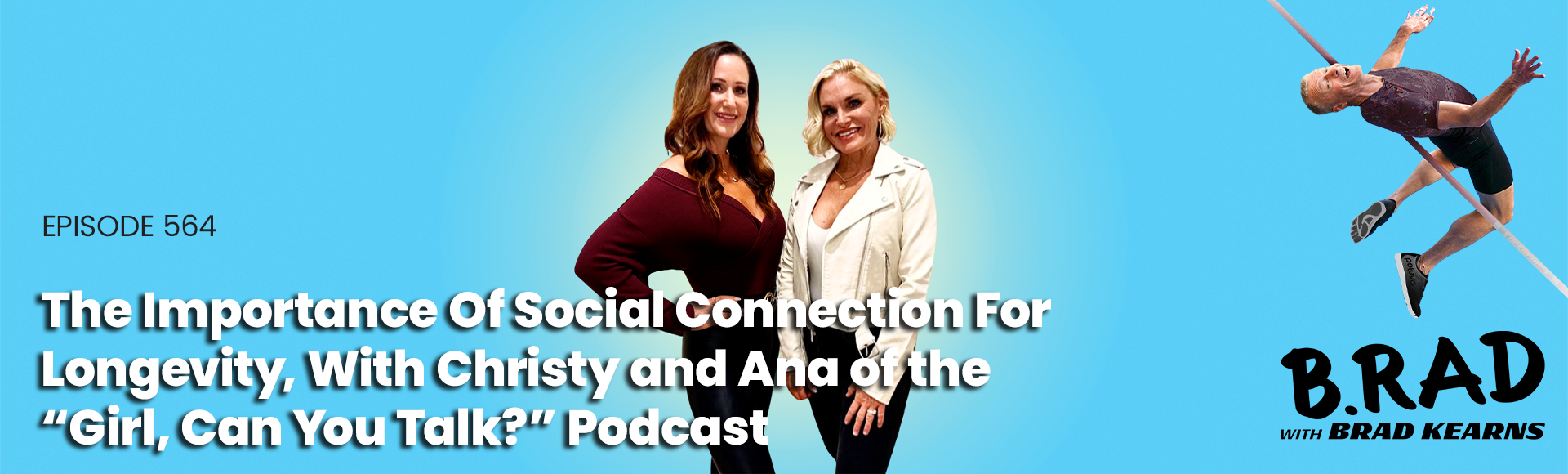
In this episode, you’ll learn about the powerful role of friendship and connection in promoting physical, emotional, and even cognitive longevity.
I sit down with longtime (40 years long!) friends Christy and Ana from the Girl, Can You Talk? podcast to explore their BOND method—Be Open, Offer Invitations, Nurture Consistency, and Deepen Through Vulnerability—a simple, intentional approach to building real relationships that help you live better, feel better, and not feel alone.
This show is great if you want to learn more about how connection impacts your health, why friendships can be more than just brunch buddies, and how simple things like sending a voice memo or asking a friend, “have you been outside today?” can literally change someone’s day. You’ll hear relatable, heartwarming (and often hilarious) real-life stories about perimenopause, empty nest syndrome, and navigating one-sided friendships. Christy and Ana share how getting in front of people, even just once a week for coffee, can turn into something meaningful—and how just one close friend can make a life-changing difference.
If you want practical tools, some good laughs, and an important reminder about the importance of building and maintaining social connections, this episode is for you!
TIMESTAMPS:
Sometimes we forget that friendship and connection are very important to our overall health. [01:03]
Having a society inundated with the internet has changed the way people relate. [07:07]
Your relationships at 50 predict your health and longevity and happiness at 80 [10:39]
B is for be open. O is for offer invitations. N is for nurture, consistency, and D is deepen through vulnerability. [13:11]
Loneliness is the new smoking as far as damage is concerned. [15:45]
You need to learn how to engage. [21:15]
There are methodical steps one can take to learn how to engage with people. B is for be open. [24:00]
O is for offering invitations without fear of rejection. Think about including someone with something you are already doing. [32:41]
N is nurturing consistency through intentional habits. [40:49]
Deepen your connection through vulnerability. [44:25]
What if your friendship feels unbalanced.? You give more than you receive. [49:08]
Be inquisitive. You learn a lot that way. [54:56]
LINKS:
- Brad Kearns.com
- BradNutrition.com
- B.rad Whey Protein Superfuel – The Best Protein on The Planet!
- Brad’s Shopping Page
- BornToWalkBook.com
- B.rad Podcast – All Episodes
- Peluva Five-Toe Minimalist Shoes
- Girl, Can You Talk? Podcast
- Cactus to Clouds Hike
 LISTEN:We appreciate all feedback, and questions for Q&A shows, emailed to podcast@bradventures.com. If you have a moment, please share an episode you like with a quick text message, or leave a review on your podcast app. Thank you!
Check out each of these companies because they are absolutely awesome or they wouldn’t occupy this revered space. Seriously, I won’t promote anything that I don’t absolutely love and use in daily life:
- B.rad Nutrition: Premium quality, all-natural supplements for peak performance, recovery, and longevity; including the world’s highest quality whey protein!
- Peluva: Comfortable, functional, stylish five-toe minimalist shoe to reawaken optimal foot function. Use code BRADPODCAST for 15% off!
- Ketone-IQ Save 30% off your first subscription order & receive a free six-pack of Ketone-IQ!
- Get Stride: Advanced DNA, methylation profile, microbiome & blood at-home testing. Hit your stride the right way, with cutting-edge technology and customized programming. Save 10% with the code BRAD
- Mito Red Light: Photobiomodulation light panels to enhance cellular energy production, improve recovery, and optimize circadian rhythm. Use code BRAD for 5% discount!
- Online educational courses: Numerous great offerings for an immersive home-study educational experience
- Primal Fitness Expert Certification: The most comprehensive online course on all aspects of traditional fitness programming and a total immersion fitness lifestyle. Save 25% on tuition with code BRAD
I have a newly organized shopping experience at BradKearns.com/Shop. Visit here and you can navigate to my B.rad Nutrition products (for direct order or Amazon order), my library of online multimedia educational courses, great discounts from my affiliate favorites, and my recommended health&fitness products on Amazon.
TRANSCRIPT:
Brad (00:00:00):
Welcome to the B.rad podcast – where we explore ways to pursue peak performance with passion throughout life. I’m Brad Kearns, NY Times bestselling author, world #1 ranked masters age 60-plus high jumper, and former #3 world-ranked professional triathlete. You’ll learn how to stay fit, strong and powerful as you age; transform your diet to lose body fat and increase energy; sort through hype and misinformation to make simple, sustainable lifestyle changes; and broaden your perspective beyond a fit body to experience healthy relationships, nonstop personal growth, and ultimately a happy, healthy, long life. Let’s explore beyond shortcuts, hacks, and crushing competition to laugh, have fun, appreciate the journey, and not take ourselves too seriously. It’s time to B.rad!
New Speaker (00:00:51):
Well, I’ll tell you what, Brad, I do not like those statistics. Like that is not good. 1.7, I mean, at least we have 2.2 kids or something. <laugh>, right? <laugh>,
Brad (00:01:03):
Welcome to this show with the dynamic duo of Christy and Ana, co-hosts of The Girl Can You Talk podcast? That’s right. That’s their clever title. And these two can talk. They are lively, energetic, full of energy and insights. I met them in person in Las Vegas. I was a guest on their podcast and I said, you guys gotta come on mine. And we picked a very interesting topic that is near and dear to their hearts. And it’s about friendship and connection, the importance of these health pursuits, which are often overlooked as we obsess about biohacking and dialing in all of our lifestyle practices, yet becoming more and more lonely in the digital age here, uh, we talk about some really disturbing statistics. They mention the Harvard Study of Adult Development, which is nearly 80 years running showing that close relationships are the number one predictor of long-term happiness and health, and how it actually reduces disease risk factors to have a thriving social network.
Brad (00:02:11):
We know that from the Blue Zones research, we touch on that a little bit. It’s also interesting to note that these two are lifelong friends. Well, they met when they were age 10, so I guess in fifth grade. And they’ve had this tight connection ever since. Their husbands encouraged them to start a podcast, uh, developing this theme of friendship and also all kinds of matters of healthy living. So we’re gonna get into how they’ve kind of, as they say, navigated the identity shifts, health changes and unexpected curve balls that come with aging. And both of them point to the thing that helped them navigate this successfully was that friendship, the greatest foundation and source of resilience, strength, and joy. So I think you’re gonna get some interesting insights out of the show. They came up with their own acronym, science-based framework called Bond, BOND.
Brad (00:03:07):
So we’re gonna learn what each of those terms mean, and it sets you up for a plan of action to help nurture a healthier, more thriving social network. And we talk about how some of these skills are on lost art these days, especially with young people who’ve been, uh, swarmed by the digital age, and especially with the, uh, seeking of a mate, a partner where we’ve been socialized to learn about a sleazy pickup strategies or revert into shyness and introversion because of the competitive nature. So here we go with Christy and Ana. You can go check out their show. Girl, can You Talk podcast? I’m one of the guests, so pick up that show. They also had John Grey recently through my introduction, had a wonderful show with him, and we sit down for some fun and matching color scheme outfits amazingly and randomly as we all connected over Riverside. But it’s good, it’s good viewing on YouTube as well. Here we go. Girl, can you talk? Yes, they can.
Brad (00:04:14):
Christy and Ana, we join up again for important conversations.
Ana (00:04:20):
Yes,
Brad (00:04:20):
Girl, can you talk? You better believe it. And what a great podcast name. So we gotta, we gotta start right out by directing listeners, viewers to go and subscribe to your podcast and check out your great work there. I can’t wait to get into the background of how you guys got going with this podcast, being lifelong friends. And that’s gonna lead into the topic of discussion, which was such a compelling overview that you sent me after we met in person in Vegas, about the importance of friendship and connection and things that, you know, as we obsess about health and all the biohacking and popular things, sometimes the basics, get overlooked. And, I’m really concerned about it now at my age, realizing that like half my life there was no internet or there was no, uh, mobile device until recent years. And it has changed the culture and changed society a lot. So we’re gonna talk about some important things. Christy and Ana, tell me about your background and how, how that podcast got started, especially
Ana (00:05:22):
Christy, do you wAna start or I could start. I mean, once we get started we have to interrupt each other, right? <laugh>? Yeah,
Christy (00:05:27):
And it’s fine. And interrupt us to please, like, we know we’re gonna have a fantastic conversation with the three of this. Energy is like crazy. So thank you so much for having us on the podcast.
Ana (00:05:38):
Yes, yes. Thank you so much, Brad. You know, Christy and I have been friends since we were 10 years old or 11 years old. And we, we are very fortunate to have our friendship. And because that is our reality, I think, that we didn’t realize that a lot of people don’t have connections with, with other, in particular for us at the time, women to have conversations to problem solve or be able to just say, Hey, I don’t feel good today. Or, Hey, good job. However it is. As we get older, people don’t, we didn’t realize that people didn’t have that until we started talking about things with other women and men. And my husband heard us talking on the phone and was like, you two need to have a podcast because obviously the things that you’re talking about people need to hear. And we were taken aback, right, Christy?
Christy (00:06:35):
Yes. We were like, say what? <laugh> Yeah.
Ana (00:06:39):
Yeah. It’s just, I think because we have that history, you don’t realize other people’s reality. So among, after talking to other friends and, and learning that friendship is not a part or long-term friendship is not a part of people’s lives, we started realizing the importance of current friendship. Even if it’s a short term, like somebody you just met, it can be somebody who can change your life.
Brad (00:07:07):
Yeah, well said. And, I don’t know all the forces in play here, but it seems like things have changed in recent times and everything is moving at a faster pace and even conversations move at a faster pace. Like, I gotta go. Let’s, let’s talk more later. You know, everything seems cut off and we’re, we’re just kind of, uh, you know, thrown into the digital age with, you know, some of that lost art. And I read stories about how young people are losing their skills, especially as it relates to searching for a maid and interacting. Everything’s done on digital device now. And so, uh, the repercussions are, are pretty strong. I remember citing some research in one of our books where the average person a a pers a person has an average of something like 1.7 close friends or some stunning statistic like that where, and then the close friend definition is someone who would drop everything at a moment’s notice to help you, for example, move out of your apartment over the weekend or, or <laugh>, you know, be there with you during a crisis or, you know, something where you can really call someone up and you don’t have to go through hoops to realize that they, they got your back.
Brad (00:08:21):
So that was the definition. And things seem to be getting more and more narrow from, uh, decades past where I think we’re interacting more in our live community. Right. And we didn’t have a digital community, so our whole life was what was in front of our eyes. That’s,
Christy (00:08:38):
Well, I’ll tell you what, Brad, I do not like those statistics. Like, that is not good. 1.7. I mean, at least we have 2.2 kids or something. <laugh>, right? <laugh>. Um, and I think this, you know, we did come up with like a method for people to connect, but it was really all in hindsight as we have been on, we, our podcast we’ve had for two years, and as we’ve had these different conversations, a lot of people ask us, like, how have you been friends for so long? And we’re not only talking about the 1.7 right? <laugh> friends, close friends that you have. Obviously Ana is my one. I don’t know who the 0.7 is, but I’ll figure that
Ana (00:09:18):
Out. I would probably be the 0.7. ’cause I’m so short <laugh>. That’s what I <laugh>.
Christy (00:09:23):
But I think the reason you’re right, this day and age, and actually our age, I’m 52 years old, Ana, you can, you know, if you wAna spill your
Ana (00:09:32):
I’m 51 still. I’m 51. 51,
Christy (00:09:35):
Yeah. Um, and we did more months graduate high school together and so on and so forth. But the thing is, is that there are definitely stages that we go through, and especially once we get to midlife, whether you’re a man, whether you’re a woman, it doesn’t really matter. A lot of us are working from home, a lot of us. I mean, I could work out from home, I could order food from home. I can do, you know, I can do everything from home. Well, I don’t think that is helping anybody. And while you talk about such fantastic things on your podcast, you know, eating well, working out, high achieving, it’s a whole package. And I think one thing that we don’t talk about is how friendships and connections impact your health.
Brad (00:10:24):
So this, uh, bond method that you developed, you actually looked at this thing, compiled a lot of information from your podcast guests, and you have, uh, a structured thing to focus on. I’d love to hear a little about that.
Ana (00:10:39):
Well, I first want to acknowledge, uh, this Harvard study that says, that took, it was like under just under 300 people in, in their sophomore year of high school, I mean, of college and studied their lives in longevity. And they talk about how it’s, you know, we talk a lot about childhood development and they’re talking about adult development. And what they discovered was super profound. That when you have really strong close relationships, it’s not money or fame that helps you <laugh> be happy. Believe it or not, it is these relationships and the connections that they really do protect you against life’s stresses, including things that, that damage you internally, like stress or heart disease and all of the, what do they call them? Morbidities that people think that are going to take ’em out, right? Well, loneliness turns out to be one of the biggest indicators of somebody’s life ending, maybe even prematurely. And in this study, the biggest thing that Christy and I got a kick out of is that your relationships when you’re 50, so not when you’re, maybe it’s kind of funny for her and I, ’cause not when you’re 10, but when you’re 50 and beyond, are the ones that really give you value that create this longevity. So that was
Christy (00:12:13):
Was one of the, well, and it shows your health of when you are 80 years old. And by the way, that’s kind of weird that your relationships at 50 predict your health and longevity and happiness at 80. But it was also an 80 year study that Ana is talking about, that they followed these people and their offspring for 80 years.
Ana (00:12:34):
So when we went back in, when we were thinking about that, and we were, well, we had heard it actually, and we were both taken aback. We really put our heads down and thought about our past and what we’ve done to create friendship. Because one of the problems that not only women, women and men, I would say men even struggle more, is making those friends and not feeling, not putting it up to be a priority. So we went back and we made an acronym. So our acronym is BOND Chris, you tell
Christy (00:13:06):
A little bit like James Bond? I mean, come on
Ana (00:13:09):
James Bond. I mean, come on. Oh oh seven bond
Christy (00:13:11):
Oh oh seven. Who doesn’t wanna be like that? Yes. Okay. So to give you the brief acronym and then we can really dig in, but it’s bond. B is for B open O is for offer invitations, N is for nurture, consistency, and D is deepen through vulnerability. Hmm. I dunno if we got your wheels turning over here, Brad, with our studies and everything. You didn’t know we were gonna come with all that did you? <laugh>
Brad (00:13:39):
Heavy stuff that, that’s funny. The Harvard study that you’re referencing and, uh, putting that, uh, marker in at age 50, predicting your, your health potential when you reach a age 80 or your, your potential to get there. In the case of the average life expectancy is just around there. So most people are dead at age 80. But the people who have strong relationships at age 50, tend to do better. And I was thinking of, um, the Cooper Institute and, uh, University of Texas famous study where they tested people’s competency in the mile run at age 50. And it was a really strong predictor of their longevity and health potential to age 80. So here we have this thing going hand in hand with those same decade references. And you, you could make the argument that if you have strong social connections, maybe you’re more likely to engage in healthy habits.
Brad (00:14:35):
I know the Framingham study has this, I think it’s three degrees of separation where, um, there’s clusters of things like obesity where people tend to have friends and connections going out three levels that are similar in terms of destructive health practices as well as, um, healthy ones. So, you know, your close circle of friends being really tight predicts that those friends have other friends where they’re also tight with in your envisioning this Venn diagram of, uh, beautiful connection. And then, unfortunately, and you can reference back to childhood and adolescence where people, you know, kind of turned into outcasts or struggled on a social level. And boy, it was, it was really rough to see or experience on certain levels, I would say. Because you realize how easy it is to kind of get spit out the back, especially today, and have those numbers go down to where you, you’re really, not nurturing these, these great friendships. And there’s a lot of lonely people out there maybe living next door that you never even meet or talk to.
Ana (00:15:45):
But one of the things that we have heard multiple times lately, you know, they used to call, or they are currently saying this, how do you say it? Loneliness. Loneliness is the new smoking <laugh>. And then, you know, they hear sitting is the new smoking. And so Christy and I are like, okay, so what if you sit, smoke and by yourself, then you’re we’re in trouble <laugh>.
Christy (00:16:11):
Yeah. And we already, we know Born to Walk, nobody’s sitting anymore. That’s right. <laugh>. We definitely wanna bring attention to the importance of close friendships. And I think definitely like females tend to run that if you’re in a relationship. Not always, but they’re the ones that are typically the ones that are setting up the dinner date with another couple or setting up things. And so I think it’s just so important for us all individually to realize the importance for ourselves and our longevity and our happiness. Especially if the women tend and, and even we speak to women about it. And it has to be a priority. And it’s not as easy, you know, when you were younger, it still could be socially hard, but when you’re in school, when you’re in college, when you go to an in-person job, it’s a little bit more there for you. I think as we get older, it, it does take some work and some thoughtful things. And that is the whole reason that we have the method. I mean, the other thing I wanted to say when you guys were talking about all the longevity was like the Blue Zones. You know, if you know anything about the Blue Zones, one of the main common denominators of all of the longest living centenarians and and Blue Zones is community. So that’s why we are here. <laugh>. Yeah.
Brad (00:17:34):
The, um, the active lifestyle and the strong social connections were the two most profound insights taken outta the Blue Zones. It’s been heavily criticized in recent years for cherry picking data about diet and a lot of Blue Zones promoters are leading with the fact that these people eat a lot of plants and de-emphasizing that they also eat a lot of animal products. There’s also criticism that they’re, uh, looking at areas that have high rates of birth certificate irregularity, pension fraud and things like that. So that’s disturbing some of the propaganda that spit out by the Blue Zones. Some of these quotes that, uh, we pulled for the book, like, uh, you know, the more meat you’re eating, the shorter your, you can, you can put on your lifespan, just nonsense like that. But what the, the great parts that I like to focus on, especially with Okinawa, one of the leading longevity pockets in the world, they have this concept called Ikigai there where they have a strong life purpose and they have a strong community where they’re kind of grouped up with, I think it’s four other people, or a total of four people in this little, this llitle pocket.
Brad (00:18:47):
And they remain lifelong friends and it’s like part of their culture to have this. So, and then of course moving around and walking around and living that, that simple life. And you said something earlier, Ana, that was interesting where, yeah, if you’re smoking, sitting around engaging with too much digital technology, you know, not into healthy eating and food prep and shopping at the farmer’s market and all those things. Those kind of go hand in hand, I was thinking, right? Because if you’re bored and sitting around and lonely, because you’re gonna find ways for instant gratification, unhealthy habits and kind of spiral downward and not be a fit, active, athletic, energetic person that’s out and about in the community all the time. Although there might be some people that fall into that category now where, um, we were doing this all day hike in Palm Springs last year, the Cactus to Clouds, and we got passed by these two females after dark.
Brad (00:19:45):
They had gone by themselves out into the wilderness to climb the toughest climb in America, 22 miles round trip. And I was like, you came out here by yourself. That is so impressive. But at the same time, I’m like, you really went on this all day thing out into, you know, seemingly dangerous, dark wilderness. And they were, they were some tough, brave females, but it’s like, I wish those two had been put together. ’cause two of them passed us, you know, in the succession of maybe they were an hour apart or something. And I know there’s good efforts to like, have group meetups, based around fitness mm-hmm <affirmative>. Yeah. Which is super awesome. Probably going back to your BOND method where you have to Yes. You know, put it out there and be open and all those things.
Ana (00:20:25):
Yes. And you know, Brad, you mentioned something there that was very key and that was that you, when you’re sitting around, we’ve all, we all experienced this, I think during COVID we are sitting indoors and it got comfortable. There’s a comfort with my groceries coming in. There’s a comfort with, you know, not having any feedback when I’m on my phone digitally. I don’t have to engage face to face. We lacked that energy with one another and we need to reintroduce ourselves as a norm rather than maintaining the norm of everything just coming back to us. So that is, it is really important and that is really digs into our BOND method.
Brad (00:21:15):
Yeah. I’m thinking of, um, how I met my wife Elizabeth was on an airplane flight. And we laugh because what I do when I get on an airplane and I have done my whole life, especially when I was racing as an athlete and got into this habit, is I get in my seat, I put on earplugs, blindfold, I blow up two pillows, and I recline as soon as, as soon as the captain button goes off. And I try to sleep just about every time I fly. And in this particular occasion I didn’t. And you know, it was a life changing decision to engage in some conversation with my wife who made the first statement and then, uh, then we started talking. And so, you think about those lost potential connections when we’re in our own world or we’re engaging a with a device in public, rather than just standing in line and offering up little tidbits of conversation and and seeing where they go. So I do realize that Nnone of
Christy (00:22:10):
That is so wild.
Ana (00:22:12):
Sorry. I
Brad (00:22:12):
Know. I
Christy (00:22:13):
Mean, well, because people, we need to add, connect on an airplane to our list of open Yeah, exactly. The open, which is our first thing. Like we literally have ideas of where you can connect. We just didn’t have the airplane on there. I so I love this. Didn’t this so much.
Brad (00:22:27):
Yeah, we were
Ana (00:22:28):
And Christy, will you get into Yeah. Will you get into the be open part, but I first wAna say Brad, that I, the thing that happened, we, I think people for, and it’s by no fault of anybody’s that we need to learn how to engage in a lot of cases. And the mothers, and both Christy and I, I think came out and were like, okay, we’re gonna help these people learn how to engage. And you know what, Christy I think the airplane needs to make the list. Yes, I think so. Yes.
Christy (00:22:57):
<laugh>. Well, hey, we have a list for Be Open Brad, if you wanna get into that now.
Brad (00:23:02):
Oh, I love it. On the airplane story. So I think, I gotta tell you, it was Southwest Airlines. Oh. And I was talking to customer service like a couple years later and begging them for an exception to their A list qualification category. ’cause we were 1000 points short or something. I said, please, please, please, uh, we love Southwest so much. That’s how we met. I met my wife on an airplane and the agent was like, wow, that’s amazing. That’s so interesting. And then, uh, they, they accepted our requests and then like a couple weeks later we got this tube in the mail and pulled out a poster of a Southwest Airlines airplane that had been signed by probably a couple dozen customer service agents. And it was like, that’s so cool. I wanna give a plug for Southwest. Our next commercial on the podcast is for awesome. So Southwest is like, that is awesome. Imagine people at work thinking, Hey, these guys met on an airplane and got married. It’s, it was really cool. But yeah, let’s hear more about the instructions. ’cause I think it’s,
Christy (00:24:00):
That is so funny.
Brad (00:24:00):
Yeah. It’s, it’s necessary thing now to go over thisi n a you know, methodical manner. Yes. Because we’ve lost the skills from whatever age that you first got your device and realized you could disengage with the world around you.
Christy (00:24:16):
Well, I mean, basically we’re talking about going fishing here. We’re gonna go fishing, we call it shopping. That we’re gonna go shopping <laugh>,
Ana (00:24:25):
We, we call it shopping, but we’re gonna go fishing. We’re gonna go
Christy (00:24:28):
Fishing.
Ana (00:24:29):
’cause we know you have a lot of men on your podcast. Ah, so when you shop at Neiman Marcus, where would you like to go? Fishing? <laugh>. Yes,
Brad (00:24:34):
Exactly. I see.
Ana (00:24:35):
Like in Baja or something. Am I, I don’t
Brad (00:24:39):
Know. Yeah, let’s make one up. Uh, that’re going for Yeah. <laugh>. Yeah, we’re going zip lining
Christy (00:24:45):
For the basically incredibly, there you go. There you go. Yeah. Okay. Um, I think it’s just important to kind of think about where you can connect because, you have to take the effort and there is the day-to-day, Hey, you’re out and about. And I think that we could have our AirPods plug in. We could be on mode, mode, mode. And we’re not really connecting. So a matter of fact, some of these big cities, you can be surrounded by people. So we’re not even talking necessarily about people when you’re only at home and still be lonely because you’re not talking to anybody. You’re not connecting. So I think just the normal day to day of being out and about, whether you’re at the grocery store or the nail shop or the gym, which is very difficult. ’cause I go in the gym to resistance train.
Christy (00:25:29):
Brad, I could do it at home. I don’t need it, but I’m like, I wAna get out of the house and go, well, it is hard to connect because everybody has their earbuds in. But it is still a place for some people where they can connect with people. I think local clubs are also a great place, whether it’s a golf club, you know, golf club, pickleball. My husband and I play pickleball and we’ve met some really nice people and it’s something we can do together. Um, chamber and stuff like that. Ana, did you want to add any to this list we got going?
Ana (00:26:05):
Well, I think the idea is being open to what you want out of life. So go to the place, see your life through the windshield, not the rear view mirror. And be open in choosing to go places that enhance your future. You, so maybe, Brad, in your case, you’re an extreme athlete, so maybe in your case you’re like, I am also looking forward to someday going, I wanna play golf more. I want to meet, I wanna go play golf. I still wanna be outdoors, but maybe I’m not gonna be jump doing the high jump anymore. So you might want to start, join a golf club, maybe not the golf club yet. Maybe you wanna just go and hit balls at the driving range. And then when you are there keeping your eyes open to see the people that are around you. Because a lot of times, like what Christy’s saying is we put in our earbuds and we stay so focused on ourselves and ourselves is not gonna get us all the way to where we wanna go in the future. So it is good a, a golf club, even the driving range. Another place that I think is, is a really cool thing to do, which can be scary, is events. Things like we went to camp be more, and we were there for three days. It was a convention. I was gonna go all by myself. I didn’t need anybody to go with me. And you know, why Brad? ’cause I wanted to meet more people and we, we ended up, Christy ended up coming and we did, we actually spent 4th of July with people we met there.
Ana (00:27:44):
Yes. And we’ve spent 4th of July with people that we met there. Oh, wow. We’ve had a really cool guy on our podcast <laugh> and become friends with you. So going to events is really good and thinking about what you want out of your future when you’re picking those events. Yeah.
Christy (00:28:01):
Nobody’s trying to waste any, any time. Right.
Brad (00:28:04):
Yeah. And like you guys said, it’s important to make the effort and put yourself in a position to succeed because we can easily shrink back. And especially for those who raise their hand and relate to being an, uh, an introvert, uh, by nature. And so it always feels like an effort to get out there and even make the smallest bit of socializing effort. But it’s kind of like you made that connection to fitness where in order to adhere to a fitness program, the behavior psychologist suggests that like the kettlebell in your house needs to be in plain sight, and you’re looking at it all day to give you a chance to build that habit. And you’re gonna do some swings every time you leave your office and go somewhere in the house. And I have videos on YouTube about like my staircase represents a fitness opportunity all day long.
Brad (00:28:53):
And every time I go up a staircase, I do fast feet like the sprinting drill rather than just walk up the staircase. And so it’s become a habit. I do it every time. And I can’t walk up a staircase normally anymore because the other part’s been ingrained. And so I’m trying to draw the connection to like, when you’re shopping at the market, and you don’t have to speak to anybody, you don’t even have to go to the market like you say. But these are the, these are the points where, you know, we need to start building these behaviors where we are going to go out of our way to make that effort to overcome introversion or overcome cultural norms and say something to somebody and get that positive payoff that builds and builds upon itself. And I know that’s tough for whatever it is. Half of the listeners viewers, right? Might be introverts and half might qualify as extroverts. But, I find, especially in United States of America and other places I’ve traveled, people are so amazingly friendly. Just the average, you know, 97 out of a hundred people that you go up to, you could do a test, we could do a YouTube video out in front of the store and saying, Hey, do you got a second? Can you tell us which of the three colorful shirts today is your favorite from the, the, the three, uh, three podcast participants? <laugh>, you know, what
Ana (00:30:10):
do you like the best?
Brad (00:30:11):
Yeah, most people will, will not brush you off in life, but we kind of have this sense of, you know, I see people oftentimes walking around with a frown and you get that first impression because whatever someone’s deeply lost in thought or they just happen to not be smiley face all day long. But as soon as you break through that first impression, it’s almost always found that everyone’s friendly. Everyone has a desire to connect and has a little time to share, which is, which is really cool about life, but it’s like hidden behind these facades that we put up, including holding onto a device where, you know, you seem busy, you seem too busy to talk to, you know?
Ana (00:30:57):
Well, we would challenge your listeners that when you see somebody with a frown, try to make eye contact with them and smile at them because you don’t know what kind of day they’re having. And you could have changed their day just by getting them to smile. It’s a, it’s actually, Christy and I it talk about it a lot. It’s our challenge, right? Yeah.
Brad (00:31:15):
Yeah. I remember having this Connell Barrett is a, a long time, uh, sports journalist, and now he’s turned his attention recently to, he wrote a book about, uh, I mean, it was picking up women essentially, uh, we could probably pick nicer words. Uh, but he realized <laugh>, he was based in New York City, and he realized this was a lost art. And not to talk about it in a sleazy way, but it was actually how to engage with an attraction of, you know, your preference. It goes for same sex too, but in general terms, it’s like how to actually make it work on an authentic level rather than the sleaze level where you have your first seven lines and none of those land anymore. But my main insight that I remember well is that if you just ask someone else about themselves, it’s a super favorite subject for everybody. And you basically can’t lose if you just go up to somebody and say, oh, hey, um, let’s say on the airplane, are you, uh, flying to your home destination? Or are you visiting, uh, Sacramento? And, um, it seems so easy and simple, but a lot of times we’re, uh, you know, self-absorbed or whatever the term is where you’re not even asking someone, uh, about themselves at all. And then you don’t connect and you don’t learn anything.
Ana (00:32:34):
It’s so true.
Brad (00:32:35):
True. Confucius said, it’s very true resolve to listen more and talk less because no one ever learns anything by talking.
Ana (00:32:41):
Well, and that goes to our next acronym, the second letter in our acronym is O which is offering invitations without fear of rejection. And what you just said, Brad, is really correlating with that because we all know that interacting with people can be nerve wracking, whether you’re looking for a new relationship on a romantic curve, or if you’re looking for just some people, a friendship, a community, or just if it’s for that day. However, if you take it one step further and you’re offering an invitation to maybe coffee or to go bike riding together or to go for a walk, that part, I know our audience can get nervous and feel like, oh my gosh, but because why are you nervous? You’re afraid of rejection. And so Christy had some really great insight on that, that I loved that get, that gets rid of the fear of rejection when you do a couple of different things. Christy, what were they?
Christy (00:33:47):
Uh, that’s a great question. You don’t
Ana (00:33:49):
Remember? No, I
Christy (00:33:50):
Don’t know what you’re referring.
Ana (00:33:51):
No, I’m referring to when you go for a walk, you’re already doing it. So inviting them to things you’re already doing.
Christy (00:33:56):
Mm-hmm. So, like, if you’re not sure, and what I said earlier, and I meant it in the most loving way, is you’re trying to build new connections, but you’re also not trying to waste your time. Like you do want it to be quality friendships. You wanna have, you know, if there’s 10 things in common, I mean, let’s be honest, you gotta have, what, eight to 10? Seven to 10. They don’t have to have everything the same. So I think the first invitation, if you are doing something that you already do, like I already go for a walk. I wanna go for a walk. So wAna walk together, wanna go on a hike together. And then you’re kind of actively, it’s not like awkward sitting across from the table where you’re trying to figure out conversation. You’re moving and you’re able to connect. So I think that would be a great example, is starting with things that you already do or that you want to do, or maybe it’s something that you wanna try new. Maybe it’s pickleball. I don’t know.
Brad (00:34:47):
That’s a great, that’s a great take because you, I think you’re inherently gonna be more confident and less fragile knowing that hey, I’m, I’m going shopping at Erewhan, would you like to go with me? And it’s like, if you, if you turn me down, it’s okay. ’cause I’m still going there. I love that. That’s really cool. I’d love to talk about it further because I do feel like that fear of rejection holds us back so much. I remember as a young person, certainly I was crippled by fear of rejection when, uh, reaching out to the female attraction. And so, um, some of that I think is, you know, deeply embedded and possibly never goes away to a certain extent where it’s really hard to put yourself out there. And so like, um, maybe you have like a role playing where you know, someone says no, and you’re okay with it, and you realize the world’s not over and you’re still a cold person or something.
Christy (00:35:48):
Well, um, I mean, I think fear of rejection is something that everybody experiences at all different stages of your life. It might be when you’re younger, it might be when you’re older. I just think it’s normal. I think it’s normal to, but I think, I think sometimes we have to take that ownership of, it’s not about like, if somebody says no thank you or whatever, a lot of times it’s about them. It’s not about you. You’ve gotta be willing to put yourself out there and have the benefits for yourself and not, I don’t know, not put too much weight on it, I guess. And that’s why I think you start casually. I mean, have you ever had somebody that you have well let’s say if it’s texting and you reach out, hey, you wanna get to, and then they don’t respond, and then all these things start going through your head of all the reasons why you’re not worthy. And you know what, it might just literally be that when you text them, they were in the middle of something and they forgot about it. So follow up, like give, I think give people the benefit of the doubt first, rather than creating your own story of why they’re rejecting you or not.
Brad (00:36:58):
Yeah. I’m thinking of Scott Galloway, the podcaster bestselling author of The Algebra of Happiness, and he’s known for being kind of hard hitting and brusque and abrasive, but, you know, speaking the truth. And he was addressing like today’s male is struggling and has a difficult time because females are more empowered than ever to live life independently. And it wasn’t like generations past where, uh, the females are stressing that their biological clock is ticking, and if they’re 30 and they’re not married yet, they’re gonna have a life of misery and become an old maid. And so now because of that he shouts out to the, he, he calls it the bottom 50% performers of today’s male. They don’t have a lot of options and they’re not succeeding very well in their pursuit of female partnership. And so he’s saying like, you need to get your act together and you need to realize that you’re in a competitive setting.
Brad (00:37:55):
And it was kind of a, you know, shocking to hear someone verbalize all these things that we might be thinking deep down. But it’s like, yeah, if you’re putting it out there and you’re not getting a lot of bites, if you’re fishing, it could be worthwhile to first of all, not attach your self-esteem to every single thing you’re doing. And second of all, look at your overall game and, you know, try, try to bring your A game and hone your A game, especially when it comes to meeting, uh, an attractive mate. Because that it’s all about competition and hardwired biological drives for, um, you know, what’s, what’s gonna, what’s gonna land and what’s gonna be just under the cut.
Christy (00:38:36):
Well, if you’ve ever watched, uh, to your, what you’re talking about, if you’ve ever watched a dating show, you can see why the topics and the things that they get into right away, why it’s not working. It’s like you gotta step into going, you know, you start by just normal basic stuff and then you gotta work your way up to, I mean, well, our last letter is vulnerability. You don’t start there. You don’t tell ’em. Well, I mean, my husband and I have two ballroom dance studios. I’ve done a lot of interviewing for jobs, right? The stuff people tell you, I’m just like, why are you telling me this right now? Well, I lost my tooth because I was in a fight at a bar, and I’m like, you’re a job interview. So I think we gotta like clean ourselves up a little bit and, you know, think, let the other person talk, think about, you know, those kind of things because it does make sense why some of the people are having problems dating <laugh>, let’s just put it that way.
Brad (00:39:39):
So yeah, you gotta be on your A game. Yeah, I like that. Yeah, I mean, uh, start small is a great tip where you don’t have to tell your life story. In fact, maybe you could just start with polite and thoughtful questions of the other person and have some back and forth where you get to know the person a little and would look forward to getting to know them more on the next three dates rather than, you know, the spewing of the, the, the Declaration of Independence on the first date. You know? Yeah.
Christy (00:40:06):
It, yeah, it’s like, let’s, you know, you don’t go like, nice to meet you, you wanna get married? Like, there’s a lot of information that goes on in between, um, you know, we, we hit a little hard on social media and so on, but that is a way to connect via phone number or connect via social media, see how the conversation goes, like you can step into it or doing something that is a more short term. And you’ve gotta be willing to take a risk. I mean, right. How else are you, you’ve gotta put yourself out there and be willing to, well, you don’t have to do anything, Ana and I say that a lot, right, Ana? Yes. So I think, you know, yes, offer invitations without fear of rejection. Start small, work your way up.
New Speaker (00:40:49):
The next one, though, I think, Ana, you can totally run with this nurturing consistency through intentional habits, which is N and, you know, this is a process as well. We’re starting with connecting. And then maybe moving on to offering invitations. So this is a stepping stone process as well.
Ana (00:41:11):
Yes. Because after you’ve offered an invitation, you’ve gone to coffee, you’ve maybe gone on a bike ride, now you’re starting to vibe with this person, typically. And then the world happens and you’re going, you went on vacation, then you come back and you haven’t talked to your friend for a long time and you feel kind of weird because you don’t have the time. Christy talks a lot about her long drives, that’s where she makes phone calls. But often when you’re creating a friendship with somebody, you don’t have that time to take. And so we talk about being consistent, but not consistently having to go visit them consistently. Keeping in touch. Hey, I just thought of you today. I know this is a funny thing, but I, I send memes to people a lot that are like, oh my gosh, I saw this and I thought of you.
Ana (00:42:00):
Or maybe you had a great discussion with them about something that you’re both very passionate about, and now you’re feeding each other some information that you’re sharing. Well, getting on the phone may take a long time. Instead, you can go back and forth maybe via on the Apple iPhone, we have something called voice memo. You can leave a voice memo, you can send them a text. Hey, I was just thinking of you, I was thinking about the conversation that we had the other day, and real quick, I wanted to spin back on whatever that would be for that person. Right? Or maybe it is a consistent, get together with them so that you can see each other’s face because you enjoy each other so <laugh> so much, right? Once a week you’re gonna go to coffee and you’re gonna meet at that place. And the cool thing about that is, a lot of times that circle grows right in front of you because consistently you’re going to coffee consistently, everybody else knows you’re going to coffee and consistently people show up because they need connection. So nurturing consistency has to be intentional, intentional habits with a friend, a connection, maybe in this case what you were talking about, relationships. I mean, how many times have you heard of somebody saying, I don’t, especially in a relationship, right? I don’t know, they never texted me after that date. And then the person that didn’t text after the date is like, I wanted to text her, but I was super busy, or I thought it was better to make a phone call or whatever is the excuse. And then that potential bond could get broken.
Brad (00:43:30):
So the consistency refers to reaching out and maintaining good, healthy connections, keeping ’em, keeping ’em alive. And I guess leveraging ideally leveraging digital communication for the time that you do meet up, even if it’s, uh, not as frequently as you’re texting or sharing, sharing information, right?
Ana (00:43:51):
Yeah. But again, we do believe that getting in front of people is prioritized. However, letting your friend know that you’re thinking of them really can give them a boost. In fact, last week we had your friend John Gray on, and he talked about boosts of oxytocin. That is a boost of oxytocin. When somebody sends you a message, you get a boost of oxytocin, whether it’s a voicemail, a text message, or a written letter in the mail. So it is helpful for longevity to maintain these relationships.
Brad (00:44:25):
Okay, now we’re to D
Christy (00:44:26):
This is when you finally get to the stage where, you know, you deepen your connections through vulnerability. And, um, you know, is it different for men and women? I think it depends on the person. I don’t, I, you know, my father-in-law, he talks to everybody, socializes with everybody. He’s the one that drives the relationships in the family. Is it odd? Possibly? Um, you know, he tells stories, all the things. So I think once you’re at a stage where you are comfortable with somebody, I think that this is really where true connection happens. That we are willing to be vulnerable, that we’re willing to show that we’re not perfect and okay all the time. And for me personally, this happened in my journey and how, part of the reason we started the podcast, not always, but perimenopause was a very, very hard time for me.
Christy (00:45:23):
And I didn’t know that that’s what it was. I just knew I had, and I was about 44 years old, 43, 44, I was in good health. I was a long-term ballroom competitive dancer. And then, you know, stayed active after, and all the things always went to the doctor with a clean bill of health. And it seemed like all the sudden I had no energy. I had no, you know, that drive that I enjoyed all of the things, and I felt like I was going crazy. So I was willing to open up to my friend. I felt safe. And she goes, go get your hormones checked. Well, the long story is by us talking about it. She was like, me too. Which is our motto, right? Ana? And I was able to find an answer, go to an integrative medicine doctor and all the things, but none of that would’ve happened without being vulnerable and without going like, Hey, I don’t wanna admit that I don’t feel like myself, that I don’t feel like, you know, that gumption or what have you.
Christy (00:46:30):
And I just think that when you deepen these connections through vulnerability, we can talk about real things, not, you know, Ana and I call the Instagram perfect posts where we’re on vacation. No, you were on vacation and one of the days you and your husband got in a big old argument or one of the days you were screaming at your child. Like, that’s life. And I think in order for us to feel good, we want true connections where we can actually have real solutions to live better. And, and I’ll tell you what, by just doing that one thing, it has helped me to live better.
Ana (00:47:06):
Yes, that’s part of it. And you know, Brad, your, your audience is, i, i, from what I gather from listening to your podcast, your audience are filled with people that are high achievers. You are talking on a different level in life, in your running, in your fitness, in your diet and exercise and trying to keep that ball rolling down the road. Well, if we don’t talk to people, not only because of the connection, but also how are you, if I don’t tell you, if I, if I’m competing with you in the, in the high jump, and I don’t tell you that my glute, for some reason it keeps spasming and I don’t know why. And it, because I don’t want you to think that you have a leg up on me. Ha ha a leg up on me. Get it. Um, I feel like, uh, you might have the answer, you know what, you need to go roll it out over there.
Ana (00:47:55):
There’s a guy over there that’s gonna help me that would be vulnerable. Even in those, in those scenarios that you and your listeners are in on. However, even more than that, that to be able to live longer and feel a purpose in life, we want to share in vulnerability because you lock arms with that person and help them solve what could be a problem or just could be a shoulder to cry on. So next time, you know, I call it friendship deposits. And if I need, I deposit with you and nurturing consistency, you might, I might need you someday. And someday I might need to withdraw on, on my deposits that I’ve been nurturing, right? So if I can make my life feel more purposeful and live a longer, happier life by making connection with other people, why wouldn’t I make that a priority? You know, you go to the doctor, you take all these supplements, you do all these things for, this is one of the most simple cost effective things you can do for your longevity. <laugh>,
Brad (00:49:08):
<laugh>, I realize there’s a common well, um, that there’s a common, uh, complaint or condition where, uh, the friendships start to feel imbalance. And so you’re making all these deposits and, um, you’re never, um, able to, uh, see the return on investment because it’s one sided and someone’s, uh, really, uh, I guess, uh, what, what, you know, whatever term you would use for that, like they’re, um, you know, kind of draining you with their friendship needs. Yes. And so that’s another challenge to navigate, I suppose. Do you have any insight on that?
Ana (00:49:41):
Christy does.
Christy (00:49:42):
It’s so funny you asked, it’s funny because <laugh>, we did a whole nother podcast episode, and it was funny, you started, I mean, we’re just kind of locking arms here, all in the same color palette and all the things, but <laugh>, you know, who’s around?
Ana (00:49:53):
We have the same cheer team. Yeah. I just wAna
Christy (00:49:55):
Know who’s around your campfire. And at some point you’ve gonna have to look at like, when I walk away, do I feel drained? Do I feel stressed? Do I find myself complaining about the conversation? And it’s fine. Sometimes we’re, you know, we’re there for our friends, but at some point, it shouldn’t be the one way, like what you were talking about. And at some point you should be feeling better and wanting to achieve more, or wanting to feel better, or you should be uplifted. It should not be a one-sided thing. So, you know, sometimes they’re not the one that might be at your tight little circle campfire. They might be, you know, when you go to like let’s say camp, you were a camp and a kid, and then they had the benches that were a little further away from the circular campfire, then they had the benches that were even further away. Well, I feel like sometimes it is good to look at your connections, and it doesn’t mean that you’re, you know, dropping them like it’s hot really <laugh>, but they might not be the person that
Ana (00:50:58):
Not throwing them in the fire.
Christy (00:50:59):
Yeah. Yeah. You’re maybe you should throw ’em in the fire, actually. No, no. But what I’m saying is that they might not be your tight inner circle anymore, because you’re right.
Ana (00:51:08):
No, Christy, go ahead. So Christy, we do have the other side of that. Okay. And that’s that sometimes. And, and you are the one that shed the light on this before, Christy and I really think about it often. Uh, what is your role in your friendship? So maybe your deposit and your friendship is something different. So Christy talked about how you may be the person doing the inviting a lot or the organizing a lot, but that could be that that is your role in the friendship and maybe owning that and disarming the fact that they aren’t putting that part in, but they’re valuable to be around. So of course you still want them to not be the person that sucks the life out of the fire. Right? But you also want to recognize that actually your expectations of your friends may be because they’re expecting you to, or they don’t want to miss out on your role in your friendship. So there is that person that has the role of being the listener and the person that has the role of being the talker. That’s a little different than maybe the person that is constantly organizing or those are the things that you wanna evaluate before you stick them in the back row of the fire. <laugh>
Brad (00:52:21):
<laugh>. Yeah. Christine Hassler, popular podcaster and coach, she says, uh, relationships often have an expiration date, and it’s okay. And I like that perspective because doesn’t, you know, things don’t have to end in flames. They just might end on a certain year of the calendar, and it’s okay. It’s like we always have to move on and keep things fresh and exciting and interesting and balanced, and that, you know, that that’s okay. We’re allowed to throw away spoiled milk and so forth. Yeah,
Christy (00:52:51):
Well, I mean, you have different seasons, you have different transitions, I think in your life. Sometimes it happens naturally, but that’s also why with the BOND method, it’s like you kind of have to keep that wheel turning of maybe making new connections because, um, the reason partly that we came up with it is you might have huge transitions where you go from having a lot of friends to none, whether it’s moving cities, whether it’s changing jobs, whether, gosh, for me it was moving and having a kid and then owning a business all at the same time. It was like party of one. So that was rough, you know? And I think this is a way in which you can nurture new relationships and also maybe, maybe at a distance, nur nurture old relationships, but sometimes they do have an expiration date, and I think that’s okay.
Ana (00:53:44):
And sometimes you might just put ’em on a shelf and let them have some space between the two of you and it can come back again. It’s okay. There’s, but I think the roundabout thing that we are trying to share is that friendship is not just what Christy put it really well the other day when she said, I’m not looking for just brunch buddies, although I do love brunch buddies, but it really is a life hack that’s getting overlooked for the reasons that we said, but also for the energy and community. And to know that you’re not alone, which is our big tagline of our podcast. It’s like, I wanna live better, I wanna feel better, and I want to not be alone. I want you to know you’re not alone. And we can make a lot of solutions together if we just make connections. And for Christy and I, it’s girl, if you can talk
Christy (00:54:41):
<laugh>. <laugh>. Yeah,
Brad (00:54:43):
Well said. You referenced your feeling outta sorts in perimenopause, and how did you, or you, you guys said you were both feeling tired and connected on that level. So how did you bring back that physical health component?
Christy (00:54:56):
Well, I think it’s, it’s, the first thing is having, it’s what we talked about. It’s having friends to talk to and, and it’s being willing to open your mouth. So it’s funny, like D is deepened through vulnerability. Well, actually sometimes maybe vulnerability. Let’s replace a word. It sounds a little deep, sounds a little scary, which is fine. But it could be literally just being inquisitive. Like we are always seeking for answers or, and for sure I am of like, no, this does this, it got, it has to be better. You shouldn’t have to suffer through this. And you gotta be willing to open your mouth in order to find those answers. So, that’s really what happened is I was willing to open my mouth, willing to have the conversation. Ann and I were, but now that I have experienced it, I am able to share and trust me, I mean, one of our new connections that we made at camp be more, I didn’t even tell her about my experience and we’re casually talking.
Christy (00:55:55):
And she goes, man, I, yeah. I go, so, oh, how is your, I saw on social media, she was rearranging like organizing, purging her garage. How’s the purging going? She goes, man, I don’t know. I had a good start, but now I just don’t know what’s wrong with me, man. I’m just not feeling the energy and I just needed to whatever. I go, I understand I have, but she just said something very casually and I said, you know what? I have been there when I, and I just kind of told her a little bit about my story. And so then, you know, other people were at a beach, yada, yada. I get a text message probably two days later. Hey, you were mentioning that you went through perimenopause. What did you do? And this was in casual conversation again, she told me a little bit, but then I was willing to also tell her, Hey, I felt that way too. People. Right. Not just, oh, good on you. I’m not gonna be vulnerable and tell you how I felt. So,
Ana (00:56:50):
And Brad, you are talking about the physical element of that, right? Like how did we get up and move? Like how did we get up and decide, okay, I gotta make a routine, I gotta physically move. My brain needs to feel better. And again, I want to reference this because when, while Christy went through that with her perimenopause thing, that was, a lot of people on here aren’t gonna Oh, yeah. Perimenopause. You, you mean you were, you were gonna start menopause. No, it is a real deal, guys. It’s like, for some women, it is harder than others. And I’m telling you right now, it wasn’t as hard for me because I had Christy because she had gone through it. But the physical part of it that I was going to mention is she called me. I went through something similar like a depression, I would say, when my kids left very big empty nest syndrome.
Ana (00:57:44):
It was real man. And I felt like I was just out of my mind. I couldn’t find my identity. One day Christy called me, I was walking circles. Now in hindsight, I also think I was having some other symptoms of perimenopause, believe it or not. But I was walking through the house in circles, just depressed. I was by myself and my husband’s at work, and I just couldn’t figure out how I was gonna get outta this cycle. Christy called me and I go, I’ve done nothing today and I’m crying crazy. And she goes, all she said to me, Brad, was, have you been outside today? It could make me emotional because I hadn’t.I hadn’t seen anybody that day. And so that’s, that is what a friend does. And you, I went out, I go, you know what? You’re right. And I went for a walk outside and it changed everything.
Ana (00:58:37):
It’s a story I will tell until I’m blue in the face because it made my day so much better. And it also reminded me, if I ever need to say she’s not gonna judge me. She’s not gonna tell me, well, you gotta go blah, blah, blah. She said, did you go outside today? And it made a huge difference. So yes, the physical part of it. And then now we’re like, did you wear your weighted vest? Did you, you know, put on your Peluva shoes because those are real. I had back pain. And she goes, you’re wearing your Peluvas. No, I was wearing these other shoes. Yes, that <laugh>. So we are definitely more physical and together. I think it’s hard to have friends that don’t have any movement or any goals. Not just physically, maybe professionally, it could be maybe for your relationships, maybe financial, whatever are your goals. When you share that with your friends, you find yourself moving forward on accident because you’re together. Nice, nice. It’s that whole thing. You know what it is? You’re the sum of the five people you spend the most time with. Mm-hmm <affirmative>. Or 1.7. Yeah, depending, <laugh>, I mean, I’m short. You can make you have room. Maybe you can have 5.3, Christy. ’cause I’m, there you go. You know the 0.7 <laugh>.
Brad (00:59:57):
Yeah. I know that research from the famous, uh, social anthropologist on Dunbar. Dunbar’s number where, um, we’re, we’re really incapable of nurturing more than 150 total relationships, which we often exceed when we’re in digital life. And it’s not meant for the human and the relationships become inauthentic, unproductive. But there’s also the, um, inner circle concept where, um, a maximum of 12 is about the most you can really manage to have an, an extremely tight it’s called mutually reciprocative relationship. I think it was a term you used where, um, you would, you would drop everything and help your friend move out of out on the weekend. And, uh, they would do the same for you. And you can’t go really with 50 people that way because you’re not gonna be there in that manner that’s really needed. So I like thinking about both of those concepts where we have a larger social circle that might be acquaintances or people that we do a certain hobby with, but they’re not maybe at the next level, maybe they will be someday, but there’s kind of two circles floating around the, the inner circle and the social circle.
Ana (01:01:08):
I love that. We call that our fire, our fireside chat, the fire ring, and then the one that’s maybe in the second row in your fire. Of course, everybody’s fire gets to be their own, choose their own circle, right? Mm-hmm <affirmative>.
Brad (01:01:19):
Yeah. And in fact, um, I think that same research revealed that if you have as, as few as one or two close friends, that’s plenty. And it’s also a good fit for quite a few people that don’t need to have this super lively and diverse social experience. And I like, uh, hearing that too because, uh, we really have to, this is all individual and by personal preference, and it’s, you know, getting from zero to one is essential for healthy life. And even disease prevention, like you mentioned, the, the tidbits, the bullets from the Harvard study that we’re talking about, dementia, stroke, depression, and these things increased risk in association with loneliness. So, busting out of that, but not being daunting and overwhelmed as we kind of close up here, uh, we don’t want the listener viewer to go away thinking like, oh, I gotta make 10 calls every morning like a salesperson No. To hit their, it’s not about that at all.
Ana (01:02:19):
Not at all. Not at all.
Christy (01:02:20):
It’s just, it’s just more about putting it on, you know, you’ve got your fitness regimen, you’ve got your stack, right? You’ve got your supplements, and you’ve got your nutrition, and you’ve got your workout, which is
Brad (01:02:32):
Social stack. Yeah,
Christy (01:02:34):
Yeah, yeah. And it’s like the social just needs to be on the list of realizing that it is important for your mental and physical and longevity that it is. It’s, it’s part of it. It’s not just the one thing.
Ana (01:02:50):
Love it. And Brad, I wAna mention you did say about the one friend, and that is very true. Having one friend is a can be for some of these people, maybe it’s their first goal to have that one close friendship yet to kind of reach out because you want go out a little bit from that just one person that you’re building a relationship because sometimes Christy will piss me off and I gotta go call my other friend. No, I’m just saying <laugh>. <laugh>. Yeah, I’m joking. But you wAna have friendships that are, I like the Venn diagram even more. Yeah. You have that one friend who maybe has one friend and that you connect together and keeping open with those friendships is what
Christy (01:03:33):
Well, yeah, because when Ana goes out of the country for three weeks, for God’s sakes, when she was gone, I was just like, do, do, do. Yes. So I better have a few more <laugh>, you know what I’m saying? Like, to put all that responsibility on one person, but it’s just about growing people that you love to connect and be around.
Brad (01:03:51):
Yeah. I mean, as John Gray reminds us too, we do not want to rely on our, on our romantic partnership to be all things to you. And so it’s essential for relationship health and keeping the, uh, the the spark and the, uh, excitement to go out and get your other needs met outside of the relationship so that you don’t have
Christy (01:04:11):
To, that sounds, and it doesn’t sound appropriate. Yeah. Can you re can you rephrase that? <laugh> <laugh> your beads met yours, actually.
Brad (01:04:18):
Yeah. How do you phrase that? Well, you know, you gotta, you gotta unload on, uh, your busy stressful day and it’s gonna be a 12 minute conversation and your husband doesn’t want to hear it and might not be as receptive as the ladies at the hair salon. You can complain to them. Mm-hmm <affirmative>. And I, I, I think about his messaging a lot because we’ve been socialized to kind of think otherwise and think that the ideal partner is one who is there to do all your hobbies together and to listen to every little thing that you have to say. Uh, even know they might not be naturally inclined to be patient and connect in that manner. That might be sort of a more female dynamic at the beauty salon historically, or at the book club or whatever. And I can say this ’cause I’ve been a guest speaker at a female book group.
Brad (01:05:01):
It was probably 30 of them. And the reason I was there is because they chose my book for that month, or I suggested they choose my book, and I didn’t get a word in the whole night. And I’m like, wait, you invited the author, but I barely said anything. But a bunch of ladies stood up and said, well, here’s my thing about diet. It’s everything in moderation. And I’m sitting back like, I wonder if they’re gonna ask me my opinion since I was the book of the month <laugh>. But I, I was not. And I realized what a beautiful they did you experience. It was they just needed me for window dressing, and then they could really get into it and, and have the conversation that they were, that that gives them, you know, that that boost of oxytocin, dopamine, all the, all the great mood elevating hormones, serotonin mm-hmm <affirmative>. Yeah. Hilarious. And so that’s awesome. Um, we, we need the community to, to, to have the most healthy and wholesome loving relationship. And, uh, Ester Perel talks about polarity where, um, you know, you miss your husband. You haven’t talked to him because you didn’t call him 27 times that day. You called your girlfriend instead.
Ana (01:05:56):
Yes.
Christy (01:05:57):
Yes.
Ana (01:05:58):
I will, uh, give you one more famous quote. Okay.
Brad (01:06:02):
Anaism.
Ana (01:06:03):
Yeah. No, it’s Gladys Bergner, who is my grandmother. Before I got married, she said this, I go, grandma, I wAna have John and I wanna have six children or, or a whole bunch of kids like you did because we never wanna be lonely. And she stopped me. She was never harsh like this. She stopped me. She said, Anamarie, you listen. Do not put that kind of pressure on your children. They’re gonna grow up and they’re gonna start their own lives, and it is likely that your husband will die before you. Statistics state that. Correct.? With men and women, especially 32 years ago. And she said, you need to have girlfriends and a lot of them and make friends as life goes on, because when you get older, they’re the only ones that will understand whatever it is.That your husband will not, and, and that, and you will never be lonely, is what she told me. And, and then I, I mean, we have carried it with us forever. So quote by Gladys Bergner, a lot of studies, I don’t know, <laugh> a life study.
Christy (01:07:07):
Well, and I’m, it’s ditto the other way around, right?
Ana (01:07:10):
Yes, yes.
Christy (01:07:11):
Like men not relying on their partner or on their kids that they actually have, you know, my dad and my husband get together and they geek out on stuff that LEC electrician and cars, and I don’t even know what they’re talking about, and I am okay with it. Think, yeah, this is, you know
Brad (01:07:27):
What I mean? <laugh>, John Gray, John Gray, cave time, testosterone boosting activities to return to the relationship, feeling whole and, and, and, uh, empowered, uh, ladies, this was great. Can you briefly recap the bond so we can have that as our nice closure here? The acronym, Christy,
Ana (01:07:43):
You go for it.
Christy (01:07:44):
Yes. So it’s Bond B, it’s an acronym. Be open, offer invitations, nurture, consistency, and deepen through vulnerability. And again, this is meant to just make you think and to have your eyes open and to enjoy life. It’s not to stress you out. It’s not to give you, you know, a million to-dos, right? It’s yes, it’s to, you know, live better, feel better, know you’re not alone. Live happy with longevity. And, and again, you, nobody wants to be on the rock by themselves. You know, like,
Ana (01:08:22):
And if you need a place to start, you can come to our podcast, Girl, Can You Talk podcast and listen to us talk about all of the things that you need to hear, <laugh>, the things that you’re struggling with, hearing with personally, that you can live better and feel better, and you are not alone. We can help you get started.
Brad (01:08:41):
Wow. Great pitch there. Okay, people, girl, can you talk? Yes. Not just for girls. I love listening to your shows and can’t wait to hear your conversation with John Gray. So I think we can find you on social media with the same Girl, Can You Talk Yes. And go to town? Yes.
Christy (01:08:56):
All right. Thank you so much,
Ana (01:08:57):
Brad. Thank you so much, Brad.
Brad (01:08:58):
Keep up the good work. Christy and Ana from Girl, can You Talk? Thanks for listening, watching everybody. That’s a wrap. Thank you so much for listening to the B.rad podcast. We appreciate all feedback and suggestions. Email, podcast@bradventures.com and visit brad kearns.com to download five free eBooks and learn some great long cuts to a longer life. How to optimize testosterone naturally, become a dark chocolate connoisseur and transition to a barefoot and minimalist shoe lifestyle.