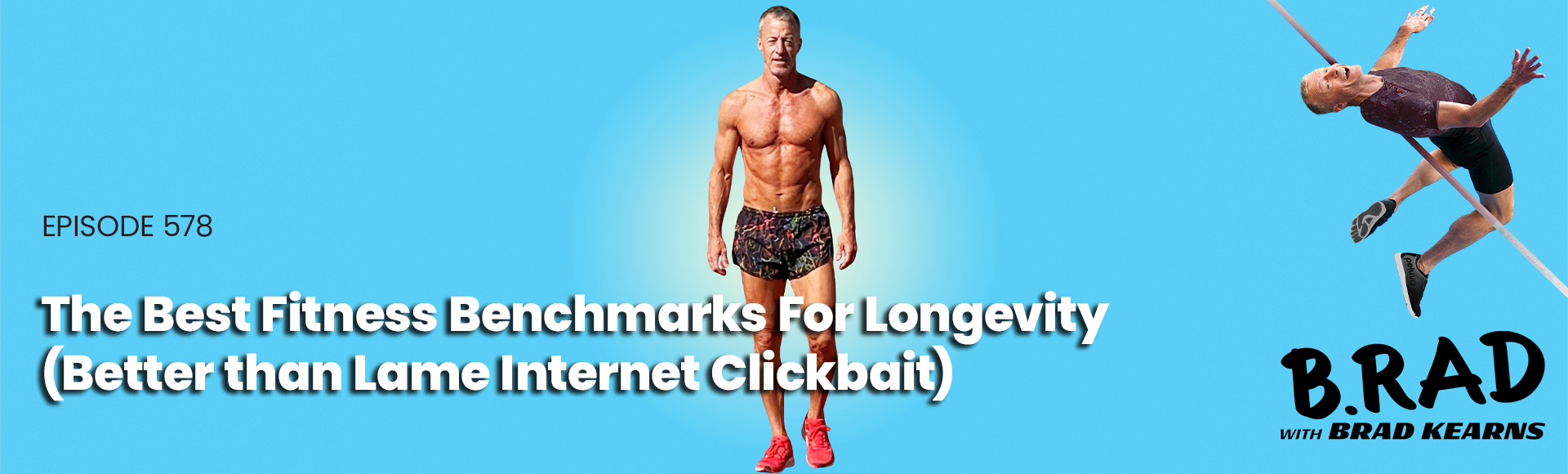
In this episode, I get into all these viral “every man should be able to…” fitness challenges you see on Instagram and YouTube—the ones with the deep-voice narrator rattling off random benchmarks that aren’t age-graded, aren’t grounded in any science, and somehow declare you “top 10% of health.”
I talk about why the subject is relevant, what these lists get wrong, and how to think more clearly about real fitness benchmarks—especially as we age. I share the simple 6%-per-decade decline metric from masters track, my own goals in the 400 meters and high jump, and the example my dad set as he gracefully slowed down from walking entire golf courses in his eighties to looping the backyard in his nineties. The big point: we all slow down, but we don’t have to fall apart.
From there, I take you through the real markers that matter for longevity and everyday vitality: walking as the centerpiece of aerobic conditioning, maintaining functional muscle strength to stave off sarcopenia and “opia,” and why explosive power—being able to save yourself from a misstep—is literally a one-rep-max that can determine your fate.
We get into the dangers of falling, the massive brain-health benefits seen in active seniors, why VO₂ max is just one slice of the picture, and why the best longevity challenge of all is simply doing something you love enough to keep doing it for life. I also make the case for the 400 meters as the ultimate full-body benchmark—an event that forces you to tap every major energy system and says way more about real-world fitness than shuffling through a half marathon or throwing around big weights.
If you want a clearer blueprint for staying strong, powerful, mobile, and fully alive deep into your later decades, this one pulls all the pieces together.
TIMESTAMPS:
Brad questions the validity of some fitness challenges on the internet. They should be age graded. [01:02]
The best longevity fitness challenge is doing something you personally enjoy doing and would like to continue doing for the rest of your life. [07:44]
There are important benchmarks in the areas of mobility and flexibility as well as strength, power, explosive power, as you age. [12:32]
In one study of seniors, it was found that the group who walked at least 4000 steps per day had bigger brains because of their walking habits. [16:47]
You have to preserve that functional muscle strength throughout life to avoid the single most prominent marker of accelerated aging, which is sarcopenia, age-related muscle loss. [18:49]
Running the 400 meter says volumes about your overall physical fitness and vitality. [21:49]
Jogging 2.0 on the YouTube channel shows a typical morning session for Brad. where he shows a variety of fitness drills. [30:24]
What is your mile time? Brad talks about a study that predicted longevity more accurately than blood work. [34:20]
There are many other benchmarks to measure your fitness. [36:29]
“Lift heavy things” means to engage in regular bouts of brief, explosive, high-intensity strength training. [38:22]
LINKS:
- Brad Kearns.com
- BradNutrition.com
- B.rad Superdrink – Hydrates 28% Faster than Water—Creatine-Charged Hydration for Next-Level Power, Focus, and Recovery
- B.rad Whey Protein Superfuel – The Best Protein on The Planet!
- Brad’s Shopping Page
- BornToWalkBook.com
- B.rad Podcast – All Episodes
- Peluva Five-Toe Minimalist Shoes
- Outlive, by Peter Attia
- Jogging 2.0 video
 LISTEN:We appreciate all feedback, and questions for Q&A shows, emailed to podcast@bradventures.com. If you have a moment, please share an episode you like with a quick text message, or leave a review on your podcast app. Thank you!
Check out each of these companies because they are absolutely awesome or they wouldn’t occupy this revered space. Seriously, I won’t promote anything that I don’t absolutely love and use in daily life:
- B.rad Nutrition: Premium quality, all-natural supplements for peak performance, recovery, and longevity; including the world’s highest quality whey protein!
- Peluva: Comfortable, functional, stylish five-toe minimalist shoe to reawaken optimal foot function. Use code BRADPODCAST for 15% off!
- Ketone-IQ Save 30% off your first subscription order & receive a free six-pack of Ketone-IQ!
- Get Stride: Advanced DNA, methylation profile, microbiome & blood at-home testing. Hit your stride the right way, with cutting-edge technology and customized programming. Save 10% with the code BRAD
- Mito Red Light: Photobiomodulation light panels to enhance cellular energy production, improve recovery, and optimize circadian rhythm. Use code BRAD for 5% discount!
- Online educational courses: Numerous great offerings for an immersive home-study educational experience
- Primal Fitness Expert Certification: The most comprehensive online course on all aspects of traditional fitness programming and a total immersion fitness lifestyle. Save 25% on tuition with code BRAD
I have a newly organized shopping experience at BradKearns.com/Shop. Visit here and you can navigate to my B.rad Nutrition products (for direct order or Amazon order), my library of online multimedia educational courses, great discounts from my affiliate favorites, and my recommended health&fitness products on Amazon.
TRANSCRIPT:
Brad (00:00):
Welcome to the B.rad podcast – where we explore ways to pursue peak performance with passion throughout life. I’m Brad Kearns, NY Times bestselling author, world #1 ranked Masters age 60-plus high jumper, and former #3 world-ranked professional triathlete. You’ll learn how to stay fit, strong and powerful as you age; transform your diet to lose body fat and increase energy; sort through hype and misinformation to make simple, sustainable lifestyle changes; and broaden your perspective beyond a fit body to experience healthy relationships, nonstop personal growth, and ultimately a happy, healthy, long life. Let’s explore beyond shortcuts, hacks, and crushing competition to laugh, have fun, appreciate the journey, and not take ourselves too seriously. It’s time to B.rad!
Brad (00:51):
You can’t be a softie and run an outstanding 400 meter times so you do have some functional muscle strength and power, even if you’re not inclined to go and lift weights regularly. But
Brad (01:02):
Have you seen these fitness challenges, viral Instagram, YouTube reels, where some narrator, somebody comes up with these important challenges that every man or every woman should be able to do to declare themselves fit. And it’s kind of cool. I always like seeing these, anything related to fitness challenges, but they’re also kind of super lame because they come outta nowhere. They’re obviously not based in science or longevity research, and just because some deep voice narrator is rattling off these challenges doesn’t mean they’re that relevant. But the subject is super relevant. So I thought I would take a little time to talk about my own favorite fitness benchmarks and challenges. The one I posted on my Instagram account, uh, the, the title, the, the narration starts out Men in the top 10% of Health should be able to do the following. <laugh>. I’m like, excuse me, top 10% of what?
Brad (02:04):
And, uh, where did you come up with these? No background, no details. Um, and also the biggest objection here as I was talking with Mark Sisson recently, me being age 60, Mark being 73 is like, none of these are age graded. Come on. So you’re throwing out, you should be able to deadlift twice your body weight. You should be able to break seven minutes in the mile. The one that I have on my Instagram says, you should be able to break 14 seconds in the hundred. Come on, man. Are you kidding me? Okay. If we had college male athletic type kids should be able to pass all these tests to declare themselves super fit. Okay? Okay, that’s great. I mean, these are great fitness challenges, but you gotta make ’em age graded. Okay. What is a good benchmark for a athletic college male kid?
Brad (02:52):
How about a female? Same for someone who’s 50 or 60 or 70, or 80 or 90. Come on, let’s figure things out. There’s great research in the Masters track and field community where they contend that you, uh, your performance declines about 6% per decade in the relevant events. So in my 400 meter goals, I’m looking at like a 3.6 second decline per decade, predictably as a consequence of aging. And of course, your training and dedicating yourself further to fitness can help override completely override these predicted age related declines. Speaking of benchmarks for the older age groups, uh, I remember the great example set by my dad when he was gracefully sailing through his eighties and his nineties. His number one sport was golf his entire life. He was a champion golfer, um, has some records like the longest time period between qualifying for the US National Championships as an amateur.
Brad (04:04):
Of course, he made it to the US amateur stroke play in 1943 at the age of 19. And then he qualified for the United States Senior Amateur. That’s for the best golfers in the country over age 50 when he would a when he was age 71, 40 some years later. And that was the biggest span known. He was also widely regarded to be the best golfer in the world, over age 90 for several years, and shot his age over 1000 times on the golf course. That means he shot a score lower than his age. So if he’s 90, he’s shooting 89. He also had the biggest range of under his age where he twice went 16 strokes under his age, shooting a 71 at age 87, and shooting a 76 at age 92. Absolutely unheard of. It’s very, very rare to shoot even one stroke under your age.
Brad (05:03):
It’s an amazing achievement. My brother did it recently, uh, shooting a 68 at the age of 69, but that’s an under par score for a 69-year-old. You don’t see a lot of that happening in golf. My dad did it so routinely that if he did not shoot his age at a round, it was an absolute disaster and would happen about once out of every 50 or a hundred rounds. He started with putting up a 66, a four under par, 66 at Lakeside Golf Club in Los Angeles when he was age 67. And then it was off and running until his final rounds played in his mid nineties. But anyway, when he was in his eighties, he could walk the entire golf course five miles. Uh, a few years later he might have been more routinely walking nine holes. Still pretty impressive. And then he might have been taking a cart more than walking as he went into his early nineties, still shooting great scores.
Brad (05:55):
And then as things wound down, he would walk his half a mile loop around the park as he got into his mid nineties. And then he would walk to the bench, uh, on the half mile loop, which was only a few hundred meters away, and then come back. So he’d do half of the park, and then as we finally come to the final wind down, he would walk around the backyard of his house and then finally walking from the bedroom to the kitchen. So, listen, people, we’re all gonna slow down. It was a beautiful graceful slowdown. So, um, it was nice to see play out and of course it’s natural and expected, but we definitely wanna fight this battle so that we’re not shuffling from the bedroom to the kitchen when we’re in our seventies. Okay? That’s the whole goal of live long, drop dead.
Brad (06:40):
That was the slogan that Marx Sisson came up with many years ago and made t-shirts. Uh, the, the, what what that’s conveying there is that if you can do a good job warding off, age related decline, guess what? Humans are really only going to live to somewhere around a hundred. So if we can maintain our health and our activity level and our functional muscle strength and all the things I’m gonna talk about further as we get into our nineties, we know that this decline to the final finish line is not going to be prolonged pain and suffering like we’re used to seeing today as the norm where people start to increase their prescriptions and decrease their activity in their sixties or in their early seventies. They’re down in, uh, basically, uh, watching other people participate and perform and not doing hardly anything. Okay? So, with that said, I think what we wanna do is establish some really cool standards to strive for and repeat these fitness challenges over time.
Brad (07:44):
Keep score. It’ll keep us focused. And so that inspires me to put together, uh, some important challenges that I think are a little more thoughtful than the stuff that’s been thrown out onto your social media feed. Now, I’m gonna tell you drum roll. You know what the absolute best longevity fitness challenge is that represents full body functional fitness for longevity. Here it is. It’s something that you personally enjoy doing and would like to continue doing for the rest of your life. What is more important and relevant than that? Walk the golf course for five miles? Like I mentioned, my brother does that virtually every time he plays. He’s 73 years old. He was playing in a hundred degree heat last summer in Los Angeles and playing a few days a week. <laugh>, I’m just amazed on some of these hot days that he was out there walking the golf course.
Brad (08:42):
And like I said, shooting his age. He shot his age recently, again last year, so out in the hot sun with a very heavy bag. ’cause he has all the accoutrements of a serious golfer like the rangefinder binoculars and extra golf balls and, and so on and so forth. So he’s carrying a heavy, heavy pack for five miles, hitting the ball straight, having a great time out there. Speaking of that list that I posted on my social media, be able to back squat 1.5 pound, 1.5 times your body weight. I don’t think brother Wally can do that. I don’t think he cares. And I think whoever can back squat 1.5 times their body weight and go out there and hit the ball really far, they’re not gonna score as low as my brother who’s focused and dedicated on golf. And that means so much to him.
Brad (09:30):
So find something that you love to do that means a lot to you, that you’ll be willing to train for, practice, prepare, and that can be your very, very best benchmark. Of course, it would be nice if it entailed, uh, those key fitness markers like aerobic conditioning and functional muscle strength with full body functional movement. Uh, that’s great, but if that’s not your thing, hey, um, let’s try to get va like a basic score on some strength parameters, and then you can unleash the dragon on whatever stuff you love to do, provided it doesn’t compromise your goals for longevity, where in a lot of cases, as we’ve talked about extensively in the book, Born to Walk, this extreme devotion to endurance training or an obsession with your VO2 Max score can indeed compromise other very important pillars of fitness and longevity. Remember, VO2 Max is milliliters of oxygen per minute, per kilogram of body weight.
Brad (10:33):
What does that mean? That means a skinny freak is gonna kick your if you’re a well muscled strong overall basic fitness person because the VO2 Max score divides by body weight. So the very slender endurance athletes of the planet, like in the Tour de France and in the Olympic running, uh, those kind of athletes are gonna have VO2 Max scores off the charts. Meanwhile, the mainstream population is now obsessing with this important laboratory score because it’s so strongly correlated with longevity, but it is only a slice, an important slice of the big picture. And contrary to a lot of the communication that’s coming out there, any form of cardiovascular exercise is going to support your VO2 Max. It does not have to be the highly regarded four by four by four workouts where you’re pushing yourself really hard for four minutes.
Brad (11:25):
Those are great, but those need to have a solid aerobic conditioning base, which is best established by a lifestyle of frequent everyday movement, the centerpiece being walking. So as far as fitness benchmarks and that endurance stuff, I think bucket list stuff is really great and trying to repeat that. So I talked previously on the show and have put posts up about my wonderful experiences on the world famous Cactus to Clouds trail in Palm Springs, California. It is widely regarded as the number one most difficult hiking trail in the United States, may be the world as measured by sustained vertical elevation game. So this trail starting in the desert floor in the town of Palm Springs ascends 8,400 feet in the first 9.3 miles. It’s like walking up a nine-mile staircase in terms of how steep it is, and the entire route that goes to the top of Mount San Jacinto, you’re kind of at the top of southern California with a beautiful 360 degree view.
Brad (12:32):
The whole route is a 22 mile hike, and I kind of wanna do that once a year. I’ve had so much fun with my friends doing it three times in recent years. So that’s gonna be on my bucket list, but it doesn’t mean I’m gonna dedicate a great deal of my fitness energy and time toward this extreme endurance challenge. I’m just gonna throw down once a year and in other areas pursue those important fitness goals, especially my primary competitive interest, which is master’s track and field with my two favorite events being the 400 meters and the high jump. So, we also have really important challenges or benchmarks in the areas of mobility and flexibility as well as strength, power, explosive power, preserving that as you age, which is way more difficult than preserving your endurance. And of course your cardiovascular endurance is always up there on those lists.
Brad (13:34):
When I talk about mobility flexibility, we also relate that often to the number one cause of demise and death in Americans over age 65. We’re gonna assume that’s also relevant for the rest of the world, and that is falling and related adverse consequences related to that fall. In the book Outlived Dr. Peter Attia cites research that 38% of people who fall and break a hip who are over the age of 65 are dead within a year. That’s absolutely scary. What happens is breaking a hip, we can survive that and get surgery and get the pins in whatever, rehab and all that. But when people break a hip, they’re bedridden for a while and they lose whatever minimal functional muscle strength, mobility, endurance they had, they decline and then they, for example, get pneumonia. They’re not strong enough to cough the, uh, problem out of their lungs and they go into demise because they’re bedridden, which all started with the fall and the broken hip really scary.
Brad (14:43):
So yes, everyone’s talking about doing balancing exercises and single leg movements and close your eyes and stand on one leg and test that, and those are all super important and great. But I also heard recently a really important, uh, insight about what falling and the protection from the danger of falling really entails. When you take that misstep, that is a single one rep max effort to control your unstable body weight and not fall and break a hip. So what does that require? A single one rep max that’s right, anaerobic, explosive muscle power for that one misstep to go, whoa. Just like you see a kid on the high school basketball court who trips over someone else’s foot and takes three stumbling steps, swings his arms, catches his balance, and runs down the court to make a layup, whereas anyone else who was not that highly athletically competent would trip over a foot and go down hard and break their hip.
Brad (15:46):
So to avoid this tragic consequence, you not only have to maintain good balance, flexibility, mobility, but that power, that explosive muscular power and the anaerobic muscle fibers, the anaerobic fibers decline much more rapidly than your endurance aerobic system and the aerobic muscle fibers. Now we see many seniors who are health conscious doing a great job walking and getting out every day and putting in their steps. It’s wonderful to see the research supporting how important it is for, especially as we age to get out there and walk and move. There was a prominent study at UCLA, showing an amazing difference distinction between a group of seniors who failed to get the bare minimum of daily movement that was defined as fewer than 4,000 steps a day versus another group of seniors who were qualified as active getting at least 4,000 and oftentimes much more than that.
Brad (16:47):
The active seniors had larger hippocampi, they had bigger brains on account of their walking habits. This also correlated with all kinds of better scores in short-term memory processing, uh, memory organization, long-term recall, and of course correlated with that better health outcomes. And that includes protection from another huge concern these days, which is the growing, uh, rate of cognitive decline conditions that are now being strongly correlated with lack of activity. Uh, the nickname from Dr. De LaMonte at Brown University for Alzheimer’s and related conditions of cognitive decline is type three diabetes because the, uh, brain decline is marked by dysfunctional glucose metabolism in the brain. So if you get into poor metabolic health, which as we know is strongly driven by your dietary choices as well as sedentary lifestyle patterns, you will, uh, harm the very sensitive cells in the brain that require, uh, good metabolic health, and when they get diabetes, you’re in big trouble.
Brad (18:02):
Okay, so, uh, the UCLA study showing that walking is so important. Um, but here’s the big one, it’s simply not enough. I kind of get on my mom on this because she’s an incredible walker and she has tremendous endurance. She can walk up steep hills. If you’re familiar with Los Angeles, we took her on a hike that made it up to Mulholland Drive when she was, I believe, 84 years old a couple, few years ago. I’m sure she can still do it now at age 87, but for a lot of hikers, it’s a pretty big challenge to get up there. I took a picture, printed it out, made a big, huge blanket. I love those blanket gifts, and she has got an A plus score in cardiovascular conditioning, but I’m also mentioning the importance of getting into the gym with a trainer and putting your muscles under resistance load.
Brad (18:49):
And she’s a real trooper. She goes in there she’s had some great help with you know, senior specialist trainers, but seniors get in there, get some help because it can be intimidating if you’re unfamiliar with the machines or the protocols, especially the need for correct form when you’re putting your body under resistance load. But you have to preserve that functional muscle strength throughout life to avoid the single most prominent marker of accelerated aging, which many experts are now promoting. It’s sarcopenia. That’s the age related loss of muscle mass and muscle strength. And we also put in the term dynoopia, which is the age related loss of muscle power, speed, explosiveness. Here’s the funny thing. It is getting a lot of prominence. Now, um, again, in the book, outlive Atia mentions that fitness is the single greatest longevity intervention ever discovered.
Brad (19:47):
Nothing else even comes close. He used to think it was diet. Now it’s getting and maintaining strength throughout your life. But the reason it hasn’t received sufficient attention until recently, and it still doesn’t have sufficient attention in the mainstream, is because this age-related decline in fitness was seen as normal, right? It’s normal to turn into a chicken leg as you age. And every senior we know, or every senior we see in the store or on the street has that frailty to them as just normal aging. Well, it’s not normal until it, it’s not normal just because most people are going in that direction. So what we need to look at are the tremendous, amazing outliers who can keep in shape and keep performing through the advanced age groups. Look no further than the amazing specimens at the front of the pack in Masters track and Field.
Brad (20:49):
My former podcast guest, Lyon Martinez, the world record holder in the a hundred meters, the most explosive event you can imagine, with an amazing time of 10.79 in the 45 to 49 age group. So at 45 years old, he’s fast enough to qualify for the Swedish National Championships. <laugh>, Can you imagine a young Swedish dude getting into the starting blocks at the national finals, trying to qualify for the Olympics and make the Swedish Olympic team, and he looks next to him and sees a 45-year-old guy, <laugh>. Good luck, Dad. May the best person win and make the team. How about my former podcast guest, Sue McDonald, the queen of Masters track and field setting 15 world records in the past year and a half? She competes in college track and field meets. I’m like, Hey, Sue, can you help me find some cool meets for the Masters to help build a schedule?
Brad (21:49):
They’re kind of hard to find. You gotta look all over the internet. And she goes, well, I’m racing over here at Westmont, and then I’m going down to Occidental. And I’m like, wait, aren’t those college meets? Yes, they let her into the college meets at age 61 because her times are right there with a decent collegiate middle distance and Sprinter <laugh>, She ran 400 meters in 61 at age 61. So defying the aging process is a beautiful inspiration to realize that we don’t have to just become more frail with each passing decade and sit around and watch other people participate. So speaking of 400 meters and Sue running that 61 at age 61, as I mentioned, this is my current athletic obsession. I think this is an absolutely fantastic longevity scoreboard marker. It’s an all encompassing challenge that says volumes about your overall physical fitness and vitality.
Brad (22:46):
And it’s also simple and relatable because 400 meters is one lap around the running track near you. It’s relatable to everyone. It’s accessible to virtually everyone. And it’s also widely regarded as the most difficult torturous event in track and field. The 800 meters, that’s two laps also gets votes there too because it’s kind of a sustained sprint that the body really isn’t naturally capable of. And I will contend, apologies out there to the endurance freaks that your competency in something like the 400 meter dash says much more about your overall fitness for longevity than being able to, for example, shuffle through half marathon, or sorry, Gym Bros. It says a lot more than just being able to throw around some heavy weights or really sorry to my over caffeinated, overly competitive adult basketball league players who I finally quit the sport when I realized they were gonna get me hurt someday because they can’t control their competitive intensity.
Brad (23:51):
But anyway, being able to shuffle around the court and still show some good moves because you’ve been playing and you played back in the day, that’s great, but it’s just something that you can kind of fake your way through without this overall athletic competency and resiliency. And in many cases, you’re faking your way through this stuff with an extremely high injury risk. So you might be playing on Tuesday night right now, but <laugh> the next game. You never know when you might just rupture an Achilles, and that will be the end and the beginning of your accelerated demise where you’re no longer a participant and you really haven’t much to show for your narrow fitness obsession. Same with being able to shuffle down the road for a 13.1 mile run. That’s great. That’s way, way better than the average unfit inactive modern human. So you can pat yourself on the back and look at your finisher medal on the wall.
Brad (24:46):
But this is a very tiny, narrow sliver of fitness if you want to pursue full body functional fitness for longevity and have a healthy, active, energetic life without that decline and demise and suffering that can occur when you, for example, do something so much as take a misstep and talking more about what the 400 meters is all about. If you’ve never tried it, it entails basically a sequential exhaustion through the various high intensity energy production systems of the body. So when the gun goes off, you start immediately into what’s known as the ATP creatine phosphate energy system. That is your system of energy production for maximum explosive power for a very short time. So the ATP creatine phosphate system powers maximum efforts of seven seconds up to seven seconds. This is what you use for that one rep max lifting a heavy bar or doing a shorter sprint where that’s all you’re doing.
Brad (25:53):
You’re using the ATP creatine phosphate system. So the a hundred meters is a very powerful, explosive and difficult event, but then it’s done before you really get tired and have to suffer and torture yourself to continue down the track. So the 400 meters is essentially a sprint that the body is literally not capable of sprinting that long because you exhaust through that short term energy system. The ATP creatine phosphate is the energy that’s contained inside the cell. So you don’t have to make any energy through the kreb cycle. You just blast out the blocks. You got a good a free pass for the first seven seconds because the energy sitting there in the cell. And then you have to transfer into the next anaerobic energy production system, which is called the ATP Lactate system, if you’ve heard that term.
Brad (26:40):
That’s right. The byproduct of burning energy with the ATP lactate system is the burn the acid production in the muscles that cause that familiar burn, and that is also gonna burn through. It’s gonna exhaust at around the 30- second mark per typical exercise physiology class discussion, right? That then you have to go into sugar-burning, what’s called anaerobic glycolysis. So you’re burning sugar without the use of oxygen because you don’t have sufficient oxygen to burn when you’re running an all out 400 meters. So you’re basically sucking air, you’re burning sugar as fast as you can, and even that system is getting overwhelmed such that you have to tap into also some aerobic endurance. So you can’t just be a pure, explosive, powerful a football player who can run a pass route in two seconds, catch the ball and continue the play for another five seconds, and then they’re done.
Brad (27:38):
This is a real athlete that has elements of all the energy production systems finely tuned and being able to perform, especially in that final home stretch, because as you’ve exhausted the ATP lactate system and are burning sugar at a high rate, and your body’s trying to keep up that energy demand, your muscles are kind of, uh, turning into rubber as you go down, and you still have to make it one more home stretch to the finish line, and that’s where the, the race of truth comes. Now, why is all this sciency stuff important? Because it entails all kinds of, uh, fitness protocols in order to be competent. So you have to have some endurance. That means you’re basically, you have aerobic conditioning base because you move a lot through life and you walk a lot and you do workouts that are lasting for let’s say 30, 45, 60 minutes.
Brad (28:35):
My 400 meter workouts will last that length of time, but a lot of the time is spent walking, recovering, doing another set of short wind sprints, for example, doing a main set where I’m doing, for example, yesterday I did a 500 meter with a seven minute rest, 400 meter six or seven minute rest, 300 meter five or six minute rest, 200 meter, four or five minute rest, and then three times a hundred meters. So I was walking a lot and sucking air and had my hands on my knees for a minute here, two minutes there. And then the short duration efforts that I mentioned that lasting for a minute and a half, a minute, half a minute, that kind of thing. But the workout itself, I was out there for a while, but I was building the aerobic system the whole time because my heart rate was up and working throughout the workout.
Brad (29:23):
That’s where we have this misconception about steady state cardio needing to be an important aspect of your overall important pillar of physical fitness. There’s no real need to engage in steady state cardio except if you’re preparing for a race of that nature. Otherwise. My sprint workout yesterday, my 500 breakdown, we call it, had a tremendous aerobic conditioning effect from the moment I exited my vehicle and started out with my warmup drills and walking and recovering and performing. My heart rate was easily double resting heart rate as soon as I got out of the car and continued that until I got back into the car after a nice graceful cool down. So I want you to get that in your head too, where you don’t have to head out the door and shuffle down the road in the name of fitness and longevity. You can instead turn some of those sessions into a more varied workout that stimulates more fitness adaptations.
Brad (30:24):
I have a video on YouTube called, Jogging 2.0 where I go with my dog and I show you my typical morning session where I go out there and jog for 30 or 40 minutes. I’ve done it for years, for decades, and in recent years, I switched it up to include things like a short series of sprint drills followed by walking recovery, followed by perhaps a little jogging until I reached the tree stump, and then did a set of box jumps up and down the tree stump, and then more walking recovery. And then finally, of course, we make it back to the car after 30 or 40 minutes, but instead of this slow trudging along at whatever pace, and it’s a pretty slow pace. Now, if you ask me to jog at aerobic heart rates, instead, I had all these different fitness stimulations, especially the drills and anything powerful and explosive, like stopping at the park or station or stopping at the bench to do some pushups.
Brad (31:18):
Okay? So that will help you develop as a 400 meter runner where you actually have some power and some explosiveness. Continuing on with some more comments about the 400 meters, of course, I can’t get enough talking in about that. It’s, as I said, it’s a sprint that lasts too long for the human to truly sprint. So you’re just challenging the maximum capabilities of your mostly anaerobic energy production. In fact, the 400 meters is in most cases, 66% anaerobic and 33% aerobic. So there’s still a big slice there that requires that endurance component. Unlike, for example, the a hundred meters, which is something like a 99% anaerobic, the 200 meters, you’re gonna have a little sliver of aerobic. Maybe it’s, uh, five or 7% or something kind of inconsequential but still there, especially when you’re looking at who’s gonna die in the last 20 meters of the Olympic final.
Brad (32:17):
But then when you get up to 800 meters, now we’re talking about an event that’s 50% aerobic, 50% anaerobic in most cases in general, that means you look on the starting line and you see skinny folks who do a lot of training and a significant number of weekly mileage. Now, when you look at the mile, which is so amazing to think it’s only lasting for under four minutes, right? With the elite males and a little over four minutes for the elite females, that event is around 80% aerobic system. So the best miler in the world, Jakob Ingebrigsten of Norway, Faith Kipyegon of Kenya, the best female middle distance runner in the world, they are training like a extreme endurance athlete it would seem from the outside running upwards of, uh, 80, 90, 100 miles a week. My former podcast guest, Shelby Houlahan, the American record holder at 1500 meters, they call it the metric mile.
Brad (33:13):
She’s out the door training for at least eight miles every single day. She’s a long distance endurance runner and doing those extremely challenging anaerobic threshold workouts like she mentioned on the show, 30 times, 300 meters at a fast pace with only a brief a hundred meter jog before she does the next one and the next one and the next one. So there’s an extreme endurance component to the mile. That’s why indeed I’m mentioning the 400 meters as a great fitness benchmark. The mile run is a fantastic fitness longevity benchmark because you’re measuring your, uh, your endurance component as well as your ability to perform, uh, at the higher heart rates in the realm of VO2 max. So the mile runtime is strongly correlated with a high VO2 max, more so than, for example, the 400 meters, which is more anaerobic oriented. So you don’t really need to have, uh, this tremendous ability to perform for, uh, four minutes at a time, like in that traditional example of the four by four by four VO two max workouts.
Brad (34:20):
You don’t see the Elite 400 meters runners spending too much time doing that, but I bet you they would have a decent score. And as I did with my entire show, which I direct you to listen to about how VO2 max might be overrated, a decent VO2 max score is really all you need to focus on or worry about when it comes to your longevity potential. Uh, the mile runtime great scientific data behind this, unlike the <laugh>, the fodder that’s thrown out on social media, the Cooper Institute in Dallas and the University of Texas Southwestern Medical School did a widely respected and and referenced study of 66,000 people. They tested their time in the mile run at around age 50 and discovered that it was strongly predictive of one’s chances of living, uh, in good health to age 80. So your predictability of your longevity based on your mile runtime at age 50 was tremendous.
Brad (35:24):
It was better than anything found in blood work or other routine medical exams. It’s like, yo, what’s your mile time? <Laugh>? More so than let’s look at this report and see what, what these blood values mean. Um, those are important too, of course, but I love when they bring in practical fitness benchmarks and have the science behind it to say, this is super important for your longevity. Those who were able to break eight minutes for male and nine minutes for female at age 50 were in the superior category, and they had an outstanding predictability of sailing to 80, or I believe it might have been 85 in excellent health. Now at age 50, those who were unable to break 12 minutes for male or break 13 minutes for female, they were in the fail category and they had an exponentially higher risk of morbidity due to their insufficient fitness at that middle age.
Brad (36:29):
Number is the mile the end all? No, but it’s pretty important because again, it entails that you’re keeping good condition in your muscles. You need some power, you need to spring off the ground even to run an eight minute mile. There requires some, some power, some explosiveness, but also a lot of endurance. And so I’m gonna put the mile on there, I’m gonna put the 400 meter on there because that represents the functionality of your anaerobic energy production systems, which as I mentioned is also super important for falling. And then we can also put some standards like, uh, excelling in these routine balance tests like being able to stand on one leg with your eyes closed. Things like the fitness benchmarks in the gym when it comes to strength. Things like being able to deadlift or squat or hang off a bar with competency are also important to reveal that full body functional muscle strength and muscle mass preserved throughout life.
Brad (37:28):
But again, like back to the 400, you can’t be a softie and run an outstanding 400 meter time. So you do have some functional muscle strength and power, even if you’re not inclined to go and lift weights regularly. But as we kinda get to the finish line here, it’s really beautiful to reference back to the Primal Blueprint Fitness model that we started communicating, uh, nearly 20 years ago, where you want to have that move frequently at a slow pace. That’s Primal Blueprint Law of having a walking oriented lifestyle, as well as other forms of regular everyday movement that indicates aerobic competency because the aerobic endurance system is best developed at the lower heart rates. So we want to stay away from this in-between stuff that’s kind of difficult and has a potential to wear us out. So moving frequently at a slow pace. The other Primal Blueprint Law referenced is lift heavy things.
Brad (38:22):
That means engage in regular bouts of brief, explosive, high intensity strength training workouts with full body functional movements. I had my former podcast guest, Dr. Doug McGuff, go through his wonderful big five protocol. That’s five machine exercises that you can find at most every gym, and you go through the protocol just once a week is sufficient. So the workout takes 12 minutes and you’re doing a pull-down move for your lats. You’re doing an overhead press, you’re doing a chest pressed, you’re doing a seated row and you’re doing a leg press. And those basically work the major muscle groups of the body, one single set to failure. What I love about it, it’s so simple and doable for everyone, and that is achieving, uh, that muscle strength, that muscle power objective. So hopefully you get some ideas, you get some inspiration yourself. I mentioned my desire to do that.
Brad (39:18):
Cactus to clouds hike every year. So maybe you have the highest peak in your county or your state that you can set up an adventure for the summer. I talk to a lot of skiers who do a lot of off season training just to be prepared for when the snow starts falling and their quads won’t go into knots when they take their first run down the hill. So training for skiing, training for climbing the highest peak, uh, doing the big five workout routinely as a component of your lifestyle. Going to the gym once a week is all is asked. And the entire workout you can get done if you want to kind of bust through it in only 15 minutes. And then I’m gonna give a huge vote for those two signature running events the 400 meter and the mile run. I would love to hear from you about what some of your favorite fitness benchmark challenges are for longevity and your desire to repeat them over and over as we go through the years and decades. Thank you so much for listening, watching. Send a note to podcast@bradventures.com and we’ll continue to push this theme and learn about some other fitness benchmarks out there. Have a good one. Go out there and do it.
Brad (40:30):
Thank you so much for listening to the B.rad Podcast. We appreciate all feedback and suggestions. Email podcast@bradventures.com and visit brad kearns.com to download five free eBooks and learn some great long cuts to a longer life. How to optimize testosterone naturally, become a dark chocolate connoisseur and transition to a barefoot and minimalist shoe lifestyle.