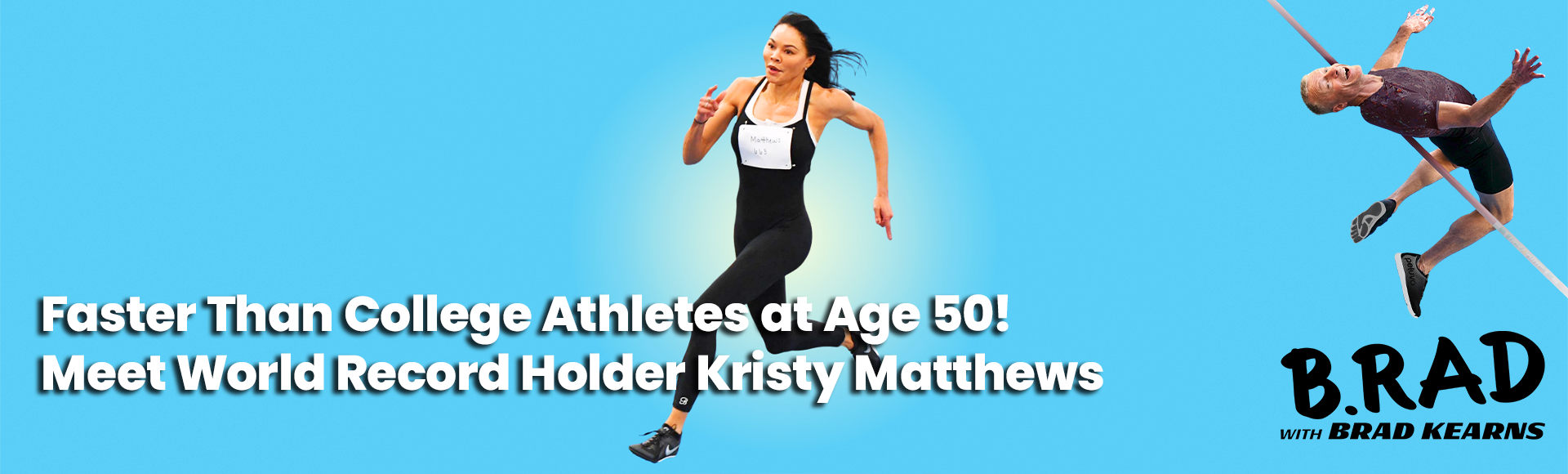
In this episode, I talk with Masters track and field world record holder, my friend Kristy Matthews, about her incredible return to competition after 30 years away from the sport, and how she came back in her 50s to run a 58-second 400 meters.
There’s also a slightly embarrassing first encounter story in here that’s worth hearing!
We get into her background as a collegiate athlete, the long break from competition, and what brought her back to the track in her late 40s, where she says it instantly felt like “home” again. We also dive into her “five W’s” framework—embrace who you are, accept where you are, identify what you want to accomplish, know when to give yourself grace, and always remember your why.
She explains how she trains more intuitively now, why joy and gratitude drive her more than pressure, and how she balances sprinting, soccer, recovery, and real life as a working mom.
It’s a great conversation about staying competitive as you age, pushing yourself in a realistic way, and simply showing up, getting on the starting line, and having fun with it.
TIMESTAMPS:
This guest has set world records in the 400 and is in the 50 to 54 age group. [01:17]
Kristy’s athletic life started as a runner in college where she was on a full scholarship. [06:11]
Even as she grew older and became pregnant, she was highly motivated to stay very fit in order to give her child a long presence in her life. [09:30]
She had a 30 year hiatus from competitive track. [11:36]
What is her secret to being able to run at age 52, with the same times as college comepetition? [18:32]
Take the time to ask yourself, “How are you doing?” Embrace who you are. [21:31]
Accept where you are. Identify what you want to accomplish. [23:06]
Ask yourself, “Why are I doing this?” Make sure you understand all the reasons. [29:55]
What does Kristy’s training look like? [32:21]
Kristy also plays soccer and sprints. [37:56]
Unfortunately, we do not see many people competing in the over 50 age group. [39:41]
Kristy is trying out Peluvas and tells Brad what experience she is having. She likes feeling the ground. [45:23]
LINKS:
- Brad Kearns.com
- BradNutrition.com – 20% OFF Your First Order!
- B.rad Superdrink – Hydrates 28% Faster than Water—Creatine-Charged Hydration for Next-Level Power, Focus, and Recovery
- NEW: B.rad Real Rad Gummies – Creatine + Nootropics for Focus, Motivation, Performance, and Recovery!
- B.rad Whey Protein Superfuel – The Best Protein on The Planet!
- Brad’s Shopping Page
- BornToWalkBook.com
- B.rad Podcast – All Episodes
- Peluva Five-Toe Minimalist Shoes
- Kristy Matthews Instagram – @kristymatthews4444
- Kristy Matthews Videos – Peluva YouTube Channel
 LISTEN:
We appreciate all feedback, and questions for Q&A shows, emailed to podcast@bradventures.com. If you have a moment, please share an episode you like with a quick text message, or leave a review on your podcast app. Thank you!
Check out each of these companies because they are absolutely awesome or they wouldn’t occupy this revered space. Seriously, I won’t promote anything that I don’t absolutely love and use in daily life:
- B.rad Nutrition: Premium quality, all-natural supplements for peak performance, recovery, and longevity; including the world’s highest quality whey protein! Get 20% OFF your first order!
- Peluva: Comfortable, functional, stylish five-toe minimalist shoe to reawaken optimal foot function. Use code BRADPODCAST for 15% off!
- Jaspr Air Scrubber: Ultra high-performance air purifier – blows other air filters away! Save $400 on your unit with code BRAD.
- Get Stride: Advanced DNA, methylation profile, microbiome & blood at-home testing. Hit your stride the right way, with cutting-edge technology and customized programming. Save 10% with the code BRAD.
- Online educational courses: Numerous great offerings for an immersive home-study educational experience
- Primal Fitness Expert Certification: The most comprehensive online course on all aspects of traditional fitness programming and a total immersion fitness lifestyle. Save 25% on tuition with code BRAD!
I have a newly organized shopping experience at BradKearns.com/Shop. Visit here and you can navigate to my B.rad Nutrition products (for direct order or Amazon order), my library of online multimedia educational courses, great discounts from my affiliate favorites, and my recommended health&fitness products on Amazon.
TRANSCRIPT:
Brad (00:00):
Welcome to the B.rad podcast, where we explore ways to pursue peak performance with passion throughout life. I’m Brad Kearns, New York Times bestselling author, world number one ranked Masters age 60 high jumper and former number three world ranked professional triathlete. You’ll learn how to stay fit, strong, and powerful as you age, transform your diet to lose body fat and increase energy. Sort through hype and misinformation to make simple sustainable lifestyle changes and broaden your perspective beyond a fit body to experience healthy relationships, nonstop personal growth, and ultimately a happy, healthy, long life. Let’s explore beyond shortcuts, hacks, and crushing the competition to laugh. Have fun, appreciate the journey, and not take ourselves too seriously. It’s time to be wrapped. It’s time to B.rad!
Kristy (00:51):
Did you ask me what I do when I first hit the track and you thought I was gonna go into something about physical? Yeah. No, no, no. It’s all mental for me. I get out the car and I’m all, and then I, first thing I’m doing, I’m telling myself, why am I doing this Uhhuh? Why am I here? And I catch myself mm-hmm <affirmative>. And I flip it and I make it positive. Yeah. Kristy, why are you here? Why are you doing this? I’m doing this because it,
Brad (01:17):
Hello listeners. It gives me great pleasure to introduce a world record holder, my friend and Masters track and field inspiration, Kristy Matthews playing out of San Diego, California, and burst onto the Masters track and field scene a few years ago, shattering records outta nowhere. People are like, who is this lady? And who she is ,is a collegiate track star who took 30 years off from competitive track and field. And then as she was pushing 50, decided to pursue some goals and get back into focus, and came out there and broke the world record for the 400 meters indoors. She ran a 58 seconds. For those of you unfamiliar with 400 meters. That’s a absolutely sensational time. It’s on a par with collegiate level track and field racers. And she’s in the 50 to 54 age group as the fastest female of all time. We are going to hear her unique approach and mindset and philosophy as it relates to challenging your body with competitive goals and developing an ideal competitive mindset and focus.
Brad (02:32):
So it’s really great insights that you get from her above and beyond being fit and pushing hard and working out hard, and all the things that, of course have made her a fantastic lifelong athlete. And as I introduce this show, I am going to tell sort of an embarrassing story about my very first encounter with her was at the Moorpark Masters track and Field, Southern California Championships, and watching this awesome race of the elite level females in the first wave where, you know, Masters track and field starts, like age is 35 and up, so you have five year age divisions and going all the way up to the seventies and the eighties and the nineties. Uh, but there’s some pretty fast people out there that are, you know, just past their, for example, competitive prime if they were elite Olympians. And they’re still pretty darn good.
Brad (03:26):
So I’m watching this exciting first race that she won in 58 seconds. And then I was warming up for my race as they get to the older guys later. And I overheard her and her group chatting in the infield, and they were all excited. And someone was saying, I think you broke the record. I think you broke the record. And I’m thinking, what are these guys <laugh>? They’re, they’re clueless. I mean, Alison Felix was in the Olympics when she was 35. She was running for, for USA, so there’s no way she broke any record. And then they announce over the loudspeaker, the age 50 record has been broken by Kristy Matthews. And I’m like, going up to her. I’m like, you’re 50, are you freaking kidding me, <laugh>? Because you don’t look 50. And that race didn’t look like no 50-year-old. But indeed, I witnessed, that was the national record for outdoors for females 50 and over.
Brad (04:16):
So if you watch the great series of videos that I published with her on the Peluva YouTube channel, you’ll have some more entertainment and some inaction demonstrations out on the running track, her office as she calls it. Uh, but I really like some of her insights about, you know, when she arrives at the track before the workout, she starts to get into that ideal competitive mindset. She expresses gratitude for being able to be there and push and challenge these goals. And right now she’s recovering from a severe injury as I published this show in 2026. So we’re gonna miss her out on the track this year. But she still exudes that positive spirit and working hard at rehab and always, you know, taking things one step at a time and enjoying the process. So I think you’re really gonna enjoy these insights about what it takes to become a world champion, even in the older age groups.
Brad (05:19):
And also this unique and refreshing competitive mindset where she has, uh, a really evolved perspective and can still kick butt. She’s also an elite female soccer player. So she plays at this tournament level with ladies younger than her and super competitive in two different sports. So let’s sit down with Kristy Matthews. Here we go.
Brad (05:41):
Kristy Matthews. We had a great day at the track meet where you set the world record. Then we did some filming. We learned all about the 400 meters from the world record holder, and now we sit down and relax Yes. To learn more. It is fun to connect with you and your amazing background story, which I’ll start out by saying, here’s this lady coming onto the Master track and field scene and breaking world records outta nowhere, but not quite. How about we start there?
Kristy (06:11):
Okay, so where did we start? Uh, let’s go back 30 some years. So like, I always like to remind people I didn’t come out of the woodwork. I was a D one athlete full scholarship at Iowa State and at San Diego State, uh, provisionally qualified for Olympic trials back in 92, which event? In the 800 meters. Okay. I won the Mountain West Collegiate Conference. I was at San Diego State. I even went and competed with the US team who went to the Japanese cross country National Championships. There, I moved, I ran a, I picked the shortest leg on the, the cross country relay, but I did it <laugh>. Oh
Brad (06:49):
Yeah, the den where they hand off. Yeah. Different distances, but it’s a relay. Yeah. <laugh>. Wow.
Kristy (06:54):
So yeah, I, I was, I was a runner all in college. And, um, I just decided to take a long break, uh, graduated, moved to France for a while to work. Um, got some traveling in and life kind of sat, you know, life set in, I should say. And um, and, uh, I sat down with it <laugh>. So, um, but, uh, yeah, then as life would have it, uh, things happen sometimes that don’t happen when you want them to, but they do happen. And I ended up getting pregnant. I was 43 years old, almost 43 years old when I had my child. And I said to myself, you know, this is the only child I’m going to have. I need to make sure that I live a long life for her. I’m mobile, I’m active, I’m healthy. Let me get back into exercising and doing some things that I love. So I started playing soccer at about age 46. And from soccer, then that turned into track at the senior games, and then that turned into U-S-A-T-F Masters and here I am today. So didn’t come out of the woodwork, just was kind of hanging out in the background, let’s say that.
Brad (08:12):
And during that break, I assume that you kept in shape in some way, shape or form. You just weren’t competing at a high level or really dedicated like you are now.
Kristy (08:21):
That’s true. I never let myself get completely out of shape. I mean, all through that time, you know, I did things like, I would take CrossFit classes, I would go to the gym. I even had some trainers at some time. And I think I was telling you, <laugh>, you gave me that. I had a weird look. But it’s true. Even when I was pregnant with my daughter, I don’t think I gained more than 20 pounds. And, you know, I just, I didn’t, I thought, I’ve always thought it’s a good idea to stay healthy and to stay fit. Mm-hmm <affirmative>. And even when the first couple months during my pregnancy, I still would go jogging, you know, ’cause exercising is a stress release for me. Mm-hmm <affirmative>. Um, it puts me in a good head space. It always has. Even when I was younger. So I never gave up on that. So, um, yeah, throughout my pregnant, I should say throughout, but the first couple months, until months six or six or so, I still would do some exercising. I didn’t just let myself go. I, um, you know, I stayed healthy. And then once I had her, I started to get back into shape. I lost the little weight that I had gained relatively quickly. And yeah. Just kept doing what I love to do. And that’s stay in shape.
Brad (09:30):
Well, that’s great that you mentioned the motivation of this daughter’s coming along and you’re, you know, you already got some years behind you, so you wanna remain youthful and, and be around for a while. And I remember my dad, who was also older when he had us kids, he was in his forties and he was so youthful. Part of it was because he was coaching us in sports and doing things that a 60-year-old might not be doing. But, you know, all the way through, he had that youthful spirit. His wife was 15 years younger than he and all that stuff. Things matter. Sure. <laugh>. Yeah. Yeah, for sure. Yeah. Yeah, yeah. So you started playing soccer and, I assume at a pretty competitive level where you’re really getting really fit out there on the soccer field. And that was when you started to get the twinkle in your eye about, Hey, maybe I should try this track. Or you had some chance encounter with a coach and said, Hey, <laugh> that.
Kristy (10:23):
Well, it was I wouldn’t say competitively at the, I mean, I do competitive tournaments, but, uh, you know, as adults, when we play recreational sports, it does get competitive. <laugh>. Yeah. Yeah. More Yeah. Than kids sometimes
Brad (10:38):
<laugh>, let me tell you about adult league basketball. Well, that’s
Kristy (10:40):
A whole nother conversation. Oh, yeah. So, with soccer, I started playing, I got a soccer coach, um, and I had a trainer because going back to my background, if I do something, I wanna do it with purpose. Mm. And I don’t wanna ever, you know, I wanna do it right. And I wanna do it to the best of my ability. So I picked up on some things quickly because I worked at it. Right. And, during that process, I realized, uh, much to the, you know, chagrin of my competitors, but the delight of my teammates that I still could move <laugh>. And so they kept telling me, you know, Kristy, you really should think about going back to running ’cause you are very fast still. And I said, yeah, you know, maybe I will, so the thing about soccer, women’s soccer, especially over 50, is, um, there are a lot of, uh, senior games tournaments for women in 50.
Kristy (11:36):
And I found out there were track meets too. So I was, then I said, oh, I’ll play the soccer tournament, but I’m gonna go run track. And I’m not kidding. I think the first track meet that I went to at a senior games was in San Diego. I was also playing in the tournament <laugh>. And I walked into back on that, that track. ’cause I was had some friends running actually, um, it felt like home. Hmm. It was the weirdest, uh, feeling because I hadn’t felt that in so long. I hadn’t walked on a track in almost 30 years, and it felt like home. And I said, yes, I need to do this again. This is my happy place. My oval office is my happy place. So that’s when I decided to make the transition and, and get back in the track.
Brad (12:23):
Yeah. I guess when you’re young and you get so deeply into it as a collegiate athlete, it like forms an imprint on your personality, on your consciousness. And maybe that lit it up when you walk back in there, even 30 years later, you, you have that familiarity and that bringing back all those memories, I guess.
Kristy (12:39):
And people around me could tell, too, they’re like, Kristy, you just seem so happy out here on the track. I said, I do. Oh my gosh. Because I’m gonna tell you, my last track meeting in, college was that Mountain West Collegiate conference. And I won the 800 meters, I won the conference title. And after that was over, I remember going down on the track and I, I went down on my knees and I kind of did a kissed it, touched the track, and I said, I’m done. Oh,
Brad (13:07):
That’s
Kristy (13:08):
What I thought.
Brad (13:08):
Yeah. Yeah.
Kristy (13:10):
But again, life comes at you differently sometimes. You never know what’s gonna happen. And I walked back on that track and said, oh, I’m not done.
Brad (13:19):
That’s interesting. ’cause I think in the college system, a lot of times it’s a grind. Mm-hmm <affirmative>. Sometimes the coaches take the fun away. And I think kissing that goodbye was like, you know, probably you’d had enough of that extreme pressure and all the things that college athletes face. And I think, I feel the same way, like coming back with a renewed perspective. Whereas in high school, I would dread these workouts. It was so much pain and suffering mm-hmm <affirmative>. And now it’s like, it’s one of the best parts of my life is getting to go to the track and push myself, even though there’s so much suffering involved.
Kristy (13:50):
I’m so glad you brought that up, because that is one thing I I love about doing sports as an older athlete or as a Masters, is because now I can really embrace the joy of it. I, yeah. I’m not getting paid like I was on a scholarship and having everything done for me. I have to make my own travel plans. I have to map out all these things, you know, all that was done for me. I get that. But it came with a lot of other things too. It came with a lot of expectations, a lot of stress, a lot of choices that I couldn’t make that were made for me. But coming out here now and doing this sport and for the pure joy of it and making decisions that make me happy, it’s like a whole new world. And I’m just so grateful for it. I’m so grateful that I’m still healthy enough to, to come back and do it and experience it on this level.
Brad (14:42):
So when you got back out there, did you have some immediate success? Did you get the bug and then start training? What was the entry into Master’s track and field? Like? Oh,
Kristy (14:55):
I don’t, I could tell you the truth, but don’t <laugh>.
Brad (14:58):
It’s okay. Don’t hate me. It’s okay. Just the cameras are rolling.
Kristy (15:02):
Im trying to, I just, I I don’t ever wanna come across as that person, but I mean, I can only tell you what happened. Yes.
Brad (15:08):
Report the facts, please.
Kristy (15:10):
I think my first, well, there were other races, but my, since we concentrated on the 400, that’s been my most successful race. Mm-hmm <affirmative>. My first 400, I get out there and running against some men and, you know, they didn’t think much of it. And I, I ran, I won and I won by a lot <laugh>. And it was your first
Brad (15:32):
Race of
Kristy (15:32):
Years, first race. And it was so cool because there were some high school girls that were helping run the meet and they were cheering for me. And it was just like, girl power. And I said to my said, yeah, girl power, I got this. You know. And, so I kept running and I kept winning at the senior meets. And then like, I think we discussed this as well. I realized that I wasn’t getting quite the competition as I wanted to. And someone said they have Masters, USA Tiff Masters. So I said, okay, well I’ll try that out. Very first National Masters meet <laugh> indoors, uh, banked track. I I hadn’t even ran on a bank track, I think in about 30, yeah. 35 years. And I only did it a couple times back at Iowa State. Mm-hmm. Um, first National meet, I come out with two world records, <laugh> <laugh>. I said, what is going on? <laugh>? So I win the 400 meters.
Brad (16:37):
This is in the women’s 55 you says?
Kristy (16:39):
Yeah, I win the 400 oh years, and I break the world record in the process. I win the 200 meters, become the national champion of the 200 meters. And then I get asked to be on the women’s third, 35 to 39, 4 by four, uh, relay. They were going for the world’s.
Brad (16:55):
Well, that’s not fair. Oh, wait, it is fair stuff. Like the women’s 35 to 39 is, I suppose the youngest person would have to, you’d have to go with that age, but they can pull in some older talent if they Yes. Goes
Kristy (17:07):
By the youngest person in the
Brad (17:09):
Room. So they pulled in a 50-year-old for the 35.
Kristy (17:11):
They did
Brad (17:12):
<laugh>. I have to, since you, since you’ve been honest on the show. I have to be honest to you. And take a break here. So I was at Moorpark when I first saw you run that 58 mm-hmm <affirmative>. And I saw that, you know, that heat there was someone else up there too. Oh yeah. And I’m like, wow, those young women, she’s
Kristy (17:28):
The poor. She’s the, she’s American. She was the, she is the American record holder for the 40 year olds.
Brad (17:32):
Yeah. Yeah. I saw these guys and I was very impressed. And then they were saying, Hey, I think you’ve set some kind of record. And I thought in my head, that’s not a record because Allison Felix ran in the Olympics when she was 35. I thought you guys were the 35 division because you were so fast. And then I’m walking around and there’s, they’re still pointing out that you set a record. And I’m like, what? And they said, she’s in the fifties. And I’m like, you’re in the fricking fifties. That’s when I end up and introduce myself. I’m like, are you kidding? Excuse me. Yeah. She’s 52 people. Yeah. A
Kristy (18:03):
A ARP Yes. A A RP. You get the magazine. She has it in her purse. If you need proof, she’s got her birth certificate and the A A RP magazine, they don’t mess around with that. No, they don’t. But your time, 58 seconds if you’re not familiar with that. This is a collegiate athlete competitive time for female running 400 meters and you’re doing it at 52. So, um, yeah. It’s a, it’s, come on, come up with, give us some secrets. It’s, it’s mind blowing.
Kristy (18:32):
Well, <laugh>, I think a lot of it has to do with mental fortitude. Mm mm-hmm <affirmative>. And just kind of a lot of the accepting where I’m at. You know, who I am now. I’m not a D one collegiate athlete anymore. I’m a 52-year-old mother of a 9-year-old. I work <laugh>. But, you know, I take all of that out with me to the track. Um, but I put in the effort and I put in the time just like all the other Master’s athletes do. And that’s why I don’t always like to dwell on my success as an individual. I also, I like to celebrate the community. None of us are getting paid to be out here like that. You know, we’re not, we don’t get the recognition other athletes do, but that doesn’t mean we try any less. That doesn’t mean we’re putting in any less effort, you know, that doesn’t mean that we’re doing any less than what we’re, we’re working with what we have. And that’s commendable.
Brad (19:33):
Oh my gosh. I mean, don’t get me started. Because we have this culture now where we’re obsessed with longevity. We have all these influencers with huge platforms, and they’re looking in the camera and saying, this is great for longevity. That’s great for longevity. I think we need to pay way more attention to what you’re doing in the 50 plus division that no woman has ever run that fast and figure out, well, um, a lot of it seems like talk and hype and biohacking strategies that cost a lot of money. And this is how you stay youthful versus like, people who are actually waking up getting in a lane, toeing the starting line and hitting the stopwatch is, has so much relevance. And we did a lot of filming on the track. You can watch those videos, but like you, um, you delivered some interesting insights, especially about that flowing intuitive mm-hmm <affirmative>. strategy rather than this is what Kristy does every day. She wakes up at 6:00 AM No, because that’s a, a lot of the programming that we’re getting mm-hmm. Is like, just don’t be a wuss and push yourself harder. Mm-hmm. And you’re, you’re conveying a more nuanced message.
Kristy (20:36):
Yes, yes. I’m, I it’s all about you, you know, uh, and I I do, I mean that in a self-centered, selfish kind of way. Yeah, I do a little bit because, you know, that’s your body. It’s who you are. It’s what makes you, it’s what drives you. It’s, you know, only, like I told you out at the track, you need to be comfortable with, you know, the direction you’re going because when you get to the destination, you’re the one standing there. So, you know, I am a firm believer in do what works for you. I know we talked about this a little bit, but, and I was gonna share with you, so I, I kind of came up with my five W’s of how I run <laugh>. And I hope I don’t mess this up too bad, but the first one I talk about, all right, what, what I think these are things I think, and I’ve kind of put together in my first one, is I want to embrace who I am.
Kristy (21:31):
Mm-hmm <affirmative>. So, like I said, I’m, I’m a 52-year-old, you know, I have a young kid too. I work all those things that, that’s where I am. Um, and that also I’ve got some injuries. That’s who I am. I need to work with that. You know? I think that a lot of times people think that they compare themselves to other people, but they’re really not looking at themselves. I mean, how many times do we look at, we’ll say all the time to each other, Hey, how are you doing? How are things going? Mm. But do we say that to ourselves often? Mm-hmm <affirmative>. No, we don’t. Mm. And I think that’s important to take that time to, you know, to ask yourself, how am I doing? And part of that’s embracing who you are. You, maybe you’ve got some things going on mm-hmm <affirmative>. You know, may to work through. And that’s, that’s all right. So embrace who you are. And then the other thing I would say is that’s number one.
Brad (22:22):
Yeah. Embrace who you are. Yeah. And perhaps, um, with a little more kindness, like, you reminded me a little more grace and kindness.
Kristy (22:29):
Oh, that comes, that comes later. Yes.
Brad (22:31):
<laugh>. Oh, I was telling, she was showing him warmup before she does her heavy sprinting. And there wasn’t much to it. Like, you weren’t like, crushing yourself before. And I’m like, gee, Kristy, maybe I’m like going too hard before I even do the main thing because for whatever reason, like, I think I really gotta get ready now. More grace. Yes. More, more honesty. I guess I would come about here. Yeah.
Kristy (22:53):
Check your ego
Brad (22:53):
Don’t, don’t pretend that you’re still a D one runner. Mm-hmm <affirmative>. You said that even though you’re just as fast as them, but in many ways you have different parameters. Mm-hmm <affirmative>. Okay, I got the point. I got the point. Yes. Yes. Okay. Number one is embrace.
Kristy (23:06):
Embrace who you are. The second thing I was gonna say is, um, accept where you are. And again, I’m not who I was before. And do I need to start at a lower level when I Yes. I was telling you, when I, um, started working out on the track, I was working out with the track club and they had different groups. And the, the, the slower group was the C group. And I, I’m in the C group. Sometimes I wish there was a D group, <laugh>, but that’s where I was at. Right. And I just had to work myself up from that, and I needed to be okay with that. And even if you get injured, you have to restart. You know, you gotta, you gotta start over, you know, tone it back down. Where are you at? Just accept that and just move forward from there. Mm-hmm <affirmative>. Mm-hmm <affirmative>. Uh, the next thing I would say then is to identify what you want to accomplish. And I hesitate to say sometimes goal, because a lot of times people might not have a goal in mind, but they know what they want to accomplish. And it could be coming up with a goal, right? Sometimes you have to do things in order to figure out what kind of goal you want. ’cause it has to be attainable. It shouldn’t be something, you know, super crazy. It needs to be realistic.
Brad (24:25):
Excellent. I love that because again, it seems like we get really tripped up with all the programming that’s coming into our brain now to say, look, you gotta set all these big goals and you gotta stick to ’em, and you gotta wake up an hour earlier to pursue all these goals. And I’m like, wait a second. And then there’s a whole maybe another segment of the population that I can identify that they have all these goals. But it, a lot of it’s talk. And, you know, the dopamine, the brain researchers state that if you simply state a goal, you get a dopamine rush from just stating it. And especially if you announce it publicly. So, like, I write a lot of books. That’s been my thing for a long time. But I could imagine like going on social media and saying, Hey, it’s Brad Kearns and I’m working on a book.
Brad (25:11):
It’s about longevity. It’s gonna be fantastic. It should be three to 400 pages, and that’s all you do. And then the project gets sidetracked a little bit, but you still get the initial payoff from announcing some bull shit goal rather than getting to work and maybe writing the down, writing down the goal yourself. Or, I think I’m getting back to what you said that lit me up is like, um, maybe you don’t have a badass goal right now because you’re not that fit. So how about you just make a goal of like, showing up and taking care of your body? And that’s okay. I love that. Yeah.
Kristy (25:42):
I think my very first goal of getting back into track, I said, you know, I just wanna be able to run a 500. That was <laugh>. That was, but it took, but it took, so stopping. Yeah. Well, I mean, you know, at a decent pace, because I hadn’t run the, those track intervals in a long time. And I say goal, but I had to figure out what I wanted to accomplish first, you know, in order to come up with that goal. Yeah. That, that’s, yeah. That’s what, and what I wanted to accomplish was showing up at the track every Tuesday to work out. Yeah. And then that was gonna give me a goal to see what I could do, you know? And then I moved on from there. Yeah. And I also think it’s important that you’re flexible with that part, because sometimes those things change.
Kristy (26:22):
That’s why I said it’s what you want to that, and that’s another beautiful thing about being a Master’s out there. No one’s gonna tell you your goal at this age. You need to come up with it, and you need to be okay with that. Mm-hmm <affirmative>. Um, so I would, I would say that, and then the other one, um, my fourth one, and I think this is really crucial for a lot of people, is know when to give yourself grace. And I’m just gonna, I’m gonna let you just think about that for a second. ’cause people don’t understand how important that is. If you set out to do something, and maybe you don’t get to that instead of beating yourself up over it, you know, mentally getting down on yourself. But if you actually kind of, you know, embrace who you, who you are, embrace who you are, and you are okay with that, give yourself some grace sometimes. You know, come back to it. I, I tell, tell people, yeah, I might have set out to do X, Y, and Z, but sometimes I only get to X. Yeah. And I need to be okay with that. There’s, you know, I, and I think a lot of times I see people and it’s not just, um, in the sports world. Mm. It’s, it’s, it’s just in life.
Brad (27:31):
Right? It, it filters into everything. It does. Especially if you maybe, you really deserve to hear this message strongly. And coming from a world record holder, I think it carries a lot of weight. So like, if you’re able to give yourself some grace mm-hmm <affirmative>. We can all think, well, she’s achieving at the highest level and she’s telling us to give ourselves some grace. That’s big. And I want to tell the, the listeners, viewers, you do live this way, and I’ve seen you in action. And yesterday you got me when, you know, some of the things we stay in our are, are our patterns and our thought patterns. They come out and I said something after the high jump, like, yeah, man, I’m, I’m stuck at this height. I wanna get a better one. And I just barely missed yesterday. And, um, that’s in general a bit of a negative statement after a great meet where I’m so grateful to be able to compete. And you set me straight, you said, Hey, man, that was impressive. That was, that was, you’re tying your best heart. You should be happy. And I’m like, yeah, you’re right. Uh, and that, so that competitive drive that’s served of so wonderfully in our lives can also be like, Hey, hey, hey. Put that in the drawer for a second. Yes. And celebrate. Yes. And give some grace if you perhaps don’t achieve to your highest standard and start feeling bad because you’re scrolling on social media and someone’s, someone’s bragging about something. You
Kristy (28:49):
Know? And I’ve had to work on that too, because I, I’ve always been more of a pessimist just in general. I know you don’t believe it, but I have been always been more of a pessimist. I’ve always seen the glass kinda like half empty rather than half full uhhuh <affirmative>. But I think being aware of that and trying to find positivity in things mm-hmm <affirmative>. Does help keep my stress level down, keep that negativity down. And I think that those are key components of having a longer, more happy life too. Right. That stress level that ne keep that negativity outta bay. You know, celebrate the positivity, the things that you did accomplish. Like I told you yesterday, I said, Hey, you tied your PR. Mm-hmm <affirmative>. That is a great day.
Brad (29:31):
Oh, I remember what I said now. I said, oh, but you know what, 10 years ago I was jumping way higher and I wasn’t even as good a shape. And you said, look man, get over it. Yeah. Because aging is aging. Yeah. And not,
Kristy (29:45):
It’s not 10 years ago, that was, we’re talking about today. Yeah.
Brad (29:48):
That was a great recalibration for me. Yeah. Mm-hmm <affirmative>.
Kristy (29:50):
Yeah. Was that, know where you’re at, know where you’re at,
Brad (29:53):
Know where you’re at. Is that number four or number five? That was number
Kristy (29:55):
Four. No one to give yourself grace. And so my number five is the, is the one that if you don’t remember anything <laugh>, that I’d
Brad (30:03):
Say there’s one takeaway.
Kristy (30:05):
One takeaway. I always remember your why. We talked about this. You asked me what I do when I first hit the track, and you thought I was gonna go into something about physical. Yeah. No, no. Oh, it’s all mental for me. I get out the car and I’m all, and then I, first thing I’m doing, I’m telling myself, why am I doing this Uhhuh? Why am I here? Uh, and I catch myself mm-hmm <affirmative>. And I flip it and I make it positive. Yeah. Kristy, why are you here? Why are you doing this? I’m doing this because it makes me happy. I’m doing this because it keeps me in shape. I’m doing this because, you know, I’m healthy, healthier from doing this. I’m doing this for my friends, my families. They can see that. And most importantly, I’m doing this for my daughter. Hmm. I want her to see her mother out there making the most of life the most of what time she has and doing it to the best ability that she can. And I want her to take away those lessons and apply that and live that in her own life. So that’s why I am doing it.
Brad (31:07):
Yeah. I think that’s in terms of parenting, that’s a thousand times more impactful than jawing at your daughter. Yeah. About being competitive or being tough, or being this or being that. You’re just showing it. Yeah.
Kristy (31:22):
I don’t, I don’t talk to her about things I’m doing or I, I just, I She sees it. You just live it. She does. And it, and it works because there’s been so many times when she’s said, you know, come to me and, oh mom, I’m having, this is hard. And this, and then I looked at her and go, well, what are you gonna do? She goes, I’m gonna try. I see you try. I’m gonna try. I’m not gonna give up. She’ll she’ll, and she reminds me too, sometimes, she sometimes said, mom, you know, winning isn’t everything as long as you try, did you finish? Yes. That’s what’s important. Wow. So I’m not telling her. I’m showing her. Yeah. And that’s why I do what I do. That’s my why.
Brad (31:59):
At the very start of it, that why, when you said, ah, what am I doing here? I think what you meant was this training is not fun. And games, it’s painful when you’re out there working hard. And so I think sometimes the brain, uh, tends to dread it. But when I was making that comparison to high school and being more appreciative now, the opportunity to push my body back, then it was like, huh, what am I doing? And I, I didn’t pull the why in really quickly. Some of it was like to get attention from the girls and see if the head cheerleader would, would know my name, even have whatever, if I could win by. You
Kristy (32:32):
Can have whatever why you want, I’m not, I’m not gonna judge you on that. Yeah. As long as you have one and it, it motivates you.
Brad (32:38):
But it’s like it’s overcoming that first bump mm-hmm. When the human inclination is to relax and, uh, you know, just kind of drift into the comforts and convenience of life, rather than putting ourselves on the starting line. Yeah. So recap those five. You’re allowed to look at your notes, but, oh,
Kristy (32:57):
Am I? You sure?
Brad (32:58):
Yes, please. Yeah. You gotta get those why in. I’m cold. We gotta get ’em in the books. My
Kristy (33:02):
Memory. <laugh>. Okay. So embrace who you are, accept where you are, identify what you want to accomplish, know when to give yourself grace and remember your why.
Brad (33:21):
Love it people. So when you’re training at this level, you know, a collegiate athlete level with amazing performances, what does the weekly or the monthly pattern look like? Like, um, how, how do you do it? How do you recover at your age? All those kind of things are See you, what you, in my curiosity,
Kristy (33:42):
See what you said is where I’m, I’m gonna ding you wrong. She said collegiate level. No, I’m at a Master’s level. That’s my, that’s the point.
Brad (33:49):
She’s world record Master’s level. Yeah.
Kristy (33:50):
But the, this is my point. I am not at collegiate level, so I don’t train like collegiate level mm-hmm <affirmative>. And my recovery doesn’t look like collegiate.
Brad (33:58):
That’s a big one.
Kristy (33:59):
And that’s okay. Yeah. So I, um, train on the track, uh, two times a week, sometimes three if I have enough time from work, you know, sometimes I’m a teacher, so I got a little bit more time. Now, do the kids know? Yeah.
Brad (34:15):
Some of your stuff, they, they can probably look up if they clever to, you know, see you breaking these records and stuff. Yeah. That’s super cool.
Kristy (34:23):
I don’t, I don’t openly share it. Yeah.But you know, some, some of the students I do, especially ones I, uh, know that are into, you know, sports, they say they, oh, they run track and they find out they’re go, oh my gosh. Yeah, Ms. Matthews. That’s so cool. It’s so inspiration. And I, that’s some of the best compliments. Oh God. You know? Yeah. But yeah, I, I train two or three times on the track. I try to get to the gym at least once, one time a week. Um, two times. Like if I, especially upper body, I am now, as I’m older. And I, we had, I would think I was telling you this before, I think this is the most serious I’ve been about training my upper body in my core. I didn’t back in college, I didn’t even go to the weight room. I mean, I, I probably should have, I probably could have done much better, but hey, that’s okay. It’s in the past. Mm-hmm <affirmative>. Moving forward, you learn your lessons. But, um, yeah, I, I train my upper body way more than I did, um, in the past. And so I, I definitely try to get to the gym to do that. And, um, I play soccer at least two to three times a week.
Brad (35:21):
Like in a game or a, it’s like a serious thing. So that’s adding up to be a lot of exercise. Yeah.
Kristy (35:26):
I play, normally, uh, when I’m not traveling for track meet, I’ll play soccer Saturdays and Sundays. Sometimes on Wednesday nights too. You know, um, it’s a little bit of a contention. You know, when it comes to my coaches and things, ’cause I, you can get hurt in soccer and I, all my injuries are from soccer. Oh. Um, but I’ve accepted that because it makes me happy and I want you to play. And, it’s, yeah, there are things that, you know, I can do in soccer that I don’t get to do in track. And, you know, the relationships that I have with my soccer teammates, I, that, that’s, I love those relationships. Uh, those are priceless for me. So, you know, track and field is a wonderful community. Absolutely. But it is a lonely sport sometimes. Mm-hmm <affirmative>. So having a team sport is another aspect that I appreciate.
Brad (36:21):
A nice balance. Mm-hmm <affirmative>. Uh, do you get a lot of sleep? Are you like, just a
Kristy (36:27):
Sleep is a priority. Especially I heard, I’m a Pisces, so I heard that people outta Pisces really like their sleep too. I didn’t know it was, but yes, we would.
Brad (36:35):
I wonder about Aquarius. ’cause I really like my sleep.
Kristy (36:38):
Maybe if I wanna look it up, I don’t know. But I’m gonna tell you, I try to sleep at least seven, eight hours every night. I take naps during the day. If I feel tired, I’m taking a nap.
Brad (36:47):
Right. In your class while they’re doing assignment or what? I take
Kristy (36:50):
I can work from home, thank God, Uhhuh. And I realize it might not be a luxury for many people. Yeah. But even on the weekends too, if you’re tired. Yeah. I say if you’re, if you’re tired and you can go to sleep, that’s when your body’s repairing itself. Yeah. That’s a nice time to reduce your stress. I’ve really taken on this idea of reducing my stress even during the day sometimes when I feel like my stress level’s getting high. Yeah. I’ll sit back. I’ve, I don’t do, you know, meditation or yoga even. I might wanna try it, but I’ll sit there and calm myself down. Do a slow breathing, kinda let it out.
Brad (37:25):
Yeah. You told her you were doing that at the meet too. Uh, because in between races you get so hyped up and then you have to I do come down mm-hmm <affirmative>. Yeah. So that’s a, that’s like a learned skill. Yeah.
Kristy (37:36):
I listen to my body a lot now that I’m older, <laugh>, and I said, yeah, when I do, before I
Brad (37:41):
Do. So I’m sorry, laughing. Looking at your face saying now that I’m older, when I was about to accuse you of, you know, saying, saying that you broke a record when you didn’t really. Oh, my apologies. Yes.
Kristy (37:54):
It’s okay. I’ll take it as a compliment. Yeah, yeah,
Brad (37:56):
Yeah. Well, I mean, uh, again, back to that longevity thing, maybe changing course a little bit here on the conversation, but, um, you’re doing soccer and sprinting mm-hmm <affirmative>. And most females your age especially are their fitness aspects are mostly steady state cardio. Mm-hmm <affirmative>. In the gym, maybe touching the weights, but generally not. Now you’re saying that you placed much more emphasis on this than even when you did in college. So it seems like a fork in the road where we might wanna look at some of your behavior patterns and honor your recommendations.
Kristy (38:29):
Well, I will say this. Um,
Brad (38:32):
You can pick up the book cover now. No, I, I, that’s a big cue for Born to walk, but
Kristy (38:37):
Here, wait, I’m, do, can I do my van a white Yeah. Yeah. Born to walk.
Brad (38:41):
But I, I think born
Kristy (38:42):
To sprint. Can we do that one
Brad (38:44):
<laugh>? Well, if we had more room on the cover, it would be Born to Walk and Sprint because humans really are born for that brief explosive activity. And that’s what declines at an accelerated rate. Right. With aging. And so, back to my earlier comment about what are the influencers saying, and you need zone two and you need VO two max and all these things. I think they’re neglecting the incredible benefits of true explosive sprinting like you guys are showing at the track meet. And now we can cue some b b-roll of Kristy running that 200 meters yesterday, just flying down the straightaway in 27 seconds. But this is like
Kristy (39:18):
Big record by the way, for my age group
Brad (39:21):
<laugh>. There’s the people at the top, like you, Sue McDonald, Cynthia Monteon, Lion Martinez. People that have been on my podcast are so amazing. And then there’s a,
Kristy (39:31):
You are too though us. Do not let him fool you. I saw him do the high jump yesterday and I’m saying, oh, I could never do that. That looks so cool.
Brad (39:39):
Okay. Well that’s helping.
Kristy (39:40):
I was impressed.
Brad (39:41):
That’s helping with my point because I was first place in the 60 and over and there was no second or third or fourth or fifth. There’s no else. And so what I’m seeing out there is like these amazing top performers and then a pretty thin ranks. Like there’s not a lot of 50 ish women trying to go after your record, unfortunately. Or even trying to line up in a lane and do it. So I wish we could take that fork in the road. The book cover’s been shown, like slow down walk and sprint. Your thoughts <laugh>.
Kristy (40:10):
Well, you know, I,
Brad (40:12):
Or play soccer. I mean, soccer’s got everything.
Kristy (40:15):
Here’s my theory. I think there are a lot of 50-year-old women that are trying to do something good for themselves. Right. Let, I I just wanna start with that. So be it track, be it pickleball, be it soccer, be it tennis, be it bowling. There are a lot of 50-year-old, not just men and women mm-hmm <affirmative>. And sixty year olds and stuff. There are a lot trying to do good things for themselves. They can pick whichever vehicle they like. Mm-hmm <affirmative>. That’s fine. And it doesn’t matter if that vehicle, you know, is a Lamborghini or the vehicle, you know, is a Pinto, am I aging myself? <laugh>? But
Brad (40:52):
If viewer unfamiliar, you can look up Ford Pinto exploding into flames and you’ll see some fun YouTube commentary. Yeah. But
Kristy (41:00):
The point is, they’re they’re, they’re going somewhere. Right. So let’s not ever overlook that they’re, they’re still moving forward. Isn’t that, isn’t that the point?
Brad (41:07):
They’re well intensioned. Yeah.
Kristy (41:08):
Yeah. Isn’t that the point to keep moving forward? Now if you sprinting, if you, you really want me to speak about sprinting? So coming from a mid distance aspect, right. Or background being an 800 meter runner. I didn’t really practice sprints a lot back in college. I was really just targeted and focused on that 800 meters. One thing I have noticed, uh, I don’t, you can take this have we look, look at it however you want to, but playing soccer because of the short bursts of energy and the back and forth, that was the first time I had to repetitively keep using my fast twitch muscles. Mm-hmm <affirmative>. And I think because of that repetition and that practice that use it or lose it, I was able to come back to track being more of a sprinter than I was mid-distance. Mm-hmm <affirmative>. And it is a use it or lose it.
Kristy (42:10):
And I, I do believe in that because I look at myself last, so last year, um, my PR in the hundred, um, was a 13.1. and that ranked me last year first in the United States, um, in the a hundred. I never was a hundred meter runner. I hated it. I was like, oh gosh, I used it. They put me on the four by one sometimes back in college when I couldn’t find somebody else. And, you know, I was like, oh, I’ll do it. You know, I mean, so the, the ability to at least move was always there. Okay. But I never worked on it this year. I noticed my a hundred meter time is not as fast, but I haven’t played, been playing as much soccer. Why? Because I haven’t been practicing and using my fast twitch mm-hmm <affirmative>. As much. So I do firmly believe it is a, it is a use it or lose it thing. And I think sprinting is something you do have to, if you wanna move fast, you do have to practice it. And you do have, you have to do it regularly.
Brad (43:04):
And when we say sprinting, it doesn’t have to be running fast down a track, which is high impact and high injury risk. But anything that’s brief and explosive for a short duration, it could be sprinting on the bicycle at first. Yes. Yeah. Mm-hmm
Kristy (43:17):
<affirmative>. Yeah. Mind is having to be soccer.
Brad (43:19):
It’s a fun way to get your workout in because it’s not as, you know, strenuous as going and just doing reps in a straight line. You just, you’re just running around having fun playing the game. Well,
Kristy (43:30):
It is strenuous. You do use different muscles. I, you know, I will say my hip flexors are more sore, my mm-hmm <affirmative>. Um, you know, my inner thighs that sore too. ’cause you got kick the ball, but you don’t think about it as much. ’cause I’m chasing the ball and I’m chasing somebody else down. Right,
Brad (43:46):
Right, right. Whew. So what’s ahead, you have some on that step number three, you’re, um, clarifying some future goals. You’re gonna keep doing what you’re doing. Yeah.
Kristy (43:55):
I’m in a, I’m in a weird position right now. I told, think I told you I’m in, I’m gonna flex right now because I, I came into Masters and I came from an 800 meter background, but I found sprints. I’m a re it’s, I, I’m a reluctant sprinter. I keep telling people I, this is not really what I do, but I just kind of, you know, fell into it. So I do wanna get back to the 800 meters. And I do have to change my training regimen to reflect more of that, to run the 800. So it is going to take away a little bit from the sprinting aspect, but I still have some, you know, I still wanna see how well I can do in the 400 meters, but now I’m trying to see what I can do in this 800 meters.
Kristy (44:42):
And it’s gonna be a balancing act. It’s, it’s tough. I’m not gonna lie. I’m gonna have to be very thoughtful and very, precise and think about, uh, what I’m doing. Very intentional, like you said in my training. So that’s a challenge for me right now. So I, I’m actually talking to a couple different people on trying, you know, getting still lots of input mm-hmm <affirmative>. trying to figure it out. But at the, in the end, it’s still my decision, right. It’s all about, it is about me and what’s gonna make me happy and work for me. But I do like to get information from a very, uh, different, a lot of different sources. Mm-hmm <affirmative>. And you put that together. So it’s gonna, I’m in a weird spot and I’m, and, and I’m comfortable saying that. Is
Brad (45:23):
It fun new challenge. Mm-hmm <affirmative>. So we got soccer, we got short distance sprinting from a hundred meters up to 800 meters. Injury risk is high in the Masters track and field group. We know that. Yep. Like my, my biggest opponent that I’m battling is injuries. And then those are my main goals. And then the performances come later after staying healthy. You just got yourself some Peluvas recently. Yes. So I’m wondering, you gotta take care of your feet. <laugh>, how is that going? And what’s been your initial experience wearing these? You did some, uh, wearing them while we were filming, but you did some lightweight stuff, which is what we were not recommending that you switch out of your soccer gear and your favorite shoe of, uh, sprint practice. But how has that integration gone for you? What have you noticed?
Kristy (46:08):
Well, I think I texted you the very first day I wore them. I told you, I said, oh my gosh, this is a really interesting feeling. I, you know, what I noticed right off the bat is I felt my toes. I know it seems like a very, like, straightforward answer, but there’s something to that a lot of times when you’re in just regular shoes, you don’t feel your toes, you don’t feel how connected they are to your foot. And I really felt them getting worked, you know, a workout from my toes. And I think that’s, I think that’s gonna be helpful because when you talk about foot strength, right? Is your foot connected to your ankle foot? Strength is important and your toes are a part of your, your feet. So, um, I’m liking that feeling. I like actually, you know, feeling that my whole foot is getting a workout.
Kristy (46:56):
My whole foot is getting stronger. Um, that was a great feeling. And I also told you that I like the, I like feeling the ground. Mm-hmm <affirmative>. Like, especially when I am moving, I, when I wear shoes that have a lot of cushioning in ’em, I’ll do it specifically if I’m running, if I have to run on concrete or if I’m doing hills, something like that where I’m not really, um, focused so much on turnover mm-hmm <affirmative>. Um, or, you know, more or less speed work. But when I’m focused on interval short, I’d like to feel the ground. That’s just the type of runner I am. And I think this will help me. Um, especially that being that type of runner, um, strengthening my foot and wearing shoes that allow me to have more contact with the track.
Brad (47:42):
Yeah. And you were mentioning like, I guess there’s different types of spikes where some of ’em are have a little bit more sensitivity and you prefer those, the ones with less padding or what have you.
Kristy (47:52):
Yes, I do. Maybe that’s ’cause I’m old. I don’t know. That’s, that’s how we ran you, we didn’t have all the fancy, you know, carbon plates on the outside or the, the Florida. We didn’t have all that. You didn’t have all that technology. So, I, maybe that has something to do with it. I don’t know. But I, I just, I like feeling what I’m running on.
Brad (48:10):
Well, I mean, you’re also running at a very high speed and generating a lot of vertical force production per stride. So you really feel these things, if you’re shuffling along, jogging, look, I’m gonna recommend the most cushioned shoe if you want to go down and run 13 miles. But that’s not really running with a lot of technique or force production. And so when you get more sensitive, because the demands of sprinting are greater mm-hmm <affirmative>. That’s when you know someone like you is gonna be way more attuned to that so that, you know, that that first day text of like, of course she’s gonna feel that ’cause she’s a sprinter anyway, needing to feel everything. Yes. And I guess in soccer, I mean, the cleats are designed to squish those toes together to have a very tight fit. I wonder when you, when you pull ’em off after practice or game, your feet are probably screaming for, you know? Yeah, yeah.
Kristy (48:58):
Yeah. The soccer cleats are not the best <laugh> in terms of support either. Um, so that’s why, you know, uh, having, working your entire foot and then strengthening the ankle too with it is important. That is, that’s another thing I will say with soccer. Um, you do need to strengthen your ankles and your ligaments all around your foot because not, you’re not just going in a straight mm-hmm. line. You are twisting and turning and, you know, doing all these different movements. So having that strength is gonna help prevent injury.
Brad (49:30):
Right. And doing that sidekick mm-hmm. Where you, you do the step over and the sidekick. I remember yeah. Trying to Master that when I was coaching the youth soccer players. So we’re seeing Peluvas also as like a, a recovery shoe for athletes where they finish the soccer game and then they put these on and get that, that’s what I did. Functionality.
Kristy (49:49):
So I had a tournament in Sacramento about three weeks ago, and played about four games in total. But after every day of the game, I, I put my Peluva shoes on and I’d get my, my toes would get a nice stretch out. Yeah. You know, and then my whole foot would kind of, you know, relax. So that’s, that’s what I did. And it was nice.
Brad (50:08):
All right. Well, a wonderful plug for Peluva. Keep up the great work. Thank you so much for an interesting interview and all the other videos that we did, Kristy Matthews, doing her thing, remember her Five Tips. Thanks for watching listening, everybody.
Kristy (50:22):
Well, thank you for having me. I really appreciate it. It was a fun day,
Brad (50:25):
Fun days. And
Kristy (50:26):
Congratulations on your PR yesterday,
Brad (50:28):
<laugh>. Thank you. I’m just glad to be out there mixing with the likes of world record holders. Ah,
Kristy (50:35):
We, you know what we’re, we’re all Great. When we show up out there.
Brad (50:38):
That’s right. Yeah. More people show up. Mm-hmm <affirmative>. Put yourself on the starting line is fun. Whatever speed you want to go. It is. Thank you so much for listening to the B.rad Podcast. We appreciate all feedback and suggestions. Email podcast@bradventures.com and visit brad kearns.com to download five free eBooks and learn some great long cuts to a longer life. How to optimize testosterone naturally become a dark chocolate connoisseur and transition to a barefoot and minimalist shoe lifestyle.