In this episode, I talk with Dr. Tommy Wood about how to protect and strengthen brain health across the lifespan—how overstimulation, chronic stress, and not giving your brain time to rest and recover undermines focus and productivity, and why restructuring your workday, prioritizing sleep, and building in real cognitive breaks can help you think more clearly and perform better.
We discuss how the balance of stimulus, supply, and support shifts as we age, why retirement and prolonged illness can accelerate cognitive decline without ongoing challenge, and how physical activity, deep work, and continued learning help maintain function and even build “crystallized intelligence”—wisdom—later in life.
We also get into genetic risk and why it’s largely a probability game where lifestyle can stack the deck in your favor; the powerful role of social connection and helping others in reducing dementia risk; how to use digital tools for real connection instead of passive consumption; and the cognitive effects of substances like nicotine, alcohol, cannabis, and stimulants. Dr. Tommy shares practical strategies—from structuring your day around focused work and restorative breaks to picking hobbies that challenge your brain—as well as simple ways to maintain cognitive function, extend the time you stay sharp, and lower the likelihood of decline over your life.
TIMESTAMPS:
Tommy Wood’s new book explains the environmental impact on your brain health. [01:07]
In adults over 40, dementia is the number one health concern. [07:21]
Why haven’t we done a better job of understanding the brain’s neurological disease? [13:28]
Studies have shown that an older adult learning a new language or musical instrument, experiences significant changes in the structure of the brain. [20:45]
Failure is the primary driver of neuroplasticity. [21:35]
If you do one of two activities such as attending lectures, writing, classes, volunteering, sports and such, you are best protected from dementia. [ 26:00]
What are the three S’s that are the key to long-term brain health and disease prevention? [29:08]
Metabolic disease like high blood pressure is a significant risk factor for dementia. [35:13]
People who are stressed usually don’t give their brain time to recover. [36:03]
Some people do have genetic influence and possibly have a higher risk that they can learn to work with. [38:33]
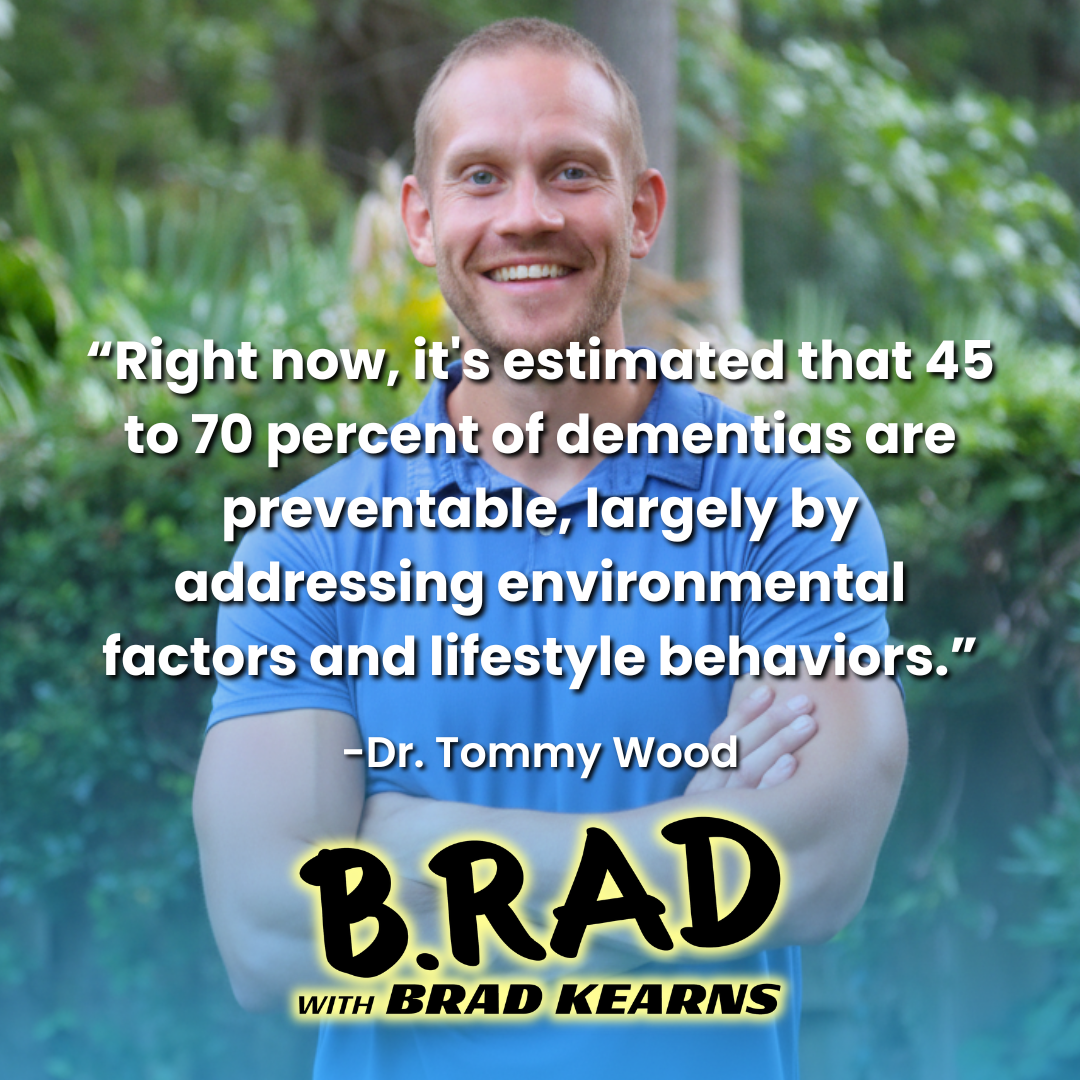
It’s estimated that 45 to 70 ish percent of dementias are preventable. [39:53]
We can eliminate this accelerated decline that we are seeing around us by hitting the checkpoints like move, nourish, stimulate, connect and adapt. [47:06]
Social connection is terribly important. [47:43]
The areas of the brain that are most susceptible to decreases in function as we age, are the areas of the brain that are negatively impacted by being socially isolated. [51:27]
What is the impact of the digital world that surrounds us? What about smoking and alcohol? [52:26]
Marijuana use definitely has an effect on the brain. [01:02:46]
If someone only has a small amount of time to learn these things, what would be the tips you would give them? [01:07:34]
LINKS:
- Brad Kearns.com
- BradNutrition.com – 20% OFF Your First Order!
- B.rad Superdrink – Hydrates 28% Faster than Water—Creatine-Charged Hydration for Next-Level Power, Focus, and Recovery
- B.rad Whey Protein Superfuel – The Best Protein on The Planet!
- Brad’s Shopping Page
- BornToWalkBook.com
- B.rad Podcast – All Episodes
- Peluva Five-Toe Minimalist Shoes
- Dr. Tommy Wood Instagram @drtommywood
- The Stimulated Mind: Future-proof your Brain
- Podcast with Wood: Metabolic Efficiency
- Podcast with Wood: Sensible Healthy Living
- Podcast with Wood: Beauty of Not Always Optimizing
- Nourish Balance Thrive
- Dr.TommyWood.com
 LISTEN: We appreciate all feedback, and questions for Q&A shows, emailed to podcast@bradventures.com. If you have a moment, please share an episode you like with a quick text message, or leave a review on your podcast app. Thank you!
Check out each of these companies because they are absolutely awesome or they wouldn’t occupy this revered space. Seriously, I won’t promote anything that I don’t absolutely love and use in daily life:
- B.rad Nutrition: Premium quality, all-natural supplements for peak performance, recovery, and longevity; including the world’s highest quality whey protein!
- Peluva: Comfortable, functional, stylish five-toe minimalist shoe to reawaken optimal foot function. Use code BRADPODCAST for 15% off!
- Ketone-IQ Save 30% off your first subscription order & receive a free six-pack of Ketone-IQ!
- Get Stride: Advanced DNA, methylation profile, microbiome & blood at-home testing. Hit your stride the right way, with cutting-edge technology and customized programming. Save 10% with the code BRAD
- Mito Red Light: Photobiomodulation light panels to enhance cellular energy production, improve recovery, and optimize circadian rhythm. Use code BRAD for 5% discount!
- Online educational courses: Numerous great offerings for an immersive home-study educational experience
- Primal Fitness Expert Certification: The most comprehensive online course on all aspects of traditional fitness programming and a total immersion fitness lifestyle. Save 25% on tuition with code BRAD
I have a newly organized shopping experience at BradKearns.com/Shop. Visit here and you can navigate to my B.rad Nutrition products (for direct order or Amazon order), my library of online multimedia educational courses, great discounts from my affiliate favorites, and my recommended health&fitness products on Amazon.
TRANSCRIPT:
Brad (00:00:00):
Welcome to the B.rad podcast – where we explore ways to pursue peak performance with passion throughout life. I’m Brad Kearns, NY Times bestselling author, world #1 ranked masters age 60-plus high jumper, and former #3 world-ranked professional triathlete. You’ll learn how to stay fit, strong and powerful as you age; transform your diet to lose body fat and increase energy; sort through hype and misinformation to make simple, sustainable lifestyle changes; and broaden your perspective beyond a fit body to experience healthy relationships, nonstop personal growth, and ultimately a happy, healthy, long life. Let’s explore beyond shortcuts, hacks, and crushing competition to laugh, have fun, appreciate the journey, and not take ourselves too seriously. It’s time to B.rad!
Tommy (00:00:51):
There is some proportion of dementias that we just don’t understand enough about yet to know whether we can meaningfully move the needle on that. Right now, it’s estimated that 45 to 70 ish percent of dementias are preventable largely by addressing
Brad (00:01:07):
It gives me great pleasure to introduce this fantastic show with Dr. Tommy Wood, the author of his new book, the Stimulated Mind. Future-Proof Your Brain From Dementia and Stay Sharp at Any Age. Tommy is one of the world leaders in alternative health, ancestral health. He’s been doing great work for over a decade, one of my favorite podcasts guests ever. We did two fantastic shows in person way back in 2019 when I visited him up in Washington State and got to experience his amazing two pet boxers in person, including a magnificent and very rare white boxer running around the house in the background. But I often send my listeners to his shows way back then to get a basic exposure and some simple practical tips for how to live a healthier lifestyle. So Tommy, who’s been this great resource for so long, but in real life, he’s a brain researcher specializing in pediatric brain injuries.
Brad (00:02:13):
He has a beautiful lab at the University of Washington that he operates to study how to heal the brain from from injury. And finally, after a decade of being at the top of his profession, he has cranked out an amazing book that is gonna be of broad general interest to everyone to escape from this very disastrous pattern of accelerated decline and increasing rates of cognitive decline, dementia, and related disease. If you haven’t heard these stats and you’re not afraid, you might be afraid pretty soon, come out from under the rock in the next 15 to 20 years, the burden of dementia is expected to at least double, if not triple, worldwide, becoming either the first or second most common cause of death in most high income countries. By 2040, Tommy is going to explain that you can relax, calm down, and not worry about getting struck down randomly by this devastating and tragic disease, but instead that your brain health is determined by your environment, your environmental inputs.
Brad (00:03:19):
We have a great show getting the overview, but I really encourage you to purchase this book and read it, enjoy it and listen to him recording it. It’s called The Stimulated Mind. You can pre-order it right now and get a bunch of bonus items that Tommy mentions. But the book is organized into three different parts. So Tommy kind of breezes through the various sections. The first section is getting into the science and the history of brain research, and then we get practical, which Tommy is so good at. And so he talks about the second section with his five tips, move, nourish, stimulate, connect, and adapt, and what those really mean. The behaviors that you might want to avoid if you’re interested in brain health, and the ways that we can protect from some of the recent challenges like this hyperconnectivity, chronic overstimulation of the brain and understand how it’s way beyond, some of these lip service that we hear about doing Sudoku puzzles when you’re a senior so you can stay sharp in the brain, that helps, but it’s not the whole picture.
Brad (00:04:24):
Tommy’s gonna give you the big picture right here in this show. So please listen all the way to the end because you are going to learn the three S’s that are the key to long-term brain health and disease prevention. And at the very end, he gives you, I said gimme three quick tips, quick takeaways for someone who is short on time to dive deep into a whole new book and just wants to improve brain health. And he fires off three that you can do right now to improve your cognitive performance today and also prevent that accelerated decline. A little bio information. Tommy works with some leading athletes in the world, including Formula One drivers and professional sports teams. He studied at Cambridge and Oxford in England, and then he got his PhD in University of Oslo, now at the University of Washington, Associate Professor of pediatrics and neuroscience.
Brad (00:05:20):
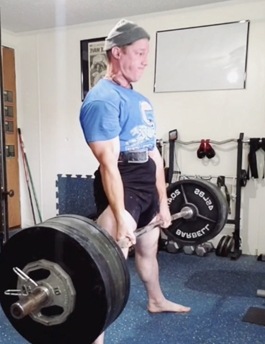
Busy guy, but taking the time out to connect with us. So I’m so glad to share this show with you. Tommy’s also a super athlete, so he walks his talk and he competes in the master’s division strongman competitions. So I know you’re gonna enjoy this entire show and the book, the Stimulated Mind, I had a great time reading the advanced copy. So let’s hear from Dr. Tommy Wood.
Brad (00:05:43):
Dr. Tommy Wood, author of The Stimulated Mind, future Proof Your Brain From Dementia and Stay Sharp at Any Age. What a great title and subtitle. I’m so excited to, uh, talk to you and excited to hear about this book launch and we’re gonna get, we’re gonna get into it on a very, very important subject. So thanks for connecting.
Tommy (00:06:04):
Yeah, great. Awesome to to see you and be back again. We’ve had a number of fantastic conversations on the podcast previously, so I’m really, really excited to be back. yeah.
Brad (00:06:13):
Now the listeners have to go back and listen to our Epic three shows. It was great to meet you in person. It was now several years ago up in Washington and now we’re using the magic of the internet to connect. But, uh, those were some of my favorite shows and most, uh, commented and most appreciated shows. And I think the, the best thing that came out of it with your, you know, high level of expertise and scientific knowledge and study, uh, but you have a great ability to kind of, uh, share complex topics in a simple and memorable way. And I’m not gonna say that I am now an expert on the material reading about the ganglia and the three different types of ganglia <laugh>, but I got the, I got the gist of it. And some, there’s always great takeaway paragraphs where even someone who’s a lay person and just wants to know how to get better or not get dementia, that’s what I think is a credit to the book, but it also is a completely, uh, thorough explanation of how the brain works. And I wanna get into some of your favorite, uh, talking points and, um, people, people better be listening up ’cause it’s a pretty important organ, huh?
Tommy (00:07:21):
<laugh>? Yeah. Yeah, I think so. And over my career I’ve sort of gravitated more and more towards the brain. Obviously I did my PhD in neuroscience, but then that even the more time I spend working with athletes, the more time I spend in the lab, the more you kind of see people’s people struggling with their brains out in the world and worrying about their brains. You know, in adults over 40 dementias the number one health, is there a number one health concern. So, knowing that there’s a ton we can do there, I think it’s, it’s important to start getting the word out
Brad (00:07:57):
Before we get into the practical steps we can take, maybe you can give us a little bit of background, particularly your scientific course of study. We can get, get a summary of there, but also how you kind of landed on working with high level athletes. ’cause that’s pretty interesting.
Tommy (00:08:15):
Yeah. So, the sort of, you know, the academic part of my CV is I did most of my training in the UK. I did an undergraduate degree in biochemistry at the University of Cambridge, then a medical degree at the University of Oxford. I worked as a junior doctor in London for a couple of years before moving to Oslo, to do a PhD in physiology and neuroscience. And that was kind of where I really started to get interested in, in neuroscience. Um, and then I’m now a faculty member and associate professor at the University of Washington. I’ve been here for about 10 years now. Um, and I, I run a, a big sort of neuroscience lab trying to find ways to treat the injured brain. But pretty much starting, starting as an undergrad. First I was, I was a rower, so I rode at both, uh, uh, Cambridge and Oxford.
Tommy (00:09:07):
And then increasingly became interested in coaching. So I was like club captain in multiple places. And then I was head coach of the, of the medical school boat club, um, uh, at, uh, Oxford. And sort of through that time kind of trying to leverage what I’m learning, you know, in the lecture halls in biochemistry and physiology and, and medicine and, and trying to sort of apply that to athletic performance. And during my PhD, I, I started, uh, to work with, with a company. This is how you and I met called Nourish Balance Thrive now, you know, 10 or 15 years ago. And, you know, working with athletes to improve all aspects of their health and performance. You know, lots of masters athletes trying to stay competitive and, and perform well for long periods of time. And through that, you know, did some health blogs, some podcasting, um, connected with a company called Hintsa Performance, which oversees, um, medical and coaching, overseas medical and, and coaching services for a number of Formula One drivers.
Tommy (00:10:17):
So I’m now head scientist for Motorsport at Hinter performance. So, so my job is to kick the tires on the science for all the stuff that might relate to health and performance for several Formula One drivers. And that’s, that’s really my sort of main foray into, uh, into professional sports, right? Right now I do, uh, a little bit of consulting with some other professional sports, particularly as it relates to like blood work and nutrient status and some of these other, some of the, these other kinds of things. And then all those things kind of come together to help me think about what are the aspects that are really required to, you know, build and then maintain or enhance cognitive function. And, you know, I ideally, you know, long-term prevent cognitive decline.
Brad (00:10:59):
So what led you to start this book project? ’cause you’ve been at this great work for many years, like, like you mentioned, and then all of a sudden you’re gonna, you’re gonna cough up a book <laugh>.
Tommy (00:11:11):
Yeah. So I, I feel like writing is one of my best mediums. You know, I, I really enjoy writing, and that’s a big part of my job as a scientist, where I have to write grant proposals and papers and all that, that kind of thing. This like writing a science book, uh, an accessible health book for the general population is a very, very different type of writing, of course. So part of it was, this was a new challenge for me, and I’d gotten to a point in my career where, you know, I now have a, a big team of people who work in my lab. They’re amazing. They get the day-to-day work done. So I, so I, I have the capacity to kind of spend a little time working on, on another project, like a book. And so like, I couldn’t have done it without them because they’re the ones sort of keeping the lights on and getting the work done.
Tommy (00:12:01):
And then I also got to the, I also got to the point where I felt like there’s a book that’s needed that doesn’t exist. And it’s like when people come to me and they’re like, Hey, Tommy, tell me what I should do for my brain. And I’m like, I don’t really quite have the book that I would want to give you. They’re either very science heavy, very technical, and some of the, like, longevity and dementia books are kind of like that, or they focus on just like one area. There was nothing that sort of, I felt give gives people an accessible sort of like comprehensible sort of, you know, um, tool toolkit and guide, uh, for, for brain health. And like cognitive performance today, like a big part of it is like, how do I perform better today? Right? Because I know that that people, people are, are asking those questions.
Tommy (00:12:50):
And because of like all those different threads of work that I work in, I was seeing the same things being important again and again and again. So I, so I also felt confident that this was a book that would be relevant at least for, you know, a few years, right? Because many books, like you write them, like you finish writing the book, but the book will be published almost a year after I finished writing it, right? Um, so it’s very easy to write a book and then by the time it comes out, it’s no longer relevant. So at least I felt like the topics in here are always gonna be relevant regardless of what happens in the future. So, so I felt confident that it would be a meaningful contribution,
Brad (00:13:28):
I’d say That’s a fair bet because of the, the education and learning how the brain works. The neurons are only 50% of the cells in the brain. What Uhhuh <affirmative>. So you organize the book into these three parts, and if you want, unless you have a better idea, um, I thought you could kind of like take us through the, the parts of the book and the, and your favorite talking points.
Tommy (00:13:48):
Yeah, yeah. So the, the, the first part is, is kind of a little bit of how do we get here in terms of neuroscience and, and how we think about the brain. Why haven’t we done a better job of treating neurological diseases in term in including Alzheimer’s disease? And so this is where, um, you know, I tell, tell the story of how we’ve historically studied the brain, including Alzheimer, you know, when he was looking at, you know, looking at his original patients. And this is really driven by the fact that we take slices of a dead person’s brain and we look at them under a microscope. And this, I mean, this is something that we do in my lab, but there is this massive gulf between what we can learn about the brain when it’s in a slide under a microscope versus what that brain was like out in the real world, and all the things that sort of affected it and resulted in it having the consciousness and the complex thought processes that it did, right?
Tommy (00:14:56):
But because we’ve been so focused on how brains look under the microscope, we’ve kind of missed a lot of the bigger picture, right? We’re very focused on proteins, amyloid, tau, um, all these different things. And those are an important part of aging in the brain and of dementia risk. But they’re, but then they’re not, most of it, actually, most of it is, is seems to be related to other factors. And so the, the kind of towards the end of that first, uh, end of that first part, I talk about how we can sort of step back and rather, rather than getting in the, into the sort of really nitty nitty gritty details and mechanisms and all those things that neuroscientists, like, we can realize and appreciate that there are these core biological inputs driven by the environment that are the primary determinants of how our brains function at an age.
Tommy (00:15:53):
And so I actually start part one with the preface is about some studies in owls that I quite like. And what well they did, these are, these are classic studies done at Stanford. And I will say that ev every other study I referenced in the book is in humans, but like the owl story is quite nice. So that they, they took these owls, barn owls, and they put prism glasses on them. And so like, you know, a prism is a thing that shifts light. So when you put these prism glasses, you can, you can, like, you can google these studies, they’re run by Eric Huson, and you can see like these cool pictures of barn owls with like these sort of like, crazy spectacles on and the light gets shifted in coming into their eyes so that where they think they see, where they think they see something is not where it actually is, right?
Tommy (00:16:45):
There’s now there’s like a mismatch between where they see something and like the representation of the world in the brains of the owls. And this is like, this is a representation that we all have in our, our brains. Like we expect things to be in a certain place. you know, we hear something and you know, if we have like a 3D hearing, right? We, uh, both our ears are working, we are like, we have some idea where something is in 3D space. Owl owls are the same. And what they found was that if you’re a young owl, you adapt to these glasses very quickly. But if you’re an older owl, you’re an adult owl, you don’t, and then.
Brad (00:17:20):
that has nothing to do with humans then <laugh> <laugh>,
Tommy (00:17:23):
well, so this is the interesting thing, is it, it has a lot to do with what we think about the adult human brain, right? We think that the adult human brain is fixed, and, um, there’s nothing that we can do to change it. And if I told you that owls, if I like stopped the owl story there, you’d be like, oh yeah, of course, like, adult brain is fixed. You can’t change it. But they did two different things that showed that this wasn’t the case. So one was in, in the original owl experiments. They have owls housed in individual cages, and they get fed dead mice. Um, which is, uh, I kind of say this like the perfect metaphor for modern human life. You’re like alone in your own box, and like food just shows up and you don’t have to do it. You don’t have to do anything else. But if they house the, if they house them socially, like multiple hours in a cage, right? So, so now you are having to like, interact and navigate other beings in your space, and you have some social interaction, then they, they found that the adult brain could adapt much later, right?
Tommy (00:18:30):
Because it was, the owl was needing to adapt because there, there, there were other owls it has to interact with. And then another version of the experiment they, they did is rather than feeding the owl, um, dead mice, it, they had, it had to hunt live mice, live mice get released into the cage, the animal has to hunt them. And what they saw was that as the a like as the owl got better at hunting, there was a shift in the internal map of the world and the brain of the owls, it even in adults. So all of this saying that the adult brain is absolutely capable of change even very late in life, sixties, seventies, eighties. And we have tons of studies that show this, but it requires active engagement in the environment and some reason to change, right? You need to tell your brain that it, it’s important that it, that it change. And so we, we see the same thing in humans. So this whole idea being that if we kind of step back from some of the like, really basic nitty gritty neuroscience and just appreciate that the primary driver of brain function is how we engage with the world and telling our brain that it’s important to engage with the world, your brain can, can change and adapt and improve like even decades later in life.
Brad (00:19:45):
So an example might be showing up in some foreign country and saying, I’m gonna learn the language. Gosh darn it. Here I am at 60 or 70 or 80 or whatever.
Tommy (00:19:55):
Yeah. Yeah, a hundred percent. So, so this then leads us into, so, so I, so I kind of at the end of that first part, I say, we need to learn how to play the game of, of brain health, right? It’s not thinking about like all the individual mechanisms we need to, like, how do we play the game of being a human that kind of helps to support our brains. And so the, the chapters then in the next part go through all the different areas where we can see significant improvements in cognitive function based on how we engage with the world. So, um, physical activity, all the different ways that different types of exercise, um, affect different parts of the brain, nutrition, all those sort of important parts of nutrition for, for brain function, uh, stimulus. Um, and so, right, the book’s called The Stimulated Mind. I make the case that how we use our brains is the primary determinant of how our brains function.
Tommy (00:20:45):
And so we need to stimulate our brains with, um, challenging tasks and skills. So, um, learning languages is one great example. There are multiple studies in older adults showing that if you learn a new language, you see significant, changes in the structure of the brain and in improvements in important cognitive functions like executive function, decision making, we see the same thing when you learn a musical instrument. We see the same thing when you take, uh, some kind of up some new sport that requires you to like react to the environment and, you know, have a strategy or comp, you know, learning complex motor skills like dancing or pickleball or skateboarding or something like that. Mm-hmm <affirmative>. And so, and then other important things come into like stress management or reframing stress like sleep and adaptation.
Tommy (00:21:35):
Then I also talk a little bit about the importance of cardiovascular health, um, hormonal health, alcohol, smoking, all that, all that, you know, those kinds of things too. Um, and so like you said, like the, this core idea that going out into the world and challenging yourself, right? Insert yourself in a new country and, and speak a new language. Or it could be a lot, it could be a lot less daunting than that. It could be anything that you, there’s a complex skill that requires you to sort of challenge yourself and fail. Failure is actually the primary and mistakes. So the primary driver of neuroplasticity in the brain, right? You imagine your owl trying to hunt, and the first time, right, she misses the mouse, but every time she misses, she gets a little frustrated, right? She’s hungry. And like each time you do that, there’s this signal in the brain to kind of slowly shift and improve itself. And it’s the same when we like make a mistake conjugating a vowel or a verb in like Spanish or French. But that is what drives neuroplasticity. So that is the, I think, the most important thing that we can do to sort of start to build additional function in the brain.
Brad (00:22:49):
So we hear about how great that is to, to try new things, and we use the example of going to a foreign country. Can it also be adaptive and beneficial to, let’s say stick with the same challenge, a lifelong golfer trying to get better and, and, uh, you know, master this frustrating game. It doesn’t have to always be new stuff. I’m assuming that you can try to become better and better and better at something that you love for a long time.
Tommy (00:23:16):
Yeah, a absolutely. So, I think there’s benefit to new skills, and we know that the, like the learning curve is fastest, you know, early on. So like, I will get like relat, I would get relatively much faster at golf than you do. ’cause you’re a much better golfer than I am, right? So, I have a that learning curve is steepest for me if I, if I take it up,
Brad (00:23:38):
Yeah. But I can double my deadlift in about six weeks, and there’s no way you can Exactly.
Tommy (00:23:44):
Yeah. Yeah. So, and, and, and there’s benefit to both of us doing that, right? Yeah. Having something a, a new challenge that kind of builds a new skillset or a new sort of like physical set of capacities. Um, but there’s also really interesting data on the development of expertise. So, there’s a very nice study that came out recently called Creative Experiences and brain clocks. And what they did was they measured electrical activity in the brain to kind of develop like a brain age. So, there are specific networks in the brain that are susceptible to the processes of aging. Things like the front of Paral network, which is really, really important for, uh, like attention and memory. And these networks kind of erode over time. Like they become less discreet and well connected, and they become like a bit fuzzier.
Tommy (00:24:37):
And so, like, then, like paying attention is a little harder, remembering things a little harder. But when they look at, they looked at creative arts. So, they had artists like, uh, painters, they had tango dancers they had musicians. Um, and what they found was that in experts compared to amateurs, there was better maintenance of the function of these networks, um, because of like the expertise that they’ve developed in this specific area. And so, I, I would put golf absolutely in that same in that same arena, right? Because it requires very specific like most coordination, uh, you have to, you know, respond to the environment, respond to the elements, you know, planning, strategy, all those kinds of things. So when we have these multi-sensory complex skills and we, you know, work to achieve mastery in them, it seems to have, like, regardless of what that skill is, as long as it sort of fits those criteria, they seem to have very similar benefits in terms of maintaining the function of the brain as we age.
Brad (00:25:48):
So if you’re good at something that’s really, really complex,
Tommy (00:25:52):
Yes.
Brad (00:25:53):
What if you’re a dabbler at 27 different things, <laugh>, could that kind of meet the same checkpoints?
Tommy (00:26:00):
Yes. I think so. Um, c obviously coming at it from a different direction. And what what’s interesting is that you see, um, regardless of the skill that you’re learning, right? So languages, like, there’s, there’s really interesting data on like complex first person video games, right? Immersive worlds. You’re having to respond, learn new motor skills, problem solve, like ra rapidly respond to the environment. And across all of these, they seem to help to maintain some of these core decision making and processing systems in the brain. So that’s kind of like the more sort of like detailed studies. But then when you look at the activities that are associated with a lower risk of dementia, again, as people get older, being in being involved in at least one or two things every day that is like, sort of like complex or novel in some, in some way and is challenging in some way. So it’s like reading, writing, attending lectures, um, going to classes, volunteering, sports dancing, right? If you do one or two of those things every day, those are the people who are the best protected against dementia long term. So if you are somebody who just prefers a smorgasbord of things to try out, then I think that’s gonna have some similar benefits as well.
Brad (00:27:26):
We always hear the familiar example of do your Sudoku puzzles and keep your brain sharp, but I’m imagining when you use those five categories in the book, they’re, they’re called move, nourish, stimulate, connect, and adapt. And you mentioned sort of things relating to those five, but that’s how the book’s organized. I imagine that it’s important to hit more than one. So if you’re just sitting around doing complex work on a computer screen, that’s great for your brain, but if you don’t exercise and you don’t eat nourishing food and so forth, you’re not gonna get a good score on that risk factors,
Tommy (00:28:07):
Yes. So in your first question related to like, Sudoku and crosswords, like that’s, that’s kind of the things that, that’s the thing that when people, when you say, like, use it or lose it, right? That’s the thing that people imagine first I’m gonna do Sudokus right when I retire, and they can be nice as like a, there are certain type of mental, it’s almost like a mental break, right? Gloria Mark, who’s a psychologist who studies how we like maintain productivity at work without feeling burnt out and stressed, she has a way of categorizing different, um, cognitive stimuli and how we use our brains. And so one, she calls rote activities, which require focus but aren’t cognitively challenging. And that, like, that’s where you find Sudoku and crosswords and things. So they’re kind of like, they’re nice to do, and they can be great to do, but they’re not, that’s not the same as, um, you know, taking a new dance class or inserting yourself into a foreign country and trying to learn the language.
Tommy (00:29:08):
Like, it’s just vastly different in terms of the level of challenge. So some of those things can be beneficial, but you also need to like really push yourself. That’s important too. Um, when we get into like part three of the book, all of those different areas that we mentioned, I kind of bring together in this model for how I think the brain works that I call the three s model. The first S is stimulation, um, so, or stimulus. And that’s kind of the stuff that we’ve talked about so far. And, I think that stimulus is the primary driver of cognitive function, and there’s, and I provide lots of evidence for that. And it is I kind of make it make a parallels to phys physical function. So we know if you want to get bigger and stronger, the most important thing you can do is lift weights, right? Um, what
Brad (00:30:03):
About sitting and thinking about getting bigger and stronger?
Tommy (00:30:06):
So does that help? Well, so there are some interesting studies about like the, the suggests there’s like a placebo effect that like, if you visualize yourself getting stronger, you do get a big, you do get a big stronger. So a little bit of that, but mainly the most important thing, the most important thing, mainly making noise. Yeah, yeah.
Brad (00:30:24):
Cranking some plates.
Tommy (00:30:24):
Yeah, exactly. And so you can get a better adaptation and outcome from your training if you attend to nutrition and sleep and recovery and all these things. But, you know, I would wish that I could just nap and drink protein shakes and get super, super jacked, but like that, unfortunately, that’s just not gonna, that’s just not gonna happen, right? I, I need to go to the gym, and, and do some work. So stimulus is the most important thing. Um, but when you stimulate a part of the brain, that part of the brain then needs a supply. This is my second guess of oxygen. Some kind of metabolic substrate, right? Often it’s glucose, could be ketones, could be lactate, um, and then some kind of, then the nutrients that kind of make the brain run. So, things like omega threes are really important.
Tommy (00:31:19):
B vitamins are really important. Vitamin D is really important. Magnesium, zinc, um, antioxidant polyphenols, like you get from berries, do really cool things for the brain. So you need all, you need all of that to, to kind of come in when the brain is stimulated. And then like the adaptation and the improvement in function, just like with exercise happens when you rest and you recover, right? Ah, so this is my third s support. So sleep is a critical part of support. Other things that are important in support are like hormonal health can make a big difference. And, um, the, the production of, of factors that kind of support changes in function in the brain, like tr we call, call ’em trophic factors like brain derived neurotrophic factor, which you release during exercise. And then we want to avoid things that kind of inhibit that adaptation.
Tommy (00:32:12):
So alcohol, smoking, chronic stress, which, which chronic stress basically creates like an over training picture in the brain, right? You never like switch off, you can never fully recover. Um, and so all of these things then kind of in interact, and I’m kind of getting to your point about sitting and working like your brain all day and not supporting in other ways. So, so yes, the, the stimulus is the most important thing, but if you wanna get the most out of it, you need to hit those other, you need to hit those other buckets too. But importantly, they interact, right? So if you take an older adult, so they’ve done studies in individuals sort of like 65 and older, and you give them a, a brain training program, they end up sleeping better because when you stimulate your brain tissue, you create a greater drive and need for sleep and recovery and adaptation. So, um, and it’s the same thing when we exercise. We know when we exercise more, we sleep, we sleep better. Similarly, if we like start to sleep better, then we become more social the next day, we are more likely to engage in cognitive stimulating tasks. We might see improvements in blood pressure or blood sugar because we’re sleeping better. So yes, we need to attend to all those different things, but equally, if you just change one thing, you start to see benefits like all over the network because they interact. So
Brad (00:33:34):
Where are we mainly falling short in modern life? You hear about this go, go, go hectic pace and the hyperconnectivity, which I guess could fall in the category of chronic stress. Uh, but also there seems to be some, this is where all the fear comes in and the mystery and the uncertainty. Uh, people are walking around with their fingers crossed, hoping that they don’t get, you know, get, get chosen for that unfortunate lottery, like Judy did. And, and that’s where, um, we’re, we’re kind of shrouded in, uh, fear and anxiety about this increasing the, the increasing rates of cognitive decline.
Tommy (00:34:12):
Yeah. Yeah. And, and understandably so. And although I will, I will say that there is some, there’s some interesting data that suggests that at the population level, we are now less likely to be diagnosed with dementia at the age of 70 than we were 10, 20, 30 years ago. So some things have improved, and a lot of that people think comes from treating and preventing heart disease. We’re much better at that than we used to be. And heart disease risk factors overlap with dementia risk factors. Um, and there’s a few other things like women in, in the workforce only really expanded in the 1970s in the us and we know that complex cognitive cognitively stimulating work is important for dementia prevention. So that’s maybe having an effect now. So lots of things have kind of changed, in a beneficial way, but we are now at a point where we’re, we’re gonna be living longer, and the metabolic health of the population has continued to get worse.
Tommy (00:35:13):
And so now people are thinking that, you know, risks might start to, to to tick up again, because, because of those two things. So I think depending on where you are in, in life, sort of, if you are, you know, you got some, some degrees and you have complex cognitive cognitively stimulating work, and you have good social connection, and you do do some kind of sport that, that requires you to like interact with other people, right? You’ve probably tick, you’re probably ticking the stimulus box pretty well, right? Right. You’re covering most of the things that you need. So then that, in that group, um, two things that are very prevalent. One is metabolic disease, and we know the metabolic disease, like high blood pressure, high blood sugar are significant risk factors for dementia. But then the other one is in, so it there, right?
Tommy (00:36:03):
They’re stimulating, but they’re not giving themselves time to rest and recover and adapt, right? They’re not sleeping enough during the day, constantly multitasking, constantly task switching, never giving your brain any kind of time to like switch off and recover. And we like it, it just takes a few minutes of like a real, like a proper break, um, to then like come back and be able to do more, more hard thinking again. And then because of that, right? We never actually get high quality work done because we’re so scattered and all over the place, and then we get stressed because we can’t focus on the work that we need to do. And it, it sort of like all snowballs from there. So that, that group, I think, needs to focus on restructuring how they approach work, giving themselves time to sleep and recover and adapt so they can benefit from all the other things that, that, that they’re doing.
Tommy (00:36:53):
But then when you get later in life, you know, especially as you approach retirement, then, um, the sort of like the, certainly the nutrient status and the metabolic health stuff sort of remains relevant, but then stimulus becomes more important because what happens is we see that when people retire, that’s the point at which cognitive decline is the, is the most rapid. And then the other one is when we have prolonged periods of illness, um, and, and because we’re not, we’re not stimulating ourselves, we’re just lying in bed, not doing anything. And so then we need to actively work harder to keep stimulating our brains so they maintain function. So I think the focus needs to kind of shift depending on where we are in that cycle of like our careers and our lifespan.
Brad (00:37:46):
Right? It seems like a lot of people are caught in the wrong, the wrong categories, like overstimulated, chronically stressed during a Yeah. A stressful work career, and then, uh, pulling the plug, retiring, and then falling below that threshold of a healthy cognitive daily challenge. Exactly.
Tommy (00:38:05):
Yeah.
Brad (00:38:07):
Whew. Um, <laugh>, if we hit those checkpoints really well mm-hmm. The stimulus, the supply, the support, getting enough sleep, getting enough nutrition, getting enough cognitive challenge, how do you like one’s odds? Is there still some randomness where, um, 4% are gonna be totally hosed even though they had this amazing, healthy, active, energetic, cognitively stimulating life?
Tommy (00:38:33):
Yes. So, so right now, we, we know that people who are at high risk, either from a health standpoint or a genetic standpoint, you can offset a lot of that risk by engaging all the things that we’ve talked about, right? So genetic risk factors like your APOE genotype, um, and it, which is the most common single genetic risk factor for late onset Alzheimer’s disease. If you, and if you have a copy of APOE four, your risk of Alzheimer’s may be like two to six times higher. If it’s, you have two copies, it might be six to 20 times higher, but it’s mainly a
Brad (00:39:06):
Six to 20 times higher than an average person.
Tommy (00:39:09):
Yeah. But then the average person who doesn’t have, so they usually benchmark against, um, a, an A O three three, which is like just the, the average. So like APOE twos have lower risk, APOE threes, which are the most common, have like the standard risk. And APOE fours have have higher, higher risk on, on average. Um, and the E four is like it’s mainly a risk multiplier. So you just get a bigger negative effect on your risk of dementia if you’re then sedentary or you drink a lot of alcohol, or you have a poor quality diet, right? But then by the same token, if you address those things, you get more benefit, right? Because you are offsetting, you are offsetting that risk. So all of this to say that if you are at higher risk, we know we can address that risk.
Tommy (00:39:53):
The problem is that nothing is certain, right? We’re all, we’re talking about probabilities. I’m talking about stacking the deck in your favor to minimize your, to minimize your risk. And there are, there are some proportion of dementias that we, that we just don’t understand enough about yet to know whether we can meaningfully move the needle on that. Right now, it’s estimated that 45 to 70 ish percent of dementias are preventable largely by addressing lifestyle, environmental, and some socioeconomic like societal risk factors. But that obviously leaves some, some percentage, you know, maybe, maybe a quarter or more of dementias where risk is still there. And, and we’re still trying to understand that the risk of those, those dementias that we don’t yet think are preventable. So we can’t prevent dementia entirely, but we can dramatically decrease risk. We can extend the period of time when we, when we maintain good cognitive function. And so then if we do sort of stretch that window out, that horizon out, you know, maybe we’ll die of something else first before we experience cognitive decline of dementia. Or if we do get dementia, we’ll get in much later and maybe we’ll have, you know, less of a symptom burden. So regardless of where you look on that scale, I think we can have a big impact.
Brad (00:41:16):
Is it possible to arrest cognitive decline almost completely, where we don’t say the same thing with our strength, our power, our explosiveness, our endurance, but, you see, examples of elderly people who are extremely sharp, maybe there’s some measurement that they’re, they’ve fallen off since they were 60 when they’re 90 or something. But, I wonder how that lines up with the inevitable physical decline that you can stave off really nicely with fitness practices, but not entirely. Yeah.
Tommy (00:41:48):
So, I think there were definitely gonna be some parallels to, to loss of fitness, strength, power, right? Power probably being one thing that, that we lose fastest, um, because we, we can’t prevent aging entirely. Like that’s, that’s not, that’s not something that, well, some people
Brad (00:42:06):
Disagree, Tommy, and they have very popular podcasts, so yeah, well, maybe you can argue with them when you’re on those podcasts.
Tommy (00:42:12):
Right now the burden of proof is in my favor, so I’m okay with that. I, I will say that most of the things that we’ve talked about here, when we don’t do them, we accelerate the processes of aging. So it’s not that we are slowing aging, it’s, it’s basically that we’re making sure we’re not making aging go faster. Does that make sense? It’s kind of, oh, that’s great. It’s kind of, it’s kind of the other way around.
Brad (00:42:36):
It’s exactly hand in hand with all the physical information that we know and, and the consequences of, uh, being inactive and, and accelerating that demise. Exactly. Yeah.
Tommy (00:42:47):
Yeah. So it, it’s, um, it’s
Brad (00:42:49):
Kinda refreshing to realize that these all go hand in hand, especially when one of your pillars is physical activity to support brain health. Yeah,
Tommy (00:42:57):
A hundred percent, absolutely. One of the most important physical activity is like, the only thing that I know of that addresses all of the biological hallmarks of aging, and a lot of that is because being physically inactive accelerates those processes, right? So anything we can do to, to, to kind of maintain and build movement can have a massive effect. So yeah, as we get older, we probably will lose some types of specific functions in the brain, but what you see is not that cognitive function just declines overall, you see a shift in the balance of, of different functions. So yes, absolute processing speed or reaction time or something like that might get worse e eventually, but we, we, as long as we are sort of like maintaining overall cognitive function and we’re we, you know, ticking all those boxes, we, you know, even into our, like sixties and seventies, we see improvements in things that we call crystallized intelligence.
Tommy (00:44:03):
So this is, um, the fancy, the fancy neuroscience word for wisdom. Like, how are we taking all the things that we know and the bigger picture of the world and kind of fitting them into, you know, a holistic model so that we can have, you know, a, a better kind of idea of, of how the world works, and then ideally help other people learn those have a transfer of knowledge to the next, to the next generation. So yes, functions, certain functions decline, but other functions continue to improve as long as you’re still maintaining the overall health of the system.
Brad (00:44:37):
Oh, that makes sense. I mean, the more experience, um, it, it’s gotta be good if, if you are applying yourself and staying focused and not overstimulated and doing the deep work and all those great suggestions. So yeah. Uh, but, uh, are there any Formula One drivers over 60 <laugh>?
Tommy (00:44:55):
No, there’s zero zero a cup there. Uh, I’m trying to remember. There was in, in former eras of Formula One, when it, when it was just kind of like, it was kind of like a hobby of, of the rich and famous. Mm. Um, yes, there were, there were drivers into their fifties, wow, maybe their sixties as well. Nowadays, you know, there were two drivers on the grid right now who were in their forties. Ah, um, so we’ve certainly sort of pushed that envelope, you know, similar to, you know, Tom Brady, LeBron James, Ronaldo in soccer or what I would call football, you know, so, so I think we’re getting better at maintaining function for longer by being, you know, very focused on training. I think we’ve done, we’ve done a better job of kind of extending performance out into our forties at like the, the highest level.
Tommy (00:45:47):
But yeah, of course you’re gonna, you’re gonna lose, you’re gonna lose a step. You’re gonna lose a little bit of, of function once, once you get to a certain point. Um, but then, right, all the accumulated experience, all the time they’ve spent learning how, how their sport works, they’ll then be in a great position to kind of stay engaged in that and, and use that wisdom then to, to, to teach others or however they wanna do it. And it’s interesting because often you’ll see older drivers perform better because right, they’re a little less impulsive, they’re a little more thoughtful, right? They’re applying a little more sort of bigger picture stuff. And this like continues in humans as they get older into sort of like fifth, sixth, seventh decade
Brad (00:46:32):
In any area. I can, I can kind of reference my writing efforts, which have been going on for many decades, and I can no longer crank out for a lengthy number of hours. Like I might’ve been able to in my thirties, but I feel like I can get the finished product done faster in less time because I’m a better writer. Yeah. So it’s kind of like this amazing trade off where yeah, you know, both are fine, but it’s, it’s kind of one of the goals of, of getting older is to get that crystallized wisdom. It’s a great term.
Tommy (00:47:05):
Exactly. Yeah. Yeah.
Brad (00:47:06):
So we can kind of eliminate this accelerated decline that we’re seeing all around us and generating so much fear by hitting those, those three checkpoints, doing the right things. Again, move, nourish, stimulate, connect, and adapt. And you mentioned the owls interacting socially, and I’ve heard you talking numerous times about the benefits of social connection and the dangers of loneliness as one of the major factors contributing to brain decline today. So maybe we could hit that pillar a little more.
Tommy (00:47:43):
Yeah, absolutely. So, so, so a few years ago, it’s like three or four years ago now, my good friend and colleague Josh, Dr. Josh Turknett, who’s a neurologist, um, we wrote a paper essentially hypothesizing that the primary driver of progressive decline in older adults is that they no longer stimulate their brains in the way that we know drives function. And that this has kind of formed the, a core sort of thesis of the, of the book, of the book. And I, shortly after it came out, I met up with a good friend of mine, he’s called Julian Abel. He’s a retired palliative care physician in the UK. Um, and he was like, I’m sure this is right, but it’s all driven by humans’ core need for social connection and social interaction with other humans. And it’s interesting that when you, when you think about evolutionary drivers of like what allowed humans to become who they are, it seems that our complex social structures plus a requirement to then look after past generations or look after like future generations, like your own offspring and the community and pass information down, seem to be part of what drove, like how complex our brains are and what the, there’s a theory, there was a theory from Charles Darwin that came out more than a decade after the origin of species, which was like survival of the fittest, evolution, all that kind of stuff.
Tommy (00:49:24):
He wrote a separate, he, like, he wrote a separate doctrine called the Descent of Man, and he realized that like an every person for themselves approach doesn’t explain human evolution. And he eventually said that the group of individuals who spend the most time looking after each other are the ones who are most likely to survive and be both fittest in the environment. And so then this got renamed, and I think popularized by a guy, uh, from UC Berkeley called Dacher Kelner as survival of the kindest. And like that’s the kind of the primary driver of evolution in humans. And so what what this means is that as, as social animals, our connection to others is a primary driver of our physiology. And then how that knocks on and, and affects our, and affects our health.
Tommy (00:50:31):
So, one of the like coolest things you can see from the, from data is that when we have the opportunities for pro-social behavior, like helping others, and that could be spouses, it could be friends, it could be volunteering, right? It dec right? It activates the vagus nerve decreases stress responses. It seems to shift the immune system, right? So you have less of like a pro-inflammatory, uh, state, and it doesn’t even have to be humans. Like you see the same thing if you have like pets or dogs, right? It’s this, it’s this core need for us to like look after other beings. And when we get opportunities to do that, we see significant, uh, well decreases in mortality risk, dementia risk. Um, and so we, we know that if you are socially isolated, and you feel lonely, then you have an elevated risk of, of cognitive decline and dementia.
Tommy (00:51:27):
And it’s very interesting that when, when they’ve, when they’ve looked at studies of individuals who are socially isolated, so they’ve done this with individuals in, um, social isolation, in prisons, in, uh, arctic explorers who are like often the wilderness like by themselves for months. They’ve looked at there, there have been studies done trying to understand how astronauts would deal with isolation in space where you go to Mars, there’s like three of you, like, what’s this gonna do to the brain? And you see that these areas of the brain that are most susceptible to decreases in function as we age, are the areas of the brain that are negatively impacted by being socially isolated, right? So social isolation drives aging processes in the brain, right? Fascinating. Um, and it, it all seems to come down to this like core need that we have to connect with others. And maybe like the, the most important part of that being our ability and opportunities to help others and support them
Brad (00:52:26):
Now that we’re in a digital world for the first time in recorded history escalating in the past 20 years, can, can digital do any type of positive benefit to replace? Like a lot of elderly have the news on all day long in their house, so someone’s, there’s a voice talking to them. And it seems like, well, maybe it’s better than just having it quiet all day long. But I know that we hear about how digital interferes with social connection and interaction. Is there any, is there any way to like circumvent if we have somewhat more of a narrow life and we’re not out socializing like crazy like we did in decades past, for example?
Tommy (00:53:04):
Yeah. So, um, a lot of the most interesting research around this was actually done during COVID because of the lockdowns you like, had an opportunity to kind of study very sudden changes in social connection and, and how, and how that affects people. And then there’s also some, like, some of the history of social media, uh, there’s a lot of research there as well. So like Facebook originally, rather than being a place to like sell you stuff and then sell your data, originally it was a place where you could like post photos and, and connect with friends and family, right? That’s what, that’s
Brad (00:53:38):
Really
Tommy (00:53:39):
Wow. That’s what it was. That’s
Brad (00:53:40):
Fascinating, right? Like
Tommy (00:53:41):
20 years ago, that’s what Facebook looked like. And so in that setting, there seems to be potential for net for net benefit. Mm-hmm. And you see in older adults adopting new technologies like, like Facebook or social media and across, uh, individuals who use social media or, or like video or chat, WhatsApp, right? If you are creating or maintaining, uh, social connections that you wouldn’t have done otherwise, there seems to be a net benefit. Of course, the closer it is to the kind of stuff that you would do in person, the better, right? So video is better than calls and calls are better than messaging in that kind of order. But if you are creating a connection that you wouldn’t have had otherwise, there’s net benefit if you’re using online connection instead of in-person connection, you could have had otherwise. Then there’s a net, there’s a net negative, and that kind of goes from, uh, you know, using like social media to, to kind of connect with, you know, with, with people, right? I mean dms or whatever, down to like the worst being just using it to consume content, right? Which, which seems to have, and like commenting on posts or consuming content seems to have like a net negative, especially when you’re doing that instead of in-person connection.
Brad (00:55:07):
So to use it to maximum benefit would be sending thoughtful, compose a text message to a friend who you haven’t seen in a while. Exactly. Vastly superior to scrolling through and getting stimulated by random content.
Tommy (00:55:23):
Yes. Yeah, exactly. And so, like, I have family on the other side of the world, if I can use Zoom or WhatsApp to stay in contact with them, that’s a net benefit, right? ’cause I can’t always be there with them in person. But if I’m not doing that, and instead I’m just like scrolling through through Instagram, right? That’s, that’s a net negative. So I think, and like conceptually this makes sense and, and like this is kind of what emerges from the research.
Brad (00:55:46):
I’d say probably everyone’s nodding their head acknowledging that and aware of that. The problem is we tend to, uh, slip or lose focus or lose willpower. You hear how the geniuses behind these platforms are very clever at drawing you in and, and by design trying to get you to waste time rather than compose a bunch of thoughtful messages to your friends with the magic of the device in your hand. It’s like a challenge to to, to use it to your advantage rather than disadvantage.
Tommy (00:56:17):
Yeah. And there, there, there are a few different ways to navigate this. So there are certainly studies where people like, go cold Turkey, right? You just quit social media immediately. Mm-hmm. And it’s, it’s interesting. It, it’s similar. There are similar like studies on quitting smoking, right? Early on it sucks. People hate it. Like they’re craving the nicotine. They’re getting the fomo ’cause they’re not on Instagram. But then like, once you get several weeks past that where they feel, they feel much better, mood improves, wellbeing improves, especially if they start to re replace social media with in-person human interaction. So like, it’s just interesting that when, depending on the study you look at, if it’s a short term study, people are like, oh, I hate that I had to give up Instagram. But you only, you’re asking ’em a week after, right? When they’re still, that’s like part of their, they haven’t adapted to it. Whereas if you, if you keep like long, like a longer time horizon, they, they start to feel better. And then you can do other things. Like you e even though the algorithm is in charge of what it shows you to an extent, you can pick who you follow, right? Yeah. Right. So, right. You have control over that changes
Brad (00:57:23):
According to your behavior, right? Yeah,
Tommy (00:57:25):
Yeah. Yeah. So you can use social media as a cognitive break, like truly, right? If your social media is full of dogs doing silly things, which is a lot of mine, and you want to, you wanna spend five minutes doing that after like an hour of really hard cognitive work and focus. Great, right? Actually there’s good evidence for that. But you have to craft what, what’s on there, right? So you have to, you have to direct the algorithm to, to, to show you that stuff. So, so you, we can use that. We, we can use it, we can use it regularly. Um, but we have to like, you know, mold our usage of it such that it’s giving us a net benefit. So equally, right, you can use Facebook just to connect with family members. Like, there’s nothing that says that you can’t do that. Right? But then it requires a little bit of conscious effort upfront such that that becomes the primary way that you use it.
Brad (00:58:19):
Yeah. I have to buy stuff too. ’cause they’re, they’re telling me I need to buy it right now. It’s on sale for only 12 more minutes. Yeah. You mentioned smoking and alcohol kind of in passing back when we were talking about nourish. So yeah, maybe we could include all the other substances that seem to be increasingly popular today. Legalized recreational prescription, uh, substances as well as the, you know, uh, processed diet and the, the very popular alcohol and smoking.
Tommy (00:58:55):
Yeah. So, so, so maybe we’ll go in reverse order. Um, smoking essentially has a, a linear relationship with dementia risk. So the more you smoke, the higher the risk. So that’s an easy one. Like, there’s, there’s, uh, it’s, it’s one of the, uh, biggest risk factors for strokes, depression, dementia, like these are the, these are like the big three neurological disorders that impact, uh, you know, at this point, the, the majority of the world may experience one or more of those over time. So that, that, that’s an easy one to, to tick off. But, um, then you might ask about other, uh, nicotine related products. Certainly, things like gums and patches, much less of a problem than than smoking. Um, vaping, they’re still kind of understanding some of the, some of the, the long-term cognitive effects, but there’s some suggestion that primarily because of the things that are in there, like the excipients and the solvents that they kind of use in the vapes, they, there’s probably a net negative effect on the brain and overall health there as well.
Tommy (01:00:06):
Um, nicotine is tricky because in small doses, like one to four milligrams of nicotine in trials, it actually boosts focus and attention, right? ’cause acetylcholine where nicotine acts is really important for that. And so some people, you know, promote nicotine as a nootropic. Mm-hmm <affirmative>. It is not a nootropic because a nootropic requires it to have, uh, no side effects, not be addictive and not create tolerance where you need to have bigger and bigger doses to have the same effects. So like, it ticks none of the boxes for an atropic and it is addictive. So, um,
Brad (01:00:39):
Oh, come on. What do you know Dr. Tommy <laugh>? <laugh>. Oh, mercy. It’s, it’s great to hear. I don’t know if listeners are fully aware, but there is a sort of this undercurrent of people promoting nootropic meanings helping brain performance. Yeah. And so people are, are pitching nicotine as this awesome concentration tool, which I, I kind of scoff at. So now I got to hear from a trained professional that it’s not a nootropic. Okay. Thumbs up.
Tommy (01:01:06):
Yeah. So, and like people occasionally using, you know, a non-damaging source of nicotine for like, focus on specific tasks, fine, but like, don’t think that you can keep going back to that well every day and it’s not gonna have some negative effects. Like we, we, we know that it likely will, um, then, right? Alcohol is the next one. The alcohol is always interesting because, um, people always want you to tell them that the level of alcohol that they consume is the right level, and that’s whether it’s none or some right or every day. Um, and so I think that the best evidence that we have is that there is no net benefit to consuming alcohol. Like previously we thought that like small amounts might be beneficial and like still, like if you, if you drink, you know, like a, a small glass of wine a day on average, right?
Tommy (01:01:55):
Like, kind of like the typical thing that people try and promote, there’s maybe a slight benefit in terms of cardiovascular risk, but then there’s a slight negative effect in terms of cancer risk and maybe stroke risk. So like the net effect on your health is zero. When it, when it comes to the when it comes to the brain, it seems like one or two drinks a week is fine. Once you are drinking every day or consuming like several drinks per week, we start to see higher, higher dementia risk. We start to see smaller brain volumes, which we know then translates to higher dementia risk. So have the occasional drink that you enjoy with your friends, but if it’s something that you are consuming every day, then I think there’s, there’s suggestions that it is gonna be a net negative for, for the, for the brain.
Tommy (01:02:46):
We know it affect negative affects sleep, right? Particularly, it creates a REM sleep deficit, And they see differences in psychiatric conditions based on marijuana use and that kind of stuff. Which is really important for like emotional processing and you know, creative problem solving and creating like connections and wisdom, right? So I think we have an inkling that it’s probably not good. But the amount consumed back then versus now, I mean it’s orders of magnitude of like tens or hundreds or thousands of times more is possible to consume. And so I don’t do this pieces myself, but I have colleagues who do research in terms of, and so this is in terms of the developing brain, so like pregnant mothers who are using cannabis products, and some of the, like, this is, it’s not typical, but there are some studies where like, and some individuals who are taking hundreds of milligrams of THC a day, like that’s ma like, it you, if, if like a typical dose, right? You have an edible or something is two or three milligrams and you’re taking a hundred times more than that, that’s a lot brownies. It’s, that’s a lot of brownies.
Tommy (01:04:31):
So like, and we just we have no idea what, what the implications of that are because this is only a very recent development. But what, what’s maybe interesting from a neuroscience perspective for me is that people often use these, these compounds, these products are, um, and because they, because they think it, like Im, improves some aspects of their function, like their creativity, right? That that’d be a typical one for THC. But when you do studies in individuals and you give them THC, and then you give them tasks where you can score how creative they’re being, they feel more creative, but actually they’re less creative. <laugh>.
Brad (01:05:11):
I knew you were gonna say that. <laugh> like, oh my gosh, it’s a masterpiece. Look at my painting. That’s pretty crappy. Okay, thank
Tommy (01:05:19):
You. Exactly. Yeah. And so a lot of these products, and, and it’s, and it’s the same for like some of the stimulants that you, that, you know, there are stimulants that we use in ADHD, um, modafinil methylphenidate, right? These sort of amphetamine based stimulants. People take them because they think it improves their focus improves their productivity, right? People who don’t need them, right? They have a, they have a different effect in in the brains of people who, you know, who have certain types of ADHD. If you are taking it for like a productivity or kind of hack again, what you see, and it’s actually, you can see the same thing with higher doses of caffeine. People feel better and they have faster reactions. So you improve their mood, but actually when you, when you quantify, or like you measure their, how they’re performing in complex cognitive tasks, they’re performing worse.
Tommy (01:06:13):
So you create, again, this disconnect between, Hey, I feel great, I must be doing better, but actually you’re doing worse. Um, and so I think it’s just interesting from like a bigger perspective, a lot of these psychoactive compounds are creating this disconnect between how we feel and how we perform. Usually when we’re not under the influence of these things, and I’m including like high doses of caffeine here, and I’m, I say that as a coffee lover, when we’re not under the influence of those things we’re, we can actually become quite good at how we feel being a judge of how we’re performing, right? In athletes subjective, um, wellbeing is one of the best predictors of performance, right? Um, but when we start to take some of these compounds, we, we, we uncouple those things. So we think we’re doing better, but actually we’re doing worse. And, and we could apply that to a large number of different compounds that you might choose to, to put in your body.
Brad (01:07:11):
Yeah. Maybe that’s why alcohol gives you,, you know, more confidence in social setting because you, you think more highly of your social skills all of a sudden.
Tommy (01:07:21):
I’m so interesting and charming right now, but actually, yeah, lemme
Brad (01:07:24):
Go talk to, lemme go bust in on that conversation and yeah.
Tommy (01:07:27):
Called
Brad (01:07:27):
The center of attention to myself. Oh, mercy <laugh>,
Tommy (01:07:30):
Great stuff. Overbearing and drooling, and you think that you’re super charming. Yeah.
Brad (01:07:34):
Where’s everyone going? Yeah. Tommy, this has been amazing, so helpful. The stimulated mind before we go for my, in honor of, of, I’m thinking of some of my buddies in particular who are, are very busy and they’re interested in health and, and delaying aging and all that, but they don’t have the time to get in deep. So if you were on an elevator with somebody and you only had a minute to give them a couple quick really positive, high impact interventions, what, what things would you pick for the average person that’s doing a decent job, trying to be healthy and yeah, nutritious and restful, but what are the, what are the big areas that you might might see
Tommy (01:08:12):
In that sort of currently working a adult picture that we talked about earlier? Right? I think one of the most impactful things that we can do is properly structure our workday, right? Give us like, there’s a period of time every day when we feel our best. Sometimes that’s in the morning, sometimes in the afternoon, depending on who we are, right? Block that time off for focused work, whatever it is. And it could be 30 to 90 minutes, whatever it is. What’s the one thing you need to get done today, right? What’s the creative problem-solving, critical thinking task you need to do? What’s the writing task you need to do? Block that, right? Email goes away, phone goes away. Notification, notifications go away. That then anchors your day because you will feel good about the fact that you actually got the work done.
Tommy (01:08:59):
And if you begin with not being able to pay attention or, or, or like focus because you’re so scattered. Usually we know that spending time focusing on a task, you can build your focus muscle. You get better at focus, right? So start there, then build in breaks, just like five minutes of walk outside. Could be watching funny dog videos on, on Instagram. Something that completely disconnects you from work like nature, mindfulness, like these, these are very restorative very quickly. Then kind of lump together your multitasking task, switching meetings, emails, kind of stuff in, in one place, right? You need to get it done. Of course we do. But if we spread that throughout the day, for a lot of people, it means that we never actually get any work done. If we don’t get work done, then our work slips over into the evening.
Tommy (01:09:53):
It makes us stress, it impacts our sleep, right? We don’t, don’t then don’t get time to exercise or, you know, these focus on these on, on these other areas. So, for them, I think building structure into our day and like having a very defined way we approach email, approach meetings, can actually do the work we need to do. That’s, that’s where I’d start with them. Then for like the other group, like as we get older, then it’s like the one thing that you can do is like pick one hobby that you want to get better at and do it. Learn a musical instrument, learn a language, learn how to play pickleball, right? That process, do that two or three times a week. That’s gonna maintain like all those important function functions in the brain. So those are like the two broad, like, here’s my pitch of what you need to do to get the maximum benefit depending on the person standing in front of me.
Brad (01:10:50):
Oh, I love it. Thank you so much. The Stimulated Mind. Where can we buy it? Everywhere books are sold, I’m sure. And how else can we, uh, connect with you?
Tommy (01:10:59):
Yeah, uh, the book available everywhere books are sold. Um, there is, it comes out on March 24th. There’ll be an audio book that I’m currently recording. If you buy the book which I will be very appreciable, then there are some pre-order goodies. Then I’ve got at home, workout videos. I’ve got some recipes. You can get a chapter of the, you can get a chapter of the book early, all of this. So like, you go to my website, Dr ommywood.com or the stimulated mind.com, they’ll, they’ll take you and give you those details. Ad then Instagram at Dr. Tommy Wood, all of my podcasts and all those other kind of things are posted there.
Brad (01:11:37):
Awesome. Thank you so much for taking the time. Wonderful project Dr. Tommy Wood, The Stimulated Mind. Thanks for listening, watching and everybody,
Tommy (01:11:45):
Thanks so much.
Brad (01:11:47):
Thank you so much for listening to the B.rad Podcast. We appreciate all feedback and suggestions. Email, podcast@bradventures.com and visit brad kearns.com to download five free eBooks and learn some great long cuts to a longer life. How to optimize testosterone naturally, become a dark chocolate connoisseur and transition to a barefoot and minimalist shoe lifestyle.