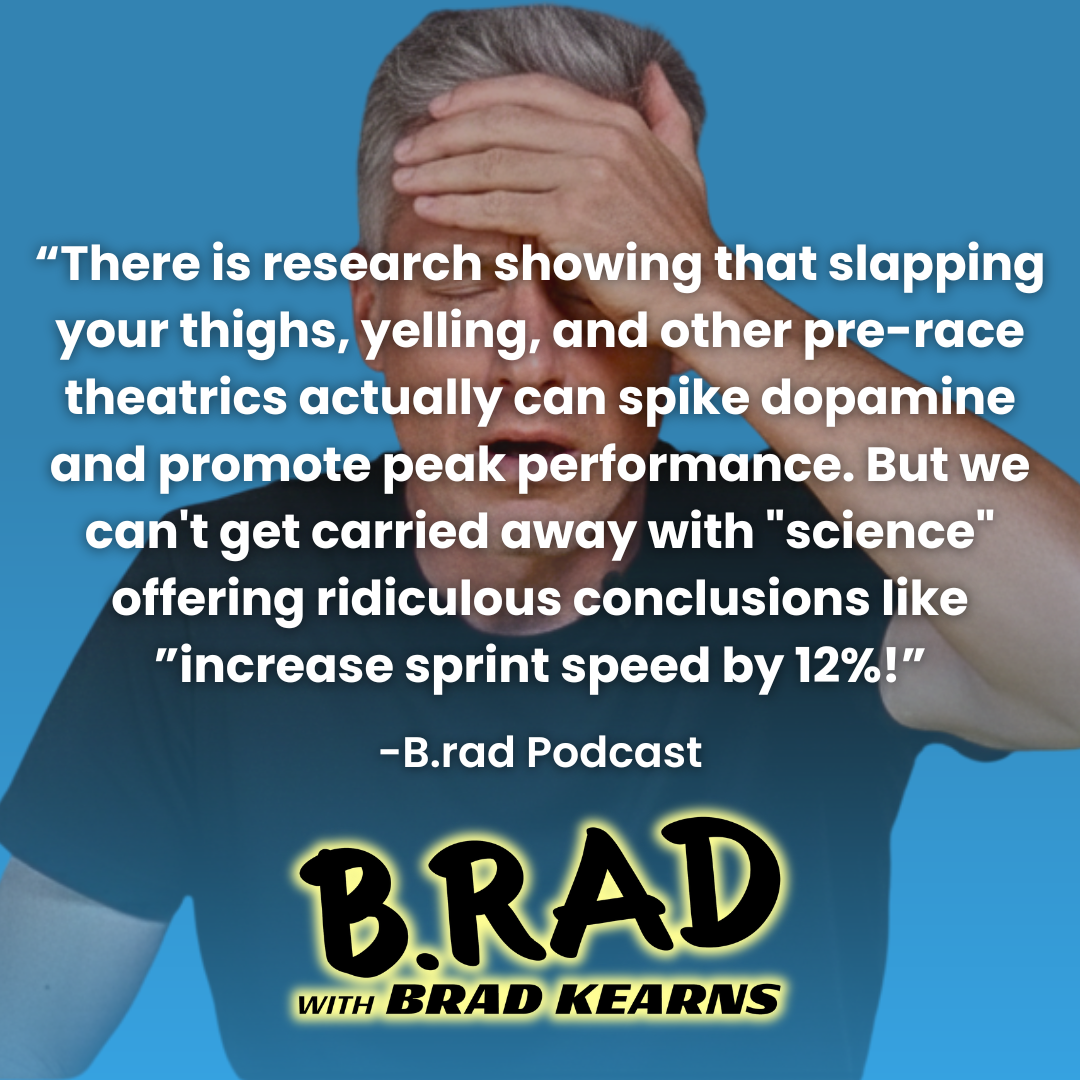
In this episode, I talk about the modern tendency to obsess over “science says…” posts—like the viral claim that slapping your quadriceps ten times will wake up your motor cortex, spike your stretch reflex, and increase vertical jump by 18% and sprint speed by 12%.
I describe why these numbers raised my hackles, walk through the reality of neural activation and theatrics we see from athletes like Karsten Warholm and Noah Lyles, and explain why a 12% speed boost would mean my 60-year-old 400-meter time drops from 60 seconds to 53.8, which is royal screaming BS. You’ll hear reactions from world-class masters sprinters like Lion Martinez and Cynthia Monteleone, and my reminder that most of these studies are done on minimally conditioned college kids getting paid $60—not real sprinters suddenly finding new superpowers.
I also broaden the discussion to our habit of oversimplifying fitness with VO₂ max numbers, zone-two worship, HRV scores, and morning heart rate, when the truth is much more nuanced. VO₂ max is highly constrained by genetics, zone two is overrated, and walking and zone one deliver tremendous aerobic benefits—just look at Eliud Kipchoge spending 83% of his training there.
I emphasize that intuitive readiness to train—your bounce, your warmup feel, your own voice—will always beat a wearable metric, and even the “best” performance booster (a gun to your head!) won’t give you a magical 12% sprint increase.
This show is all about using critical thinking, not getting intimidated by data, and remembering that nothing is more powerful than your own intuition.
TIMESTAMPS:
There is some validity to the idea of waking up the central nervous system and priming it for a peak explosive effort, but Brad has some problems with “facts” that are on the airwaves. [02:06]
We need to apply critical thinking to these scientific insights that get pounded down our throat every day. [05:26]
V02 max is overrated and Zone Two is overrated. [08:57]
Always come back to the intuitive approach which is the foundation of making correct training decisions. [12:51]
LINKS:
- Brad Kearns.com
- BradNutrition.com
- B.rad Superdrink – Hydrates 28% Faster than Water—Creatine-Charged Hydration for Next-Level Power, Focus, and Recovery
- B.rad Whey Protein Superfuel – The Best Protein on The Planet!
- Brad’s Shopping Page
- BornToWalkBook.com
- B.rad Podcast – All Episodes
- Peluva Five-Toe Minimalist Shoes
 LISTEN:We appreciate all feedback, and questions for Q&A shows, emailed to podcast@bradventures.com. If you have a moment, please share an episode you like with a quick text message, or leave a review on your podcast app. Thank you!
Check out each of these companies because they are absolutely awesome or they wouldn’t occupy this revered space. Seriously, I won’t promote anything that I don’t absolutely love and use in daily life:
- B.rad Nutrition: Premium quality, all-natural supplements for peak performance, recovery, and longevity; including the world’s highest quality whey protein!
- Peluva: Comfortable, functional, stylish five-toe minimalist shoe to reawaken optimal foot function. Use code BRADPODCAST for 15% off!
- Ketone-IQ Save 30% off your first subscription order & receive a free six-pack of Ketone-IQ!
- Get Stride: Advanced DNA, methylation profile, microbiome & blood at-home testing. Hit your stride the right way, with cutting-edge technology and customized programming. Save 10% with the code BRAD
- Mito Red Light: Photobiomodulation light panels to enhance cellular energy production, improve recovery, and optimize circadian rhythm. Use code BRAD for 5% discount!
- Online educational courses: Numerous great offerings for an immersive home-study educational experience
- Primal Fitness Expert Certification: The most comprehensive online course on all aspects of traditional fitness programming and a total immersion fitness lifestyle. Save 25% on tuition with code BRAD
I have a newly organized shopping experience at BradKearns.com/Shop. Visit here and you can navigate to my B.rad Nutrition products (for direct order or Amazon order), my library of online multimedia educational courses, great discounts from my affiliate favorites, and my recommended health&fitness products on Amazon.
TRANSCRIPT:
Brad (00:00):
Welcome to the B.rad podcast – where we explore ways to pursue peak performance with passion throughout life. I’m Brad Kearns, NY Times bestselling author, world #1 ranked masters age 60-plus high jumper, and former #3 world-ranked professional triathlete. You’ll learn how to stay fit, strong and powerful as you age; transform your diet to lose body fat and increase energy; sort through hype and misinformation to make simple, sustainable lifestyle changes; and broaden your perspective beyond a fit body to experience healthy relationships, nonstop personal growth, and ultimately a happy, healthy, long life. Let’s explore beyond shortcuts, hacks, and crushing competition to laugh, have fun, appreciate the journey, and not take ourselves too seriously. It’s time to B.rad!.
Brad (00:51):
He could see Layne Norton before he approaches the deadlift bar doing his theatrics and also probably referencing scientific research that there is a wake up effect to doing things like slapping your thighs with all the muscle spindles with great force. Now here’s my concern about posts like this. Coming up. Got a thigh slapping post.
Brad (01:15):
Slapytheir quadriceps hard 10 times before races not for warmup, but for neural activation that increases power output by 18%. Your quadriceps have the highest density of muscle spindles. Sensors that communicate with your motor cortex slapping creates rapid stretch reflex that wakes up your entire motor system. Sports scientists measured the power output. 10 slaps increased vertical jump by 18%. Sprint speed by 12%. Reaction time improved 30%. The slaps must be hard enough to sting slightly. The sharp sensory input floods your motor cortex with activation signals. Your nervous system interprets it as prepare for explosive movement. The effect peaks at 30 seconds post slapping and lasts about five minutes. Olympic coaches.
Brad (02:06):
Okay, interesting stuff and I too have read some information about spiking dopamine prior to competition by engaging in theatrics that we see many of the Olympic sprinters and jumpers doing their rituals where they’re jumping up and down explosively, screaming out in the manner of Noah Lyles or the great Norwegian hurdler, Karsten Warhol, who’s a a professional slapper. He is pounding his chest, he’s slapping his thighs right before he enters the box and heads out for a peak performance. So there is some great validity to the idea of waking up the central nervous system and priming it for a peak explosive effort. You could see Layne Norton before he approaches the deadlift bar doing his theatrics and also probably referencing scientific research that there is a wake up effect to doing things like slapping your thighs with all the muscle spindles with great force. Now here’s my concern about posts like this.
Brad (03:13):
We seem to have this tendency today to obsess about science and all the great research and all the access we have and the ability to exchange information. New research reveals that tomatoes help reduce the risk of prostate cancer and so do pomegranates. So drink the pomegranate juice every day. That kind of thing where we make these intuitive leaps to apply some scientific conclusion or scientific premise right directly into real life. and especially with this post, it raised my hackles because of the numbers that the narrator here conveyed. Slapping your thighs aggressively right before your race will deliver a 12% increase in sprinting speed. Hmm, that’s a lot, isn’t it? So I’m a devoted hard training masters track and field athlete. My favorite event being the 400 meters, that’s one lap around the track at 60 years old, I can run around 60 seconds <laugh>. It’s a tough effort for me.
Brad (04:22):
I do want to get faster and work hard and bring that time down to 59. Who knows, maybe 58 point something someday. But a 12% increase in sprint speed from running a one minute per lap that’s around a four minute mile and that’s 15 miles per hour. Nice and easy to calculate here in our head. A 12% increase results in a running speed of 16.8 miles per hour. So if I slap my thighs, you’re telling me I’m gonna increase my speed from 15 miles an hour to 16.8, that would give me a 400 meter time of 53.8 seconds. Anyone remotely familiar with track and field can realize that this insight, this conjecture is royal screaming BS. World record holding fellow master sprinter Lion Martinez of Sweden a hundred meters and 10.79 seconds at age 45 plus division. He’s the fastest 45-year-old of all times in recorded human history.
Brad (05:26):
And he says total garbage is his comment. Cynthia Monteleone, also world champion, 400 meter female master sprinter in the 45 plus division coaches, numerous elite masters track and field athletes as well as Olympic level athletes. Says, no study backs this claim up. Neural activation. What are you talking about? Do it correctly with PIOs sprints or PAP, not slapping quads. So that’s the problem that we take some perhaps decent thoughtful information about doing that little wake up call. Warhol slaps his face too, which also has high sensitivity along with the muscle spindles in the quads. We take an insight and then we vomit out a ridiculous number, like an 18% increase in power or 12% increase in sprint speed. So don’t throw the whole thing in the garbage can, but we need to apply critical thinking to these scientific insights that get pounded down our throat every day.
Brad (06:37):
I’m also calling out the high popularity of zone two cardiovascular exercise for longevity and the V02 max workout as one of the ultimate objectives. In order to promote longevity, you need to increase your VO O2 max. I did an entire show talking about how V02 max is highly overrated and misappropriated oversimplified, all those things where we’re taking a basic broad scale insight about what it means to be fit and what it means to promote longevity and trying to pinpoint it into a number and some laboratory research and VO 2 max values are strongly correlated with morbidity risk. Of course that’s true, but it’s sort of like a proxy for overall fitness and a quote unquote V02 max specific workout, like the popular four by four minutes at, uh, maximum effort with four minutes rest. Hey, it’s a great workout, but it’s certainly not the end all to where you need to plug that into your weekly schedule obsessively and robotically in order to boost your V02 max in order to live longer.
Brad (07:46):
So taking long leisurely walks will also promote VO2 max. Doing short sprints will also promote VO2 max. And then as the research clearly reveals but is rarely talked about, VO2 max is highly constrained by genetics and is minimally trainable. So you can boost your VO2 max a bit going from outta shape to medium shape and better shape of course, but then you’re gonna reach this ceiling where you have a competent VO2 max, you have a VO2 max that’s outside of the danger zone, but trying to increase it more from there has minimal correlation with anything including endurance, athletic performance and including longevity. So don’t oversimplify things like, Hey, I gotta boost my VO2 max and I gotta do a bunch of time in zone two training and then I’m checking my boxes. And some of you, uh, health fitness leaders, you know who I’m talking to when I talk about oversimplifying and trying to plug everything into scientific numbers, much more nuanced and complex than that.
Brad (08:57):
VO2 max is overrated. Zone two, cardiovascular exercise is overrated and oversimplified because we don’t hear anyone talking about the wonderful, amazing benefits of zone one cardiovascular exercise, like medium to brisk walking or even slow to medium walking if you’re not that fit. This has a tremendous aerobic conditioning benefit, but all we do is talk about peggingithat heart rate at that zone two, and that’s gonna be your key to getting fitter in a lot of cases, it’s could be an overly stressful pattern if you keep pegging your heart rate up at zone two instead of spending sufficient time in zone one. As I talk about a lot, the greatest marathoner of all time, Eluid Kipchoge spends 83% of his weekly training time in zone one, not zone two. Zone one, Hey, for him, that’s a 6 26 to 8 0 3 pace per mile at high altitude <laugh>.
Brad (09:58):
And so if you see him running along the trail outside of elder at Kenya, you’ll go, wow, he’s really hammering today. Nope, he’s doing a zone one workout, but he’s so supremely conditioned that it correlates to running along at a pretty decent pace For mere mortals like you and I spending that time in zone one will indeed not even be a jog in many cases. And this is the premise that Mark Sisson and I talk about extensively in the book Born to Walk, that the vast majority of endurance runners shouldn’t really be running. They should be mostly walking in the model of the greatest marathon runner of all time, and the other elite athletes that spend all that time in the aerobic zone building and building their aerobic competency at a comfortable pace rather than pegging the heart rate right up the edge of zone two because some scientists spouts out that that shows tremendous benefits.
Brad (10:54):
Also, keep in mind with all this research about fitness, exercise physiology, athletic peak performance and what this guy’s talking about here with the 12% increase in sprinting speed, we are most likely dealing with sedentary or minimally conditioned subjects. I promise you and bet you my life and my laptop computer that I’m recording this on, that if you take a group of well-trained competitive sprinters, you are not going to see anybody increasing their sprinting speed by 12% for any reason or any substance that they inhale into their nose before or how many slaps they get onto their thigh. In fact, you know what the scientifically validated technique for the greatest increase in sprinting speed possible, is? That’s right. It’s having a gun to your head. So when you are forced to run for your life, that is going to generate by far the greatest increase in sprinting speed than any other intervention.
Brad (12:02):
And that also goes for your endurance. So I don’t think I’m quite capable of finishing a marathon right now since I don’t do endurance training anymore. But if someone came over right now and interrupted this recording and put a gun to my head and said, Hey, Brad, let’s go run 26.2, I promise you I’m going to be able to finish that event <laugh>. I might go straight from there to the hospital and get some intravenous fluids and whatever else they need to carry me off the course. But I am painting this picture and illustrating that unpleasant insight of having a gun to your head because that’s when we’re really gonna have the maximum wake up for the nervous system. Slapping the thighs is gonna be a distant second, and even in the case of having a gun to my head, I promise you, I would not be able to run a 53.8 second 400 meters.
Brad (12:51):
So take the scientific insights with the grain of salt, take the data and the biohacking and the wearables and all the things that you have at your disposal with some intuitive reasoning and some critical thinking behind it. I just heard popular strength training expert, Dr. Andy Galpin on his podcast talking about how HRV has some reliability and some variation between person to person issues such that certain people have minimal variation in HRV even with stress patterns being extreme in their life. And certain people have extreme variation in HRV even with minimal disruption or challenges to their homeostatic balance. What does that mean? It means that we can’t make HRV the end all. We can’t make morning heart rate, the end all morning heart rate has a long delay period according to Galpin. So if you start getting overtrained and feel crappy, you might have a stable morning resting heart rate for several days afterward.
Brad (13:56):
And when it comes to HRV, there’s perhaps a delay in certain people, perhaps not great stuff to reason with and measure as I’ve done for many, many years. But I always come back to the intuitive approach, the intuitive foundation of making correct training decisions. Nothing else is more powerful or more relevant than your intuitive sense of what you should do with your body day in and day out. Dr. Kelly Starrett, author of Becoming a Supple Leopard and the Ready State Podcast host says that quote, readiness to train the subjective readiness to train evaluation of the individual is the number one metric ever discovered better than blood lactate meters better than HRV, better than anything that you can do in a scientific laboratory. It’s the athlete getting up, getting their butt outta bed, walking down the hall. Are you shuffling? Are you limping? Do you have a little bounce in your step and then getting out?
Brad (15:05):
And what I say a lot, especially to endurance athletes is, Hey, you’re not sure about your readiness to train your state of recovery. Go out there and begin the workout and do the, the warmup mile or whatever, or head to the track. In my case, when I’m doing sprint workouts, I’ll go through my warmup process, my drills, my dynamic stretching, and when I get into medium to difficult intensity, skipping drills, jumping drills, things like that, I’ll notice whether I have that usual explosiveness and that usual central nervous system focus stimulation and pop as they call it when we’re talking about jumping or sprinting. Or on other days I’ll notice a tiny bit of sluggishness, maybe even having to start with a basic set where I’m checking my usual time for a hundred meter stride across the grass, noticing it’s slower, or noticing a little hitch in my step or tightness in my lower back and nothing, none of the assembly of the greatest coaches in the world sitting in the stands, all the dirty dozen of the best Olympic coaches, whatever.
Brad (16:10):
Nothing is going to be superior than my intuitive sense of what I should do with my body on that day. Oh Brad. But you’re an expert, but you have a lot of experience sprinting and training and making training decisions. This goes for anyone from the most basic novice athlete, novice fitness enthusiasts to the elite Olympians who also apply that intuitive approach in every case. So I encourage you to own your own voice, protect your own voice. I tell this to young endurance athletes all the time when they’re in the high school system or the college system. The coach is doing their best, but they’re coaching 18 or 23 people. They can’t account for your own voice and your own intuition better than you. So intuition trumps all scientific insight, scientific data. It’s not that complex. Please do not get intimidated by all the information you that is shoved down your throat as you enthusiastically consume information trying to become a more knowledgeable fitness enthusiast.
Brad (17:13):
Thanks for listening, watching and thanks, Bud, for putting up this interesting post. Uh, let’s just be careful when we’re spouting these, uh, research stats like they’re the end all, or that they have a direct application to real athletes. Again, I was trying to finish that statement that most of these studies are taken with minimally conditioned. Usually it’s volunteers from a college campus who agree to get paid 60 bucks to go through these protocols and then come out with a 12% increase in sprinting speed. Maybe they were partying too much the previous night. <laugh> came into the facility, did their first sprint or jump test, and it was pretty drag. And then they said, okay, I better get serious here ’cause they’re paying me 60 bucks. Let me go 12% faster on my next repetition that they’re measuring. And boy, then it gets spread out to the world like it’s the end all not feeling that. So be careful. Use your critical thinking in the background at all times.
Brad (18:09):
Thank you so much for listening to the B.rad Podcast. We appreciate all feedback and suggestions. Email, podcast@bradventures.com and visit brad kearns.com to download five free eBooks and learn some great long cuts to a longer life. How to optimize testosterone naturally, become a dark chocolate connoisseur and transition to a barefoot and minimalist shoe lifestyle.