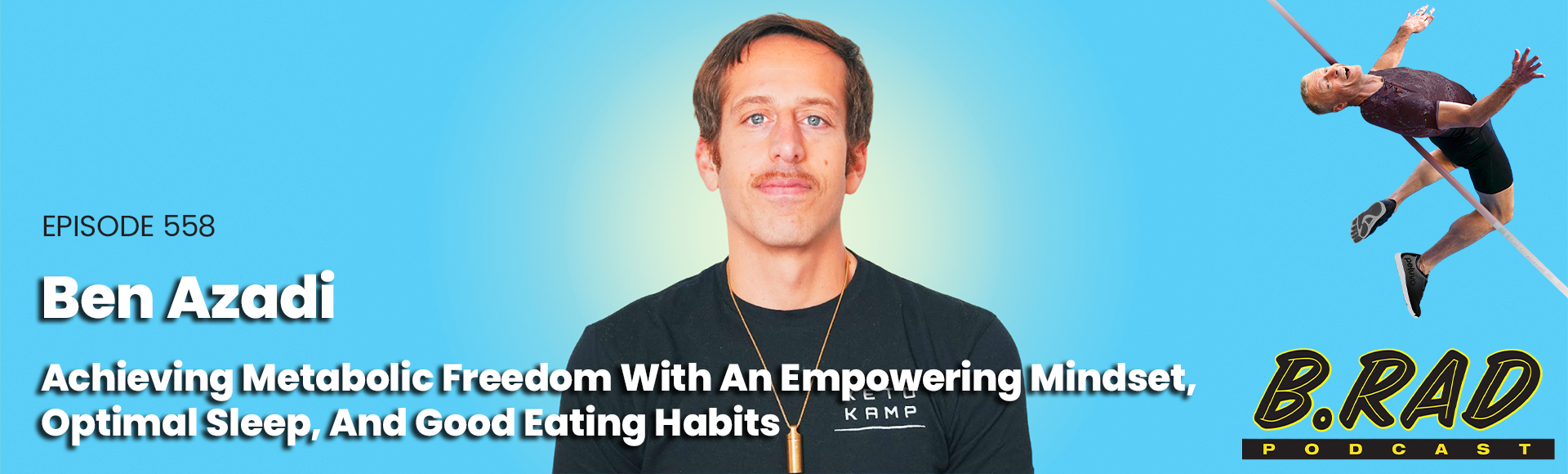
I welcome bestselling author Ben Azadi to the show on the occasion of the release of his new book called Metabolic Freedom: A 30-Day Guide to Restore Your Metabolism, Heal Hormones & Burn Fat.
Of course, we get into all the important talking points about the ketogenic diet, intermittent fasting, how to lose body fat safely and sensibly, but this show is also going to be way more than you bargained for, because we got into a nice groove, starting with Ben sharing his amazing backstory. You will hear about how he suffered for some 20 years as a child, going into early adulthood with obesity, depression, lack of self-confidence, and suicidal thoughts, and he turned everything around by making a change to his mindset. We went really deep in this show and I can appreciate how the discussion really colors how we can approach diet and fat reduction in the most effective manner, rather than just focusing on the mechanics.
You’ve probably heard some podcasts already with people telling you which foods to eat and which foods to avoid, but we do have a good discussion on all those levels. Ben also talks about things like constant spaced repetition—empowering thoughts or statements or phrases that you write down and you look at and repeat every day.
You will also hear him talk about the difference between faith and fear, as well as how you cannot outperform your image, so you first have to change your self image, your thought patterns, and that is how you progress toward lifestyle transformation. It’s not about smooth sailing every step of the way; he talks about how to navigate setbacks as well, so you will get a really broad based, colorful conversation from a colorful guy down in Miami in this episode, Ben, who has a great program going called Keto Camp, and I think you’re going to love our conversation and his new book, Metabolic Freedom.
TIMESTAMPS:
This discussion looks at how we can approach diet and fat reduction in the most effective manner. [01:07]
Is ChatGPT going to replace the act of sitting down and writing a book on your own? [04:39]
Ninety-three percent of Americans are metabolically handcuffed. [07:00]
When insulin is chronically elevated, it’s a fast path toward metabolic disease. One of the most important tests you should get done is the insiulin blood test. You want to see that between three and six. [11:10]
Are there actual symptoms supporting to indicate when you get metabolic insulin resistance? [18:40]
Keto is a good way to go but it shouldn’t be the only way. You can go back and forth. [20:44]
So someone looking to lose extra weight would be told to firstly look at their sleep regimen. Sleep is the foundation that builds the house of health. [24:06]
A study on metabolism found that between the ages of 20 years old and 60 years old, there were no significant changes in metabolism. If you are after 60 and start showing a decline, in metaabolism, it is indicative of a loss of muscle mass. [31:26]
Ben is physically active with healthy blood work now. In the past, he was obese and was pre-diabetic with low testosterone and, at times, suicidal. This is why he wants to teach others. [35:56]
The health of the Population of the United States is horrible, especially with Type 2 diabetes. The US ranks 37th right behind Costa Rica on health. [38:27]
The second you take responsibility, the second you create change. You cannot blame others for your situation. [42:54]
Your thoughts, you image of yourself, influence your metabolism, disease, or healthy and longevity. [53:48]
Seed oils stay in your body for years. They create inflammation. One French fry cooked in vegetable oil is equivalent to the tobacco in one cigarette smoked. [58:26]
LINKS:
- Brad Kearns.com
- BradNutrition.com
- B.rad Whey Protein Superfuel – The Best Protein on The Planet!
- Brad’s Shopping Page
- BornToWalkBook.com
- B.rad Podcast – All Episodes
- Peluva Five-Toe Minimalist Shoes
- Metabolic Freedom: A 30-Day Guide to Restore Your Metabolism, Heal Hormones & Burn Fat
- BenAzadi.com
- Burn
- You2 (Squared)
 LISTEN:
We appreciate all feedback, and questions for Q&A shows, emailed to podcast@bradventures.com. If you have a moment, please share an episode you like with a quick text message, or leave a review on your podcast app. Thank you!
Check out each of these companies because they are absolutely awesome or they wouldn’t occupy this revered space. Seriously, I won’t promote anything that I don’t absolutely love and use in daily life:
- B.rad Nutrition: Premium quality, all-natural supplements for peak performance, recovery, and longevity; including the world’s highest quality whey protein!
- Peluva: Comfortable, functional, stylish five-toe minimalist shoe to reawaken optimal foot function. Use code BRADPODCAST for 15% off!
- Ketone-IQ Save 30% off your first subscription order & receive a free six-pack of Ketone-IQ!
- Get Stride: Advanced DNA, methylation profile, microbiome & blood at-home testing. Hit your stride the right way, with cutting-edge technology and customized programming. Save 10% with the code BRAD
- Mito Red Light: Photobiomodulation light panels to enhance cellular energy production, improve recovery, and optimize circadian rhythm. Use code BRAD for 5% discount!
- Online educational courses: Numerous great offerings for an immersive home-study educational experience
- Primal Fitness Expert Certification: The most comprehensive online course on all aspects of traditional fitness programming and a total immersion fitness lifestyle. Save 25% on tuition with code BRAD
I have a newly organized shopping experience at BradKearns.com/Shop. Visit here and you can navigate to my B.rad Nutrition products (for direct order or Amazon order), my library of online multimedia educational courses, great discounts from my affiliate favorites, and my recommended health&fitness products on Amazon.
TRANSCRIPT:
Brad (00:00:00):
Welcome to the B.rad podcast – where we explore ways to pursue peak performance with passion throughout life. I’m Brad Kearns, NY Times bestselling author, world #1 ranked masters age 60-plus high jumper, and former #3 world ranked professional triathlete. You’ll learn how to stay fit, strong and powerful as you age; transform your diet to lose body fat and increase energy; sort through hype and misinformation to make simple, sustainable lifestyle changes; and broaden your perspective beyond a fit body to experience healthy relationships, nonstop personal growth, and ultimately a happy, healthy, long life. Let’s explore beyond shortcuts, hacks, and crushing competition to laugh, have fun, appreciate the journey, and not take ourselves too seriously. It’s time to B.rad! Responsibility is your ability to respond to life. That is your responsibility. It makes sense. He said, if your ability to respond to life is poor, like you’re the victim, you’re going to get poor results. But when your ability to respond is great, like you take ownership, you get,
Brad (00:01:07):
Hey, please welcome bestselling author Ben Azadi on the occasion of a release of a new book called Metabolic Freedom, A 30-day guide to restore your metabolism, heal hormones, and burn fat. And of course, we get into all the important talking points about the ketogenic diet, intermittent fasting, how to lose body fat safely and sensibly. But this show is gonna be way more than you bargain for, man. ’cause we got into a nice groove. And this guy told his amazing backstory where he suffered for some 20 years as a childhood, going into early adulthood with obesity, depression, lack of self-confidence, suicidal thoughts, and he turned everything around with the change in his mindset. He talks about some of those strategies and techniques that he used. So we went really deep in this show, and I also appreciate how the discussion really colors how we can approach diet and fat reduction in the most effective manner, rather than just focusing on the mechanics.
Brad (00:02:12):
You’ve probably heard some podcasts already with people telling you which foods to eat and which foods to avoid, but we do have a good discussion on all those levels. But he talks about things like constant spaced repetition, and these are empowering thoughts or statements or phrases that you write down and you look at and repeat every day. He talks about the difference between faith and fear. He talks about how you cannot outperform your self-image. So you first have to change your self image, your thought patterns, and that is how you progress toward lifestyle transformation. It’s not about smooth sailing every step of the way. He talks about how to navigate setbacks. And so I think you get a really broad-based, colorful conversation from a colorful guy down in Miami. His name is Ben Azadi, a popular speaker. He’s got a great program going called Keto Camp, and I think you’re gonna love our conversation and his new book, Metabolic Freedom. Here we go with Ben Azadi. Ben Azadi, I’m so glad to join you.
Ben (00:03:19):
I’m glad to join you, Brad, big fan of your work. Thank you for having me today.
Brad (00:03:22):
Thanks On this historic occasion of another book launch, I will say, from the bottom of my heart. Congratulations on, you know, making this incredible effort to, to bring a book out to the world. It seems like a lost art. I don’t know what you feel about that, but like we have so much content shoved down our throat every single day in different forms, especially on social media, video and all that. And like is there still a place on the planet for really thoughtful and carefully presented books? And let’s hope so.
Ben (00:03:54):
<laugh>, I think there is, there’s something special about having a book in your hands. I’m not a Kindle guy. I like having the actual physical copy. I have your, Born to Run book you wrote with Mark right here. I was just showing you. And I like having the copy. Even if I listen to the audible, I’ll still buy the actual paperback or the, the hardcover to have the physical copy. It’s different than social media dopamine hits. It’s like you get to experience this journey and take, you know, the authors whatever, 10 years, 20 years, 30 years of experience and, uh, not just experience, but like failures and learn from their mistakes and apply it. So yeah, there’s still a need for it, and I’m grateful that I have my book and I love that you have your book as well. And it’s fun times for us.
Brad (00:04:39):
People ask me. I I’m completely clueless about Chat GPT and the, the potential I, I just haven’t integrated yet. And I, I know I need to in all the various areas of my, my work that might be valuable. But I still have no idea how this could someday replace what you did sitting down and writing a book or what Mark and I do. Uh, what do you think about that?
Ben (00:05:04):
It’s not gonna replace it, at least I don’t think so. <laugh>, who knows? But you could use it. I’ve used, I used a little of Chat GBT for my book to find certain research studies I was looking for and certain things. But to have it write for you and your, the way you story tell your personality, it’s not gonna replace that. I mean, I could tell if a book was written by Chat GBT or for the author or a passage was written by Chat GBT or the author. So there’s nothing that could replace our personality and our style. No, I don’t think so.
Brad (00:05:36):
Yeah. And I think it’s connecting the dots, like, you know, you have to tell a story and it’s up to you, um, which, you know, which lily pad you’re gonna jump to from the next chapter or the next paragraph. And I think that’s the part where the richness comes from a real human that’s, like you say, lived through the experience.
Ben (00:05:56):
Yeah, exactly. There’s something really special about that person sitting down, thinking about the chapters coming up with the themes and where it wants to lead to, like you said, the lily pad, what’s the next lily pad they’re jumping to? That’s something really special about reading that and also creating it yourself like you just did with your book. It’s a cool experience. And at first, I remember when I first started writing the book, it felt like a little bit of a daunting task. I had a certain timeframe to submit the book to the publisher, and all my other books were self-published. So my timeframe was like on my own time constraints. And that was pretty much whenever I wanted to get it done. But there was a benefit because I knew I had a certain deadline. It forced me to prioritize the book, and I’m really excited with the way it turned out.
Brad (00:06:39):
So it’s called Metabolic Freedom. I love that title. And you’re gonna describe what it means and, and why that was your inspiration to make the title. And I’m, I’m, I’m guessing what you’re gonna say, but it, it really is a powerful message. So let’s talk about that title and then I can tee you up to, to go into detail what the book’s about.
Ben (00:07:00):
Yeah, for sure. I mean, we know Mark Sisson is the godfather of metabolic flexibility, right? He really brought this to the forefront, and it’s really a spin on that. It’s, it’s metabolic freedom is metabolic flexibility, being able to use whatever substrate is available for energy, whether that’s carbs, fat protein, your body fat, heck, oxygen, sunlight, your metabolism was designed to use those substrates, produce energy, burn fat, feel good. Unfortunately, around 93% of Americans are metabolically handcuffed or metabolically unhealthy. So this, this book was written for the masses. It was written to give you the exact steps to achieve metabolic flexibility, which is metabolic freedom. And what’s interesting, Brad, is that my last name Azadi translates to freedom in Farsi. My parents are from Iran, they speak Farsi, and that’s the literal translation of my last name. Azadi translates to freedom. So for me, it was the perfect fit.
Brad (00:07:57):
It was your destiny, man. Yes. Yeah,
Ben (00:07:59):
I believe so. <laugh>,
Ben (00:08:00):
I took a funny picture. I was visiting my sister in hospital environment. She’s a doctor, and one of the placards on the hall was Dr. KNEE. And I’m like, well, of course, if your last name is KNEE, you’re gonna be a fricking orthopedic surgeon. You have no, you have no choice. Yeah.
Ben (00:08:18):
That is so cool, man.
Brad (00:08:20):
Yeah, yeah. Um, so the freedom refers to, I guess you should describe the opposite situation with those 93% of people. They’re trapped and they need regular feedings of outside calories to get through the day.
Ben (00:08:37):
Yeah. They’re in a metabolic prison. They’re sugar burners. And there’s nothing wrong with using sugar as a fuel source unless you’re only using sugar as a fuel source. It leads to rapid aging, inflammation, weight gain, and then eventually a whole host of metabolic diseases like diabetes and cancer and heart disease. So, unfortunately, 93% of people are dealing with that, that are sugar burners. They’re relying, like you just said, on food for fuel, short burst of glucose spike and short burst of energy, which then is not long lasting. So they have to continue eating and grazing throughout the day. And what’s interesting, Brad, one of my colleagues, Dr. Don Clum, did a patient population survey study where he had his patients to simply write down how many times they were eating throughout the day, whether it was a meal or a snack. And the average person was eating 17 to 23 times per day.
Brad (00:09:29):
No way.
Ben (00:09:29):
Isn’t that insane? Is like,
Brad (00:09:31):
Like just reaching for peanuts counts is one of your Yes. One of your sessions.
Ben (00:09:35):
It does. Yeah. So peanuts, almonds, sipping of kombucha, anytime you spike glucose and start the digestive system, they classify it as a meal. And the average person was doing it pretty much 20 times a day or so, which is a sugar burning metabolic prison.
Brad (00:09:50):
So let’s get more specific here. I don’t think we’re speaking in absolutes, or maybe we are like, is a sugar burner at 0.7 respiratory quotient all day long? In other words, are they burning almost entirely carbohydrates? Or is it that they’re predominantly relying upon their feedings and the calories and not really burning body fat at a rate where maybe the next person who has more freedom is, is getting to?
Ben (00:10:20):
Yeah. Great, great clarifying question there. They’re predominantly using carbohydrates in their diet as a form of energy, which is, as you know, converted into sugar. And when they’re not, their body is either breaking down protein as a source, turning into glucose via glucogenesis, or there’s a cortisol response doing the same thing because they don’t have the ability to tap into store fat, that’s a problem. So metabolic freedom is the ability to yeah. Burn sugar from food. And then when you’re not eating that food, burn stored fat and go back and forth. Those people that are sugar burners, they are dealing with just glucose as, and whether that glucose is from food protein or cortisol as their major fuel source, as a matter of fact, pretty much their only fuel source, they’re not using fat, they’re not using ketones. They’re stuck in in sugar-burning mode.
Ben (00:11:10):
And that’s, that’s detrimental because what happens is this, first we’re gonna see insulin levels increase. Insulin, as you know, is an energy sensor, fat burning, a fat storage, excuse me, hormone. And when it’s chronically elevated, it’s a fast path towards metabolic diseases. It’s the first domino to fall. And you could have full-blown insulin resistance for over a decade without your blood sugars changing at all, whether it’s your fasting blood sugars or even your A1C. There’s a study I put in the book, the Whitehall study, that showed that you could have insulin resistance for six to 14 years without your blood sugars changing because your pancreas is so busy producing massive amounts of insulin to clear that excess glucose until it cannot, until your receptor sites for insulin go deaf to the screams. And then there’s a dramatic increase in your blood sugars, and then your pre-diabetic or even some cases full-blown diabetic. So I make the case that a fasting insulin blood test is one of the most important tests you could get done for your metabolism. You want to see that between three and six. That means you have a very sensitive insulin levels. If it’s above that, you’ve got issues. So go get that test done for your audience. If you haven’t gotten it done, get it done. It’s one of the most important tests you could get done for your metabolism.
Brad (00:12:28):
I love that. I love Dr. Paul Saladino emphasizing that. He picks his number one preferred blood test, and then you go into, uh, traditional medical environment. And my wife was going in for her annual screening, and I said have him add, uh, hba one C, fasting insulin, vitamin D, uh, all these things that they don’t generally do with a, a complete blood count test, which by the way is like 20 bucks on the street where you, you can go online to one of the, the portals and pay for these tests yourself. And there was all this pushback that, they didn’t want to add, fasting insulin to the panel. And it’s, it’s just so amazing that, you know, these, these health leaders like yourself and, and many others are saying, these are the truly most revealing tests. And they don’t even, they don’t even test people.
Ben (00:13:17):
Oh, it’s so, it’s so frustrating. I didn’t know that about Paul Saldino. I love his work. I didn’t realize he was preaching the message of fasting insulin. He’s spot on. And you’re, you’re correct. Traditional doctors are not gonna order a fasting insulin because there’s not a medication that could prescribe for high insulin, only for high glucose. There’s no medication for insulin. That’s one reason. The second thing, you want to pay attention to that, let’s say you do convince your allopathic doctor to order that test, or you order it separately and they review it. This is what you want to pay attention to the reference range that will come back on that fasting insulin is between three and 25 or three and 28. So if it comes back as 11, 17 normal, yeah, they’re not gonna flag it. It’s normal. You’re within the reference range. But that’s insulin resistance. I would argue if you’re at a eight or a nine that’s leading towards insulin resistance, you want it to be between three and six. I’ve tested mine a couple times a year in the last four or five years, and I’m always 3.2, 3.3. I’m always hovering around three. And if you can get your fasting insulin around three, you’re gonna have more energy, more fat loss, you’re gonna increase your lifespan. It’s just gonna be overall better, better experience for you.
Brad (00:14:26):
I like you bringing up the reference range on blood panels because we are referencing the fattest sickest population in the history of the human race. And so when we come back and say everything was normal, you really should replace normal with pathetic. And I got this insight, I was doing a show on, you know, testosterone, how important that is to track and how it represents the essence of aging gracefully, especially for males, but for females too. And I was patting myself on the back reading my reports that I was in the 95th percentile. And then I’m like, wait a second. If you’re not in the 95th percentile, you royally suck. And there’s no other way to describe it. And the same with insulin. So the Ben range is three to five optimal and definitely, uh, desperately want to be under eight. I’ve written down the same notes from, uh, from Saladino, Dr.
Brad (00:15:18):
Cate Shanahan, Dr. Ron Sinha, other people that are on the cutting edge here of looking at these numbers and realizing, look, do you want to be a pathetic normal American human where we have 93% of people that are off base, or do we wanna be optimal? So you like that three to five range. I’m sure you detail that in your book. A quick weird comeback question. I’ve been tracking this as well, and a couple people commented that there is a point where if you’re lower than that, I had a 2.71 time, I had a 2.3 another time, and I kind of bumped it back up with increasing my carb intake, increasing my insulin production, because I’m an athlete and I wanna perform and I wanna recover. And insulin, as we know, is a very, um, it’s, I I guess literally it’s an anti catabolic hormone, so it helps you restore nutrients and, and replenish and all that. In most people’s cases, it’s, what’s it doing is storing fat all day long because your glycogen stores are full. But I wonder if you have any insight on when we’re talking about optimal, and you said three to five, I just wanted to dip into that other side for a second. Yeah,
Ben (00:16:27):
It’s a great, it’s a great, um, it’s a great idea to look at insulin and if it’s below three, I sometimes see that with those doing long term chronic ketosis, chronic carnivore, chronic
Brad (00:16:39):
Carnivore, chronic ketosis, love it more new terms. We have chronic cardio, we have chronic ketosis. It’s all alliterative. Okay.
Ben (00:16:48):
And even like chronic fasting, although that doesn’t roll off a tongue as well as the other ones. But I would, I always look at C peptide as well to see what’s going on with the pancreas and the insulin. And if I see that, let’s say under 0.8 and the insulin is low, yeah, it’s probably, you’ve been doing it too long, too aggressively. Introducing some healthy carbs as a way to kind of get your pancreas familiar again with producing insulin is a good idea. This is a problem for people in the keto fast and carnivore space for 93% of Americans, as you mentioned, they need to lower their insulin levels. It’s not, this is not their problem.
Brad (00:17:23):
Yeah. Well said. I think I, I wanna take a couple backpedal steps to make sure the listeners falling along carefully as we compare contrast. So you’re talking about this chronic overproduction of insulin driven by dietary habits that are trying to get us through the day, because we are poor at burning stored body fat, so we’re relying on these doses, and insulin has to carefully regulate blood sugar levels at all times, otherwise we pass out and, and collapse and have to go to the ER. So that’s the case for most people. And then we have that whole seesaw over on the other side where we have the females with low body fat doing CrossFit and then adhering to ketogenic macros and throwing their system into a high stress pattern because they’re not getting sufficient fuel for all the fuel that they’re burning.
Ben (00:18:17):
Yeah, exactly. It’s another form of metabolic inflexibility. They’re only burning fat and not burning sugar. Now, for the majority of people, they’re doing the opposite. They’re only burning sugar and not burning fat. But in my space, my keto space, I see the same problem in terms of metabolic inflexibility. They forgot how to burn carbs and forgot how to burn sugar. So it’s another form of metabolic inflexibility.
Brad (00:18:40):
And is there actual symptoms and research supporting that where you kind of get what is it, what is it called? Metabolic insulin resistance?
Ben (00:18:52):
Yeah, like a physiological
Brad (00:18:54):
Response. A physiological insulin resistance.
Ben (00:18:56):
Yes. What happens is the body wants to survive. That’s the number one priority for the body, right? So if you’re only fuel source is fat, meaning your body fat for a long period of time, and for some,
Brad (00:19:08):
Or eating a bunch of fat, right. Bacon, butter and body fat or whatever.
Ben (00:19:11):
Yeah, yeah, exactly. Yeah, exactly. Exogenous or endogenous, your body is gonna be really clever in preserving that fuel supply. Uh, the analogy is this, and then I’ll get to some studies. The analogy is, if you lived in a, in Alaska, in the middle of the woods and you lived in a small cabin, there’s not a AC, there’s not a heating system. You only use firewood to heat up the cabin, but it’s the summer. You don’t have to worry about it being too cold. The weather’s perfect, but you know, in a few months it’s gonna be fall, it’s gonna be winter, it’s gonna be very, very cold. So you start storing firewood, think of that as your body fat. Mm-hmm. You start storing firewood, winter rolls around, and let’s say you only stored about 20 logs of firewood. It’s your only fuel supply. You have months of cold weather, you’re gonna burn that fuel supply as slowly as possible to get through those cold winter months.
Ben (00:19:57):
Meaning your body does the same thing. When you’re only burning fat for a long period of time, you slow down fat loss, your body literally sends a signal to insert water into your cells, which creates like dimply fat, and it blunts those receptor sites. So that’s that physiological insulin resistance that’s happening different than other insulin resistance. And it’s a problem, especially long term. And there’s some more things that happen that I’ll get to. But when you have what I call a metabolic flex day, as I call it in the book, it’s like your body, your buddy coming over and saying, oh, Brad, you only have 20 logs of firewood, dude, no worry. I have thousands of logs of firewood. I’m gonna give you a couple hundred and now you’re gonna burn that firewood. You’re gonna ramp up the production. So introducing a high healthy carb day is like that, dumping the firewood.
Ben (00:20:44):
Your body is gonna remind the body, it’s not starving. You’re gonna ramp up production of fat burning ’cause you have a different fuel supply. What I’ve seen, so I’ve taken maybe seven or 8,000 people through keto fasting carnivore protocols through my programs over the last few years. And I, I teach the message of going in and outta ketos, but some people feel so good, and they stay in, in a long time, in a long time. And I see their T three levels start to decrease. Mm-hmm <affirmative>. Their active thyroid decrease. I see for men, their testosterone start to decrease because their aromatizing, estrogen ’cause their sex hormone binding globulin goes up. And I know with Paul Saladino story, who’s getting a lot of, um, electrolyte deficiencies and mineral deficiencies as well. So it’s a problem, uh, with this, the keto space, and I love keto, don’t get me wrong. I think it’s really important. Those 93% of people that are metabolically unhealthy, I call them being in a keto deficiency, but it’s one tool in the shed. It’s not the only tool. We wanna be able to go back and forth.
Brad (00:21:44):
And so the strategic inclusion of healthy, nutritious dietary carbs, when one is in the, you know, the mindset of optimizing diet, optimizing nutrient density, that’s something that’s gonna help keep us insulin sensitive. And it’s not evil to have a meal once in a while with a good, a good carb count, especially if you’re going to these extremes. If you’re using the tools to, let’s say drop excess body fat is is kind of what you’re arguing for.
Ben (00:22:18):
Yeah, exactly. And, and when I say a high healthy carb day, It’s not a cheat day. It’s, it’s healthy carbs. It’s like nice, it’s fruit, sweet potato. I do well with white rice personally, you find your kind of carbohydrate threshold, but it’s having healthy carbs to make those hormonal conversions to remind the body that’s not starving, to give it a different fuel source. And, and you go back and forth. The way that I do it right now, personally, Monday through through Saturday, on most weeks, I’m actually carnivore and I do fasting each day. I get my protein, uh, count, I eat mostly meat. Sundays, I completely flex out of that. Where I’ll personally have, Brad, three to 400 grams of healthy carbs on a Sunday, no fasting. And then Monday I’m back to fasting in, in carnivore, and I’m back in ketosis. So that’s my personal metabolic flex approach.
Brad (00:23:07):
And there are many ways to slice this. I know. I like how Ben Greenfield has talked over the years about banking many hours in fasted or ketogenic state and then hitting the carbs hard. I think he describes every evening he gets in with his family and they make homemade ice cream. And, uh, this ensures that he’s glycogen refueled because he’s a highly active athletic guy the next morning. But he is still getting, I guess, arguably various benefits, just like you described with your Sunday refeed or whatever you wanna call it.
Ben (00:23:42):
Exactly. Yeah. So he does it daily, and I do it, uh, weekly. There’s many ways to do it. And of course, it depends on how active you are. Ben’s very active more than me and how healthy your metabolism is. And that is the goal. That’s the way our ancestors did it. They had, they were in ketosis and then they were not. They had the meat and they had the fruit. They ate seasonally. And we could kind of model that by this metabolic flex approach.
Brad (00:24:06):
So if someone’s coming to you for guidance, and I guess the typical ambition would be to shed a stubborn extra five, 10, or 20 pounds of excess body fat what would you, what would you, uh, recommend to, like in a general sense, if, if possible, or you can split us into different forks or camps if you want Keto camps. I like that.
Ben (00:24:33):
I like the iteration.
Brad (00:24:35):
Okay. Yeah.
Ben (00:24:36):
I would say Brad,, I would start with sleep. I, yeah, sleep.
Brad (00:24:39):
Listen to this people <laugh>, this guy’s, this guy’s messing with our heads now. What do you mean start with sleep? What about my grams of carbohydrates and my blood meters. Starting with sleep?
Ben (00:24:50):
Yeah. I would start with sleep. I would make sure you’re getting quality sleep. The reason why I say that is I, I call sleep the Swiss Army knife of metabolic health because look, you could be eating keto, doing fasting, doing your workouts, but if your sleep is crap, you’re just not gonna get the results you want. Your body does amazing things during sleep. You know this, Brad, it repairs you, detoxifies you activate fat burning hormones. I remember a client that I, was working with a few years ago. He was 80 pounds overweight. He was using a sleep apnea machine every night and he had high blood pressure pre-diabetic, and he wanted to lose weight. That’s exactly what you just said. He had more weight than the question, but he was, he thought he was doing something right. He signed up for a gym membership and he would wake up early.
Ben (00:25:34):
So he would, he would sacrifice about an hour and a half of sleep to go work out. Yeah. Right. And I said, look, instead of doing that, instead of exercising right now and losing out on that 90 minutes of sleep, let’s stay in bed, work on getting better sleep, get those 90 minutes and then we’ll bring in some light exercise later on. And just by doing that, by stop exercising and getting more sleep, he started to lose some weight and feel better. Eventually he lost all the weight, got off his sleep apnea machine. So sleep is important. Studies are showing just five nights of poor sleep categorized by five hours or less in healthy men lowered their testosterone levels and it increased their blood sugars. It increases your hunger hormone, ghrelin decreases the hunger, the satiety hormone, leptin. It’s this vicious cycle. So I would start with sleep. If you’re not tracking your sleep, track it. I aim, personally, to get about an hour and a half of REM and an hour and a half of deep every day. I can tell you this, Brad, uh, when I woke up this morning and I checked my aura ring sleep stats, I got two hours and four minutes of REM sleep last last night, which is a little bit more than what I’m used to. And I was super jazzed about it. ’cause I said, I’m gonna crush this interview with Brad Kearns today, <laugh>, because red so sharp
Ben (00:26:49):
<laugh>, It makes you sharp, right? It helps with memory and processing information. So yeah, I would start with sleep and we could move on to other things for that visceral or, or belly fat. But sleep is where I would start.
Brad (00:27:00):
So when you’re seeing the stats there of this much REM sleep, this much deep sleep, where, where are the other hours categorized if they’re not in that two hours of REM or two hours, hour and a half of REM hour and a half of deep, what’s the rest? Medium or something? <laugh>
Ben (00:27:15):
<laugh>, it’s categorized as light sleep. So there’s be, yeah, there’s benefits to it. ’cause you’re still in a parasympathetic rest mode. But deep is where your body is activating fat burning hormones. Your body’s activating the glymphatic system. The brain is literally shrinking in size and this cerebral spinal fluid is flushing over the brain to clear toxins and proteins. And then REM which is rapid eye movement is processing short-term memory for long-term memory is great for, for mood memory focus. That’s why I said I was gonna crush the interview with you. And then light sleeper, there are just some parasympathetic benefits there. So, uh, I, I’m a big fan of personally tracking it to see how much REM and deep sleep I’m getting.
Brad (00:27:55):
Yeah, I am a big fan and, um, I’m very good at napping as well as banking a lot of hours in the evening. And sometimes I feel like a wuss because I’ve determined that my optimal evening sleep is around nine hours and 15 minutes, which is a lot, but that’s what it always comes out to be. Like 10:30 to seven, 15 is optimal. And I usually hit that very close to that because I shut down if I stay up later than that. And I don’t often sleep in much longer than that. But I just caught a video on YouTube, uh, with the great middle distance runner, Yako Binga Brisson from Norway, and they’re asking him about his sleep habits and he says, you know, my optimal time is around nine hours and 15 minutes. And I’m like, yes. Wow. Awesome. <laugh>.
Brad (00:28:38):
But I, I wanna put in a plug for the individuality there. And I think the importance when you’re talking about tracking it, yeah, you can get the high tech devices and I think it’s also important to like track your sleeping environment and evening habits leading up to the, the bedtime period. Is it dark? Is it calm? Is it mellow? Are you blasting high impact digital entertainment programming and then shutting the, the laptop screen and trying to fall asleep right away. So there’s a lot of ways to track sleep and some of ’em are just intuitive and, and, and noticing how you feel in the morning. But to put that at top priority, that’s great because I don’t think there’s enough attention paid to that thing you mentioned in brief there is that if you don’t get good sleep, you dysregulate your appetite and say tidy hormones.
Ben (00:29:26):
Yeah, I’ve seen it time after time because it’s not sexy to really talk about sleep <laugh>. It’s sexy to talk about biohacks and supplements and different things then they’re all great. But sleep is where it’s at. It really is. And for me it’s about an eight, eight and a half hour spent in bed to feel really well rested and get quality sleep. So not too far off from you. And that’s eight and a half hours spent in bed, meaning not total time sleeping. ’cause it takes some time.
Brad (00:29:50):
You’re texting, you’re watching Instagram. No, no, no, no, no. <laugh>
Ben (00:29:54):
Not doing that. But it takes you like, what, 15, 20 minutes to fall asleep. I’ll wake up and lie down for 10 minutes and then wait, and then, you know, wake up. So there’s a little bit of a buffer there. But yeah, finding your sweet spot. Some people could do seven hours and thrive. It’s just finding that, that customization as you mentioned.
Brad (00:30:09):
And I think everyone can relate just how powerful the variable of appetite is, because our best laid plans will go out the window if we, you know, have that sensation of wanting to eat more food. And to think that that’s directly connected to the quality of your sleep is kind of like a cheat code, I suppose, to be able to adhere to devoted dietary restriction where you’re trying to clean up your act and not reach for all the Ben and Jerry’s at night.
Ben (00:30:40):
It’s true. And I would, I would even say this, I would say sleep is more important than exercise and nutrition combined. Combined. And the reason why, look, I could go days and weeks without exercising and be sedentary and sure, I wouldn’t feel great. I could eat like crap for weeks and months and sure I wouldn’t feel great. But if I went weeks and months without sleep, first of all, you can’t do it. But I would turn into a crazy person. I would not function. So it is the foundation. You can’t skip the fundamentals. Sleep is the foundation that builds the house of health. And if you don’t build the foundation, the walls will come down wall by wall day after day, week after week. So I would start with sleep. Now on top of that for fat loss, then we get into the conversation of, of insulin.
Ben (00:31:26):
We get into the conversation of, first of all, if you’re eating every, every two to three hours, you stop the snacking. You have three meals a day. You gradually lower your carbohydrate intake, increase protein and fat. This gets you from burning sugar to burning fat. You start building strength training. And I’ll make the case for, for building lean muscle. Because when I dug into some of the studies on metabolism for this book for so many years, Brad, I would hear people say they would use this excuse, oh, I’m gaining weight because I hit 40 or I hit 50 and my metabolism slows down. There’s nothing I can do. That’s just what happens with age. Yeah. So when I looked into the research, first of all, I discovered the metabolism doesn’t even necessarily work in speeds. It’s either efficient or it’s inefficient. But there’s one study, I think it’s the most comprehensive study that I’ve seen.
Ben (00:32:16):
It is the most comprehensive study I’ve seen on the metabolism. And it was from Duke University in 2021, it was published and there was a 6,600 people in the study. It’s a worldwide study, meaning they involved several countries and they had the, the age ranges of the participants in the study was from age one all the way to age 95 and everybody in between. And they were using the gold standard of metabolism measurement, which was this urine test where they would measure their metabolism through urine. And here’s what the study said. It said between the ages of 20 years old and 60 years old, there are no significant changes in the metabolism. Then it went on to say, which by the way, that just throws your excuse away. You can’t make that excuse anymore. Then it went on to say, we’ve noticed once the participants reached age 60, they noticed a 0.7% decline in the metabolism every year after age 60. Now, that might sound like a bad thing if you’re over age 60, but the study said the reason why that happens is loss of muscle mass. So if you build lean muscle mass, preserve lean muscle mass, whether you’re under 60 or over 60, you could be 75 years old with the same metabolism as when you were 25 years old. And that’s where the strength training, muscle mass, muscle building comes into play. Great for insulin sensitivity, great for fat loss, great for longevity. So I would throw muscle building into that conversation.
Brad (00:33:50):
Love it. So the, the basic notion that we’ve carried along the basic excuse is complete nonsense. I wonder if Dr. Herman Pontzer was involved in that study. ’cause he’s from Duke and he’s the world’s leading expert on caloric expenditure.
New Speaker (00:34:03):
He was, yeah.
Brad (00:34:04):
Among humans as well as primates. He’s been on my show a couple times and wrote the book Burn and.
Ben (00:34:09):
Yeah. Oh, oh, I Follow
Brad (00:34:11):
Up book. Yeah, yeah.
Ben (00:34:12):
Pontzer it was Pontzer and an international team of scientists. Yep. You spot on. Yeah.
Brad (00:34:17):
So, his life’s work contends that humans have a fixed calorie burning ceiling no matter what. And it’s very similar, whether we’re active or not active, which is another mind blowing insight. But that totally lines up with the idea that our metabolism, our metabolic rate is very similar until we start losing muscle mass. Because, uh, in other words, humans have this upper limit calorie burning ceiling, as a function of their musculature, right? So a lightweight female that weighs a hundred pounds burns fewer calories a day than a heavily muscled male that weighs 200 pounds, obviously. But if that muscle mass is the key variable that’s gonna maintain your metabolism, I love it, man. Some ripped 75-year-old like Mark Sisson, oh, almost he’s 70, uh, two or so, but it’s, it’s completely, um, possible with the proper health practices rather than envisioning this steady decline where you, you start hearing people in their thirties complaining how their metabolism slows down from from college age, right? No, come on now.
Ben (00:35:25):
Yeah, it’s true. So you can’t use that excuse anymore. I mean, Mark’s the perfect example. And I remember when I had Mark on my podcast a couple years ago, he made a really important point that I actually put in the book. We don’t necessarily even wanna like speed up or boost the metabolism. The animals and the wildlife that have the fastest metabolism have the shortest lifespan. It’s not about boosting the metabolism, it’s not about fixing a slow metabolism or creating a fast metabolism. It’s about having a flexible, efficient, metabolically free metabolism. Mm-hmm
Brad (00:35:57):
<affirmative>. Love it. Now let me ask you, since you are of a healthy body composition, healthy blood work, I assume you’re active, energetic guy, your diet is totally dialed in and you’re still utilizing these techniques like fasting, ketogenic, eating, um, the carb surplus on just one day a week. Are you doing these for <laugh>, for R and D for to put out a nice book for the masses? Or is this in search of peak performance, cognitive as well as physical? Or what’s your rationale, assuming let’s say that you’re not trying to drop a stubborn 10 pounds of belly fat that you need to implement these extreme tools?
Ben (00:36:43):
a I just want to feel great and, and live a long, impactful, healthy life. I’ve seen the opposite for most of my life. I was obese, I was metabolically handcuffed, um, for 20 plus years I was obese and I saw the opposite. I had a whole bunch of symptoms. I was pre-diabetic. I had, uh, low testosterone, erectile dysfunction. I was suicidal. I was wanting to give up my life. And I’ve been there, and I don’t want to go back to that, Brad. I want to feel great. I wanna look great. I wanna be able to perform and educate people. And every, every day, you know, right now, you know how it goes. Right now I’m in the middle of book launch and I’m doing podcasts after podcasts. You just went through it. You’re still going through it. And if I was not healthy, I would not be able to do sustain what I’m doing.
Ben (00:37:28):
I would not, same thing with you. If you were not healthy, there was no way you could be on all these podcasts promoting the book. And this is, this is important to me. I saw my dad suffer through metabolic disease and he had type two diabetes, which then caused him to suffer a massive stroke, which left him paralyzed with the inability to speak. This was in 2013. And then in nine months later, 2014, he died, he passed away. And I saw what happened to him. And I don’t want that to happen to me. I don’t want that to happen to anybody out there because what he had was completely preventable and it was completely reversible. And the same information that I now know and understand would’ve would’ve saved his life. So now I feel like it’s my responsibility, it’s my duty to get it out into the world. And if I wasn’t taking care of my health, I would not be able to get it out into the world. I would not be able to do all these podcasts. And
Brad (00:38:20):
Plus we wouldn’t, we, we would dismiss you out of hand, man, who’s this.
Brad (00:38:24):
Exactly,
Brad (00:38:25):
who’s this dummy talking about? Yeah,
Ben (00:38:27):
Exactly. I mean, yeah, exactly. ’cause I wouldn’t live it to lead it. Right. You gotta live it to lead it. You live it to lead it. Mark lives it, to lead it. You, you play the part. So yeah, it’s important to me, uh, because people are suffering. And when we think about the US, the United States, we spend, $4.6 trillion on healthcare every year. If that was a GDP, that would be the fourth largest GDP in the entire world. Oof. Wow. Yet, yet, we are sicker than ever before. We rank amongst the worst in terms of first world countries with, with health and pharmaceutical companies are richer than ever before. And one out of every $4 spent on healthcare is on diabetes, primarily Type 2 diabetes, which is a metabolic disease that is completely preventable and completely reversible. Type two. So this is a big issue, and I want to be able to get the message out there and essentially strip the powers away from big pharma and give it back to us, the people. So we take responsibility and we feel good and we look good.
Brad (00:39:31):
You know, Dr. Doug McGuff, he wrote Body By Science and also another book he co-authored called Primal Prescription. And he cites statistics in there that with the current growth rate of Type 2 diabetes and the tremendously expensive cost it is to care for these patients. However, we have the ability to care for them for many, many years. They don’t die quickly as they might have decades ago. He says, if the rate continues, the cost of caring for Type 2 diabetes will bankrupt the United States Treasury by the year 2060. And you just mentioned we’re, it’s already the fourth largest economy on the planet to, to do sick care for Americans. It’s pretty embarrassing. I’m also amused to see that we rank, I believe it’s 37th in life expectancy right behind Costa Rica. And these, you know, far less developed nations that don’t have the medical and the scientific advances that we can capitalize on when we need help. So it’s definitely something we need to turn around. Now, Ben, you said you, you suffered for around 20 years, is that what you said? With obesity and, and the related adverse health conditions. So what ages was that from,
Ben (00:40:42):
My childhood until I was 24 years old, I was yeah, obese for most of my life. My mom worked at Kentucky Fried Chicken when I was a kid, <laugh>. So she would bring home free stuff. Yeah, the good stuff, the greasy stuff, and I was happy as a kid eating that Kentucky Fried Chicken, but it was destroying my health. I had addictions to drugs, alcohol, video games, sugar, and as a kid, I was very unhealthy. And then as an adult, I became obese. I was depressed. I mentioned I was suicidal, I was looking on the internet for ways to end my life. And every time I explored suicide, I kept thinking about my mom and I didn’t want to hurt her and create that devastation for her. So it stopped me from doing that, and it really forced me to figure things out.
Ben (00:41:27):
It forced me to take responsibility. ’cause I was blaming everybody except for myself. I started to actually, it started with a mindset shift before it started with food or movement. I started to read Dr. Wayne Dyer and Bob Proctor’s books. And it really just opened up a whole new world for me and helped me take ownership and responsibility. And then nine months after that, I lost 80 pounds. I went from 250 pounds to one 70. I went from, 34% body fat at my highest to 6% body fat at my lowest. And it completely just transformed my health. And that was 17 years ago. That’s what got me into the health space. I was a personal trainer for many years. I owned a CrossFit gym for many years in Miami, and now I’m writing books and sharing on your awesome podcast.
Brad (00:42:12):
I appreciate you relating the story. It’s fascinating to know, like, what is the trigger there when so many people are stuck? And some of ’em might be listening to the podcast right now, and maybe it’ll have a profound impact. And they’ll turn around and they’ll go order the books that you recommended along with Metabolic Freedom, or others will just have it pass through their ears like so many other things. And I’m sure so many people reached out to you. You had the loving mother there that was trying to do the best. You probably had a somewhat of, you know, a, a support network, but nothing kicked in until, until the day that Ben decided to make radical change. I guess I’d love to drill further on, on how that whole thing played out.
Ben (00:42:54):
Yeah, exactly. The second you take responsibility, like I did, is the second you change your life for the better. I started to hear Dr. Wayne Dyer say things that lit me up. He said he used the word responsible and responsibility differently than how I learned it. He would say, responsibility is your ability to respond to life. That is your responsibility. It makes sense. He said, if your ability to respond to life is poor, like you’re the victim, you’re going to get poor results. But when your ability to respond is great, like you take ownership, you get great results. And he would say, you have to stop blaming other people for your circumstances and your problems. You gotta stop being the victim. He said, if you were constantly being the victim, then you’d have to hire a psychiatrist for the rest of the world in order for you to get better. <laugh>, <laugh>. I’m like, that is true. It’s
Brad (00:43:47):
Unrealistic. Like, can’t everyone be perfect around me? And that I associate with, right? Yeah.
Ben (00:43:50):
Right. It’s unrealistic. So, the second you take responsibility, the second you create great change. And that’s what I did. I took ownership. I stopped being the victim of my history. I started to become the victor of my destiny. And the rest is history. I transformed my health. I created a new image of myself, a new self-image. I changed my environment. I changed my subconscious mind, my paradigm. I changed the input coming in. It doesn’t happen overnight, but it happens over time. So I’m empathetic to whatever somebody’s dealing with right now. But it may not be your fault, but it is your responsibility and there’s a difference there. You gotta take ownership and responsibility. You gotta stop blaming people. I was blaming my enabling family members, my bad genetics and slow metabolism, but none of that served me. None of that is serving you. When you take ownership, it may be really difficult to do because it feels good to blame somebody else. It it, it doesn’t allow you to take that responsibility and it feels good ’cause it’s their fault, not yours. But when you take ownership, it might be difficult at first, but it’s one of the greatest gifts that you could give yourself.
Brad (00:44:55):
And how long did it take? I mean, did you close a book and stand up and say, okay, I’m no longer blaming my enabling family members. I love you guys, gimme a hug now I’m gonna go out for my first CrossFit workout. Or how, how does that <laugh> timeframeikop, play out in your experience?
Ben (00:45:14):
Man, I wish it, I wish it was that easy, huh, Brad? I wish it was just like that. You get the book, it’s done. You’ve changed your entire subconscious mind.
Brad (00:45:20):
I wish. Yeah. I mean, people, they quit smoking cold turkey or they, you know, I, I’ve heard stories of people that, you know, they just flip on a dime, which is kind of dramatic and good for Hollywood. But, there’s probably, you probably had some backslides along the way to losing 80 pounds and all those amazing things.
Ben (00:45:37):
Yeah, absolutely. So there’s essentially, I learned this from Bob Proctor. There’s only two ways to change the paradigm. The paradigm is, is your behaviors. It’s exactly what’s resulting in your results. It’s deep in your subconscious mind. It’s just an autopilot. 95% of your results are coming from that paradigm. And there are only two ways to change it. Number one, an emotional impact. Alright? The example you just gave as a smoker. Somebody smokes cigarettes for many years and they get diagnosed with cancer. They might just give it up cold turkey because that’s an emotional impact. It is a scare That is an example of an emotional impact. Now, nine times outta 10, an emotional impact is negative and it’s unpredictable. So it’s not the ideal route to change the second option, which is the preferred option. This is how I did it. I actually did it.
Ben (00:46:24):
A combination of both. I had an emotional impact because of the, um, suicidal thoughts and depression. But also the second way is what I did, which is the constant space repetition of that new idea, the new paradigm, which is the input. It’s, it’s continuously reading the books, continuously, listen to the podcast, continue continually, continually making tweaks, creating this brain tattoo where you’re now reconditioning that subconscious mind. Where now this is your new level of, of programming. And it doesn’t happen over time, but you can make significant changes in, in 30 days. You could do some, some significant changes in that subconscious mind within 30 days and then 60 days. So to your point, Brad, it wasn’t a straight line towards like losing 80 pounds of fat. There were constant times where I had to course correct. And I like the way that Price.
Ben (00:47:15):
Prichard wrote a book called You Squared, and he said, rockets fail their way to the moon. They have a goal to go to the moon. They take off, they go off course, which are these setbacks. And they course correct course, correct course correct until they get there. I did the same thing. We do the same thing. So it’s not about the setback. Mm, it’s about the get back. It’s about the course correction. So that’s what I did, that’s what I recommend. It’s gonna happen to you. Success is never that straight line. It’s always that course correction. And that’s the way that I would recommend doing it.
Brad (00:47:47):
You called it constant space. Repetition. Repetition, yeah. What do you mean by space or,
Ben (00:47:55):
So what I mean by that is the way that your subconscious mind was built. If you have a victim mentality, if you’re blaming other people, if you have a self-image of yourself as being unhealthy and overweight, that was built through constant space repetition. It was through the conversations you had as a kid, your experiences. So you could rebuild that by literally, this is what I do, Brad, to this day, and I talk about this in chapter 10 of the book, writing down this new version of yourself on a card and in present tense. I’m so happy and grateful now that insert the new self image and reading it throughout the day, reading it every day. That’s the constant spaced repetition. Hmm. That’s the way it was built. And that’s the way you replace the old idea, which is not serving you with the new idea that is serving you. I gotta tell you, if you do this for 30 days, which is the plan in the book, I’m not just telling you what to eat, how to fast get your steps in. I’m giving you a specific affirmation. And if you do it for 30 days, you will change your life. Mm. You’ll see, if you actually do it for 30 days, it’ll change your life.
Brad (00:48:57):
I love it, man. Um, I would characterize myself as a bit of a rebel or a free thinker. You know, I don’t adhere to the, the tight structure of society. And so over time, when I’m presented with, uh, such similar type of protocols or recommendations, um, one of my knee jerk reactions might to be to scoff at it and think how silly Ben just showed this card and, and put it up to the camera and it says, I’m so grateful for. And then when you catch yourself and realize if you think this stuff is hokey pokey and woo woo, you’re absolutely 100% correct. It’s total BS. It’s nonsense. It’ll never work. It’s silly. And so therefore, you are absolutely right. Pat yourself on the back. Ben can smile away and think that he, he knows this stuff is, is really effective for him.
Brad (00:49:52):
But, I’m so smart and, and above all this that I’m just gonna reject it out of hand. And then as I get older, hopefully more mature, you realize, like, wait a second. Everything that I’ve achieved and accomplished in my life, I dreamed about beforehand. And at some level, I believed in myself that I could achieve it. And I have my great reference from competitive athletics that is very intense and dramatic and, and very easy to prove. Like, I dreamed of winning the race, and then I won the big race and wasn’t that fantastic. And it’s like, yes, it was because I made it happen myself with that constant spaced repetition and all the things that come with it. So I guess I, I’m saying that I’ve come around from being a partial skeptic to the world of manifestation or self-talk and all those things, to now realizing that the areas that were successful, we do it already and it’s automatic.
Brad (00:50:51):
And the areas where we struggle, we’re fricking stuck. We have not written down the sticky note yet, and we’re gonna remain stuck and remain in excuse and blaming until further notice. And so now, if you like, kind of, I’m glad we’re talking about this ’cause we could walk away from the show now and notice the next 17 conversations you have with different people and try to like, categorize them into people that are exuding gratitude and self-confidence and all the things that have worked for you, and then how much we like to commiserate and complain and blame.
Ben (00:51:26):
Well said Brad. Yeah. I love that you’re correct, right? Whether you think this is gonna work for you or think it’s not gonna work for you, you are correct in that notion, that thought. But that the way that everything is created was first of thought. Thoughts do become things. And if look your way is not working, why don’t you try mine for 30 days and see what it does for you? Like, that’s what a mentor once told me when I was broke and unhappy. That’s great. Your way is not working. Why don’t you try mine? Yeah. And the, the interesting thing about faith versus fear, they’re the same thing. It’s putting your energy into something you cannot see. Why not choose the positive route, which is trying it out, seeing if it works for you, you know, the left brainers. And it sounds like you’re more of a left-brainer. Correct me if I’m wrong, which is more analytic facts, figures. Is that true? Are you more of a left-brainer or,
Brad (00:52:14):
Oh, isn’t right brain. The analytic facts figures type
Ben (00:52:17):
No. Left, left brain is analytics.
Brad (00:52:19):
Oh, sorry, sorry. Okay. No, I’m more of, I’m more of the creative freewheeling type and I Yeah. I’m averse to kind of a structure and regimentation and all that. Yeah.
Ben (00:52:27):
Okay. Left brainers struggle a lot with this concept because they want to see the studies, they want to see the facts, the figures, and then it’s out there. Don’t get me wrong, you could find that. The right brainers adopt this right away. They’re more imaginative and they use visualization, but, so that’s bad news for left brains. But then it’s also good news for left brains. ’cause once left brainers get this, like if you just really try it and do it, you, you take off like more than the right brainers. I consider myself a combination of both left and right, kind of go back and forth. But the left brainers, they do struggle with this concept. Those are gonna be lawyers, architects, engineers, those, I mean, like, so they kind of struggle with this, but once they get it, they just take off.
Brad (00:53:07):
Yeah. Yeah. They, they need, they need a distinctive proof right away in order to buy in or something. No, I’m gullible, man. I’ll do whatever you say <laugh>. Like, let’s bring it on here. However, yeah.
Ben (00:53:19):
Sorry. I was just gonna say that same author, Price Prichard said in that same book, you Squared, and by the way, that’s a really, a really small little book that could change your life. You2 squared. He said, absence of evidence is not evidence of absence. Mm-hmm <affirmative>. All right. So remember that, just ’cause you can’t see it doesn’t mean it’s not changing for you.
Brad (00:53:37):
Love it, man. Love it. Oh, I was, I was thinking of my great podcast with Thais Gibson, founder of the Personal Development School. I’m not sure if you’ve heard of her, but I’ve
Ben (00:53:48):
Heard of that school.
Brad (00:53:48):
Yeah. She, she’s super awesome. And she was talking about how, um, sometimes we’re going through all these correct motions. We’re writing down the statements of gratitude and manifestation and our, our stated goals and, you know, kicking butt every day in pursuit. And then things aren’t happening. And so I, I complained to Thais like, you know, I have success in these areas and I’m, I’m satisfied. And then other areas, like I want more, uh, financial responsibility, awareness, freedom and and so forth. And she says, well, your subconscious is sabotaging you. Because if you say you want that and you have all these exercises that you’re going through in order to, uh, you know, to get what you, what you, uh, dream of, but it’s not happening, then we have a disconnect. And that one hit me really hard. So like, you had to get deep. You mentioned subconscious at one point when you were talking about your story, but like somewhere deep down, not only did you do the constant space repetition, but you felt all of a sudden, or I guess over time, deserving of a 6% body fat physique rather than being, feeling sorry for yourself and the rest
Ben (00:54:59):
That is spot on. That is one of the most important things. I think your audience could learn what you just said. You’re referring to the self-image. You’re gonna love chapter 10 of this book, Brad, because I get into the self-image. Chapter 10 is all about how your thoughts influence your metabolism, disease, or health and longevity gets into the no placebo effect, the placebo effect, but also the self-image. So I, I wanna share this real quick ’cause it’s a really important part of the book. I might write, my next book might be all about chapter 10, I might call it mental freedom. And in, in chapter 10, I talk about this plastic surgeon, Dr. Maxwell Maltz from the 1960s. He wrote a book called Psycho-Cybernetics. It’s an old book, but he called this the greatest physiological discovery of his generation. Here’s what you noticed.
Ben (00:55:46):
He noticed that individuals that had these really wicked facial disfigurements were unhappy. They were self-conscious, they were depressed. So they would hire this plastic surgeon, Dr. Maxwell Maltz, to perform surgery to remove that facial disfigurement. And once he performed the surgery, he noticed that nothing changed for them. They were still unhappy, depressed, self-conscious. They would literally look in the mirror and still see the facial disfigurement because that was their self-image. It wasn’t until he worked on their self-image and changed it that they became happier, uh, less depressed, more, more confident. So it’s the self-image, like you said, we cannot outperform the self-image. And the example that I give in chapter 10 is having a self-image of somebody who’s overweight. If that’s your self-image, then you can make a conscious decision to do Keto, to do fasting, to exercise, to lose the weight. And yeah, you might lose five pounds that first month, but if you didn’t work on the soft image, those five pounds that were lost are now found the next month.
Ben (00:56:52):
And usually it’s seven of those pounds because you keep identifying as somebody is overweight. And you will find a way to sabotage yourself to be congruent with the self-image. But when you work on the self-image and write down a passage that I give an affirmation in chapter 10, I’m so happy and grateful now I am at my perfect weight. I’m healthy, I’m happy. The perfect health I seek is now seeking me. I remove any blockages between us. And you read that every day for 30 days. You will change, you will put this new idea and replace the old idea in the subconscious mind. Now you continue to make progress. You don’t sabotage yourself. And you could apply this to every area in your life. It works so magnificently.
Brad (00:57:35):
He snuck it into our, into our bookshelf with metabolic freedom. And now we’re talking about mental psychological freedom. It’s just freedom all the way around for Azadi here, the Azadi freedom man, <laugh>. I love it. That is really cool that this stuff is integrated into your book. I’m glad we got to talk about it too, but like, me too. That’s what I feel like a really breakthrough diet healthy living book can include is the big picture. Because I wonder, and I should ask a question here too, like, um, have we said everything there is to say about, uh, you know, progressive eating habits and the role of, uh, processed carbohydrates and seed oils and so forth in disease patterns? Or do we still have like further breakthroughs and optimization in the area of food choices that you can envision in the future?
Ben (00:58:26):
I mean, I love that there’s a huge conversation now happening, uh, about seed oils and processed seed oils and it’s become more mainstream. It’s good. And it’s also bad because there’s gonna be some propaganda pieces. Like there was a propaganda piece just a month ago showing that actually seed oils are healthy. And these, this, this study, this JAMA study actually shows people who consume butter have more likelihood of dying than those who had these seed oils. And of course, that study was like a questionnaire study based off of every four years asking people what they ate. It’s a whole bunch of BS, but the piece looks legit. But yeah, seed oils are found and you’ve had Dr.Cate Shanahan, she’s amazing. Seed oils are found in 80% of our food supply. They’re really inflammatory. So it is important to swap those out with saturated fat monounsaturated fats. Why I love Primal Kitchen, right? Avocado oil, butter, GH saturated fats, that’s a big piece because that creates a lot, lot of cellular inflammation. And a couple of things here with the seed oil piece. Number one, these seed oils stay in your body for years. The half life of linoleic acid is 680 days. Meaning if you stopped eating them today, around two years later, half of them will still be around your cell membrane.
Brad (00:59:36):
Congratulations. Yeah. <laugh>, I’m doing a detox. It’s gonna take two years.
Ben (00:59:41):
Yeah, two years to detox that. Well, yeah. That’s insane. Right? Two freaking years for half of them to detox to get rid of. Oh yeah. Not even the full extent of them. It’s actually five to six years for all of them. And Martin, Dr. Martin Feld has a study that he did recently where he measured the aldehyde contents from french fries cooked in vegetable oil. Aldehydes of course are carcinogenic cancer causing similar to smoking tobacco cigarettes. There’s aldehydes being produced. And he showed that essentially one french fry cooked in vegetable oil is equivalent to a tobacco cigarette smoked in the, in terms of the aldehyde production. So yeah, that’s a big piece there that we wanna swap out. I’m sure you’ve done a lot of episodes about that, but chapter four of my book talks about these processed foods where in seed oils fit right into that.
Brad (01:00:29):
Yeah. I love, Kate. Reminds me another anecdote that Dr. Cate gave your neighbor down there in Florida. Uh, yeah,
Ben (01:00:35):
She’s in Orlando.
Brad (01:00:36):
She said, um, uh, the smoking of a single cigarette disturbs the healthy function of the cardiovascular system and stiffens up the arteries and so forth for around eight hours. It’s very destructive, toxic thing to do. And consuming a single serving of French fries, shows a disturbance of up to 24 hours. So, um, that’s not a, that’s not to
Ben (01:00:59):
Say that three times longer.
Brad (01:01:00):
Yeah. It’s not to say that smoking is less offensive than french fries, but, um, it’s nice to, to highlight the destruction caused by processed food. And then, again, you know, using these tools and, and techniques in a strategic manner rather than the extreme manner that you caution against as well when you’re going overboard with your, uh, your food restriction.
Ben (01:01:25):
Yeah. Yeah. And we’re not saying to go pick up a cigarette ’cause it’s healthier for you. Don’t pick up a cigarette. But yeah, these seed oils are everywhere, so it’s important to make those swaps. I know when I go to restaurants, I actually use I created a seed oil allergy card where I show this to the server and it says, nice allergic to seed oils and they bring it back to the chef and then they go over the whole menu and show me what’s safe for me to consume. So I don’t take that hit. So, um, you could just tell ’em you’re allergic to seed oils and do the same thing at restaurants. ’cause nine times outta 10 a restaurant’s going to use seed oils to cook their food, unfortunately,
Brad (01:01:59):
Yeah, that’s pretty scary. I mean, we know from fast food, uh, of course that’s their go-to. But it’s also pretty shocking to learn that in the medium like the chain restaurants. And then even at fine dining, my, my son worked at one of the most expensive restaurants in Los Angeles, celebrity chef, a hundred dollars steaks, the whole thing. And he reports that back in the kitchen they’re making their sauces and things that they serve on this incredibly expensive food with plastic jugs of crap that come from the big box store. So,the awakening is happening for those who are listening and attentive to it. And that’s really cool. People like you doing great work. Let’s give some final, uh, plugs for the book, Metabolic Freedom, how we Can Connect With You.
Ben (01:02:41):
Thank you Brad. And yeah, there is an awakening and unfortunately yeah, even the high, high-end restaurants are cooking with it. It’s such a shame. And you might think just one more thing here before I talk about the book. You might think when you go to a steakhouse, you’re free of seed oils. ’cause there it’s grilled, you’re safe. Not necessarily. So sometimes they’ll marinate the steak in seed oils.
Brad (01:03:02):
Ooh, Yeah,
Ben (01:03:03):
I have found that time after time. So when I show the allergy card or tell them I’m allergic, you’ll find out. And Steak and Shake has been in the news because they’re saying we’re now cooking our fries and beef tallow 100% beef tallow, which sounds great, but you know what I found out, Brad, before they fried in beef towel, it’s already cooked in vegetable oil.
Brad (01:03:23):
<laugh>.
Ben (01:03:24):
Geez.
Brad (01:03:24):
Brutal. Yeah,
Ben (01:03:25):
Brutal bro. So you gotta be careful because they’re gonna take advantage of this beef tallow bandwagon. It doesn’t necessarily mean it’s seed oil free. Okay. The book is called, Metabolic Freedom. Here it is right here. I just got my offer copies. My friend Dr. Mindy Palls wrote the Forward and our friend Mark Sisson gave me an amazing endorsement that have here in the book and goes over the problems, the top problems that lead to metabolic disease, which is the first half of the book, second half of the book, it’s about the solutions. And then it’s all tied together in a 30-day plan because I could give you the information, but if you’re not gonna apply it, it’s just potential power. I want it to be powerful for you. So I give you the plan. There’s fat burning recipes. Um, it’s really easy to follow.
Ben (01:04:09):
There’s 275 citations if you’re a left brainer, who wants the science <laugh> <laugh>. And, we have a special gift for your audience to get the book with some free gifts. So you’re going to get an entire course on the metabolism that I built out, 12 lessons. You’ll get that for free along with some exclusive interviews in that course with Dr. Jason Fung, Dr. Daniel Pompa, Megan Ramos, and Cynthia Thurlow. So if your audience goes to metabolic freedom book.com, you could see different retailers to pre-order the book or order the book. And then you put your name, email, order number, and your instantly sent to free course with those interviews over at metabolicfreedombook.com.
Brad (01:04:50):
And I’m sure there’s links to order wherever your preferred retailer is from your book landing page. So that’s where we’ll go. Yes. We can connect with you on social look for Ben Azadi, right?
Ben (01:05:01):
Yeah. At the Ben Azadi. And then my website is my name, ben azadi.com
Brad (01:05:06):
Freedom, everybody,
Ben (01:05:08):
Everybody. Freedom. I love it. Brad, this has been a fantastic conversation, bro. Thank you
Brad (01:05:12):
So much thanks alot, Ben. Thanks everyone for listening, watching. Thank you so much for listening to the B.rad podcast. We appreciate all feedback and suggestions. Email, podcast@bradventures.com and visit brad kearns.com to download five free eBooks and learn some great long cuts to a longer life. How to optimize testosterone naturally, become a dark chocolate connoisseur and transition to a barefoot and minimalist shoe lifestyle.